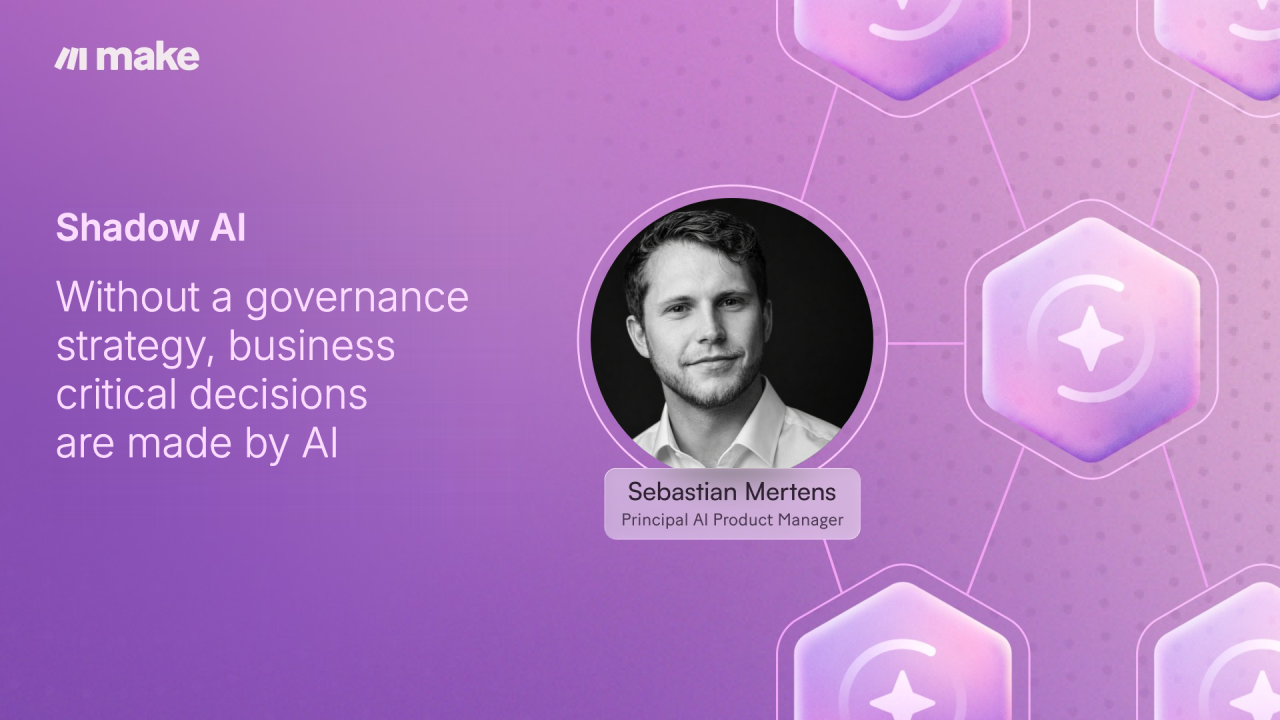
Shadow AI: Without a governance strategy, business critical decisions are made by AI
You deploy AI back and forth through your entire company. Did it ever occur to you that the most influential AI process in your business might not be on your radar?

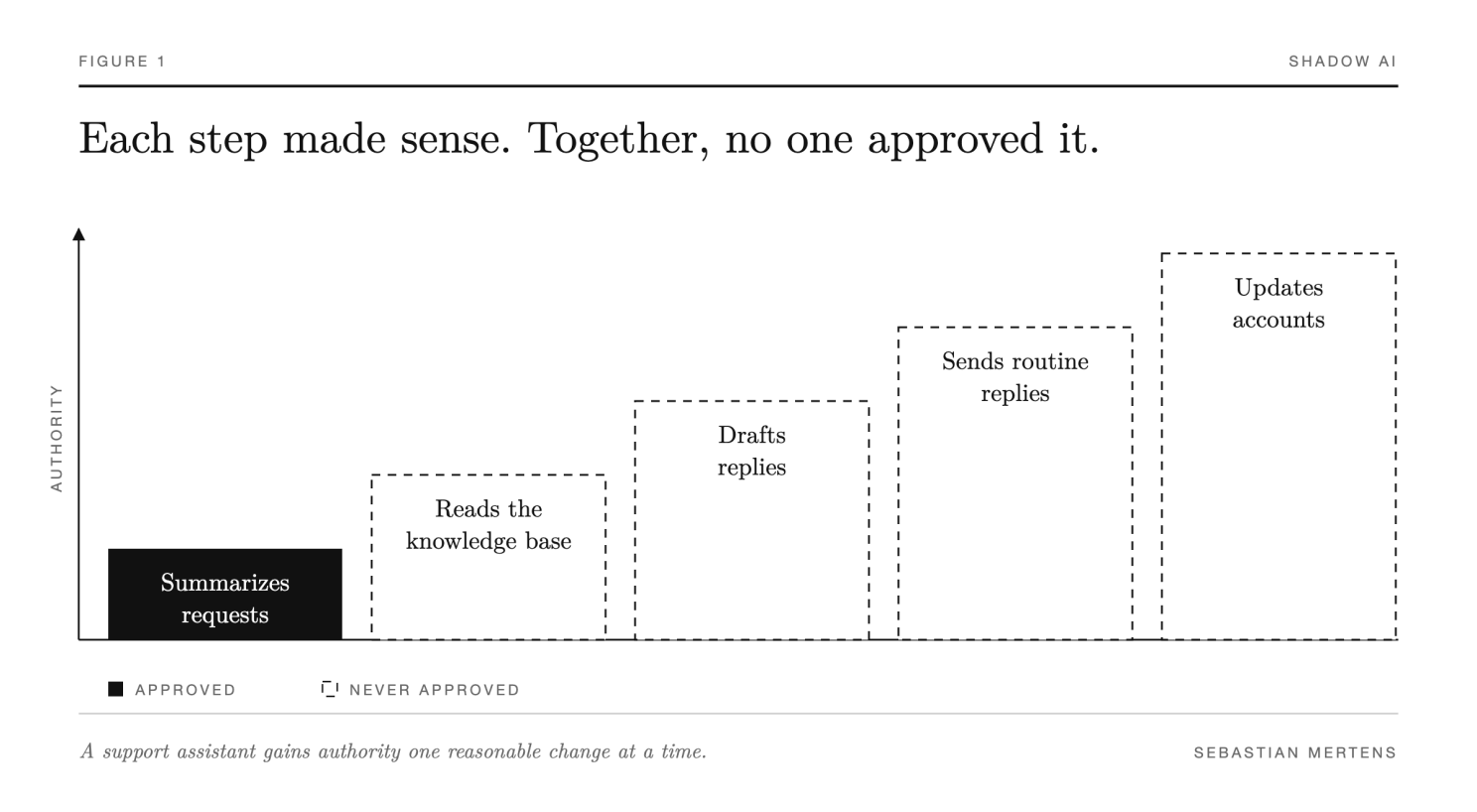
Imagine a support team using AI to summarize incoming customer requests. It works, so someone connects it to the knowledge base. Then it starts drafting replies. The drafts are good, so routine responses go out automatically. Eventually, it can update customer records and update accounts.
Each change makes sense individually. However…
Together, an AI writing assistant has become a system making decisions on the company’s behalf. Without the right people ever approving it.
That is the Shadow AI problem I think leaders need to pay more attention to. Not primarily employees using AI tools IT haven't consented, but AI automation acquiring authority over business processes it wasn’t supposed to control.
As a Principal AI Product Manager at Make, I understand how hard it is for governance to keep up with the speed of AI evolution. In this blog, I explore what happens when your team evolves faster than you can follow, how to handle the so-called 'Shadow AI’, and how you can turn this risk into an advantage.
An authorized AI tool doesn’t promise authorized decisions
When people talk about Shadow AI, the conversation tends to start with tools: which models do employees use? Where do they paste company information? Have those vendors passed security review?
Those are necessary questions. However, they aren’t sufficient.
An approved model connected to an approved customer database can still produce an unapproved business decision via MCP or API. In other words, the components may be approved while the behavior of the combined system is not.
Consider the previous Customer Support example. Permission to summarize a complaint doesn’t imply permission to update your database. By the same logic, permission to recommend a refund doesn’t imply permission to issue one.
Let’s compare this with traditional automation. It also needs boundaries, but it is deterministic in nature. A deterministic workflow can't make an unauthorized judgment. Every component and connection works as a whole in the way it's designed and results in an expected outcome.
AI adds a critical second layer that we need to pay attention to. With AI, the system can interpret ambiguous information, flexibly use tools, and decide what happens next. Therefore, the customer can receive an answer they were never authorized to receive.
So, if governance only checks whether the AI tools are approved, it misses the most critical question: what decisions is the AI tool permitted to make?
Banning the solution won't fix the problem
I would be careful about treating every instance of shadow AI as an employee discipline problem.
Picture this: leadership asks everyone to adopt AI. Managers expect faster delivery. An employee finds a way to remove repetitive tasks, but the approval process has no clear owner or timeline, nor does the LLM trigger the review. It’s no surprise that at this speed, the actual work moves faster than the paperwork.
I’m not saying we should excuse mishandling data or bypassing necessary controls. I am saying, though, that “stop doing that” is an incomplete response.
An unofficial workflow can reveal something valuable: a process people need, a bottleneck they are tired of, or a capability the official environment does not provide.
Ask what exists, what it influences, and why it was built. Address immediate risks, but stay open to promising experiments. Otherwise, you remove the automation without removing the bottleneck that led to it.
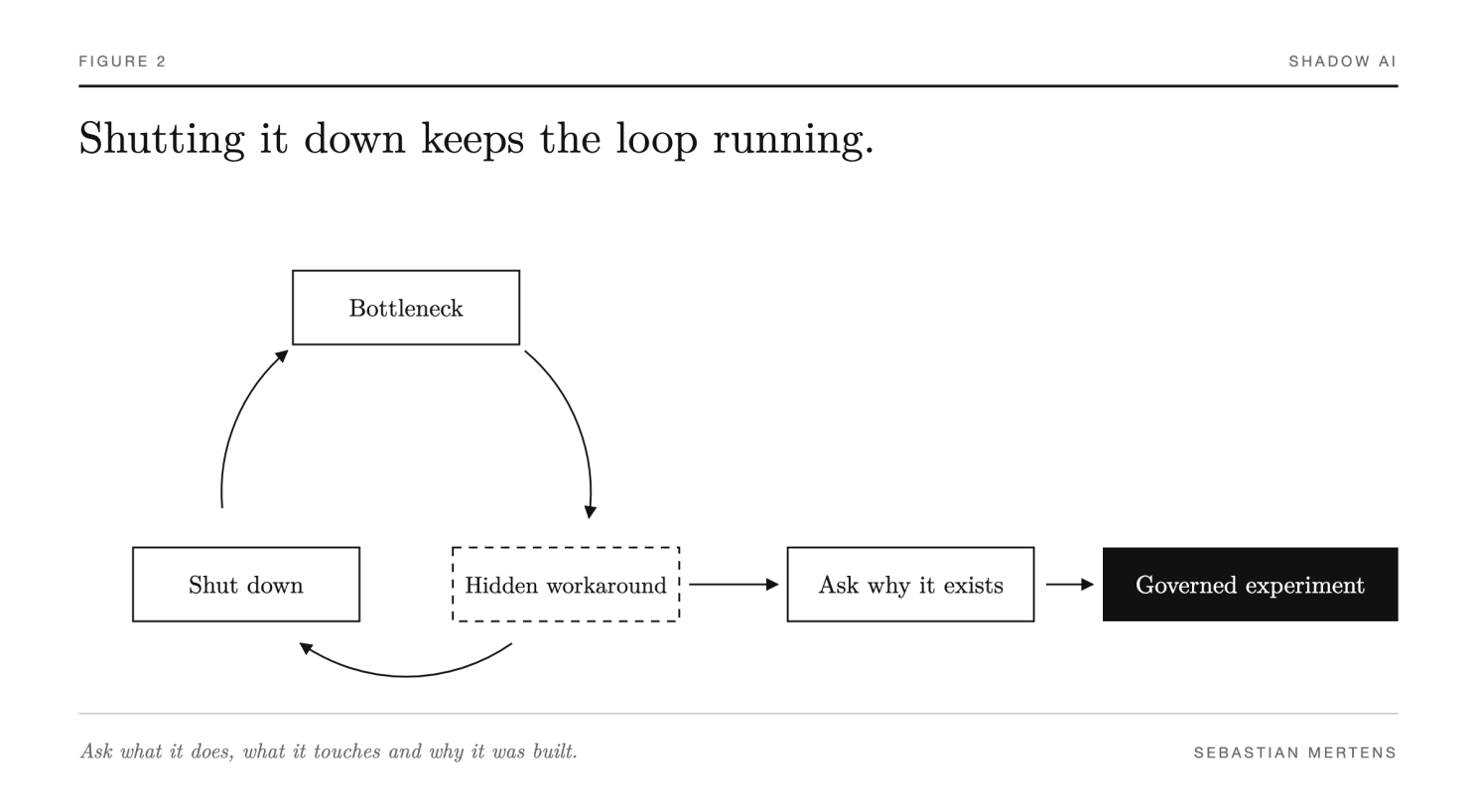
If eliminating an experiment only creates trouble for its builder, they may keep generating more Shadow AI and visibility becomes much harder to achieve.
Three questions to shape your AI governance
Ultimately, while they can be in conflict, it’s critical to protect both security and innovation in your business.
To achieve this, consider reframing the typical response. Instead of placing restrictions on employees (or monitoring their experiments equally), consider creating clear boundaries for the access and authority AI has in different processes.
You can establish the appropriate level of AI governance within a process by asking yourself these three questions:
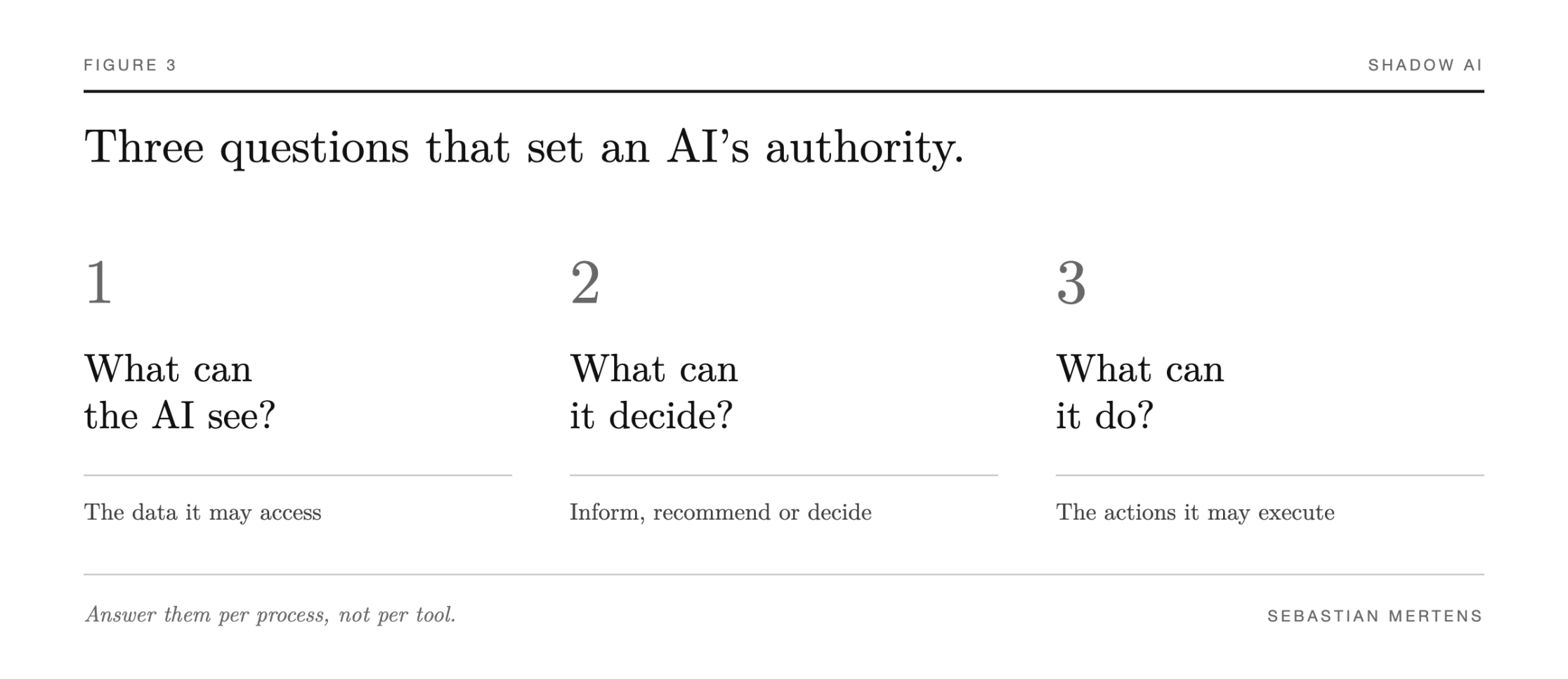
In answering these questions, it is important to tailor the intensity of governance to the context of that specific process. You don’t treat summarizing public information with the same vigilance as handling confidential records or moving money.
When you clarify the boundaries of AI’s authority within a specific process, teams can experiment with greater freedom and you don’t have to review every minor improvement. With the right setup, mainly requests to expand the access of AI or to involve it in more consequential decisions should trigger review.
Governance must survive the people who built it
For those of us building automation platforms, including me at Make, ownership, permissions and review should come as a default part of the software experience. For example, an Agentic Profiles feature can steer granular access for every AI agent, so the boundaries are built into the system.
Also, if you swap the LLM model in your AI automation setup, add a new tool, or change what data an agent can access, review should still get triggered.
But even with such governance-friendly software, once an AI automation experiment becomes a shared dependency, it needs consistent human oversight: an assigned business owner, a maintenance owner and a way to pause things. Roles can overlap, but accountability can’t remain implicit; the knowledge must survive the original process owners.
To make sure anyone can understand how AI processes work in your business, it’s important to keep appropriate records of them.
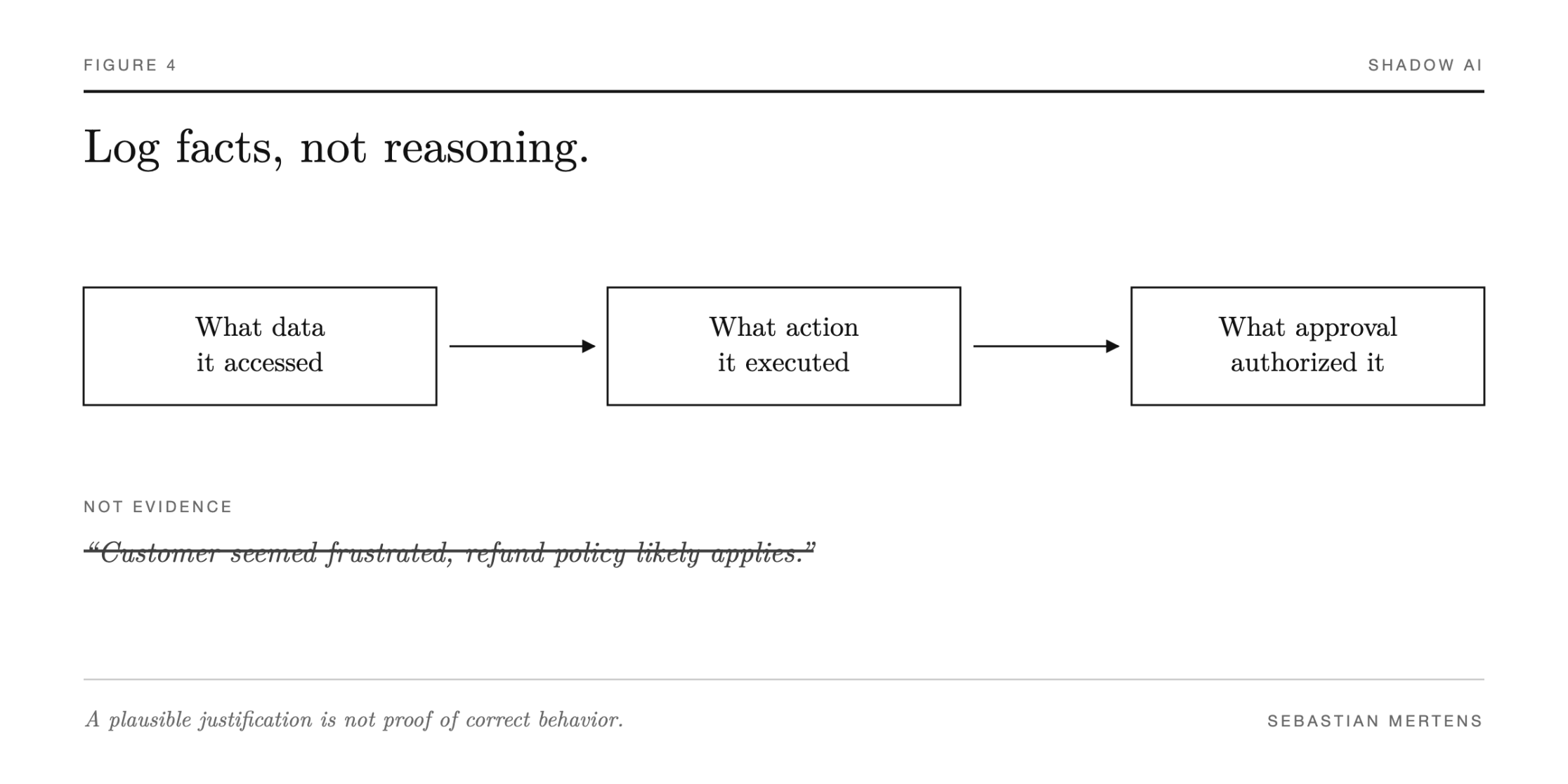
These records shouldn't be a vague AI-generated reasoning, though. A plausible justification like “customer seemed frustrated, refund policy likely applies” is not proof of correct AI behavior.
Your logs should be factual: what data the AI accessed, what action it actually executed, and what approval (if any) authorized it. That's what gives human reviewers context they need to understand what happened.
Turn Shadow AI into an AI you trust - a Glassbox.
Every company has their own version of this story: there was an unaddressed bottleneck, somebody created an automation no one signed off on, and the workflow picked up more authority than intended.
Now, the Shadow AI is making critical business decisions for you. Your instinct is to shut it down fast, but I recommend that you do the opposite. Rather than simply eradicating the disease, investigate where it hides and turn it into an experiment.
Ask yourself: Which AI automation or AI Agent would disrupt the business if they stopped working tomorrow, and who is accountable for each? Start there. Give these processes the right amount of governance. Decide who owns them and who reviews them. Create a proper record of what AI automation does so the knowledge outlives the original process owners.
That’s how you turn your biggest threat into your biggest asset as a Glassbox.
Related blogs
Tool and strategies modern teams need to help their companies grow.
AI
Most businesses run internal AI programs, few see real impact. Here’s how we scaled to 96% adoption at Make.
Most companies plateau at 16% AI adoption. Here's the internal AI adoption strategy that took Make from 8% to 96%, and the three-layer structure behind it.

Sara Maldon
August 6, 2026
AI
Mid-sized companies that get AI adoption right can challenge enterprises twice their size. Nobody's telling them how.
Most AI advice is built for enterprises or startups, leaving mid-sized companies stuck in pilot purgatory. Here's the playbook that helps them turn scattered AI experiments into company-wide adoption, and rival enterprises twice as big.

Darin Patterson
September 10, 2026
AI
The AI maturity payoff: Why 'AI saved us time' is the least useful sentence in your business case
A stage-by-stage look at how AI payoff actually gets measured, once "hours saved" stops telling the truth.

Daria Hvizdalova
July 17, 2026