Jul 20, 2026 | 10 minutes
AI Adoption: What It Means and Why It Matters
AI adoption means moving artificial intelligence from isolated pilots into everyday operational use across every team, workflow, and business decision.

AI adoption is the organisational process of moving AI usage from isolated experiments into everyday operational use across teams, workflows, and decisions.
It matters because 37% of organizations are still using AI only at a surface level, with little or no change to existing processes, while just a third are using it to deeply transform how they work.
Unlike automation or straightforward digital transformation, AI adoption involves systems that learn from data and adjust their outputs over time, rather than following fixed rules.
This guide explains what durable requires: leadership climate, skills progression, governance, and how to make AI a dependable part of how work gets done across your teams.
For mid-market companies, AI adoption is the bridge between promising pilots and operational impact that shows up in cycle times, customer response quality, and headcount leverage.
What is AI adoption and where to start?
AI adoption refers to the process of introducing AI tools and abilities into an organisation: identifying use cases, selecting models and platforms, connecting AI to source systems, training staff, and embedding oversight.
The scope extends well past buying licences for a chat assistant.
It includes redesigning workflows so AI outputs feed downstream steps, wiring model calls into a Make scenario that routes results to the right system, and instrumenting each operation so leaders can see where AI actually saves time.
Scope also covers the human layer. Adoption depends on clear permission from leadership, visible internal examples, and enablement that helps non-technical staff describe problems AI can solve.
If you want a structured way to size where your teams sit today, the AI benchmark gives a practical reference point for maturity conversations.
What are the main stages of AI adoption?
AI maturity moves through five recognised stages, per Gartner's AI Maturity Model:
Stage | What it looks like |
Awareness | The organisation knows about AI but has not used it yet. No pilots or experiments are underway. |
Active | AI appears in proofs of concept and informal experimentation. |
Operational | AI is used in at least one workflow. |
Systemic | AI is present across most workflows and operations, driving new business models. |
Transformational | AI is built into the core of how the business runs. |
Who owns it internally?
Ownership of AI adoption is typically shared.
Executive sponsor: sets priorities and secures budget
Operations or automation lead: owns the platform, guardrails, and shared connection registry
Department leads: own use cases in their domain
IT and security: define acceptable data flows, model providers, and logging
Centre of enablement: curates patterns, maintains a template library in the Scenario Builder, and trains staff to describe outcomes
A published AI playbook keeps these roles legible across the organisation.
Why does AI adoption matter for an organisation?
AI adoption matters because it decides whether an organisation gets lasting value from AI or keeps spending budget on experiments that never make it into production.
For mid-market teams, the difference is stark: a few people running personal prompts on one side, and a coordinated system on the other, where scenarios, agents, and human review work together across finance, support, marketing, and operations.
Getting this right affects cost, what your employees are capable of, and how you compare to competitors.
That is why AI adoption needs to be run as a strategic programme, not treated as a one-off tooling decision.
Operational impact
AI adoption changes how repetitive, low-judgement work moves through the business.
When a Make scenario connects a model to your systems of record, tasks like ticket triage, invoice coding, lead enrichment, and content drafting move from manual queues into supervised automation.
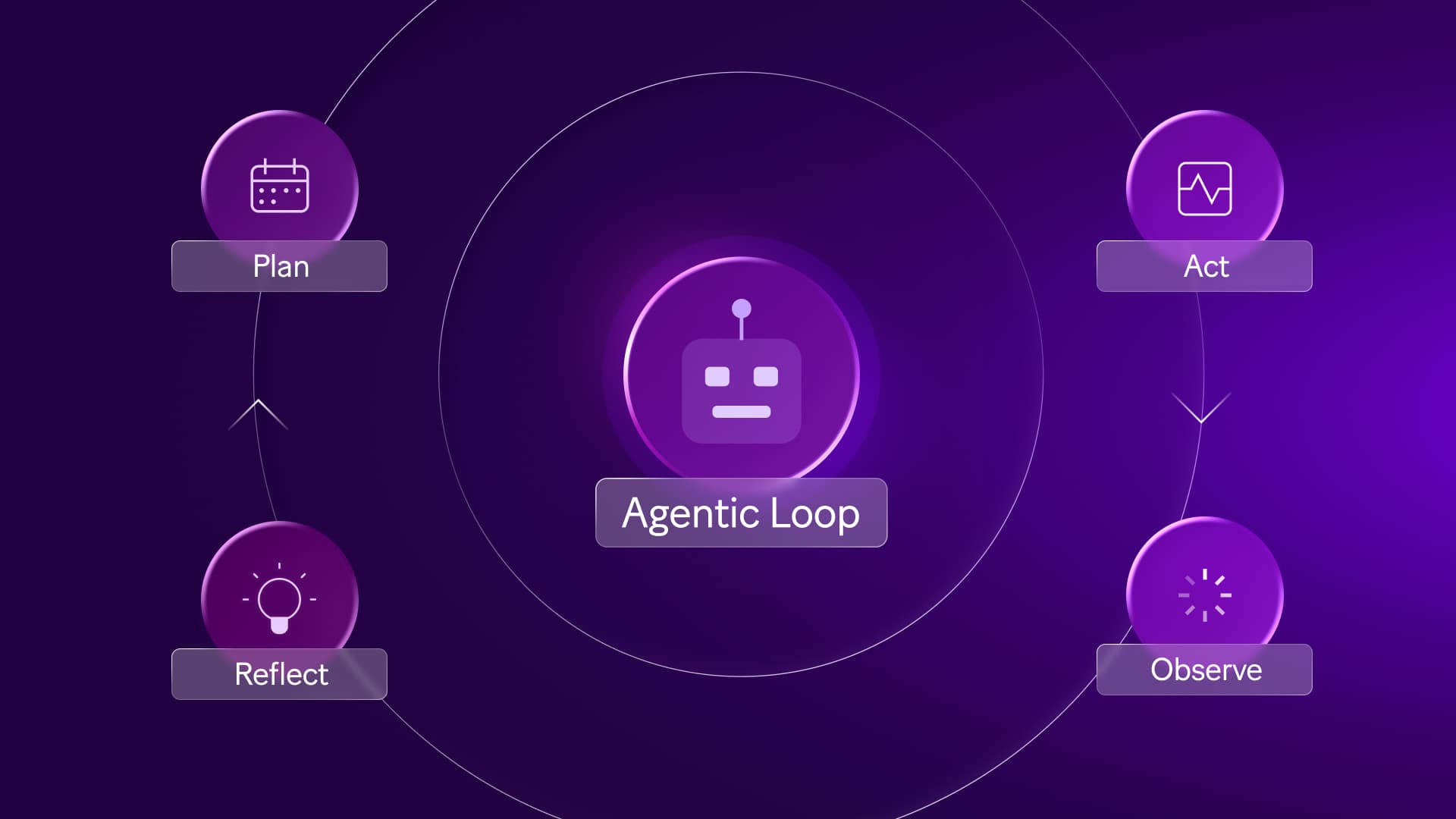
The pattern, where an agent plans a task, calls tools, checks the result, and repeats until done, extends this to multi-step processes that used to need a person at every step.
Cycle times drop when modules like OpenAI - Create a Chat Completion and HTTP - Make a Request replace manual copy and paste between systems.
Error rates fall when a Router sends unclear cases to a human reviewer while confident results go straight through.
Teams get more capacity without adding headcount, freeing analysts and operators for higher-value work."
Workforce readiness
AI adoption raises the skill level across the whole team and beyond.
As employees move from casual chatbot use to building and reviewing scenarios, they learn to write clear inputs, judge whether a model's output is correct, and build in a fallback when it is not.
This skill spreads: a support lead who understands how a Slack - Create a Message alert gets triggered by an agent's decision can suggest the next automation, check its results, and teach others.
Without that progression, tools go unused and gaps in oversight get wider.
Competitive positioning
Companies that use AI in daily operations, not just pilots, can respond to customers faster, price more accurately, and ship product changes with fewer delays.
The shows how one mid-market organisation turned connected scenarios into repeatable gains in revenue and service.
Companies that stay stuck at the pilot stage tend to fall behind on cost per transaction and response quality over time, as competitors build up a library of working automations, connections, and internal know-how.
How does AI adoption work?
AI adoption works by combining four things: a clear use case, a data and model layer, a workflow layer that puts AI output into real business processes, and a feedback loop that improves the model and the process over time.
In Make, that means connecting AI providers inside a visual scenario, where each module does one job: fetching data, calling a model, routing the result, and writing it back to your systems of record.
AI adoption succeeds when these four layers work together as one system, not as separate experiments.
Core mechanism
At its core, AI adoption turns a model's probabilistic output into a reliable business action.
A trigger module such as Gmail - Watch Emails or Google Sheets - Search Rows passes structured data to a model call like OpenAI - Create a Chat Completion or Anthropic Claude - Send a Message.
The response gets parsed, checked, and passed to a Router that decides what happens next.
Each pass through the scenario is one operation, and the Scenario Builder shows every decision point, which is what lets teams that work reliably instead of just in testing.
PRO TIP: Start with one high-volume workflow, for example inbound lead triage using OpenAI - Create a Chat Completion feeding a Router, and prove value on that single scenario before scaling to adjacent processes.
Key components
Four key areas take AI adoption from pilot to production:
Model layer: supplies reasoning through provider modules such as OpenAI - Create a Chat Completion, Anthropic Claude - Send a Message, or a custom HTTP - Make a Request call to an internal endpoint.
Data layer: supplies context through system-of-record modules like Monday - Get an Item, Google Sheets - Search Rows, and Slack - Create a Message.
Orchestration layer: coordinates the flow using a scenario plus Iterator, Aggregator, Router, Switcher, and Set Variable modules
Governance layer: covers each connection, error handling, and audit history.
Data and workflow flow
Data enters through a trigger, gets enriched by lookups, and is sent to a model with a structured prompt.
From there it flows through a route that separates confident answers from cases that need a human to check.
The Iterator splits list data into individual items.
The Aggregator puts model outputs back together into a single record for the final write. Every step passes a bundle to the next module.
A second scenario can capture reviewer corrections and log them, closing the feedback loop.
Teams that need more conversational, multi-step orchestration can extend this pattern with that plan actions across the same modules."
AI adoption use cases
AI adoption use cases are key, in order to show how mid-market teams move from isolated experiments to operational, everyday use of AI across support, finance, and revenue teams.
The three scenarios below reflect common entry points where scenarios built in Make combine LLMs with system-of-record data to produce predictable, measurable outcomes.
Each one starts with a single high-volume workflow, proves value, and then extends into adjacent processes as confidence grows.
1. Customer support automation
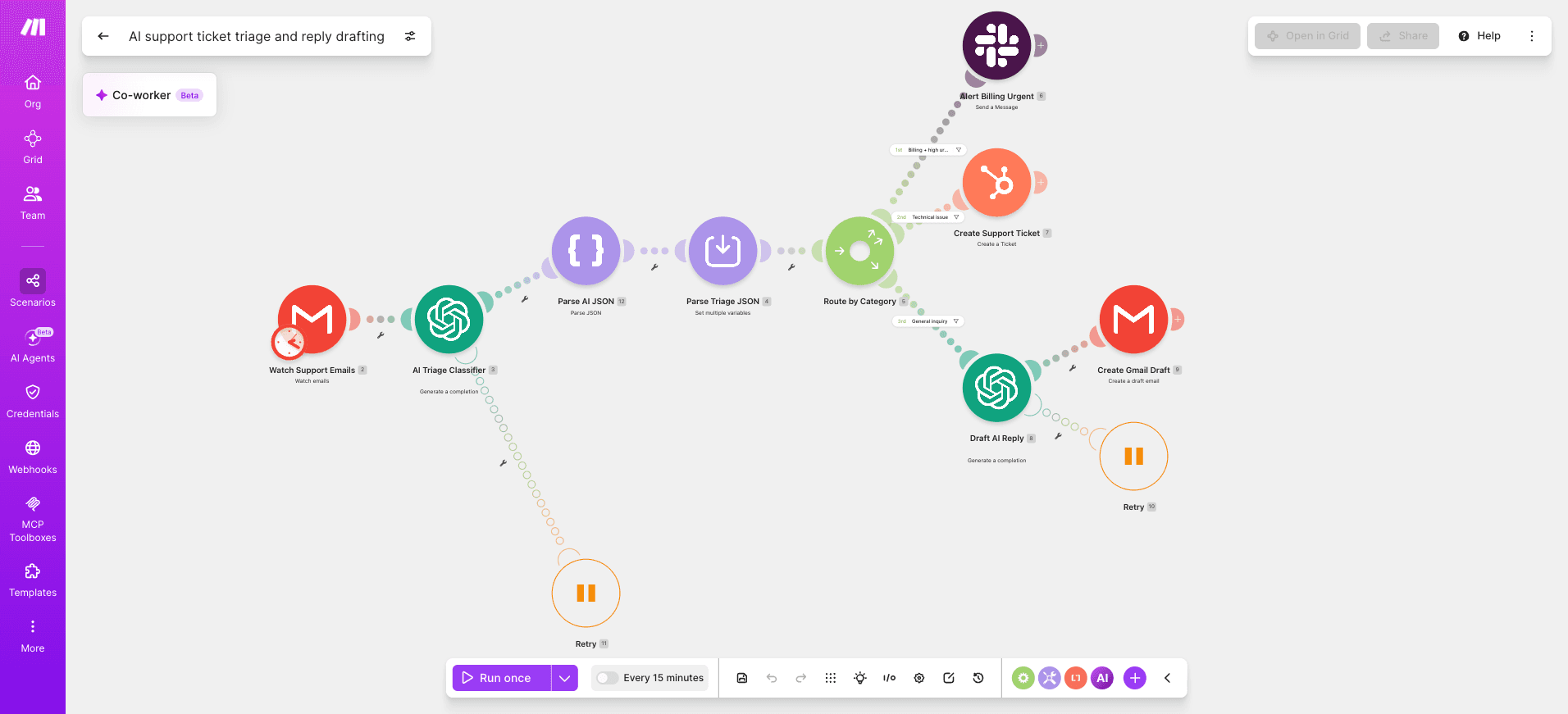
Support ticket triage is one of the highest-return AI adoption entry points because inbound volume is predictable, categories are learnable, and reply drafts save agent minutes on every message.
A Make scenario can watch a shared inbox with Gmail - Watch Emails, pass the subject and body to OpenAI - Create a Chat Completion for classification and summarisation.
Afterwards, use a Router to send urgent billing issues to Slack - Create a Message, log technical problems into HubSpot - Create a Ticket, and draft replies to general questions with Gmail - Create a Draft.
Real-world deployments have followed this pattern too.
The Stellantis customer support team uses Make to automate large-scale ticket handling, and reference architectures for customer support agents show how classification, retrieval, and reply drafting layer together inside one scenario.
2. Finance and reporting workflows
Finance reporting bots turn recurring close activities into governed scenarios where AI handles narrative work and Make handles data movement.
A month-end reporting scenario can pull ledger balances with Google Sheets - Search Rows, aggregate line items through an Aggregator, send the structured summary to Anthropic Claude - Send a Message for variance commentary, then post the finished brief into Slack - Create a Message and archive a PDF version to a shared drive.
Similar patterns cover expense categorisation, invoice extraction, and cash flow narratives.
The Finn empowers teams story illustrates how operations groups extend these scenarios across departments once the first workflow is stable.
3. Sales and marketing operations
Lead scoring and pipeline cleanup are natural next steps, since revenue teams already track structured signals.
A Make scenario can trigger on a new HubSpot contact, enrich the record through HTTP - Make a Request, score fit and intent with OpenAI - Create a Chat Completion, and route qualified leads into the right sequence using a Switcher and a Set Variable module.
Marketing teams can add content drafting, campaign summaries, and outbound personalisation into the same scenario family.
Recruiting teams run similar patterns too.
The guide walks through a candidate-focused version that uses the same modules.
How to check if your organisation is ready to adopt AI?
AI adoption readiness comes down to three things: governance and data, skills and enablement, and tooling and integration.
Each one has practical signs mid-market teams can check before scaling automation and agentic workflows.
The table below sets out the criteria, what to look for, and why each one matters for moving from pilot to production inside a Make scenario or a wider agent programme.
Governance and data
Governance covers who can build, who can approve, and how sensitive data moves through your AI systems.
Strong governance means data residency rules, audit trails at the operation level, role-based access on every connection, and a review step for prompts and model outputs.
Data readiness means your source systems are documented, free of duplicates, and reachable through stable APIs, so a Google Sheets - Search Rows or HTTP - Make a Request module returns the same structure every time.
If you are weighing automation vs agents, check that your governance covers both fixed workflows and agent decisions.
Skills and enablement
Skills readiness covers three things: general AI literacy, comfort with the Scenario Builder, and the ability to design multi-step logic with Router, Iterator, and Aggregator modules.
Enablement means internal documentation, regular office hours, and a shared library of reference scenarios, so individual habits become shared knowledge.
Tooling and integration
Tooling readiness asks whether your platform connects to the systems your teams actually use.
Make connects to more than 3,000 apps, so a scenario can combine OpenAI - Create a Chat Completion, Slack - Create a Message, and Monday - Get an Item without custom middleware or tools.
Check authentication methods, webhook stability, error handling, and visibility into every bundle moving through the flow.
Criterion | What to look for | Why it matters |
Data quality and access | Documented sources, stable APIs, clean fields reachable by HTTP - Make a Request | Poor inputs produce unreliable model outputs and force manual rework |
Governance controls | Role based access, approval steps on every connection, prompt review policy | Reduces exposure of sensitive data and satisfies compliance reviewers |
Observability | Execution logs, retry policy, alerting on failed operation counts | Operators need to see where a scenario broke and why |
Skills coverage | Builders comfortable with Router, Iterator, and Set Variable | Complex logic requires confident use of core control flow modules |
Integration breadth | Native connectors for CRM, ticketing, email, storage; see AI agent platforms | Fewer custom bridges means faster delivery and lower maintenance |
Change management | Version history, staging environments, rollback for each scenario | Safe iteration keeps production flows stable while teams experiment |
Score each factor as foundational, operational, or scaled and use the gaps to decide what to invest in next, rather than buying more licences.
Teams running larger programmes often check this scorecard against Make Grid practices.
Next steps for AI adoption
AI adoption is the ongoing work of moving AI from isolated experiments into everyday operational use across teams and processes.
Companies that succeed treat it as a portfolio: they pick specific workflows, connect them, and expand once each one proves reliable.
With more than 3,000 apps, a Scenario Builder built for agents, and modules like OpenAI - Create a Chat Completion, HTTP - Make a Request, and Google Sheets - Search Rows, teams can build real automations without heavy engineering.
Start by mapping your first three workflows, get stakeholders aligned on what success looks like, then get started for free.
Frequently asked questions
Q1: What is the difference between AI adoption and AI implementation?
AI implementation is the technical act of deploying a model or tool. AI adoption is the organisational shift that follows: people using the technology in daily work, processes redesigned around it, and governance keeping outputs reliable across teams.
Q2: How long does AI adoption take at a mid-market company?
Most mid-market companies see meaningful AI adoption over six to eighteen months. Initial pilots run in weeks, but scaling AI adoption across departments requires process redesign, enablement, and governance work that unfolds gradually as teams build confidence.
Q3: What are the biggest barriers to AI adoption?
The main barriers to AI adoption are unclear ownership, fragmented data, weak change management, and inconsistent governance. Technology rarely blocks progress. Cultural resistance, missing enablement resources, and a lack of leadership permission slow AI adoption far more than model capability or integration limits.
Q4: How do you measure AI adoption success?
Measure AI adoption success through active usage rates, hours saved on target workflows, quality of AI-assisted outputs, and business outcomes tied to automated processes. Combine quantitative telemetry from your scenario logs with qualitative feedback from the teams operating the workflows.
Q5: Do employees need technical skills for AI adoption?
Employees do not need coding skills for AI adoption when using visual platforms. They need prompt literacy, judgement about when to trust AI outputs, and comfort configuring a module or reviewing a bundle inside a no-code Scenario Builder.
Ready to make the automation revolution happen?