Aug 6, 2026 | 7 minutes
Most businesses run internal AI programs, few see real impact. Here’s how we scaled to 96% adoption at Make.
Most companies plateau at 16% AI adoption. Here's the internal AI adoption strategy that took Make from 8% to 96%, and the three-layer structure behind it.
Most businesses can measure their AI adoption.
Despite this, few of them really transform how business works.
I understand why this happens. They are still very early on their AI transformation journey, and most follow some version of the same playbook.
They buy an AI tool they have been researching for months and spread it internally.
They measure how many employees are using the tool in a certain period of time.
The adoption numbers keep growing. Everything seems right.
But then, the growth stops.
And while a stable number of people still use AI on a daily basis, there is no visible impact on a business level. They ask themselves: what’s missing?
Maybe people just need a better tool.
Maybe the company needs more employees with technical education.
Maybe the AI should replace those who didn’t adapt to it.
I’m here to tell you: none of this is what moves the needle.
When I started as a Head of Business Automation & AI at Make, all we knew was that AI is important for us.
Today, the internal AI adoption ramped up from 8% to 96% of 350+ people automating. While I’m proud of this number, it hides the real story of our success.
Here’s how we got there.
Why AI adoption always falls flat at the same point
Businesses get stuck at a certain level of internal AI adoption because only a small group of people moves proactively.
That's expected: it's what Everett Rogers proved in his .
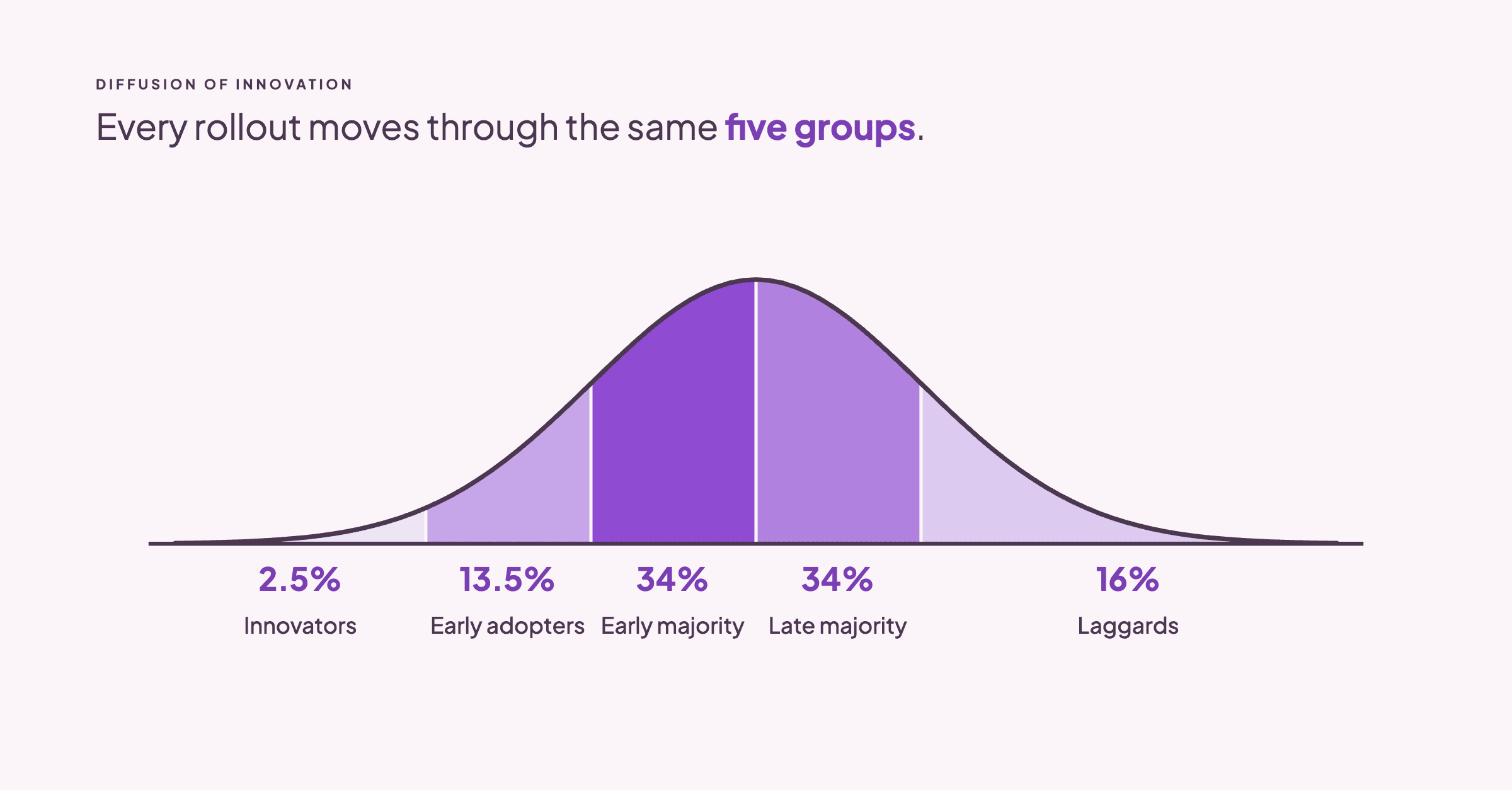
Around 2.5% of the population are natural innovators. When you introduce them to a change, chances are high that they already thought about it and started experimenting on their own.
Then, there are early adopters: people naturally keen on the change. They may not always seek the tools proactively, but you don’t have to convince them to start adopting. You give them information, access to the tooling, and they will learn and use them by themselves.
These two groups are your AI automation champions and power users.
The problem: they only make up around 16% of the population.
The rest, the mass adopters, is where the adoption numbers stop growing organically. This is the ceiling that companies usually hit within their AI adoption strategy.
What matters is getting past the 16% ceiling.

So, what actually moves your mass adopters?
Two solutions usually surface: giving them time and incentives. But time is a rare commodity. Incentives are fun, but usually work at scale with big budgets and resources.
We took an unpopular step: Make AI adoption mandatory.
We made it part of individual performance expectations. Every employee needs to show initiative on a quarterly basis. Yet, we were very careful not to make it feel like a ‘one size fits all’. Everyone could (and still can) choose their own approach based on the stage where they are.
It worked tremendously.
From a survey I conducted with employees, 88% of employees were grateful for the nudge to get out of their comfort zone, doing something they normally wouldn’t.
This shows that “mandatory” doesn’t have to come across as authoritarian. When done right, the initial push grows into an environment where people lean in not because they have to, but because they are expected to experiment, and see an actual impact on their work.
The hamburger mandate: A three-layer adoption setup that removes siloes
Making adoption mandatory got people building.
But it didn't answer two crucial questions many businesses skip:
Who decides how you scale AI adoption internally once motivation is no longer the bottleneck?
And who's accountable for building for impact?
Both come down to where ownership sits.
Many companies set AI transformation as a company-wide goal, but if ownership for it reaches only one layer of the business, that goal means nothing.
I learned that firsthand, because for a while, I was that one layer.
I started my role at Make with no team, about half of one person’s time in support, and nobody reporting to me.
But sitting that close to the ground floor had its upside.
It brought me close to those who are building products, speaking to customers, running the processes AI was supposed to improve. It helped me understand where AI could help, and built strong employee support from the bottom up.
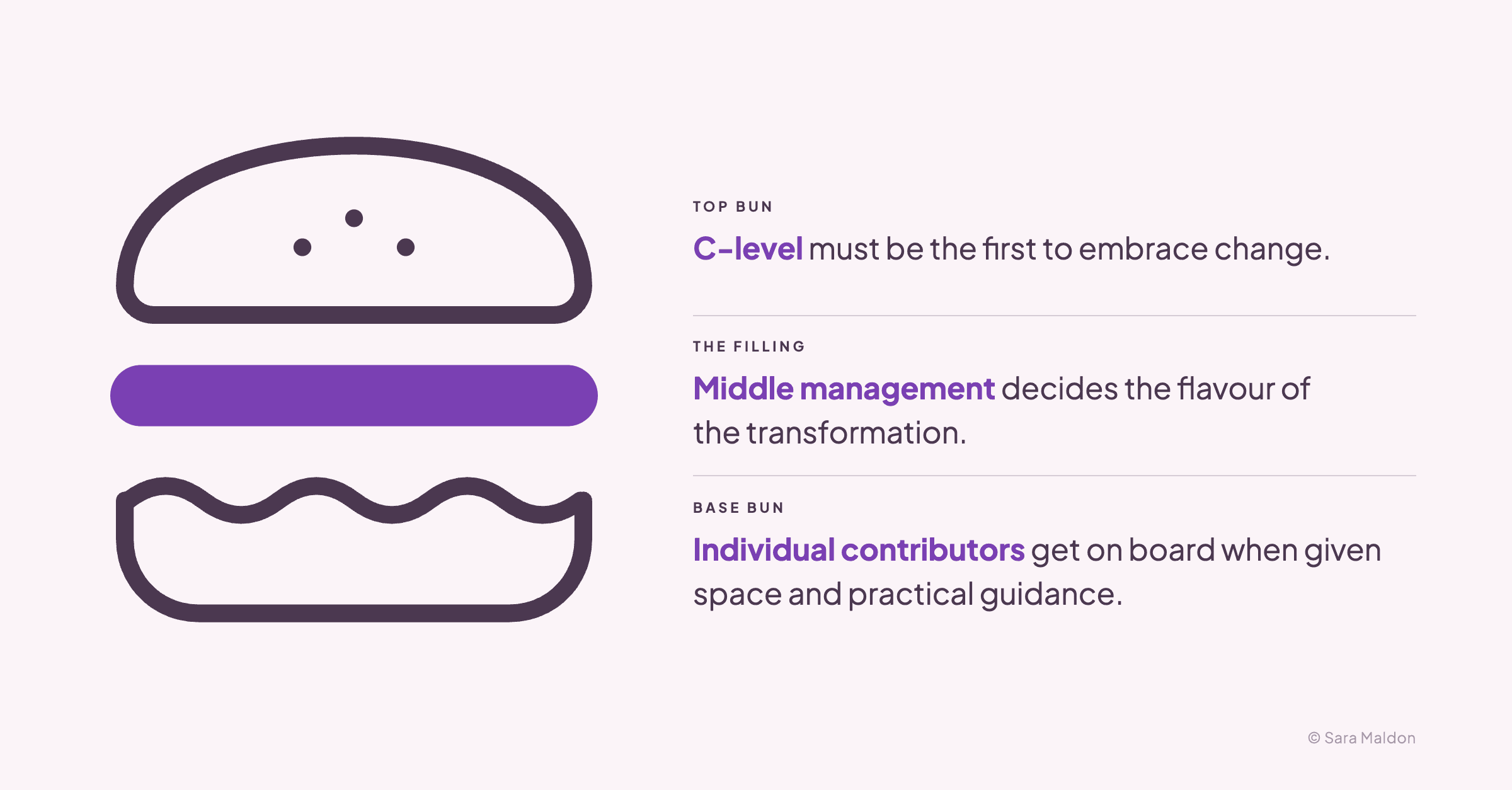
That's when I started thinking of AI accountability as a hamburger: three layers, each with its own job.
The top bun: leadership – the CEO, C-suite, and senior leaders providing sponsorship, resources, and access to decisions.
The bottom bun: ICs, closest to the daily work, who spot the use cases that actually matter.
The middle: departmental managers who decide what gets time and capacity, and whether an experiment scales into a use case that gets adopted. This is what gives the whole thing its flavor.
So with these insights in hand, what’re the three critical steps that got us past the 16%?
Three-step strategy that grew Make’s AI adoption to 96%
Step I: Finding the right AI transformation lead
Many times, companies deploy two distinct roles: a change manager with strong soft skills and a technical AI specialist with exceptional hard skills.
I function as two roles in one. In my role as the Head of Business Automation & AI, I was hired to lead our AI implementation. But also to train people and manage change. A mix between AI generalist with technical expertise, business acumen and change management skills.
Whichever system you choose is up to what works for you, but think very carefully about who you’ll choose as a face of the change. You need someone who is:
A recognizable face behind the movement: when someone says AI transformation, this person should pop up in people’s minds.
A relatable leader: someone with enough experience to be trustworthy but also enough people skills to be trusted
An approachable person: the lead shouldn’t sit in an ivory tower. They need to observe the field, ask questions, and offer help.
Why does this help you move past the 16% ceiling? The mass adopters are more keen on joining the movement when it has a recognisable, relatable, and approachable face behind it.
Step 2: Inserting AI automation leads to each department
In February 2025, we knew we were serious about making AI the priority across the entire company.
There was another key decision to make: will we run the AI transformation project in a centralized way, so as a one “center of excellence” for all teams, or do we decentralize?
I decided for the latter. Make departments the direct owners of their transformation efforts.
I came up with a quite unique concept of full-time AI automation champions.
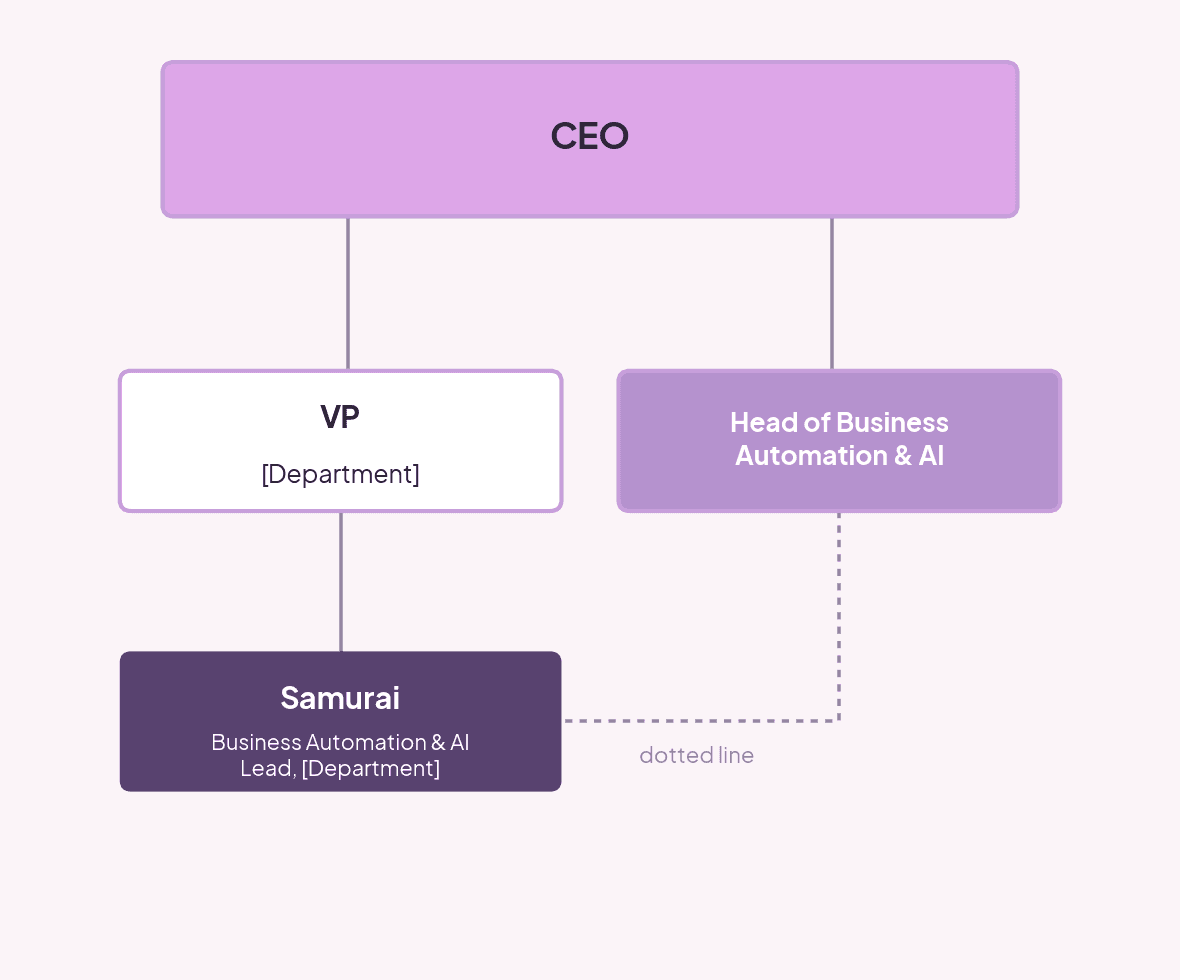
Internally at Make, we call them Samurai.
These champions are inserted directly into specific departments to help them build automations for their needs.
Here’s where they sit within our organizational structure:
They work based on the 70-20-10 rule.
70% of their role is building high-impact projects
20% goes into teaching others
10% is left for the automation maintenance
This approach brought strong results: 23 of 32 projects, or 72%, achieved business impact on core KPIs.
My Samurai are people who are AI and AI automation experts, senior in their business domain, and capable of mentoring others.
When choosing one, I look for a person who:
understands the daily work of the department
genuinely seeks to help others learn
has enough influence and trust to change behaviour
can meet beginners where they are, but is a few steps ahead of them
Why does this help you move past the 16% ceiling? Having a dedicated AI automation champion inside each department made AI relevant, actionable and valuable for every team.
Step 3: Turning "mandatory" into a clear bar to hit
The last step in our journey was to define the individual path to adoption.
In September 2025, we closed that gap with the AI bar.
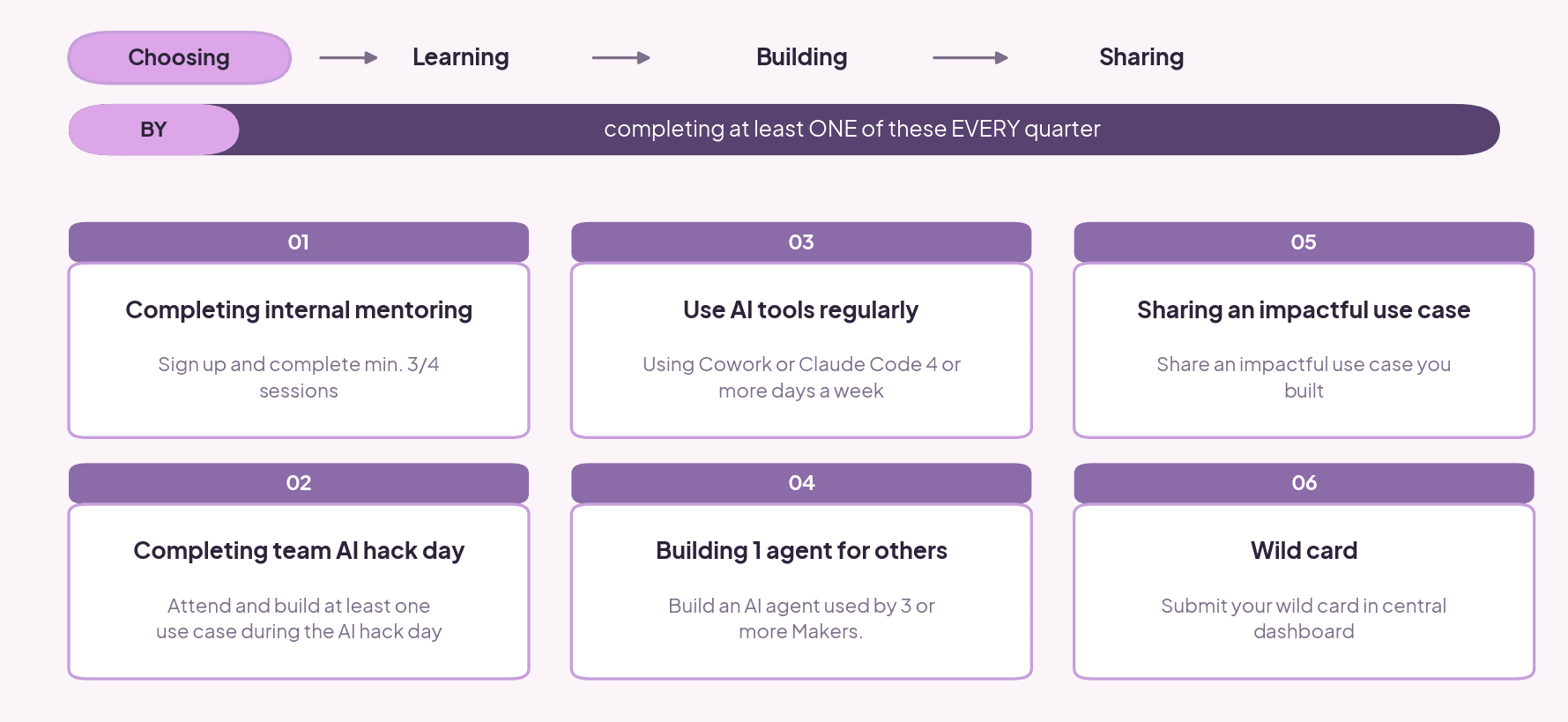
Everyone knows exactly what "using AI" means for their role, and whether they've hit the bar or not, so there's no gray area left to hide in.
As a result, 96% of employees are using and building AI agents, compared to the 16% before the AI bar existed.
And this isn’t only a number on a paper. I see the real-life impact time and time again.
For example, I met a colleague resting in an office kitchen. When I joked about what brings him by at this time of the day, he said: “An AI agent is working on something for me. So, I came to grab a coffee.” He wanted to figure out how to create an agentic environment where agents work while he sleeps.
As I later found out, he succeeded.
There are many more stories like this. It proved to me that the use cases we create are a scalable, transferable niche showing business-critical impact.
Clear expectations. Clearly measurable.
Why does this help you move past the 16% ceiling? It removes ambiguity. The milestones are clearly defined, with specific goals to achieve and a set timeline. It was enough clarity on what good looks like to give everyone the freedom to learn their way.
Your ultimate AI transformation checklist
There is no single AI transformation strategy that works for everyone. Each company has different resources, different structure, and different goals.
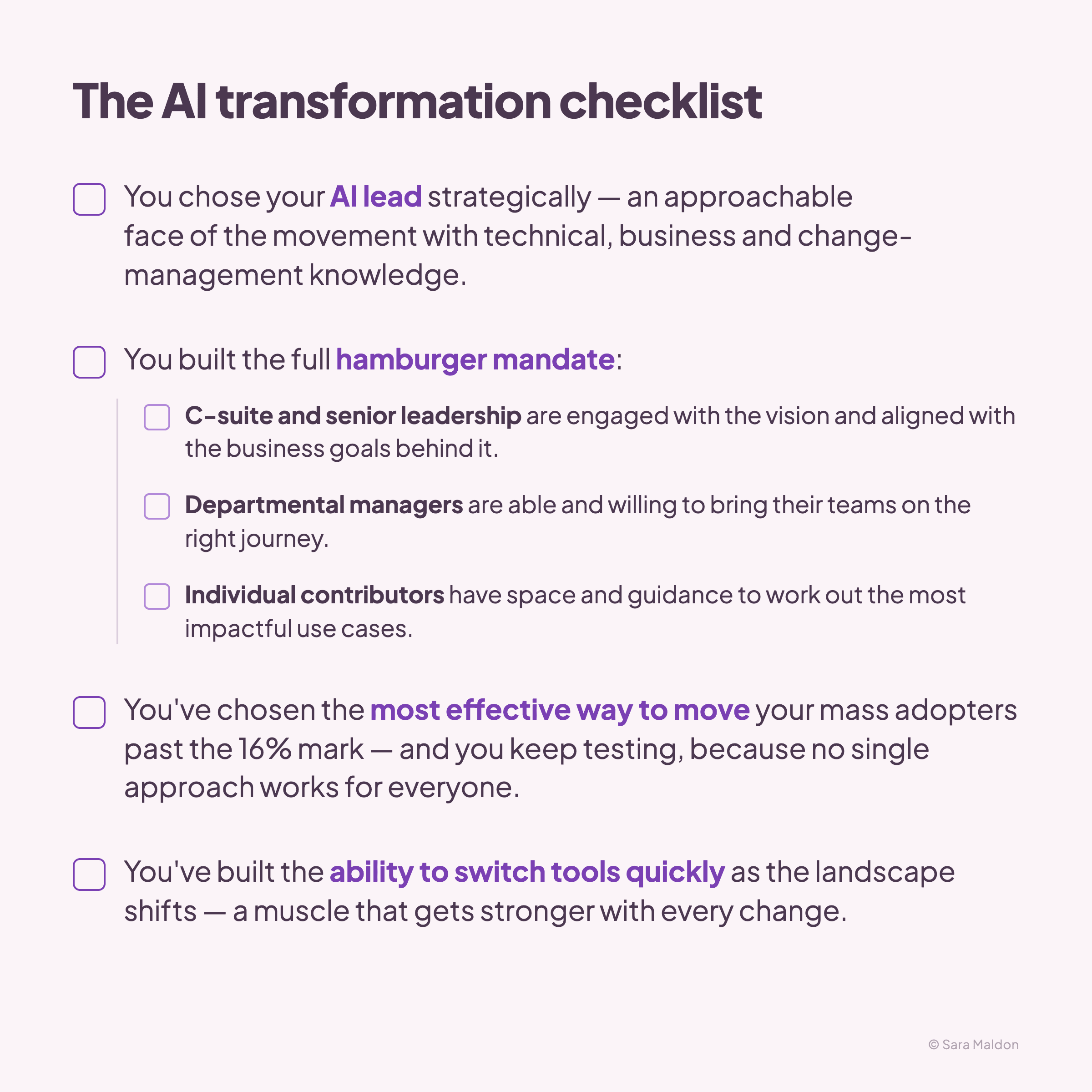
But if I were to share a checklist that helped me succeed, it would look something like this:
Lastly, remember that the AI transformation journey is all about building momentum. Show people the real impact of AI on their work, and the business impact will follow.
That is how you break the 16% ceiling and reach 96% internal AI adoption.
Ready to make the automation revolution happen?