
Connect Airtable and OpenAI (ChatGPT, Whisper) integrations
Transform your Airtable database into an AI powerhouse by automatically triggering OpenAI actions like ChatGPT responses, DALL-E image generation, and Whisper transcriptions whenever records change. With Make's automation platform, every update in your tables instantly activates AI-powered content creation, turning static data into dynamic, intelligent outputs without manual intervention.

Returns all newly created or updated records in a view (requires "Created Time" or "Last Modified Time" fields).
Triggers when a new response is submitted.

Analyzes images according to specified instructions.
Cancels an "in-progress" batch. The batch will be in status "cancelling" for up to 10 minutes, before changing to "cancelled", where it will have partial results (if any) available in the output file.
Creates and executes a batch of API calls.
Creates a new skill.
Creates a new immutable skill version.
Creates a new vector store and optionally adds files to it, or adds files to an existing vector store.
Deletes an existing conversation.
Deletes an existing model response.
Deletes a skill. This action cannot be undone.
Deletes a skill version. This action cannot be undone.
Deletes a vector store. This action cannot be undone.
Downloads a file from a container.
Downloads a skill as a ZIP file using its ID.
Downloads a skill version as a ZIP file.
Creates an edited or extended image given one or more source images and a prompt.
Generates a chat completion.
Qualifies whether the provided image or text(s) contains violent, hateful, illicit or adult content.
Creates an embedding vector representing the input text.
Generates a response.
Transcribes an audio to text.
Translates an audio to English.
Generates images using GPT Image.
Generates an audio file based on text input and settings.
Retrieves details of the specified batch.
Retrieves an existing model response.
Returns information about a specific skill by its ID.
Returns information about a specific skill version.
Performs an arbitrary authorized API call.
Generates text responses from prompts without requiring an account or connection.
Identifies information in a prompt's text and returns it as structured data.
Updates the default version pointer for a skill.
Uploads a file to be used across the OpenAI platform.
Retrieves a list of batches.
Lists input items.
Returns a list of skills.
Returns a list of skill versions.
Returns a list of vector stores.
Searches a vector store and returns the file content chunks that match your query.
Trusted by thousands of fast-scaling organizations around the globe





Automate your work. Build something new.
Just drag and drop apps to automate existing workflows or build new complex processes. Solve problems across all areas and teams.
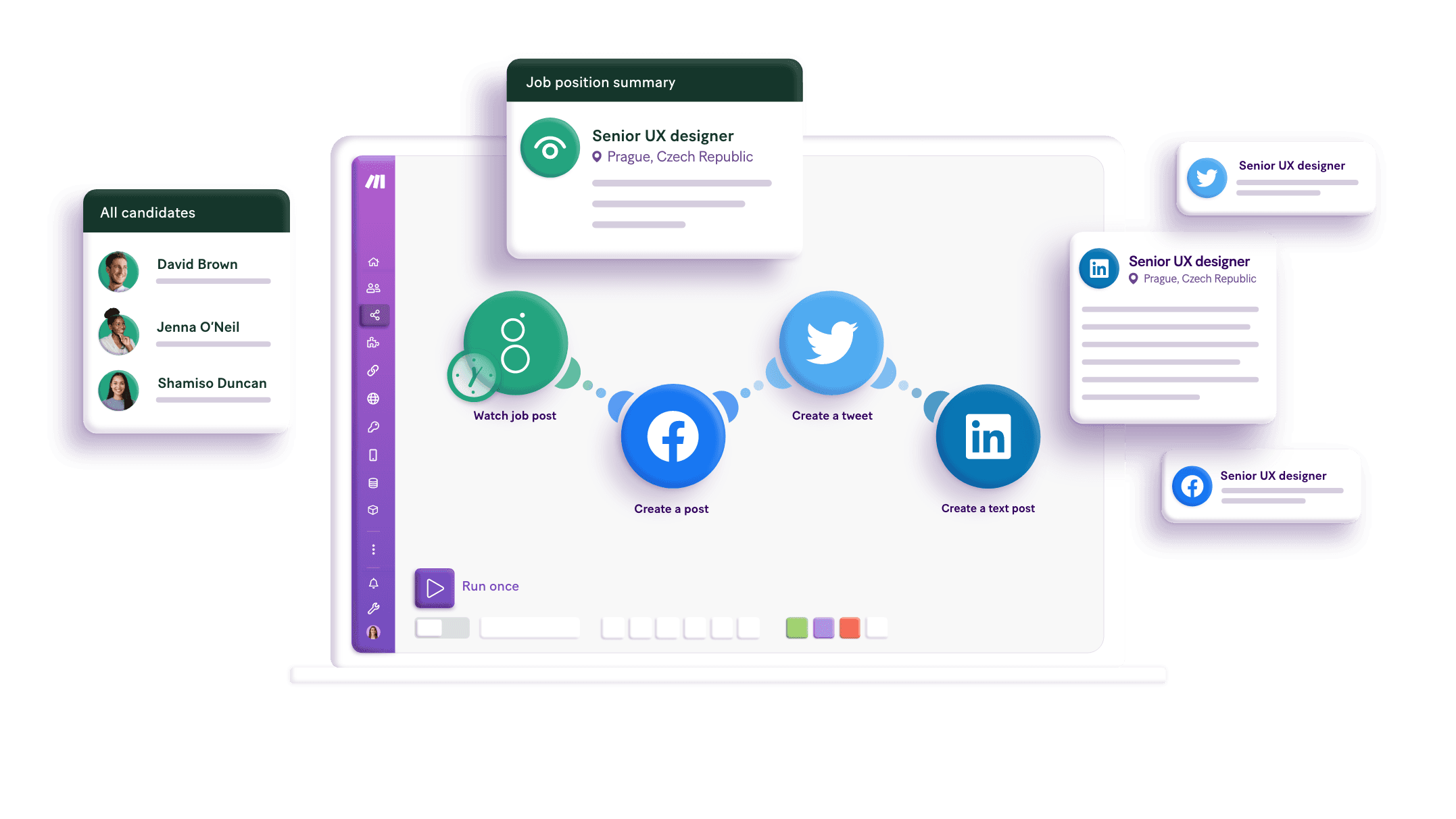
Build your Airtable and OpenAI (ChatGPT, Whisper) integrations.
Connect OpenAI (ChatGPT, Whisper) as a trigger and Airtable as an action through Make's automation platform. When records are created or updated in your OpenAI (ChatGPT, Whisper) base, automatically trigger OpenAI actions such as generating ChatGPT responses, creating DALL-E images, or transcribing audio files with Whisper based on your database changes. This integration enables you to monitor OpenAI (ChatGPT, Whisper) for new or modified entries and instantly process that data through OpenAI's AI tools, with results that can be stored back in your tables. Set up workflows where OpenAI (ChatGPT, Whisper) database updates serve as the trigger event that initiates AI-powered content generation, image creation, or audio transcription actions through OpenAI, creating automated processes that respond to your data changes in real-time.
Analyzes images according to specified instructions.
Сreates multiple records.
Deletes multiple records.
Updates multiple existing records.
Upserts multiple records.
Cancels an "in-progress" batch. The batch will be in status "cancelling" for up to 10 minutes, before changing to "cancelled", where it will have partial results (if any) available in the output file.
Creates a new record in Airtable.
Creates and executes a batch of API calls.
Creates a new skill.
Popular Airtable and OpenAI (ChatGPT, Whisper) workflows.
Connect Airtable with OpenAI's suite of tools to harness the power of AI-driven automation. Transform your structured data into intelligent, personalized content at scale—from automated marketing copy and SEO-enriched records to AI-generated social media posts and personalized email responses.
Improve your content workflows and enrich your database with ChatGPT's natural language processing capabilities. Process leads in real-time, generate context-aware communications, and maximize your content reach across platforms—all without manual effort.
How to setup Airtable and OpenAI (ChatGPT, Whisper) in 5 easy steps
Choose your connection method
Make offers two ways to connect Airtable to your automation: OAuth or Personal Access Token. OAuth is the more straightforward option that lets you grant access with just a few clicks, while Personal Access Token gives you more direct control using a special password you create. Both methods are secure, so pick whichever feels more comfortable for you.
Add Airtable to your workflow
Log in to Make and open the automation where you want to use Airtable. Add an Airtable module from the available apps, then look for the Connection field and click the Add button next to it. This starts the process of linking your Airtable account to Make so they can work together.
Connect using OAuth
When connection options appear, select 'Airtable OAuth' as your connection type. After clicking Save, you'll see an authentication screen where you can click 'Add a base' to view your Airtable bases. Select the specific base you want Make to access and click 'Grant access' to complete the connection.
Connect using Personal Access Token
If you prefer using a Personal Access Token, first create one in your Airtable account by going to your profile icon and selecting 'Developer hub.' Create a new token with a memorable name, then copy it immediately as you won't see it again. Back in Make, select 'Airtable Token or Key' as your connection type and paste your token into the designated field.
Save and start automating
After entering your connection details with either method, click Save to establish the connection. Make will verify everything works properly, and your new connection will appear in the connection menu. You can now use Airtable modules to read data, create records, or update information in your automated workflows.
AI-powered automation: Airtable and OpenAI integration benefits
Discover how integrating Airtable and OpenAI (ChatGPT, Sora, DALL-E, Whisper) transforms your workflow with automated content generation, intelligent data enrichment, and personalized communications.
Automatically transform data stored in Airtable into AI-generated content like social media posts, emails, and marketing copy without manual effort.
Use ChatGPT to automatically generate SEO keywords, summaries, and additional insights from your Airtable records, enriching your database with valuable information.
Automatically draft personalized email responses based on Airtable data using ChatGPT, saving time while maintaining quality communication with clients and customers.
Convert blog articles and published content stored in Airtable into multiple social media posts across platforms using ChatGPT, maximizing content reach and engagement.


FAQ
By connecting Airtable with OpenAI through Make, you can automatically enrich your database records with AI-generated content. For example, you can use GPT-4 to automatically generate product descriptions from basic specifications stored in Airtable, summarize customer feedback entries, categorize records intelligently, or translate content across multiple languages. This eliminates manual data entry and content creation, saving hours of work while maintaining consistency across your databases. Make's visual workflow builder lets you set up these automations without coding, triggering OpenAI actions whenever new records are added or updated in Airtable.
The integration opens up powerful business applications: Content teams can store article ideas in Airtable and automatically generate drafts using GPT-4, then save them back to the database for review. Sales teams can analyze customer inquiries stored in Airtable and generate personalized responses using ChatGPT. Marketing teams can use DALL-E to automatically create custom images based on campaign briefs in Airtable. Customer support can transcribe voice feedback using Whisper and store structured data in Airtable. HR departments can screen resumes stored in Airtable by having GPT-4 extract key qualifications and rank candidates. Make enables all these workflows to run automatically, connecting your structured data with AI processing.
No programming skills are required. Make provides a user-friendly, drag-and-drop interface that makes connecting Airtable and OpenAI straightforward and intuitive. You start by selecting Airtable as your trigger (for example, 'when a new record is created'), then add OpenAI as an action (like 'generate text with GPT-4'), and finally route the results back to Airtable or another destination. Make handles all the technical API connections, authentication, and data formatting behind the scenes. Most users can build their first working automation in under 15 minutes. Plus, Make offers pre-built templates for common Airtable-OpenAI workflows that you can customize to your needs, making it even faster to get started.
Make offers significant advantages over custom scripting: First, it eliminates development and maintenance overhead—no need to write code, manage API keys in scripts, or handle error cases manually. Second, Make provides built-in reliability with automatic error handling, retry logic, and execution monitoring that would take weeks to build yourself. Third, it offers visual workflow management, making it easier for non-technical team members to understand and modify automations. Fourth, Make scales effectively—whether you process 10 records or 10,000, the platform handles it without infrastructure concerns. Finally, you get access to 1,500+ other apps, meaning you can easily expand your workflow to include Slack notifications, Google Sheets exports, or email triggers without additional integration work. This flexibility and reliability makes Make the smart choice for businesses that want powerful automations without the technical burden.
A scenario represents a workflow or a project of your own creation, and it is made up of a series of modules that automate apps and services. Creating a scenario allows you to transfer and transform data between apps and services via these modules to automate anything and improve the way you work.
Modules are the main building blocks of automation in Make. Modules represent actions that Make performs with an app, like creating, updating, or deleting data.
How it works
Traditional no-code iPaaS platforms are linear and non-intuitive. Make allows you to visually create, build, and automate without limits.
Trusted by 350,000+ customers
"Make really helped us to scale our operations, take the friction out of our processes, reduce costs, and relieved our support team. It is difficult to not become a fan."

Philipp Weidenbach
Head of Operations at Teleclinic
"Make drives unprecedented efficiency within our business in ways we never imagined. It’s having an extra employee (or 10) for a fraction of the cost."

Cayden Phipps
COO at Shop Accelerator Martech
"The simplicity, flexibility and ability to build real complex automations without any knowledge of programming makes it the best thing since sliced bread."

Erkki Markus
Product Owner at Smaily
"True citizen development in the entire company. Make is present in every department, empowering the company to offer a unique customer experience."

Andreas Stryz
CTO & Co-founder at FINN
"I can't count the number of hours I've saved by using Make. Every single day is simpler because of Make's automation."

Kimberly D
Owner of Media Production