
Connect Figma and WordPress integrations

Triggers when a new comment is created.
Triggers 30 minutes after editing stops in the file.

Creates a category.
Creates a comment.
Creates a media item.
Creates a post.
Creates a tag.
Creates a user.
Deletes a category specified by its ID.
Deletes a comment specified by its ID.
Deletes a media item specified by its ID.
Deletes a post specified by its ID.
Deletes a tag specified by its ID.
Deletes a user specified by its ID.
Returns info about a category specified by its ID.
Returns info about a comment specified by its ID.
Returns info about a media item specified by its ID.
Returns info about a post specified by its ID.
Returns info about a tag specified by its ID.
Returns info about a user specified by its ID.
Performs an arbitrary authorized API call.
Updates a category specified by its ID.
Updates a comment specified by its ID.
Updates a media item specified by its ID.
Updates a post specified by its ID.
Updates a tag specified by its ID.
Updates a user specified by its ID.
Searches for specific categories.
Searches for specific comments.
Searches for specific media items.
Searches for specific posts.
Searches for specific tags.
Searches for specific taxonomies.
Searches for specific users.
Trusted by thousands of fast-scaling organizations around the globe





Automate your work. Build something new.
Just drag and drop apps to automate existing workflows or build new complex processes. Solve problems across all areas and teams.
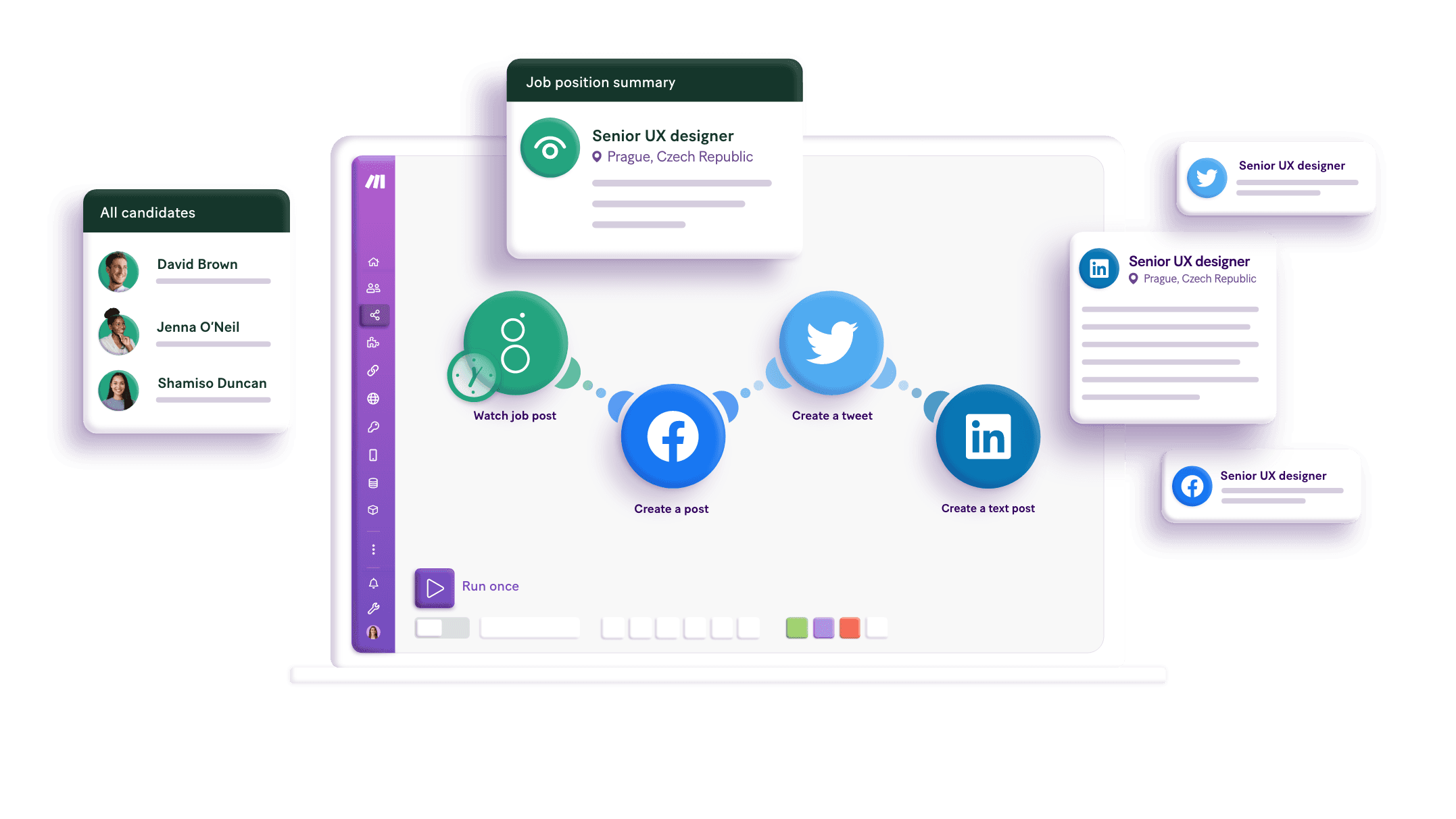
Build your Figma and WordPress integrations.
Integrate Figma as a trigger and WordPress as an action with the Make platform for enhanced productivity. Automatically synchronize design updates in Figma to your WordPress site by setting triggers in Figma to publish or update content in WordPress. This integration reduces repetitive tasks, ensuring consistent and compelling visual elements without manual intervention. Experience a creative and efficient workflow by connecting Figma's design capabilities with WordPress's content management, transforming your digital projects into an automated process.
Creates a category.
Creates a comment.
Creates a media item.
Creates a post.
Creates a tag.
Creates a user.
Deletes a category specified by its ID.
Deletes a comment specified by its ID.
Deletes a media item specified by its ID.
Popular Figma and WordPress workflows.
Looking to get more out of Figma and WordPress? With Make you can visually integrate Figma and WordPress into any workflow to save time and resources — no coding required. Try any of these templates in just a few clicks.
How to setup Figma and WordPress in 5 easy steps
Start with figma
Begin the connection process by opening the Figma module on the Make platform.
Link your figma account
Allow Make to access your Figma account to establish a connection between the two applications.
Set up wordpress plugin
Install and activate the Make Connector plugin on your WordPress site.
Prepare your wordpress site
Retrieve the API Key from the Make Connector plugin in WordPress, as it is essential for creating the link.
Finalize the connection
On the Make platform, use your WordPress site's URL and API Key to save and establish the connection.
Optimize efficiency and branding with figma and wordpress integration
Integrating Figma and WordPress simplifies design updates, improves collaboration, and ensures consistent branding by automating the transfer of design elements with the Make platform.
Instantly update WordPress with new Figma designs to keep content fresh and aligned.
Transfer Figma assets directly to WordPress projects for efficient content creation.
Reduce manual tasks by automating the transfer of design elements with Make.
Ensure brand consistency by maintaining design integrity across platforms.


FAQ
Integrating Figma with WordPress using Make allows you to transfer your design work into your website and streamline your workflow. This enables you to maintain consistency between your design files and live content, ultimately saving time and reducing errors in the design-to-development handoff.
With Make's automation capabilities, you can set up triggers that automatically push updates from your Figma designs to your WordPress site whenever changes are made. This ensures your visual content is always up-to-date on your website without the need for manual updates, providing visitors with the most current version of your designs.
While the integration process is user-friendly, some users may initially encounter challenges with understanding Make's automation flow setup. Fortunately, Make offers comprehensive tutorials and a supportive community, helping users quickly overcome any initial hurdles and fully leverage the integration.
Make offers advanced automation features such as conditional logic, multiple triggers, and data mapping that allow users to create customized workflows between Figma and WordPress. This not only enhances efficiency but also empowers users to tailor the integration to specific project needs, extending the functionality of both applications.
A scenario represents a workflow or a project of your own creation, and it is made up of a series of modules that automate apps and services. Creating a scenario allows you to transfer and transform data between apps and services via these modules to automate anything and improve the way you work.
Modules are the main building blocks of automation in Make. Modules represent actions that Make performs with an app, like creating, updating, or deleting data.
How it works
Traditional no-code iPaaS platforms are linear and non-intuitive. Make allows you to visually create, build, and automate without limits.
Trusted by 350,000+ customers
"Make really helped us to scale our operations, take the friction out of our processes, reduce costs, and relieved our support team. It is difficult to not become a fan."

Philipp Weidenbach
Head of Operations at Teleclinic
"Make drives unprecedented efficiency within our business in ways we never imagined. It’s having an extra employee (or 10) for a fraction of the cost."

Cayden Phipps
COO at Shop Accelerator Martech
"The simplicity, flexibility and ability to build real complex automations without any knowledge of programming makes it the best thing since sliced bread."

Erkki Markus
Product Owner at Smaily
"True citizen development in the entire company. Make is present in every department, empowering the company to offer a unique customer experience."

Andreas Stryz
CTO & Co-founder at FINN
"I can't count the number of hours I've saved by using Make. Every single day is simpler because of Make's automation."

Kimberly D
Owner of Media Production