Connect Google Gemini AI and Anthropic Claude integrations
Harness the combined power of Google Gemini AI and Anthropic Claude by building automated workflows where Google Gemini AI triggers intelligent processes and Anthropic Claude delivers advanced reasoning and content generation. Transform your business with AI-powered automation that connects through Make's visual integration platform.

Triggers when a long running task has finished.

Creates a new prompt based on a structured list of input messages.
Creates a new Skill.
Creates a new Skill version.
Deletes an existing file.
Deletes an existing Skill.
Deletes an existing Skill version.
Downloads a Claude-generated file.
Retrieves an existing file's metadata.
Retrieves an existing Skill.
Retrieves an existing Skill version.
Performs an arbitrary authorized API call.
Generates text responses from prompts without requiring an account or connection.
Uploads a new file.
Returns a list of files within a workspace.
Lists all existing Skills.
Lists all existing Skill versions.
Trusted by thousands of fast-scaling organizations around the globe





Automate your work. Build something new.
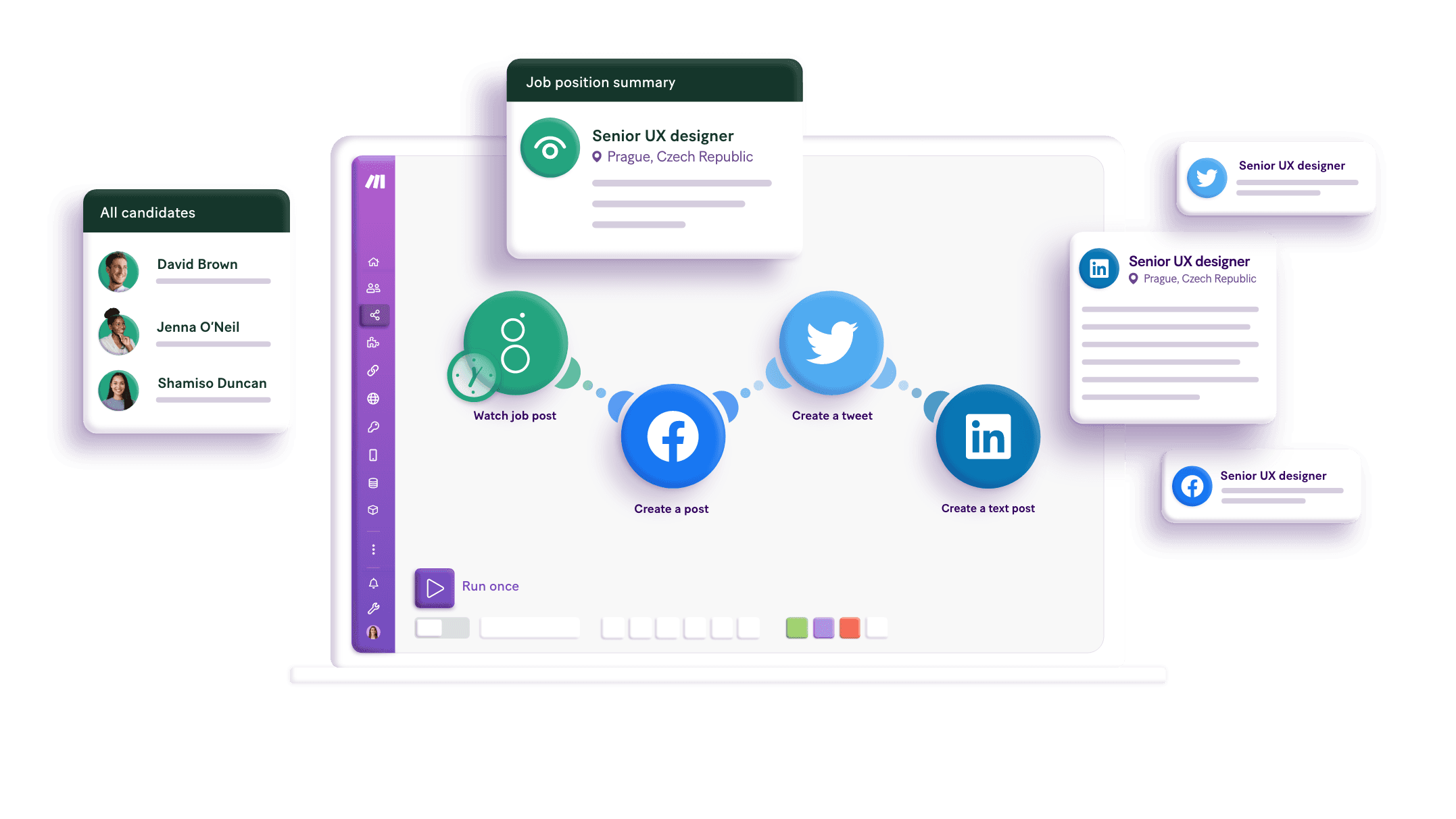
Just drag and drop apps to automate existing workflows or build new complex processes. Solve problems across all areas and teams.
Build your Google Gemini AI and Anthropic Claude integrations.
Automate your workflows by connecting Anthropic Claude as a trigger and Google Gemini AI as an action through Make's integration platform. When Anthropic Claude processes data or generates output, it can trigger automated workflows that send information to Google Gemini AI to perform advanced reasoning and content generation actions. Make provides the visual tools and connectivity you need to design this integration, allowing Anthropic Claude to initiate processes that Google Gemini AI completes within your automated workflows. Start building your AI-powered automation today—use Make to integrate Anthropic Claude as a trigger and Google Gemini AI as an action to transform how your business uses artificial intelligence.
Creates a new prompt based on a structured list of input messages.
Creates a new Skill.
Creates a new Skill version.
Creates a new file search store.
Deletes an existing file.
Deletes an existing Skill.
Deletes an existing Skill version.
Deletes a file from a selected files search store.
Deletes a file search store.
Popular Google Gemini AI and Anthropic Claude workflows.
Looking to get more out of Google Gemini AI and Anthropic Claude? With Make you can visually integrate Google Gemini AI and Anthropic Claude into any workflow to save time and resources — no coding required. Try any of these templates in just a few clicks.
How to setup Google Gemini AI and Anthropic Claude in 5 easy steps
Get your API key from the application
Before Make can automate tasks with your chosen application, you need to get a special access key called an API key. Log into the application you want to connect (like Anthropic Claude or Google Gemini AI) and navigate to the API settings section. For Anthropic Claude, look for a key icon in the bottom-left corner. For Google Gemini AI, open Google AI Studio and find the 'Get API key' option. Once you're in the right section, create a new API key by clicking the appropriate button. You may need to name your key or select a workspace. The system will generate a unique string of characters that acts as your secure password for Make to access the application. This key is your permission slip that allows Make to work with your account.
Copy and securely save your API key
As soon as your API key is generated, copy it immediately to your clipboard. Most applications will only show you the complete key once for security reasons, so it's crucial to save it right away. Store this key in a secure location like a password manager or a private note. Treat your API key like you would treat a password—keep it private and never share it publicly. If you lose the key, you'll need to generate a new one and update your connection in Make. Anyone with access to this key could potentially use your account through automation tools, so protecting it is essential for your security.
Add your application module in Make
Log into your Make account and either create a new automation scenario or open an existing one where you want to use your application. Use the search function to find and add the module for your chosen app, whether it's Anthropic Claude or Google Gemini AI, to your workflow canvas. When you add the module for the first time, Make will automatically detect that you haven't connected this application yet and will prompt you to create a connection. This is the bridge that allows Make to communicate with your external application using the API key you generated earlier.
Create and name your connection
In the module settings, click on 'Create a connection' when prompted. This opens a dialog box where you'll enter the information needed to establish the secure link between Make and your application. You can give your connection a custom name to help you identify it later, which is especially helpful if you plan to manage multiple connections. Choose a descriptive name that will make sense to you in the future, like 'My Claude Account' or 'Gemini Work Project.' This naming step is optional but recommended for keeping your workspace organized, particularly if you work with multiple accounts or different applications.
Enter your API key and save
Paste the API key you copied earlier into the 'API Key' field in Make's connection dialog. Make sure you've copied the entire key accurately without any extra spaces or missing characters, as even tiny errors will prevent the connection from working properly. Click the 'Save' button to finalize your connection. Make will automatically test the connection to verify that your API key is valid and working correctly. Once confirmed successful, you can use this connection in any future scenario with that application without needing to reconnect each time, making your automation process much more efficient.
Powerful AI synergy: Google Gemini AI and Anthropic Claude integration
Combine Google Gemini AI and Anthropic Claude to create intelligent workflows that compare outputs, provide automatic fallbacks, distribute tasks based on AI strengths, and optimize costs for superior results.
Automatically route the same prompts to both Gemini and Claude to compare responses, validate outputs, and choose the best result for your specific use case.
Create resilient AI workflows that automatically switch between Gemini and Claude if one service is unavailable or fails to meet quality thresholds.
Take advantage of each AI's strengths by routing coding tasks to Gemini and complex reasoning or safety-critical tasks to Claude based on content type.
Combine Gemini's creative writing capabilities with Claude's editing and refinement skills to produce higher-quality content through sequential processing.


FAQ
By integrating Google Gemini AI and Anthropic Claude through Make, you can create intelligent workflows that utilize each AI's unique strengths. For example, you can use Gemini's multimodal capabilities and code generation for technical tasks, while taking advantage of Claude's 100K+ token window for processing large documents and its Constitutional AI for safer, brand-appropriate responses. Make allows you to route different types of requests to the most suitable AI model automatically, compare outputs from both models for critical decisions, or use them sequentially where one AI's output feeds into the other's processing. This multi-AI approach ensures you get the best possible results for each specific task without manual switching between platforms.
Make's visual workflow builder enables you to create sophisticated AI-powered automations without any coding knowledge. You can build workflows such as: content creation pipelines where Claude drafts long-form content with its extensive context window and Gemini refines or translates it; customer support systems that route complex queries to Claude for safer, more thoughtful responses while using Gemini for quick factual answers; document processing workflows where Claude analyzes large contracts or reports and Gemini generates summaries or extracts data; and creative projects where both AIs collaborate on writing, brainstorming, or code generation. Make's drag-and-drop interface lets you connect these AI models with thousands of other apps, creating end-to-end automations that save hours of manual work.
Make provides enterprise-grade security features that are especially important when working with sensitive data across multiple AI platforms. When you integrate Google Gemini AI and Anthropic Claude through Make, your data flows through encrypted connections, and Make acts as a secure intermediary. Notably, Anthropic Claude offers best-in-class data retention policies with no training on your data, which Make helps you take advantage of while maintaining consistent security standards. Make allows you to set up data filtering, transformation, and routing rules to ensure sensitive information is handled appropriately with each AI model. You can also implement conditional logic to determine which AI processes specific types of data based on your security requirements. Additionally, Make provides detailed execution logs and monitoring, giving you full visibility and control over how your data moves between applications.
Absolutely! Make offers a free tier that allows you to start experimenting with Google Gemini AI and Anthropic Claude integrations immediately without any upfront investment. You can create test scenarios to compare how each AI model handles your specific use cases—for instance, testing Claude's performance on large document analysis versus Gemini's approach, or comparing their outputs for creative writing, code generation, or data extraction tasks. Make's intuitive visual builder means you can set up your first integration in minutes, not hours. You can build parallel workflows that send the same prompt to both AIs and compare results side-by-side, helping you understand which model works best for different tasks. This hands-on experimentation with real integrations gives you practical insights that go far beyond reading documentation, and once you identify the optimal setup, you can scale your workflows confidently as your needs grow.
A scenario represents a workflow or a project of your own creation, and it is made up of a series of modules that automate apps and services. Creating a scenario allows you to transfer and transform data between apps and services via these modules to automate anything and improve the way you work.
Modules are the main building blocks of automation in Make. Modules represent actions that Make performs with an app, like creating, updating, or deleting data.
How it works
Traditional no-code iPaaS platforms are linear and non-intuitive. Make allows you to visually create, build, and automate without limits.
Trusted by 350,000+ customers
"Make really helped us to scale our operations, take the friction out of our processes, reduce costs, and relieved our support team. It is difficult to not become a fan."

Philipp Weidenbach
Head of Operations at Teleclinic
"Make drives unprecedented efficiency within our business in ways we never imagined. It’s having an extra employee (or 10) for a fraction of the cost."

Cayden Phipps
COO at Shop Accelerator Martech
"The simplicity, flexibility and ability to build real complex automations without any knowledge of programming makes it the best thing since sliced bread."

Erkki Markus
Product Owner at Smaily
"True citizen development in the entire company. Make is present in every department, empowering the company to offer a unique customer experience."

Andreas Stryz
CTO & Co-founder at FINN
"I can't count the number of hours I've saved by using Make. Every single day is simpler because of Make's automation."

Kimberly D
Owner of Media Production