
Connect OneDrive and Perplexity AI integrations
Transform every OneDrive upload into intelligent action by automatically triggering Perplexity AI to analyze, research, and generate insights from your files. Connect your cloud storage with powerful AI capabilities that turn documents into structured knowledge, answering queries and processing data without lifting a finger.

Triggers when a file or folder is created or updated.

Creates a chat completions with the chosen model.
Generate a response for the provided input with optional web search and reasoning.
Generate contextualized embeddings for document chunks. Chunks from the same document share context awareness, improving retrieval quality for document-based applications.
Generate vector representations (embeddings) for the text you provide.
Performs an arbitrary authorized API call.
Returns the ranked search results from Perplexity's continously refreshed index.
Trusted by thousands of fast-scaling organizations around the globe





Automate your work. Build something new.
Just drag and drop apps to automate existing workflows or build new complex processes. Solve problems across all areas and teams.
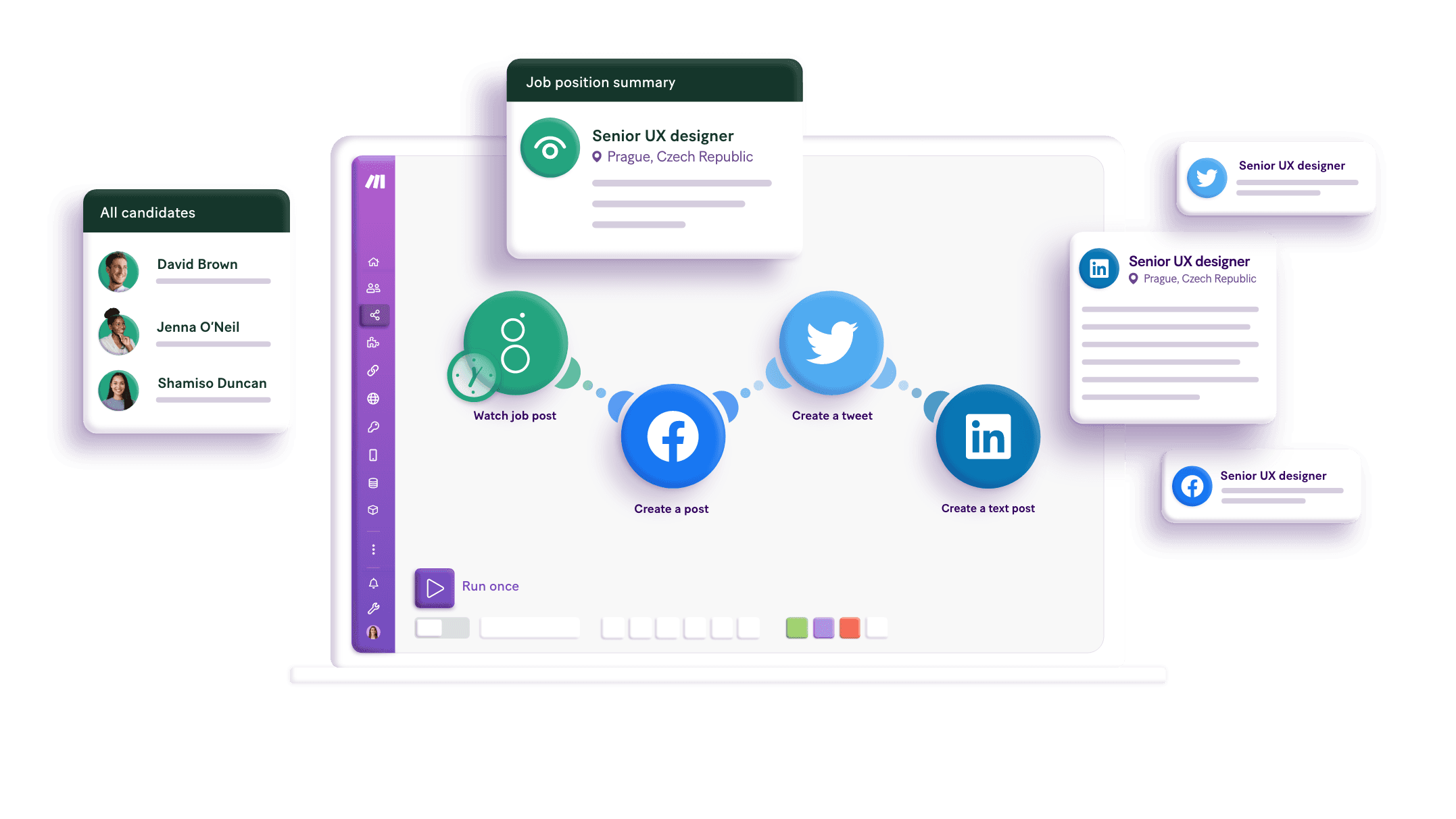
Build your OneDrive and Perplexity AI integrations.
When a new file is uploaded to Perplexity AI, it serves as a trigger that automatically initiates a workflow. This trigger activates OneDrive as an action, which can process the file content, generate AI-powered research outputs, or create insights based on the uploaded document. The integration allows Perplexity AI file events to prompt OneDrive to perform specific tasks, such as analyzing data, answering queries related to the file content, or generating structured information that can be utilized in your workflow.
Copies a file into new folder location.
Creates a new folder.
Creates a chat completions with the chosen model.
Generate a response for the provided input with optional web search and reasoning.
Deletes a file or folder.
Downloads a specified file.
Generate contextualized embeddings for document chunks. Chunks from the same document share context awareness, improving retrieval quality for document-based applications.
Generate vector representations (embeddings) for the text you provide.
Gets the metadata of a specified file.
Popular OneDrive and Perplexity AI workflows.
Looking to get more out of OneDrive and Perplexity AI? With Make you can visually integrate OneDrive and Perplexity AI into any workflow to save time and resources — no coding required. Try any of these templates in just a few clicks.
How to setup OneDrive and Perplexity AI in 5 easy steps
Add your app module and start the connection
Log in to your Make account and open your automation scenario. Add either a OneDrive or Perplexity AI module from the apps list. When the module appears, click the 'Create a Connection' button to begin linking your chosen app to Make.
Give your connection a memorable name
When the connection window opens, you can enter a custom name to help you identify this connection later. This is especially useful if you work with multiple accounts. Choose something descriptive like 'My Work OneDrive' or 'Perplexity Research' so you can recognize it quickly.
Get your Perplexity AI access key
For Perplexity AI, you'll need an API key to connect. Log in to Perplexity AI, click the Settings icon, select API from the sidebar, then go to API Keys. Click 'Create Key' to generate your key and copy it immediately to use in the next step.
Complete the authentication process
For Perplexity AI, paste your API key into the connection window and click 'Save'. For OneDrive, clicking 'Save' will open Microsoft's login page where you'll sign in and grant Make permission to access your files. Follow the prompts to approve access.
Start building your automation
Once your connection is confirmed, you're ready to automate tasks between your apps. You can now configure your modules to perform actions like managing OneDrive files or using Perplexity AI features. Your connection will remain active for future scenarios.
Powerful automation: OneDrive meets Perplexity AI
Integrate OneDrive and Perplexity AI to automate document analysis, intelligent file organization, and better knowledge management. Transform your cloud storage with AI-powered insights and workflows.
Automatically analyze OneDrive documents using Perplexity AI to extract insights and generate intelligent summaries without manual effort.
Use Perplexity AI to categorize and tag OneDrive files based on content analysis, creating an intelligently organized cloud storage system.
Save Perplexity AI research findings and answers directly to OneDrive folders for better knowledge management and team collaboration.
Generate AI-powered content with Perplexity and automatically store it in designated OneDrive locations for immediate access and sharing.


FAQ
By connecting OneDrive with Perplexity AI through Make, you can automatically save research findings and AI-generated insights directly to your OneDrive folders. This integration enables you to build a searchable knowledge base where Perplexity's powerful information discovery capabilities feed directly into your cloud storage, making it easier to organize, share, and access AI-powered research across your team or personal projects without manual file transfers.
Make enables powerful automation scenarios such as: automatically querying Perplexity AI whenever new documents are added to specific OneDrive folders and saving summaries back to OneDrive; scheduling regular research reports generated by Perplexity AI and storing them in organized OneDrive directories; or triggering Perplexity searches based on OneDrive file content and appending insights to existing documents. These automations eliminate repetitive tasks and ensure your knowledge discovery process runs continuously in the background.
No programming skills are required. Make provides a visual, drag-and-drop interface that allows you to connect OneDrive and Perplexity AI through pre-built modules. You simply authenticate both applications, select triggers and actions, and map the data flow between them. Make's intuitive platform is designed for users of all technical levels, with templates and step-by-step guidance to help you create sophisticated automations in minutes rather than hours of coding.
Manual processes require you to constantly switch between applications, copy-paste information, and remember to save files correctly. With Make's integration, these workflows become fully automated—running 24/7 without your intervention. This saves hours of repetitive work weekly, reduces human error, ensures consistency in how information is processed and stored, and allows you to scale your knowledge management operations without additional effort. The time saved can be redirected to higher-value activities while Make handles the routine data flow between OneDrive and Perplexity AI.
A scenario represents a workflow or a project of your own creation, and it is made up of a series of modules that automate apps and services. Creating a scenario allows you to transfer and transform data between apps and services via these modules to automate anything and improve the way you work.
Modules are the main building blocks of automation in Make. Modules represent actions that Make performs with an app, like creating, updating, or deleting data.
How it works
Traditional no-code iPaaS platforms are linear and non-intuitive. Make allows you to visually create, build, and automate without limits.
Trusted by 350,000+ customers
"Make really helped us to scale our operations, take the friction out of our processes, reduce costs, and relieved our support team. It is difficult to not become a fan."

Philipp Weidenbach
Head of Operations at Teleclinic
"Make drives unprecedented efficiency within our business in ways we never imagined. It’s having an extra employee (or 10) for a fraction of the cost."

Cayden Phipps
COO at Shop Accelerator Martech
"The simplicity, flexibility and ability to build real complex automations without any knowledge of programming makes it the best thing since sliced bread."

Erkki Markus
Product Owner at Smaily
"True citizen development in the entire company. Make is present in every department, empowering the company to offer a unique customer experience."

Andreas Stryz
CTO & Co-founder at FINN
"I can't count the number of hours I've saved by using Make. Every single day is simpler because of Make's automation."

Kimberly D
Owner of Media Production