
Connect OpenAI (ChatGPT, Whisper) and NetSuite integrations
Transform OpenAI's AI-powered outputs from ChatGPT, DALL-E, and Whisper into instant NetSuite actions through Make's no-code automation platform. Automatically flow product descriptions, marketing visuals, and transcribed calls directly into your ERP system—updating inventory, creating listings, and populating CRM records without manual data entry, so your team can focus on strategy while AI handles the execution.

Triggers when a batch is completed.

Attaches a file to a record by its ID and the record ID.
Creates a new custom record.
Creates or updates a folder by its Internal ID or External ID.
Creates or updates a record by its Internal ID or External ID.
Deletes a custom record by its Internal ID or External ID.
Deletes a record by its Internal ID or External ID.
Detaches a file from a record by its ID and the record ID.
Download an existing file by its internal ID or external ID.
Retrieves the details of a custom record by its Internal ID or External ID.
Retrieves the details of a record by its Internal ID or External ID.
Performs an arbitrary authorized REST API call.
Performs an arbitrary authorized RESTlet API call.
Performs an arbitrary authorized SOAP API call.
Updates a custom record by its Internal ID or External ID.
Uploads a file by an external URL or binary data.
Retrieves multiple custom records by their IDs.
Executes a SuiteQL query.
Retrieves a list of custom records filtered by a query.
Retrieves a list of records filtered by a query.
Retrieves a list of records filtered by a saved search.
Trusted by thousands of fast-scaling organizations around the globe





Automate your work. Build something new.
Just drag and drop apps to automate existing workflows or build new complex processes. Solve problems across all areas and teams.
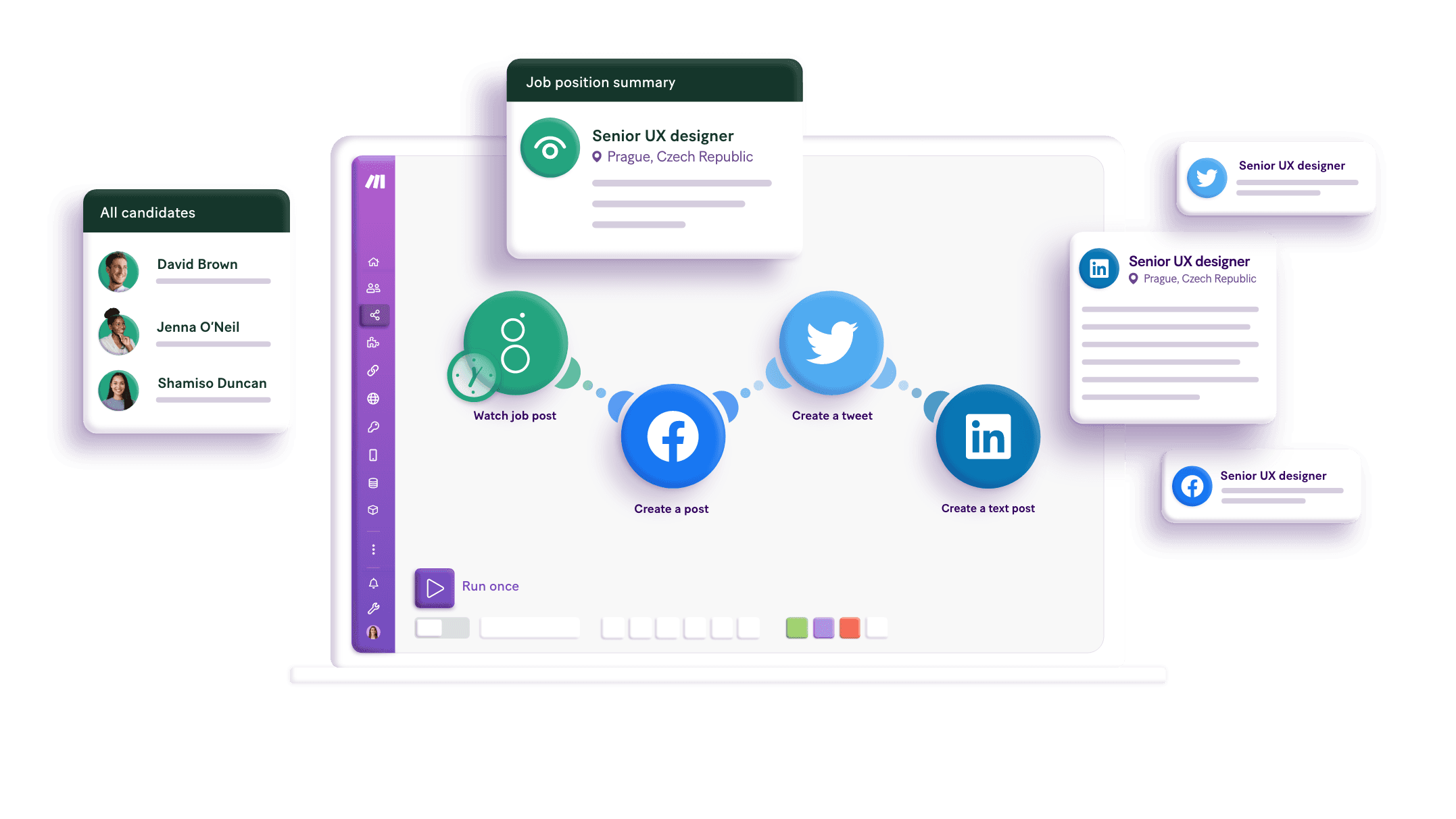
Build your OpenAI (ChatGPT, Whisper) and NetSuite integrations.
Connect NetSuite as a trigger and OpenAI (ChatGPT, Whisper) as an action through Make's integration platform. When OpenAI generates output—such as product descriptions from ChatGPT, marketing visuals from DALL-E, or transcribed customer service calls from Whisper—these results automatically trigger actions in OpenAI (ChatGPT, Whisper), such as updating inventory records, creating e-commerce listings, or populating CRM records. This trigger-action workflow enables you to automate data flow from OpenAI's AI-generated content directly into OpenAI (ChatGPT, Whisper)'s ERP system without writing code, optimizing content creation, customer communications, and data management processes across your organization.
Analyzes images according to specified instructions.
Attaches a file to a record by its ID and the record ID.
Retrieves multiple custom records by their IDs.
Cancels an "in-progress" batch. The batch will be in status "cancelling" for up to 10 minutes, before changing to "cancelled", where it will have partial results (if any) available in the output file.
Creates a new custom record.
Creates and executes a batch of API calls.
Creates a new skill.
Creates a new immutable skill version.
Creates a new vector store and optionally adds files to it, or adds files to an existing vector store.
Popular OpenAI (ChatGPT, Whisper) and NetSuite workflows.
Looking to get more out of OpenAI (ChatGPT, Whisper) and NetSuite? With Make you can visually integrate OpenAI (ChatGPT, Whisper) and NetSuite into any workflow to save time and resources — no coding required. Try any of these templates in just a few clicks.
How to setup OpenAI (ChatGPT, Whisper) and NetSuite in 5 easy steps
Enable token authentication in NetSuite
Before connecting NetSuite to Make, you need to turn on a security feature called Token Authentication in your NetSuite account. Log in as an administrator, navigate to Setup > Company > Enable Features, find the SuiteCloud tab, and enable SuiteScript, SuiteTalk Web Services, and Token-Based Authentication. This allows Make to securely communicate with your NetSuite data without needing to share your password.
Create integration credentials in NetSuite
Next, you'll need to generate special keys that act like a secure handshake between NetSuite and Make. Go to Setup > Integration > Manage Integrations in NetSuite and create a new integration with a descriptive name. After saving, NetSuite will provide you with a Consumer Key and Consumer Secret—these are like a username and password specifically for Make to access your NetSuite account, so copy them somewhere safe as you'll need them in the next steps.
Set up permissions and access
For Make to work properly with NetSuite, you need to create a role with the right permissions and assign it to a user. In NetSuite, create a new role with access to web services, custom fields, and the ability to view and manage transactions. Then assign this role to an employee account that Make will use to interact with your NetSuite data, ensuring the connection has appropriate access without compromising security.
Connect NetSuite to Make
Now it's time to link NetSuite with Make. In your Make account, add a NetSuite module to your automation and click Create a Connection. Paste the Consumer Key and Consumer Secret you saved earlier into the connection form. Make will use these credentials to establish a secure connection with NetSuite, allowing the two platforms to exchange information automatically.
Add OpenAI GPT-3 and build your workflow
With NetSuite connected, add an OpenAI GPT-3 module to your Make scenario and authenticate your OpenAI account. Then configure your automation by selecting what event in NetSuite should trigger an action (like when a new customer is added) and what OpenAI should do in response (like generating personalized content). Test your workflow to ensure data flows correctly between both applications before activating it to run automatically.
AI-powered automation benefits for OpenAI and NetSuite integration
Discover how integrating OpenAI with NetSuite transforms your business operations through intelligent automation, from AI-driven data entry and customer insights to predictive analytics and smart communication.
Eliminate manual data entry by automatically creating, updating, and managing NetSuite records using AI-powered data extraction and processing from OpenAI.
Generate automated, AI-driven summaries and analysis of NetSuite customer data, sales trends, and financial reports using ChatGPT for faster decision-making.
Automatically draft personalized emails, responses, and communications based on NetSuite customer records and transaction data using OpenAI's language models.
Use OpenAI's Whisper and GPT models to transcribe meeting notes, process invoices, and extract key information that automatically updates NetSuite records.


FAQ
By connecting OpenAI with NetSuite through Make, you can automate complex workflows such as generating intelligent customer communications, analyzing financial data with AI-powered insights, creating automated sales reports with natural language summaries, and processing customer inquiries using ChatGPT to update CRM records. This integration eliminates manual data entry, reduces response times, and enables your NetSuite ERP system to leverage advanced AI capabilities for smarter decision-making across finance, sales, and customer service operations.
Make's visual workflow builder allows you to create powerful integrations without coding, such as: automatically generating product descriptions using GPT-4 for your ecommerce catalog in NetSuite, transcribing sales calls with Whisper and logging them as notes in customer records, creating AI-powered chatbots that pull real-time inventory and order data from NetSuite, generating financial report summaries using ChatGPT from your NetSuite data, and using DALL-E to create marketing images that sync with your product database. Make's intuitive drag-and-drop interface makes these advanced automations accessible to everyone.
Yes, Make provides enterprise-grade security for your integrations with robust encryption, secure API connections, and granular permission controls. You have complete control over what data flows between NetSuite and OpenAI, allowing you to set up filters and conditions to ensure sensitive financial information is protected. Make supports data mapping and transformation, so you can anonymize or aggregate data before sending it to OpenAI, and all connections use industry-standard authentication protocols. Additionally, Make is compliant with major security standards, giving you peace of mind when automating business-critical workflows.
You can create your first automation between OpenAI and NetSuite in minutes using Make's pre-built templates and modules. Make offers ready-to-use scenarios that you can customize to your needs, eliminating weeks of custom development time. Simply connect your OpenAI API key and NetSuite account, select the triggers and actions you want, and activate your workflow. Many users see immediate value from basic automations like AI-generated email responses to customer inquiries or automated data analysis. As you become familiar with the platform, you can build increasingly sophisticated workflows, and Make's extensive documentation and active community support help you scale your automation strategy quickly.
A scenario represents a workflow or a project of your own creation, and it is made up of a series of modules that automate apps and services. Creating a scenario allows you to transfer and transform data between apps and services via these modules to automate anything and improve the way you work.
Modules are the main building blocks of automation in Make. Modules represent actions that Make performs with an app, like creating, updating, or deleting data.
How it works
Traditional no-code iPaaS platforms are linear and non-intuitive. Make allows you to visually create, build, and automate without limits.
Trusted by 350,000+ customers
"Make really helped us to scale our operations, take the friction out of our processes, reduce costs, and relieved our support team. It is difficult to not become a fan."

Philipp Weidenbach
Head of Operations at Teleclinic
"Make drives unprecedented efficiency within our business in ways we never imagined. It’s having an extra employee (or 10) for a fraction of the cost."

Cayden Phipps
COO at Shop Accelerator Martech
"The simplicity, flexibility and ability to build real complex automations without any knowledge of programming makes it the best thing since sliced bread."

Erkki Markus
Product Owner at Smaily
"True citizen development in the entire company. Make is present in every department, empowering the company to offer a unique customer experience."

Andreas Stryz
CTO & Co-founder at FINN
"I can't count the number of hours I've saved by using Make. Every single day is simpler because of Make's automation."

Kimberly D
Owner of Media Production