
Connect RSS and Perplexity AI integrations
Transform your RSS feeds into actionable intelligence by automatically routing new content from RSS to Perplexity AI for instant analysis, summarization, and research. Eliminate manual monitoring and let this powerful trigger-action integration deliver AI-powered insights and enriched summaries the moment fresh content arrives.

Triggers when a new RSS feed item is posted.

Creates a chat completions with the chosen model.
Generate a response for the provided input with optional web search and reasoning.
Generate contextualized embeddings for document chunks. Chunks from the same document share context awareness, improving retrieval quality for document-based applications.
Generate vector representations (embeddings) for the text you provide.
Performs an arbitrary authorized API call.
Returns the ranked search results from Perplexity's continously refreshed index.
Trusted by thousands of fast-scaling organizations around the globe





Automate your work. Build something new.
Just drag and drop apps to automate existing workflows or build new complex processes. Solve problems across all areas and teams.
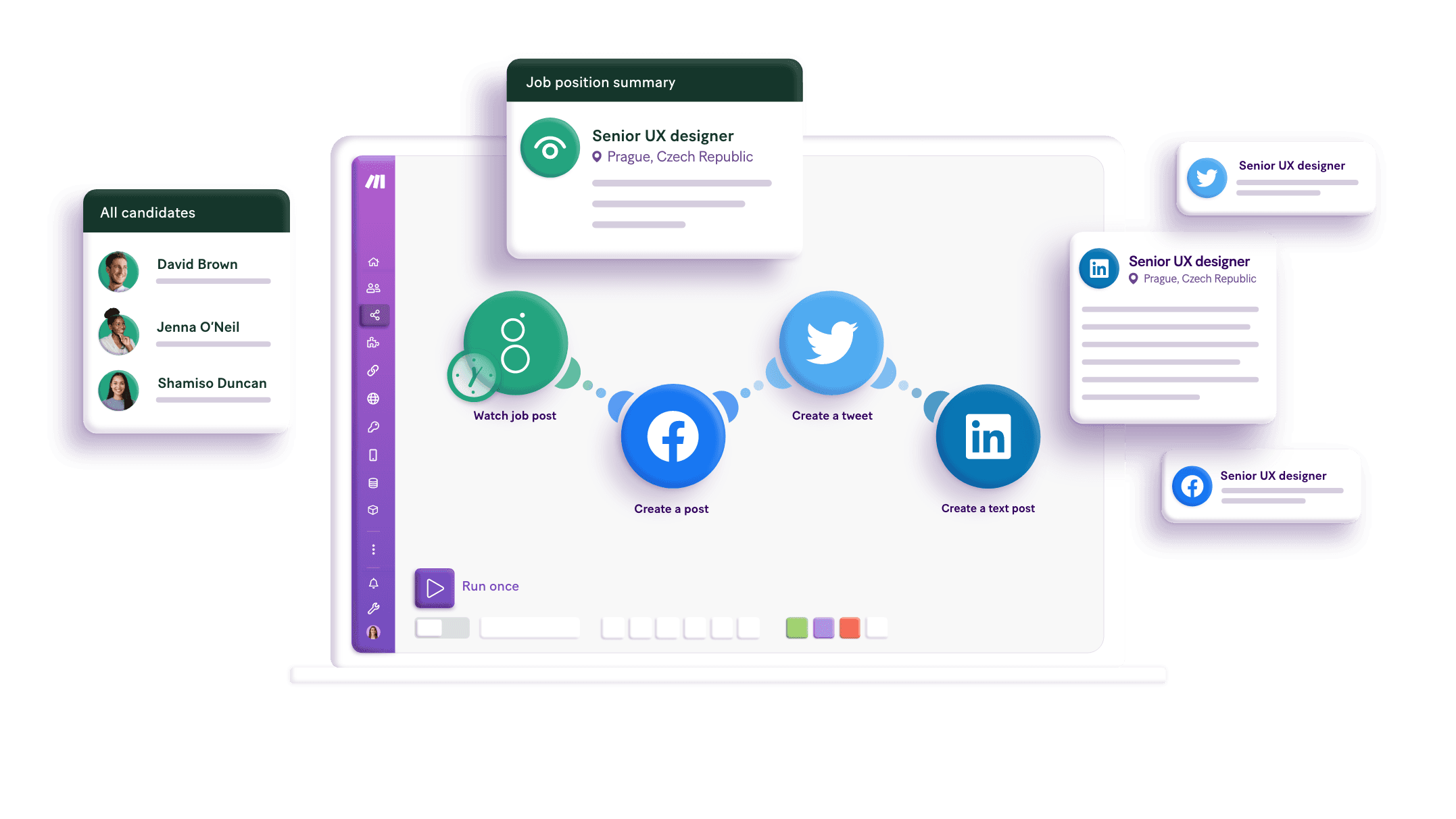
Build your RSS and Perplexity AI integrations.
Perplexity AI functions as a trigger that automatically captures feed updates and initiates workflows when new content is published. When Perplexity AI detects new items in your monitored feeds, it triggers the automation to route this content directly to RSS. RSS then acts as the action component, performing advanced AI-powered analysis, summarization, or research on the Perplexity AI feed content. This trigger-action integration enables automatic generation of insights, answers to complex questions about the content, or creation of enriched summaries from Perplexity AI sources without manual intervention.
Creates a chat completions with the chosen model.
Generate a response for the provided input with optional web search and reasoning.
Generate contextualized embeddings for document chunks. Chunks from the same document share context awareness, improving retrieval quality for document-based applications.
Generate vector representations (embeddings) for the text you provide.
Returns the ranked search results from Perplexity's continously refreshed index.
Performs an arbitrary authorized API call.
Retrieves RSS feed items from a specified URL.
Triggers when a new RSS feed item is posted.
Popular RSS and Perplexity AI workflows.
Supercharge your content workflow by connecting RSS feeds with Perplexity AI's powerful analysis capabilities. Automatically transform news articles and blog posts into intelligent summaries, social media content, and organized knowledge bases.
This integration eliminates manual content curation, letting you distribute AI-powered insights across Telegram, WordPress, Google Sheets, and social platforms—all on autopilot through Make's automation.
How to setup RSS and Perplexity AI in 5 easy steps
Get your API key from Perplexity AI
Log into your Perplexity AI account and navigate to the Settings area by clicking the icon next to your username. In the left sidebar, click on API to access the connection tools. You'll need to create an API group by filling in the requested information and clicking Save. Then, go to the API Keys tab and click '+ Create Key' to generate your unique connection key. Copy this key immediately and store it somewhere safe, like a password manager, as you'll need it to connect with Make.
Add payment information to Perplexity AI
Before you can use the API connection, Perplexity AI requires you to enter payment details. This is a standard security measure to track future usage, and your card won't be charged just for setting up the connection. The payment information is stored securely and you'll only be billed based on your actual usage of the API. This step ensures that your account is ready to communicate with external services like Make.
Add a Perplexity AI module in Make
Log into your Make account and open the scenario where you want to use Perplexity AI. Select Perplexity AI from the available apps to add it to your workflow. When you add the module, you'll see an option to 'Create a connection'—click this button to begin the linking process. This opens a setup window where you'll establish the connection between Make and your Perplexity AI account.
Enter your connection details in Make
In the connection setup window, you can optionally give your connection a memorable name like 'My Perplexity AI Connection' to help you identify it later. Then, find the 'API Key' field and carefully paste the entire key you copied earlier from Perplexity AI, making sure there are no extra spaces. Double-check that the key is entered correctly, as any mistakes will prevent the connection from working properly.
Save and start using your connection
Click the Save button to establish the connection between Make and Perplexity AI. Make will verify your API key, which usually takes just a few seconds. Once successful, you'll see a confirmation message and your connection will be active and ready to use. You can now build automation workflows that use Perplexity AI alongside other apps in Make, and all modules will automatically use this connection to communicate with your account.
Transform RSS feeds with AI-powered automation
Integrate RSS and Perplexity AI to automatically transform feed content into intelligent summaries, deeper insights, and multi-format distributions across your platforms—all without manual work.
Automatically transform RSS feed articles into AI-generated summaries and insights, then distribute them across multiple channels like Telegram, WordPress, and social media without manual intervention.
Use Perplexity AI to instantly analyze and summarize RSS feed articles, creating concise, engaging content for your audience while saving hours of manual reading and writing.
Automatically capture RSS feed updates, enrich them with AI-generated insights from Perplexity, and organize them in Google Sheets or Notion for quick reference and team collaboration.
Transform raw RSS content into polished, AI-optimized social media posts that maintain consistent publishing schedules across platforms without constant monitoring.


FAQ
With Make, you can create automated workflows that monitor RSS feeds for new content and instantly send relevant information to Perplexity AI for deeper analysis and knowledge discovery. For example, when a new article appears in your industry RSS feed, Make can trigger Perplexity AI to research related topics, summarize key points, or find additional context. This integration transforms passive RSS monitoring into an active knowledge enhancement system, saving you hours of manual research while keeping you informed with AI-powered insights.
Integrating RSS with Perplexity AI through Make enables powerful content intelligence workflows. You can automatically enrich news articles with AI-generated summaries, fact-check claims from multiple sources, generate market intelligence reports from industry feeds, or create comprehensive research briefs on emerging trends. This automation means your team spends less time gathering information and more time acting on insights. Make handles the connection between your RSS sources and Perplexity's AI capabilities without requiring any coding knowledge, making enterprise-level content intelligence accessible to businesses of all sizes.
Not at all! Make's visual workflow builder simplifies connecting RSS feeds with Perplexity AI, even without programming skills. You select RSS as your trigger to watch for new feed items, then add Perplexity AI as your action to process that content. Make provides pre-built modules for both applications, so you can set up automations through an intuitive drag-and-drop interface. Most users create their first working integration in under 10 minutes. Plus, Make offers templates and extensive documentation to guide you through the process, and you can start with a free account to test your workflows before committing.
Absolutely! Make gives you complete control over your RSS and Perplexity AI integration. You can set filters to only process RSS items matching specific keywords or categories, customize the questions or prompts sent to Perplexity AI based on the feed content, route different types of articles to different AI analysis workflows, and determine what happens with the results—whether that's sending them to Slack, saving to a database, creating documents, or triggering additional actions. Make's flexible scenario builder allows you to create sophisticated, multi-step automations that adapt to your exact needs, making your content intelligence workflow as straightforward or complex as your use case requires.
A scenario represents a workflow or a project of your own creation, and it is made up of a series of modules that automate apps and services. Creating a scenario allows you to transfer and transform data between apps and services via these modules to automate anything and improve the way you work.
Modules are the main building blocks of automation in Make. Modules represent actions that Make performs with an app, like creating, updating, or deleting data.
How it works
Traditional no-code iPaaS platforms are linear and non-intuitive. Make allows you to visually create, build, and automate without limits.
Trusted by 350,000+ customers
"Make really helped us to scale our operations, take the friction out of our processes, reduce costs, and relieved our support team. It is difficult to not become a fan."

Philipp Weidenbach
Head of Operations at Teleclinic
"Make drives unprecedented efficiency within our business in ways we never imagined. It’s having an extra employee (or 10) for a fraction of the cost."

Cayden Phipps
COO at Shop Accelerator Martech
"The simplicity, flexibility and ability to build real complex automations without any knowledge of programming makes it the best thing since sliced bread."

Erkki Markus
Product Owner at Smaily
"True citizen development in the entire company. Make is present in every department, empowering the company to offer a unique customer experience."

Andreas Stryz
CTO & Co-founder at FINN
"I can't count the number of hours I've saved by using Make. Every single day is simpler because of Make's automation."

Kimberly D
Owner of Media Production