
Connect Todoist and Anthropic Claude integrations
Transform your task management with intelligent automation by connecting Todoist and Anthropic Claude through Make. Every task you create, update, or complete can automatically trigger AI-powered analysis, smart recommendations, and enhanced descriptions—turning your to-do list into an intelligent productivity system that works for you.

Triggers when a new event occurs on Todoist.

Creates a new prompt based on a structured list of input messages.
Creates a new Skill.
Creates a new Skill version.
Deletes an existing file.
Deletes an existing Skill.
Deletes an existing Skill version.
Downloads a Claude-generated file.
Retrieves an existing file's metadata.
Retrieves an existing Skill.
Retrieves an existing Skill version.
Performs an arbitrary authorized API call.
Generates text responses from prompts without requiring an account or connection.
Uploads a new file.
Returns a list of files within a workspace.
Lists all existing Skills.
Lists all existing Skill versions.
Trusted by thousands of fast-scaling organizations around the globe





Automate your work. Build something new.
Just drag and drop apps to automate existing workflows or build new complex processes. Solve problems across all areas and teams.
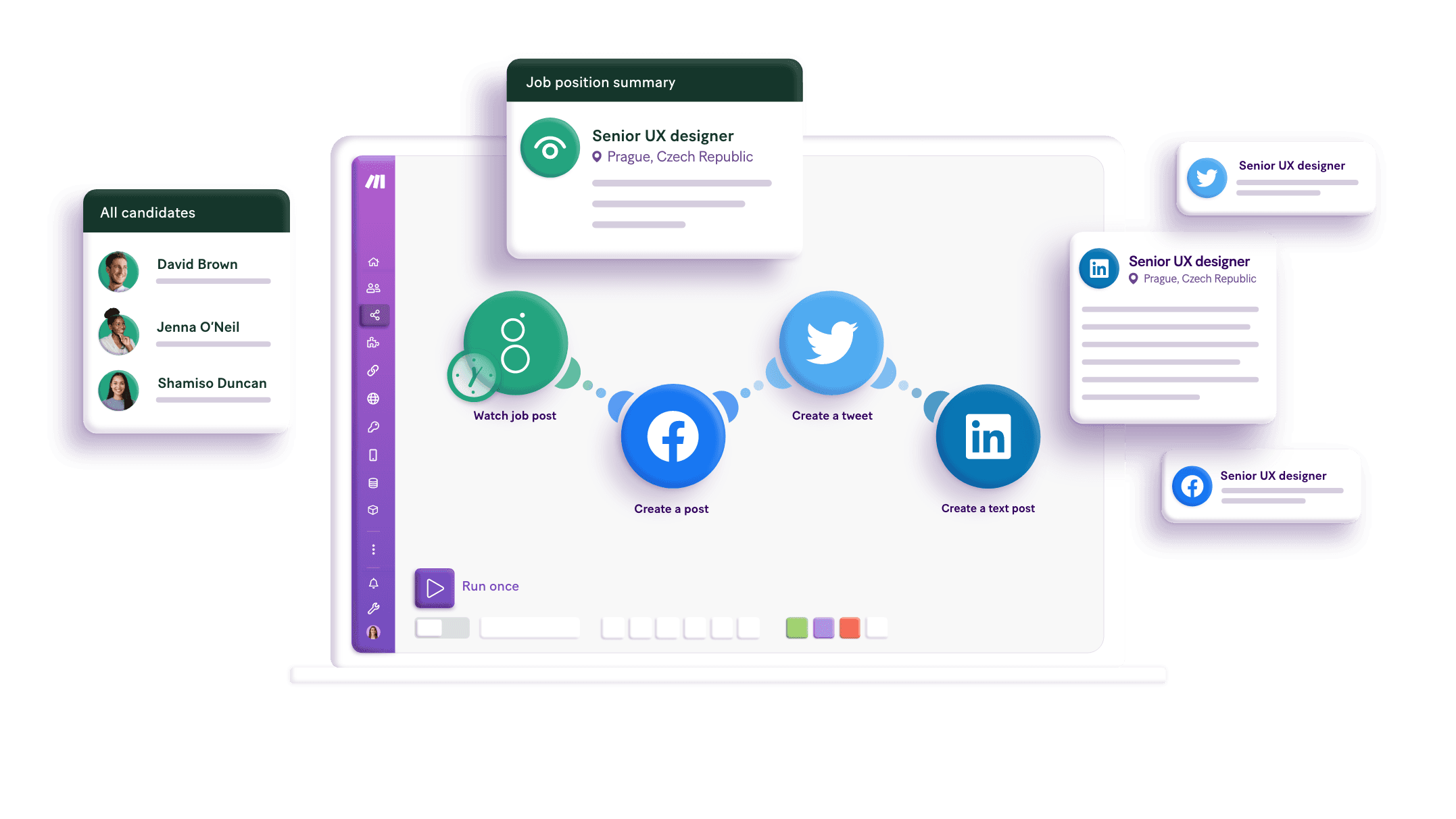
Build your Todoist and Anthropic Claude integrations.
Connect Anthropic Claude and Todoist through Make's automation platform to create workflows where Anthropic Claude functions as a trigger and Todoist as an action. When specific events occur in Anthropic Claude—such as creating a new task, updating a task, or completing a task—these triggers automatically activate Todoist to perform actions like analyzing task content, generating smart descriptions, providing intelligent recommendations, or processing information to improve your task management. Make's visual workflow builder enables you to set up these trigger-action scenarios, mapping data from Anthropic Claude triggers directly to Todoist actions for AI-powered task automation.
Closes a task. Regular task is completed and moved to history, subtask is checked (marked as done, but not moved to history), recurring task is moved forward (due date is updated).
Completes a recurring task.
Completes a task.
Creates a new prompt based on a structured list of input messages.
Creates a new Skill.
Creates a new Skill version.
Creates a comment.
Creates a filter.
Creates a label.
Popular Todoist and Anthropic Claude workflows.
Looking to get more out of Todoist and Anthropic Claude? With Make you can visually integrate Todoist and Anthropic Claude into any workflow to save time and resources — no coding required. Try any of these templates in just a few clicks.
How to setup Todoist and Anthropic Claude in 5 easy steps
Get your API key from Anthropic Claude
Log into your Anthropic Claude console and locate the key icon in the bottom-left corner to access the API keys section. Click '+ Create Key' to generate a new API key, give it a name, and immediately copy it to a safe place since you won't be able to view it again later.
Add Anthropic Claude to your Make scenario
Open your Make account and navigate to the scenario where you want to use Claude. Add an Anthropic Claude module to your workflow, which will automatically prompt you to create a connection between Make and Claude.
Connect Claude by entering your API key
When prompted in the Anthropic Claude module, click 'Create a connection' and paste the API key you copied earlier into the API Key field. You can optionally give your connection a custom name to help identify it, then click 'Save' to finalize the connection.
Connect Todoist to Make
Add a Todoist module to your scenario and click to create a connection. Make will redirect you to the Todoist website where you'll be asked to authorize access by clicking the 'Agree' button, allowing Make to read and modify your tasks and projects.
Start building your automation
With both Anthropic Claude and Todoist connected to Make, you can now create automations that use both services together. For example, you could use Claude to automatically generate task descriptions or analyze data from your Todoist projects.
AI-powered task management: Todoist meets Anthropic Claude
Supercharge your productivity by connecting Todoist with Anthropic Claude. Automatically transform complex information into organized tasks, leverage AI to prioritize your workflow, and create intelligent automation.
Automatically generate, prioritize, and organize Todoist tasks using Claude's advanced AI capabilities to process complex instructions and large amounts of project information.
Improve Todoist task details with Claude's 100K+ token context window to automatically create comprehensive task breakdowns, summaries, and action items from lengthy documents or meeting notes.
Use Claude to analyze incoming information from multiple sources and automatically create contextually relevant Todoist tasks with appropriate due dates, labels, and priorities.
Transform conversational or unstructured input into properly formatted Todoist tasks using Claude's natural language understanding to interpret complex requests and convert them into actionable items.


FAQ
By connecting Todoist with Anthropic Claude on Make, you can leverage AI to automatically categorize tasks, generate detailed project descriptions, create smart task breakdowns for complex projects, and even draft content for your to-dos. Claude's 100K+ token window means it can analyze entire project lists and provide intelligent suggestions for prioritization and organization, while Todoist captures and organizes everything.
Absolutely. Claude is designed with Constitutional AI and offers best-in-class data retention policies with no training on your data. When you integrate Todoist with Claude through Make, your task information remains secure and private. Make also employs enterprise-grade security measures, ensuring your productivity data is protected throughout the automation process.
You can create powerful automations like: automatically generating detailed task descriptions from brief notes using Claude's AI, breaking down complex projects into actionable subtasks, analyzing your completed tasks to provide productivity insights, creating smart reminders based on task context, generating meeting agendas from your Todoist projects, and even drafting responses or content for tasks that require communication. The possibilities are extensive with Make's visual automation builder.
No coding skills required! Make provides an intuitive visual interface where you can connect Todoist and Claude with drag-and-drop actions. You can set up triggers (like when a new task is created in Todoist) and actions (like asking Claude to analyze or enhance that task) through configurable modules. Make handles all the technical complexity, allowing you to focus on designing workflows that improve your productivity.
A scenario represents a workflow or a project of your own creation, and it is made up of a series of modules that automate apps and services. Creating a scenario allows you to transfer and transform data between apps and services via these modules to automate anything and improve the way you work.
Modules are the main building blocks of automation in Make. Modules represent actions that Make performs with an app, like creating, updating, or deleting data.
How it works
Traditional no-code iPaaS platforms are linear and non-intuitive. Make allows you to visually create, build, and automate without limits.
Trusted by 350,000+ customers
"Make really helped us to scale our operations, take the friction out of our processes, reduce costs, and relieved our support team. It is difficult to not become a fan."

Philipp Weidenbach
Head of Operations at Teleclinic
"Make drives unprecedented efficiency within our business in ways we never imagined. It’s having an extra employee (or 10) for a fraction of the cost."

Cayden Phipps
COO at Shop Accelerator Martech
"The simplicity, flexibility and ability to build real complex automations without any knowledge of programming makes it the best thing since sliced bread."

Erkki Markus
Product Owner at Smaily
"True citizen development in the entire company. Make is present in every department, empowering the company to offer a unique customer experience."

Andreas Stryz
CTO & Co-founder at FINN
"I can't count the number of hours I've saved by using Make. Every single day is simpler because of Make's automation."

Kimberly D
Owner of Media Production