Agentic commerce: what it is and how to prepare
A practical look at the protocols that complete the transaction and the inventory, fraud, and fulfillment systems that still have to keep up.
An AI agent can now find a product, compare it, and complete the purchase without a person clicking buy. That shift, called agentic commerce, already runs through open checkout protocols on several platforms.
Those protocols stop the moment payment clears, leaving fulfillment, fraud checks, and refunds to your existing systems.
This article covers what agentic commerce is, how those protocols work, and what your back office needs to be ready.
Key takeaways
- Agentic commerce is online commerce in which an AI agent researches, compares, and completes a purchase on a customer's or business's behalf, usually within limits the person sets in advance.
- Three open protocols, the Agentic Commerce Protocol (ACP) from OpenAI and Stripe, the Universal Commerce Protocol (UCP) from Google, and the Agent Payments Protocol (AP2) also from Google, standardize how an agent completes a transaction, but none of them cover what happens after the order is placed.
- As of October 2026, only 36% of measured US storefronts were technically configured to complete an agent-led purchase from product discovery through payment, according to InMobi.
- An order an agent completes still has to move through the same inventory, order routing, fraud, and refund systems as any other order, and most of those systems weren't built with agent behavior in mind.
- The Make "MCP server" lets an AI agent call a company's own Make scenarios as tools, so an agent can trigger an inventory check, route an order, run a fraud check, or start a refund directly.
What is agentic commerce?
Agentic commerce is online commerce in which an AI agent researches, compares, and completes a purchase for a person or a business. An AI agent is a program that uses AI to decide on and carry out a multi-step task toward a goal.
The agent usually works inside limits the person sets beforehand, such as a budget, a brand preference, or a delivery window.
That's different from a chatbot that only makes a recommendation.
In agentic commerce, the agent carries the transaction through to completion rather than handing the decision back to a person at checkout.
The clearest way to see the difference is to compare how each one actually runs.
- Traditional ecommerce: a person searches, compares products, and clicks through checkout themselves, one step at a time.
- Agentic commerce: a person states a goal once, and an AI agent handles the search, comparison, and purchase within the limits set in advance, then reports back.
A person might ask an agent for waterproof hiking boots under $150, deliverable by Friday.
The agent checks several retailers' product data, applies the budget and delivery constraints, and completes the purchase, a process a person would otherwise do by hand across several browser tabs.
This kind of multi-step, AI-driven decision making also shows up in workplace automation. Make AI Agents use the same approach to handle tasks whose outcome isn't fixed in advance, adjusting their actions as conditions change.
What are the benefits of agentic commerce?
The opportunity behind agentic commerce is large enough that most retailers and business-to-business (B2B) sellers can't treat it as optional.
A McKinsey report published in October 2025 estimates agentic commerce could orchestrate up to $1 trillion in US business-to-consumer (B2C) retail revenue by 2030.
Globally, it puts the figure at $3 trillion to $5 trillion.
That revenue only reaches businesses whose systems can actually support an agent-led transaction from start to finish, which is exactly what the rest of this article covers.
- Speed: an agent completes in one pass what a person might otherwise do across several separate visits.
- Availability: a purchase can happen whenever the agent is asked, without waiting for a person to be online.
- Personalization: the agent can factor in a buyer's past preferences automatically, rather than relying on the buyer to re-specify them each time.
- Lower friction on repeat purchases: routine or recurring orders need less manual input from the buyer.
How does agentic commerce work?
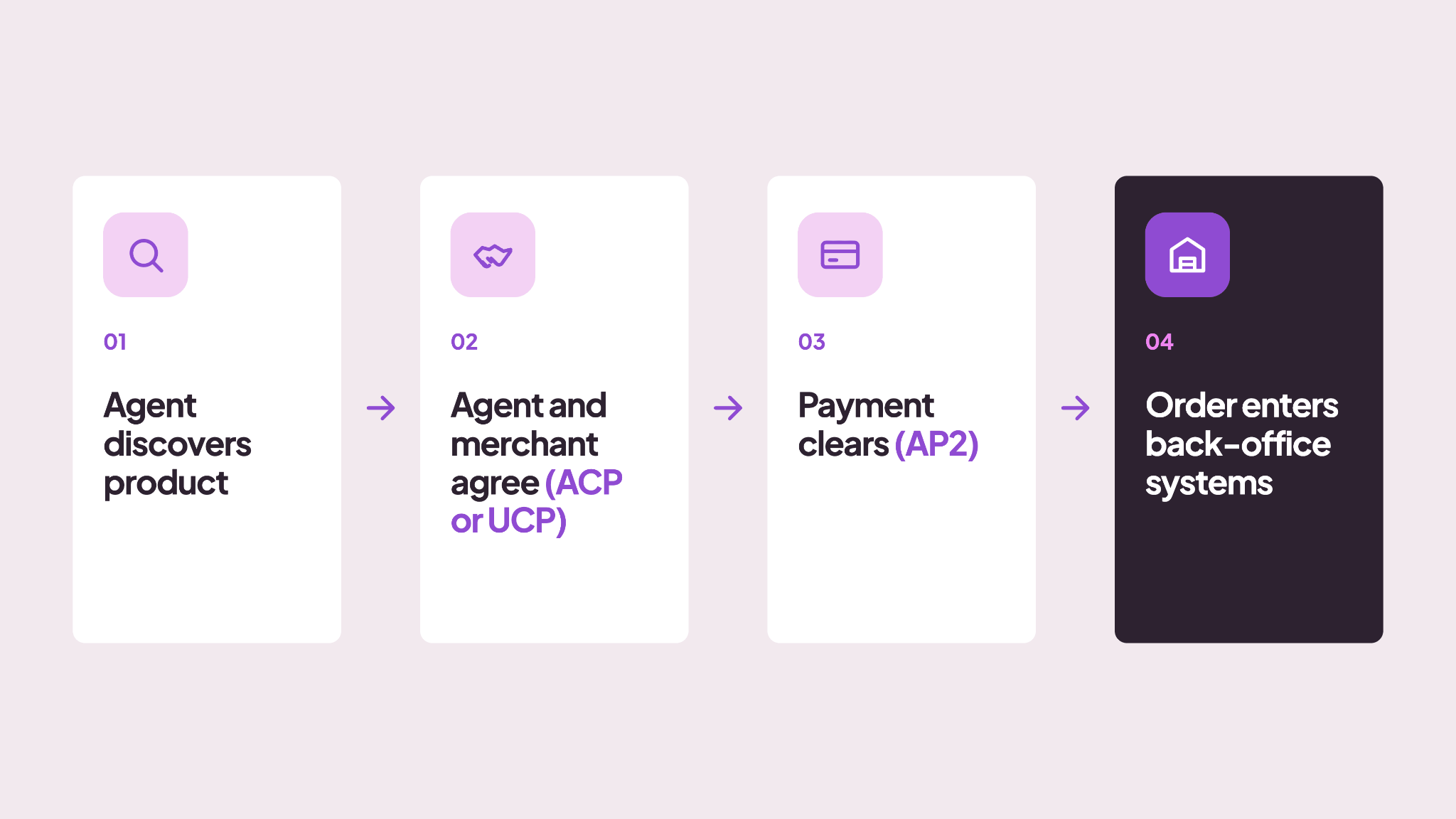
An agent-completed purchase moves through three stages before it ever reaches a business's back office: discovery, agreement, and payment.
The agent discovers and evaluates products
An agent reads a merchant's product data directly instead of scraping a web page built for a person to read.
- Structured listings: prices, availability, and specifications published in a machine-readable format the agent can parse without guessing.
- Live data: listings that update as stock and pricing change, so the agent isn't working from a stale snapshot.
The agent and merchant agree on a transaction
Once an agent has a product in mind, it still needs a standard way to tell the merchant what it wants to buy and get the merchant's confirmation back.
Two open standards currently handle this step, and they compete with each other rather than working together.
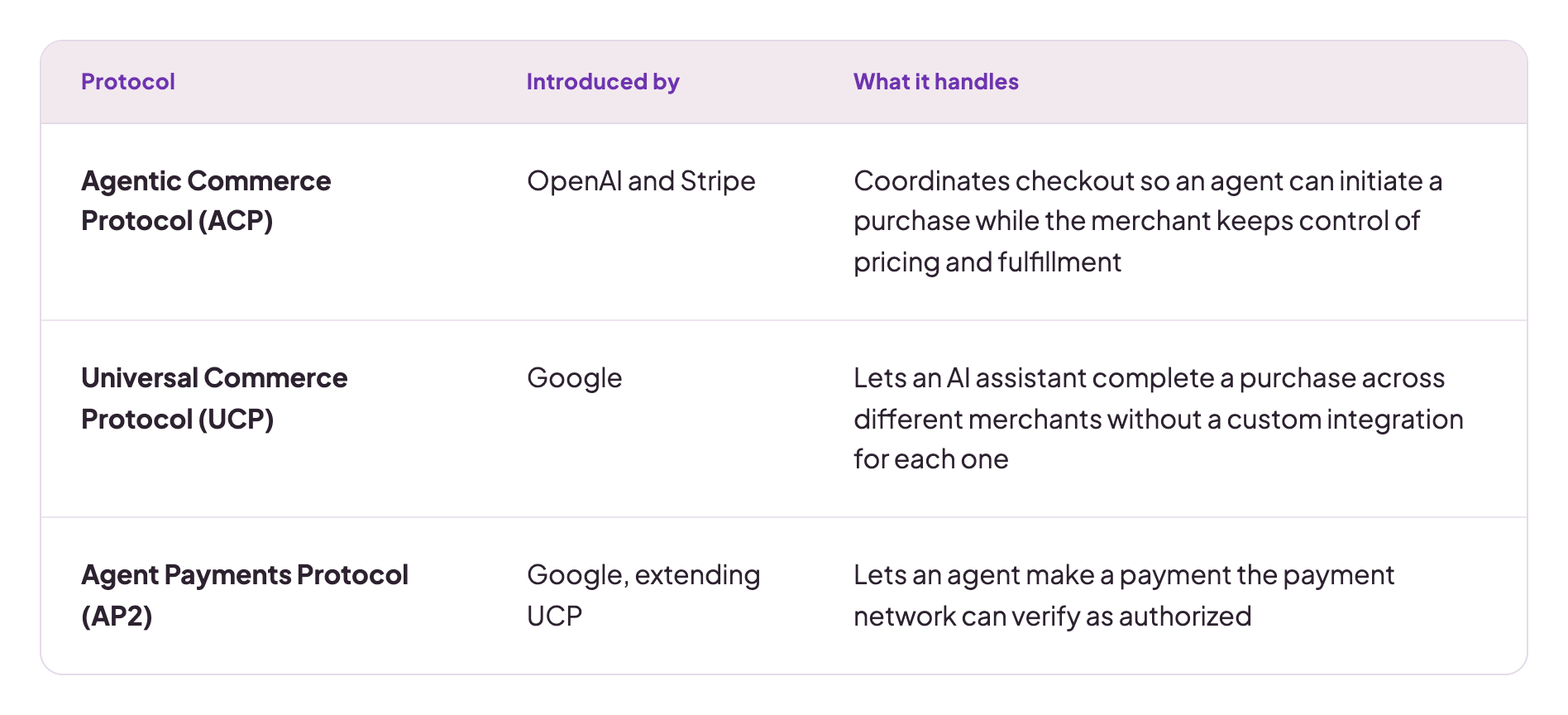
The Agentic Commerce Protocol (ACP) is an open standard from OpenAI and Stripe that coordinates checkout so an agent can initiate a purchase. The merchant keeps control over pricing, product selection, and fulfillment throughout.
The Universal Commerce Protocol (UCP) is an open standard Google introduced in January 2026. It lets an AI assistant complete a purchase across different merchants without a custom integration built for each one.
Payment moves through an agent-ready rail
A completed agreement still has to turn into an authorized payment, and standard card networks assume a person is the one approving the charge.
The Agent Payments Protocol (AP2) is an open protocol from Google that extends UCP.
- What it verifies: that the agent making the payment is actually authorized by the person or business who holds the account.
- Who's standardizing it: Google has donated the protocol's standardization work to the FIDO Alliance (Fast Identity Online), an industry group that develops authentication standards.
The purchase moves into the merchant's existing systems
Once ACP, UCP, or AP2 clears the payment, the order becomes a normal order.
It still has to be checked for fraud, routed to a warehouse or vendor, logged in inventory, and made refundable like any other purchase.
That's the part these protocols don't touch.
This is where the Model Context Protocol (MCP), an open standard introduced by Anthropic, becomes useful.
MCP gives an AI agent structured, machine-readable access to a specific set of tools and data, instead of guessing from a web page or simulating clicks.
Make's MCP server is Make's own version of this idea. It lets an AI agent call a company's own automated workflows directly, a mechanism covered in detail in the How Make helps section below.
The table below compares the three protocols by who introduced them and which part of the transaction each one handles:
What can go wrong in the back office when an agent completes the purchase?
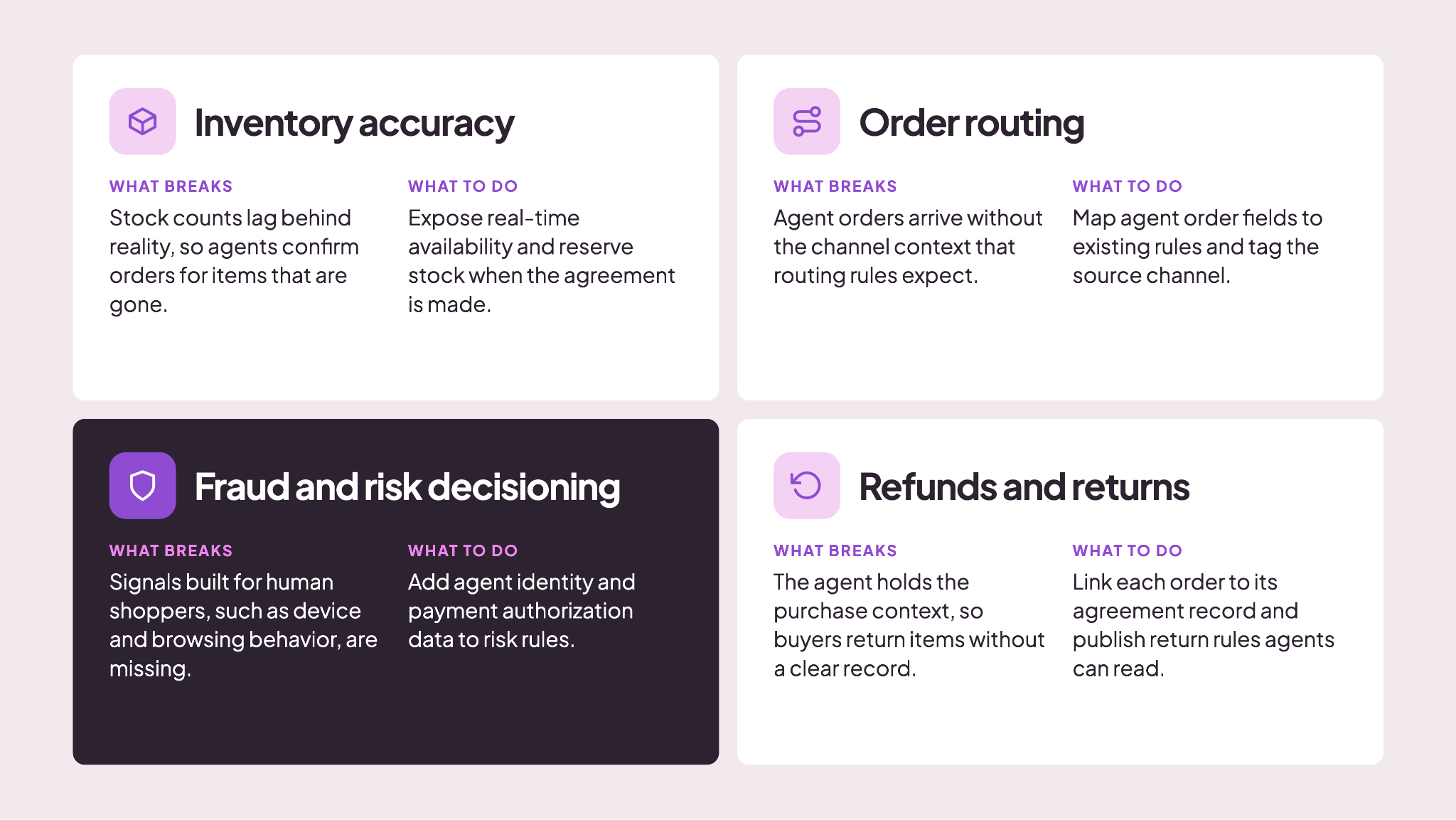
Four back-office functions have to keep up with an agent-completed order the same way they would with any other order, and most companies' systems weren't built for agent behavior.
As of October 2026, only 36% of measured US storefronts were technically configured to complete an agent-led purchase from product discovery through payment. That's according to InMobi research covering 3 million US digital merchants.
Separately, an IBM NRF study published in January 2026 found that 54% of surveyed brand executives report persistent challenges across their channels and systems.
The four functions below are where that readiness gap actually shows up.
Inventory accuracy
An agent checks stock and commits to a delivery window in the same request.
- What breaks: stock data that became outdated, even if only a few hours ago, turns into a promise the business can't keep.
- The fix: a real-time sync between the storefront and the fulfillment system, so the number an agent sees always matches what's on the shelf.
Make's inventory automation use case covers exactly this, syncing stock levels and triggering purchase orders automatically.
Order routing
An agent-completed order still needs to reach the right warehouse, vendor, or fulfillment partner.
- What breaks: routing rules were built for a steady flow of orders that people place during the day. Agents can send many orders at once, at any hour, so orders pile up or go to the wrong warehouse.
- The fix: let routing run automatically the moment an order arrives, and log where each order went and why. Your team can then check the log afterward instead of approving every order by hand.
Fraud and risk decisioning
Fraud decisioning, the rules and checks a business uses to decide whether a transaction is legitimate before it ships, was built around how a person behaves at checkout.
- What breaks: an agent can complete a purchase in seconds, from a device or network the business has never seen tied to that customer, which standard rules often flag as risky.
- The fix: extend fraud rules so they recognize a legitimate agent making an authorized purchase, instead of treating every agent-initiated order as a bot trying to abuse the checkout.
Refunds and returns
The agent completed the purchase but it won’t be dealing with refunds and returns if an order doesn't fit or arrives damaged.
- What breaks: a return process built around a human filling out the original order form can break when the order came from an agent, since the same fields and references may not line up.
- The fix: a return and refund flow the person on the other end can trigger directly, without needing the agent's involvement to resolve it.
Make's customer service automation guide walks through this kind of flow, including routing a return or refund request automatically and a pattern for flagging suspicious claims before approving them.
Agentic commerce examples
These four examples show agents completing real orders, changes, and bookings. For each one, you can see what sets the agent off and what your systems have to do in response.
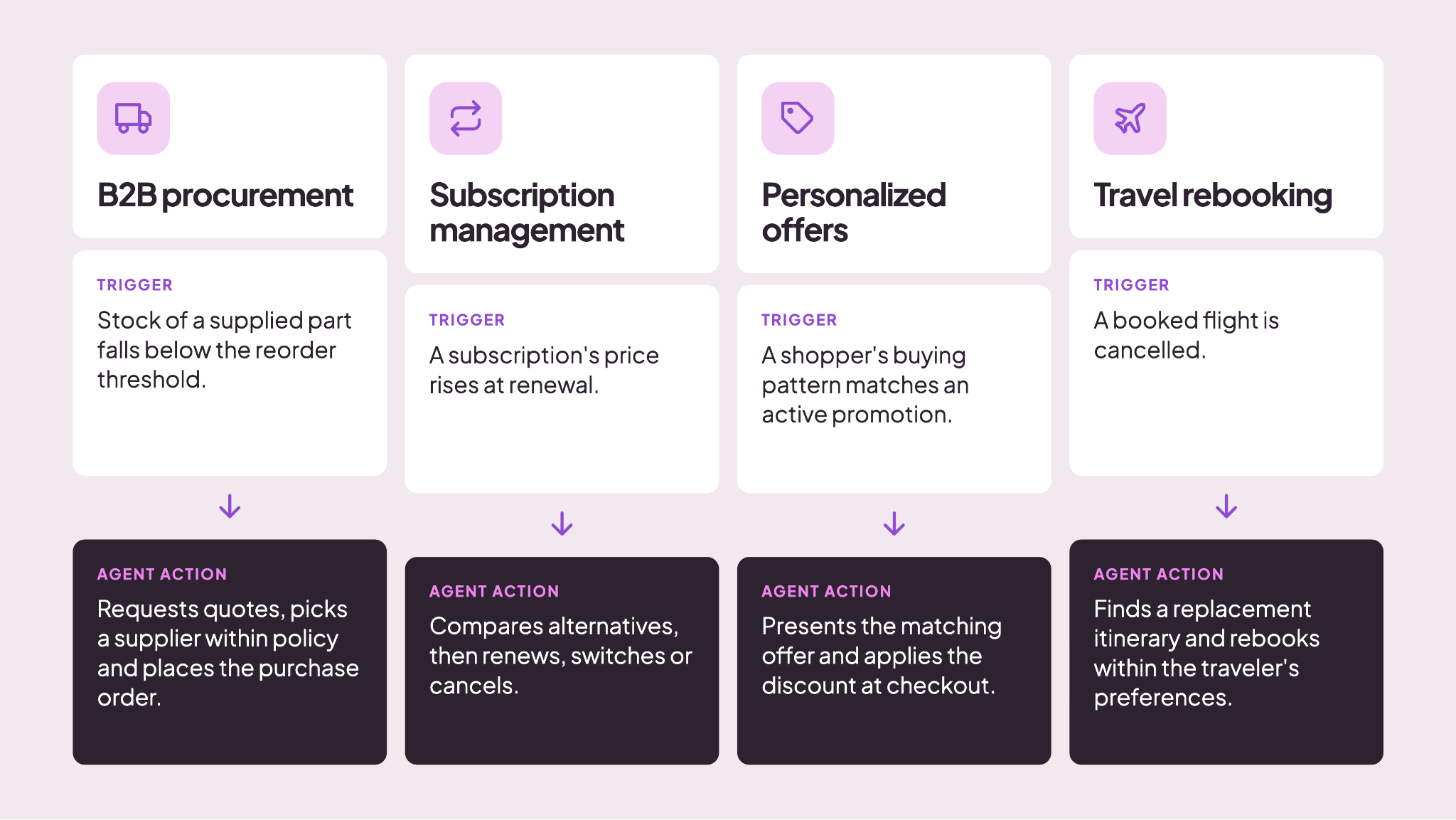
B2B procurement reordering agent
- Trigger: stock of a component drops below a set threshold.
- Agent action: reorders the component from a pre-approved list of vendors, staying inside a fixed budget, then notifies the account owner after the fact instead of asking for step-by-step approval.
Customer service voice agent
- Trigger: a customer calls a dealership to ask where their car is in the workshop queue.
- Agent action: identifies the caller and their vehicle from the phone number, then tells them where the car sits in the workshop queue, without a person picking up.
Make’s customers have built agents like this. Stellantis &You UK’s Make-powered AI voice agent handles about 20,000 calls a month and saves about £200,000 a year on customer support.
Inventory-aware personalized offer agent
- Trigger: a shopper asks an agent to buy a camping kit for a weekend trip, within a set budget.
- Agent action: builds the bundle only from items the retailer has in stock, then completes the purchase, instead of recommending products that might be backordered.
A scenario built on Make's Shopify integration can keep that stock picture current by syncing inventory levels the moment an order comes in.
Agent-initiated travel rebooking
- Trigger: a booked flight gets canceled.
- Agent action: rebooks the best option that fits a preset budget and schedule window. If the only options cost more or add a longer layover, it doesn’t book and asks the traveler to confirm first.
How does Make help with agentic commerce?
Every example above needs your systems to act the moment an agent sends a request.
That's what the Make MCP server is built for.
The Make MCP server exposes a company's own active scenarios as callable tools.
That means an AI agent can trigger a real scenario: check inventory, route an order, run a fraud check, start a refund, and get a structured result back.
In practice, that means scenario patterns like these:
- An inventory-check tool an agent calls before confirming a delivery date.
- An order-routing scenario that triggers the moment payment clears.
- A fraud-check scenario that flags a transaction for human review instead of approving it automatically.
- A refund scenario a support agent or an AI agent can trigger without re-entering the order's details.
None of this requires a dedicated engineering team to build.
Make's Scenario Builder lays out each step visually, and Maia by Make, Make's conversational AI coworker, can build or adjust a scenario from a plain-language request.
A business that already runs its back office on an automation platform has a head start, since the same scenarios handle both regular operations and agent requests.
Make's operations automation solutions page covers how operations teams already use this kind of setup, including AI agents that check stock or create orders through chat.
None of this replaces ACP, UCP, or AP2.
It's what runs the moment those protocols hand off a completed transaction, the part a checkout standard was never built to cover.
What will your back office do with the next agent-completed order?
The protocols behind agentic commerce solve the transaction; they don't solve what happens after it.
Start by naming which of the four back-office functions, inventory, order routing, fraud decisioning, or refunds, would break first under an agent-driven order.
Then build the Make scenario for that one.
If you're still mapping where this fits into your broader AI plans, the Make AI Playbook lays out a next step for whatever stage of AI adoption your team is at.
Frequently asked questions
Q1: What's the difference between agentic commerce and traditional ecommerce?
In traditional ecommerce, a person searches, compares, and purchases themselves, one step at a time. In agentic commerce, an AI agent completes those steps on the person's behalf, inside limits set in advance.
Q2: What is the Agentic Commerce Protocol (ACP)?
The Agentic Commerce Protocol (ACP) is an open standard from OpenAI and Stripe that coordinates checkout so an AI agent can initiate a purchase. The merchant keeps control of pricing and fulfillment throughout.
Q3: Is agentic commerce safe for businesses to accept?
Safety depends less on the checkout protocol and more on a business's own fraud and verification systems. Those systems need to recognize legitimate AI agent traffic, instead of treating every agent order as suspicious.
Q4: How can a business get its back office ready for agentic commerce?
Four functions need attention: inventory data that stays current in real time, order routing built for agent-driven volume, fraud rules that recognize legitimate agents, and a refund process that works also when the original buyer isn’t human.
Q5: What is the Model Context Protocol (MCP) and how does it relate to agentic commerce?
The Model Context Protocol (MCP) is an open standard introduced by Anthropic that gives an AI agent structured access to a specific set of tools. That's what lets an agent call a business's own systems, like Make's MCP server, directly after a purchase completes.
Related blogs
Tool and strategies modern teams need to help their companies grow.
AI
RPA vs. agentic AI: What's the difference and which should you use?
Your RPA bots break when interfaces change. Learn when to use RPA vs agentic AI, how it earns its place, and how to build a hybrid automation program with Make that handles both

Raife Dowley
April 20, 2026
AI
AI Adoption: What It Means and Why It Matters
AI adoption means moving artificial intelligence from isolated pilots into everyday operational use across every team, workflow, and business decision.
Raife Dowley
July 20, 2026
AI
7 AI automation examples you can build in Make (2026)
Seven real AI automation examples, each paired with a Make scenario template so you can clone the exact module chain instantly.
Raife Dowley
September 24, 2026