AI voice agents: how they work and 7 top platforms for 2026
Most voice agents can hold a conversation; fewer can update your CRM mid-call. See which platforms fit and where Make handles the actions.
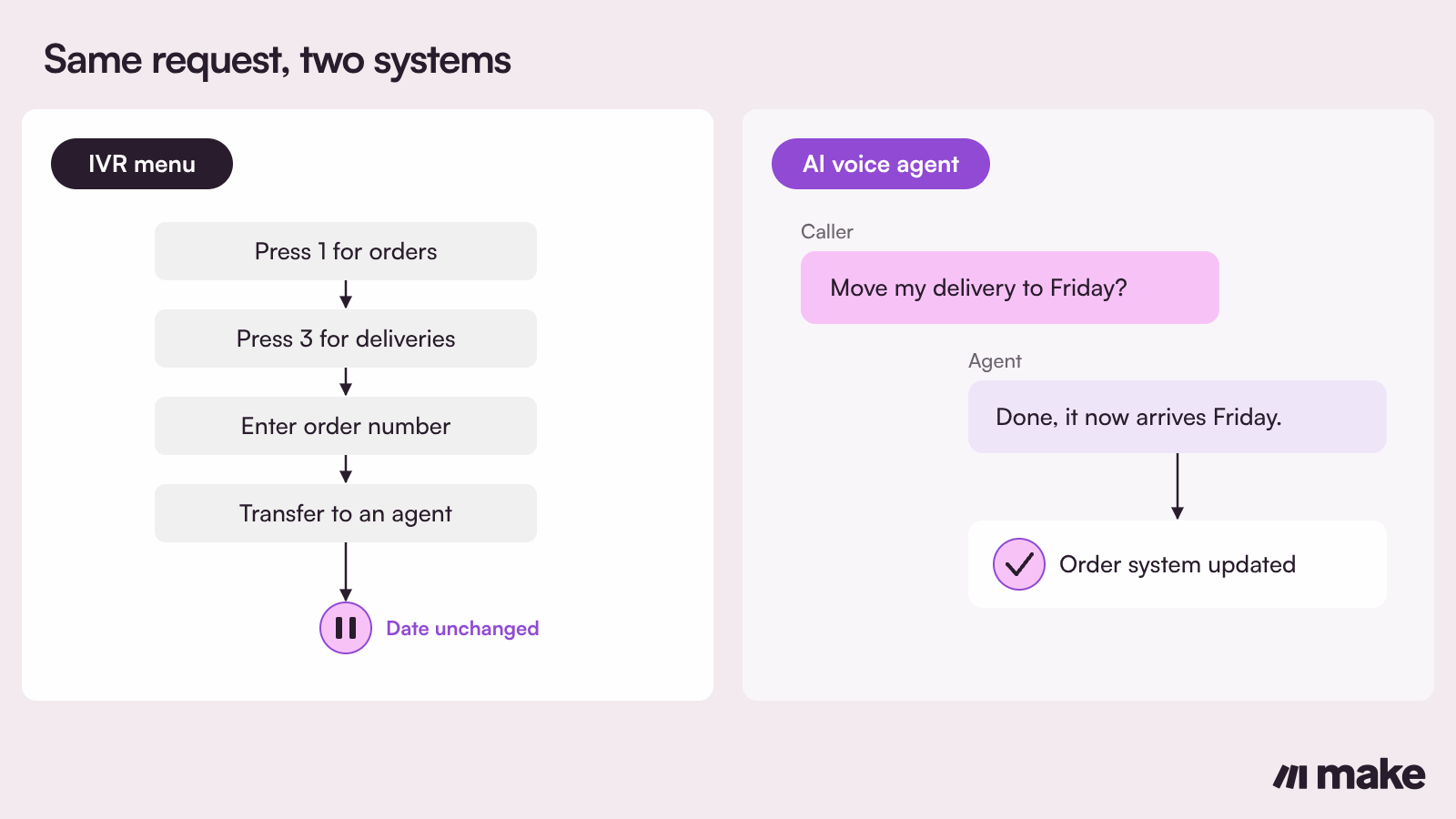
A customer calls to move a delivery date to Friday. If the AI voice agent on the line can only talk, someone still has to change the date in the order system by hand.
This guide explains how AI voice agents act during a call, compares seven platforms, and shows where Make connects each platform to your business systems.
Key takeaways
- An AI voice agent is software that holds a real-time phone conversation and completes tasks by reading and writing data in connected business systems.
- Every AI voice agent combines speech recognition, a large language model, text-to-speech, and a turn-taking model that decides when each side speaks.
- This guide compares seven platforms that handle live calls, call business systems during a call, and publish their pricing model.
- As of Nov 2026, voice agent pricing ranges from 2 cents per minute for a model-only API to annual enterprise contracts.
- A voice agent that updates several business systems needs automation to carry out those updates, such as Make scenarios that the voice platform calls as tools.
What are AI voice agents?
AI voice agents are software programs that hold real-time spoken conversations, usually over a phone line, and complete tasks during the call. Each agent completes those tasks by reading and writing data in connected business systems, such as a CRM or a calendar.
An interactive voice response (IVR) system, by contrast, plays a fixed menu and asks the caller to press a number. A voice agent understands open-ended speech, works out what the caller needs, and acts on it.
Make's chatbot comparison guide makes the same distinction for text channels: a chatbot answers questions, while an AI agent completes tasks across connected systems.
Teams give voice agents calls that follow a repeatable pattern, including:
- Inbound support: answering order, billing, and account questions, then passing complex calls to a person with the context attached.
- Scheduling: booking, moving, or canceling appointments against live calendar availability.
- Lead qualification: asking the screening questions a sales development representative (SDR) would ask, a task Make's AI SDR guide covers for email.
- Reminders and after-hours calls: confirming appointments or deliveries, and answering calls that would otherwise reach voicemail.
Klarna uses a voice agent built on ElevenLabs as the first point of contact for phone support across all 35 million of its US customers. According to the Klarna case study, customers whose queries the agent handles get resolutions up to 10x faster.
Faster resolutions like Klarna's depend on four components that run every time the caller speaks.
How do AI voice agents work?
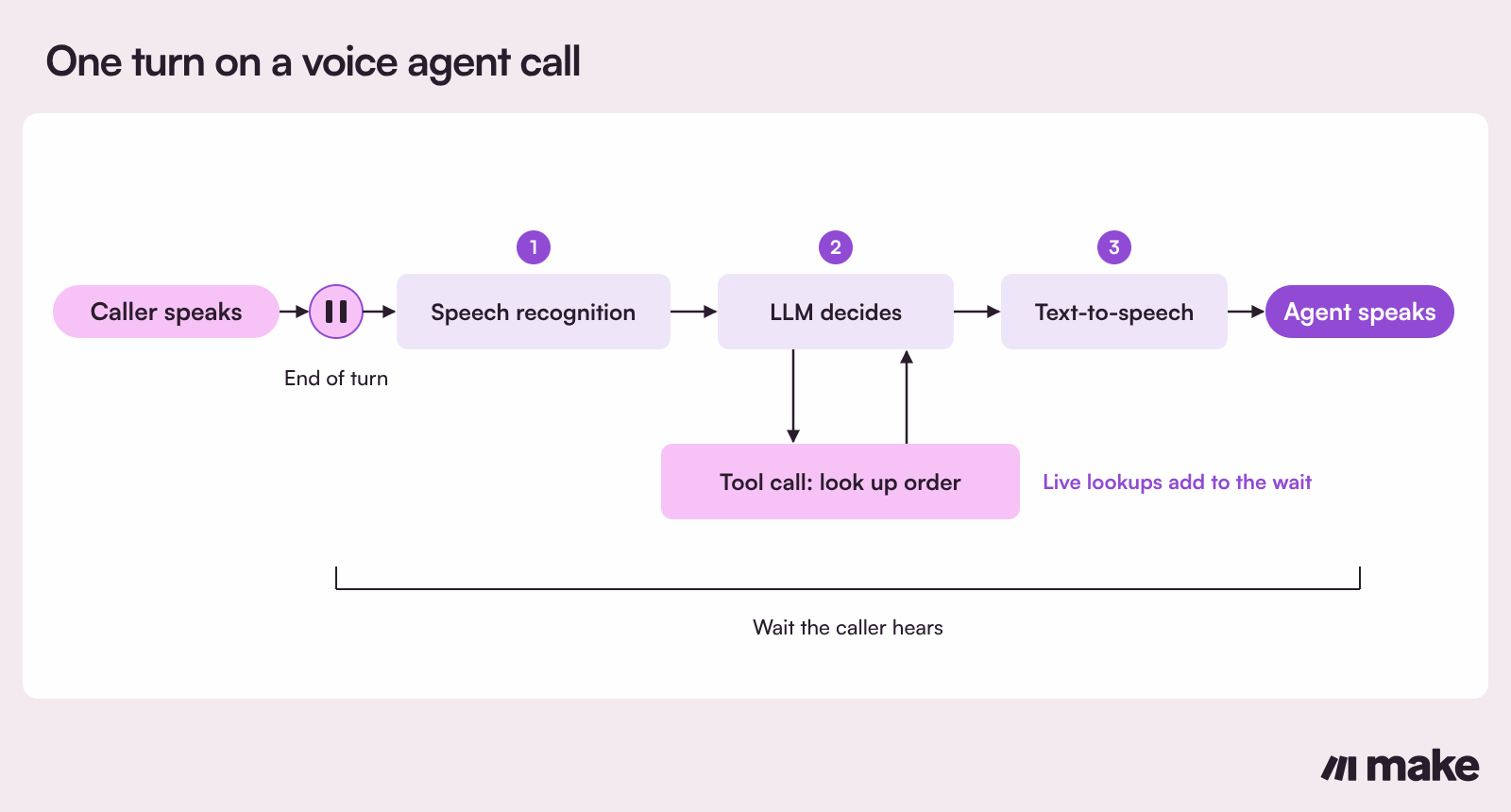
Each time the caller stops speaking, an AI voice agent runs four components in order, fast enough that the reply sounds like normal conversation.
Speech recognition turns audio into text
Automatic speech recognition (ASR), also called speech-to-text, converts the caller's audio into text. Accuracy drops on strong accents, noisy lines, product names, and strings of digits such as order numbers.
Test recognition on recordings of your own calls before you choose a platform, since a misheard order number can send the next lookup to the wrong record.
The language model decides and calls tools
A large language model (LLM) reads the transcript, works out what the caller wants, and chooses the next action. When the answer depends on live data, the LLM calls a tool, such as an API request that looks up the caller's order.
This cycle of reading, deciding, and calling tools is an agentic loop, and Make's agentic loop guide breaks it into four stages: perceive, reason, act, and observe.
Text-to-speech speaks the reply
Text-to-speech (TTS) turns the LLM's written reply into audio in a chosen voice and language. Platforms differ on voice quality, language coverage, and the cost per minute of speech.
Turn-taking manages timing
A turn-taking model decides when the caller has finished and when the agent should stop talking. It handles three timing problems:
- End of turn: telling a finished sentence apart from a pause in the middle of one.
- Interruptions: stopping the agent when the caller talks over it, a behavior called barge-in.
- Latency: keeping the gap between the caller's last word and the agent's reply short enough to sound natural.
Some platforms combine speech recognition, reasoning, and speech output in one speech-to-speech model. OpenAI's voice agents guide compares that design with a chained pipeline, where you can inspect and replace each stage separately.
Platforms package these four components differently, so the checks in the next section focus on how each one handles live calls and business data.
How we chose these AI voice agent platforms
We looked for platforms that run all four components on live calls and can act on business data. Each one passed three checks against its own documentation and pricing pages as of Nov 2026:
- It handles live phone calls.
- It can call your APIs or business systems during a call.
- It publishes its main features and its pricing model.
Together, the seven cover three ways to buy: developer platforms (Retell AI, Vapi, and Bland AI), a voice-first platform (ElevenLabs Agents), and managed enterprise vendors (Synthflow, PolyAI, and Sierra).
Voice is one of several channels where companies run agents. For agents that work beyond the phone, Make's review of AI agent platforms ranks general-purpose builders.
What are the best AI voice agents?
The seven platforms below range from developer tools you configure yourself to managed vendors that build the agent with you. All prices are as of Nov 2026.
1. ElevenLabs Agents
ElevenLabs Agents, also called ElevenAgents, comes from ElevenLabs, a company known for its speech synthesis models. It pairs a fine-tuned speech recognition model with your choice of LLM, low-latency TTS, and its own turn-taking model.
- Voices and languages: 10,000+ voices across 70+ languages.
- Deployment: phone calls through Twilio or SIP trunking (a standard for connecting to existing phone systems), plus web and mobile apps.
- Make app: the ElevenLabs integration has a Watch Tool Call Request trigger that runs a Make scenario mid-call.
Best for: teams where voice quality and language coverage decide the purchase.
Pricing: a Free plan and paid plans from $6 a month, on credits shared across ElevenLabs products. Enterprise adds business associate agreements (BAAs) under the Health Insurance Portability and Accountability Act (HIPAA).
2. Retell AI
Retell AI is a voice agent platform for developer teams, with a self-serve builder, an API, and agent templates. You choose the LLM and voice provider, including OpenAI, Anthropic, Google, and ElevenLabs models.
- Mid-call actions: custom functions call your own API during a live call, for example to look up an order.
- Security: SOC 2 certification (an independent security audit), HIPAA readiness, and single sign-on (SSO) on Enterprise.
- Make app: Retell maintains the Retell AI integration, which places calls with Create a Phone Call and retrieves call details with Get a Call.
Best for: developer teams that want usage-based pricing and a fast pilot.
Pricing: $0.07 to $0.31 a minute on pay-as-you-go, with $10 in free credits and 20 concurrent calls included. Enterprise pricing is custom.
3. Vapi
Vapi is a developer platform that lets you choose each voice agent component from dozens of providers. Assistants run on one system prompt plus tools, while Squads pass a call between specialized assistants.
- Response time: under 600 milliseconds, according to Vapi's documentation.
- Production tools: versioned publishing, simulated test calls, and call monitoring with alerts.
- Make app: Make maintains the Vapi integration, including Watch End of Call Report and Create an Outbound Phone Call modules.
Best for: engineering teams that want to swap speech, model, and voice providers independently.
Pricing: $0.05 a minute for Vapi hosting, with model and speech costs passed through at cost. The Pro package starts at $999 a month, and HIPAA compliance is a $2,000 monthly add-on.
4. Bland AI
Bland AI charges one per-minute rate that covers the LLM, speech-to-text, and TTS, with no separate token charges. Telephony is billed separately, on your own carrier or on Bland's at cost.
- Mid-call tools: custom tools call any web API during a call, for example to update a CRM or book an appointment.
- Enterprise hosting: on-premises or virtual private cloud (VPC) deployment, BAAs, SSO, and data residency.
- Rollout: a 28-day enterprise deployment framework, run with Bland engineers who work directly with your team.
Best for: teams that want one per-minute rate to forecast costs at high call volumes.
Pricing: $0.14 a minute on the Start plan, or $0.12 a minute plus a $299 monthly platform fee on Build. Enterprise pricing is custom.
5. Synthflow
Synthflow sells voice agents to mid-market and enterprise teams under one annual contract covering telephony, integrations, security review, and launch support. Teams build agents in a visual flow builder or through APIs.
- Integrations: native connections to Salesforce, HubSpot, and Zapier, plus webhooks and APIs.
- Telephony: Synthflow's own phone network, SIP trunking, or approved enterprise telephony.
- Launch support: Synthflow engineers build, test, and launch agents with your team when the contract includes it.
Best for: teams that want the vendor to scope and launch the deployment with them.
Pricing: an annual enterprise agreement scoped to expected call volume, with no free plan, trial, or per-minute rate.
6. PolyAI
PolyAI builds enterprise voice agents on its own dialog models. Its flagship, Dialog-RSN-1, reasons over raw call audio to handle turn-taking, recognition, and the response in one model, then speaks through the TTS you choose.
- Speed: under 300 milliseconds to the model's first output and under one second per full turn, according to PolyAI.
- Business systems: transactions run as calls to your own APIs, so your systems keep the final record.
- Compliance: SOC 2 Type 2, HIPAA with a BAA, and the Payment Card Industry Data Security Standard (PCI DSS).
Best for: large service teams handling complex or regulated calls, such as identity checks and payments. Teams running voice and chat support side by side can compare chat-first options in Make's roundup of customer support agents.
Pricing: the Dialog-RSN-1 API costs 2 cents per connected minute plus text tokens, without telephony or orchestration. The full platform is sold separately.
7. Sierra
Sierra is a conversational AI platform for customer experience teams, with voice agents for inbound and outbound calls. Its Ghostwriter tool builds an agent from uploaded procedures, transcripts, and recordings, or from a goal written in plain English.
- Languages: 55+ languages, with switching mid-conversation.
- Voice payments: card and bank payments collected during the call through Level 1 PCI-compliant infrastructure.
- Escalation: hands calls to human agents with the full context and history.
Best for: customer experience teams that want a vendor-built agent across voice and digital channels.
Pricing: custom contracts with outcome-based pricing, where you pay when the agent completes an agreed outcome, such as a resolved conversation.
AI voice agent platforms at a glance
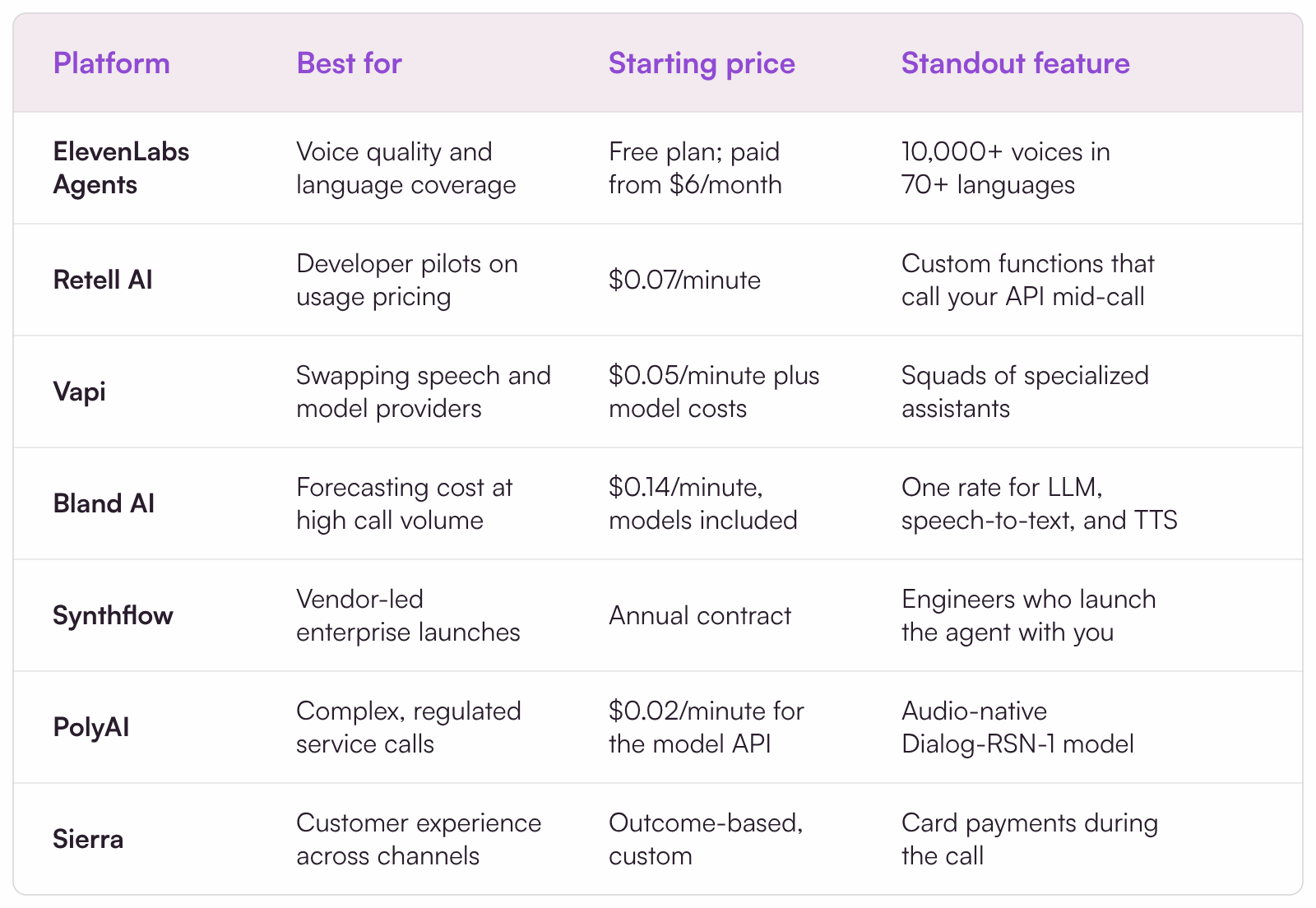
The table below compares the seven platforms by best fit, starting price as of Nov 2026, and standout feature.
Whichever platform you choose, call transcripts and customer data will move into other systems, so check who can access them at each step.
Make's governance features add audit logs and custom roles on the Enterprise plan for the scenarios that handle that data.
How Make fits alongside AI voice agents
For teams whose voice agent only answers questions from a knowledge base, the tools built into these platforms are a solid baseline. For teams whose calls have to change records in a CRM, a calendar, and a helpdesk, Make runs those changes as scenarios.
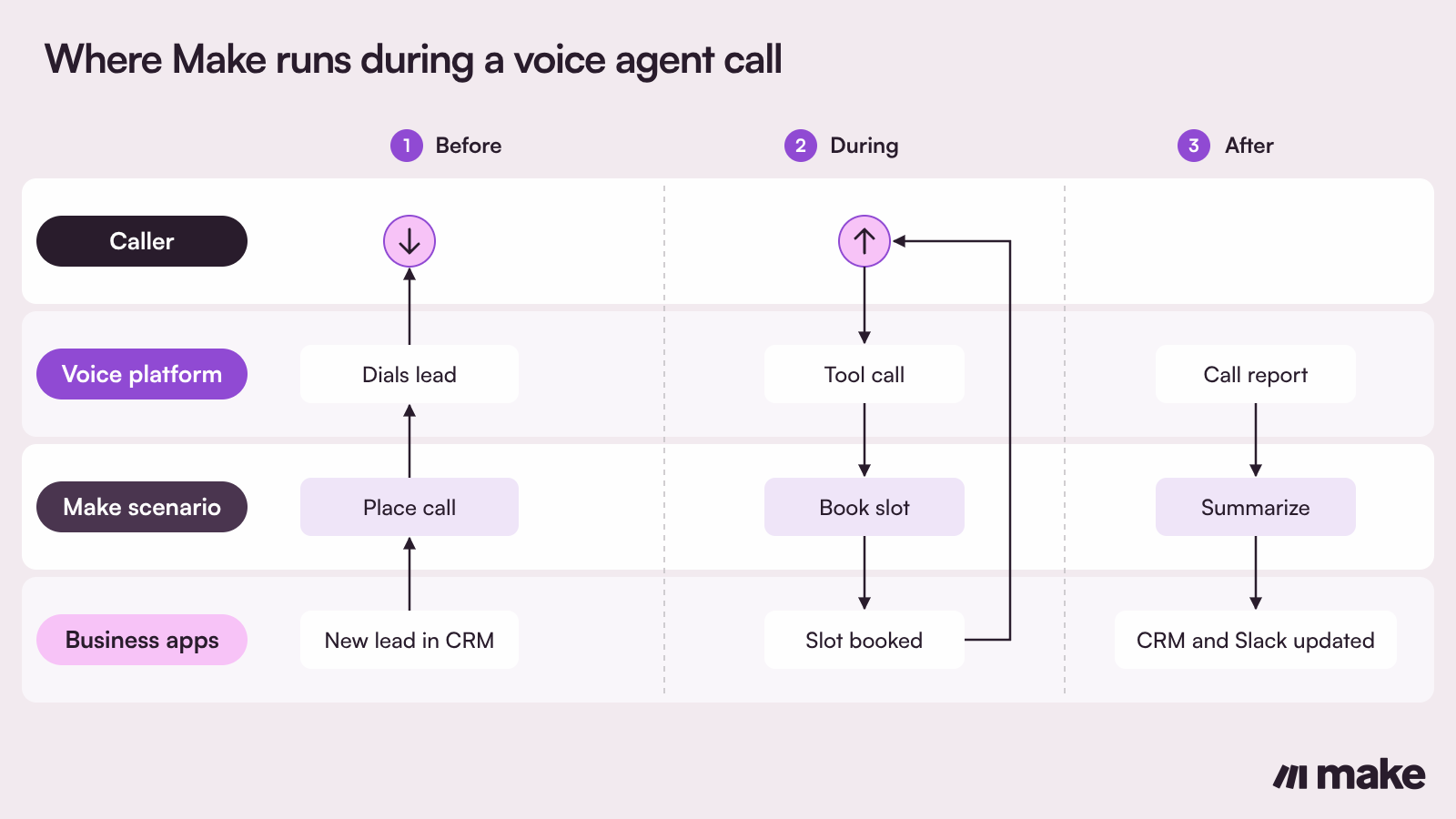
Make connects to a voice agent at three points around a call:
- Before the call: a CRM event, such as a new lead, triggers the Retell AI > Create a Phone Call module so the agent calls the lead.
- During the call: the voice platform runs a Make scenario through a Vapi > Watch Tool Call Request module or the matching ElevenLabs trigger. The scenario checks an order or books a slot, then returns the answer to the agent.
- After the call: The Vapi > Watch End of Call Report module sends the transcript to a scenario that updates the CRM and posts a summary in Slack.
Make's Retell AI walkthrough builds the after-call pattern step by step, from fetching completed calls to alerting the team in Slack.
Two more Make features build on the same scenarios:
- MCP Server: The Make MCP Server turns scenarios into tools for any agent that supports the Model Context Protocol (MCP), an open standard for connecting AI to tools.
- AI Agents: Make AI Agents can classify a transcript and choose the next step, showing each decision in the Reasoning panel with manual approvals before sensitive updates.
Which AI voice agent will you connect to your stack first?
Choose an AI voice agent by how well it reaches the systems your calls depend on, as well as by how it sounds. Start with one call type, such as appointment rescheduling, on a platform above that offers a free tier or free credits.
Then open the Scenario Builder and connect that agent's tool calls to a Make scenario.
You can also describe the after-call scenario you need to Maia by Make, Make's AI coworker, and review each step she builds.
Frequently asked questions
Q1: What are the best AI voice agents?
As of Nov 2026, leading AI voice agent platforms include ElevenLabs Agents, Retell AI, Vapi, Bland AI, Synthflow, PolyAI, and Sierra. The best choice depends on your call volume, compliance needs, and the business systems the agent must update.
Q2: How much do AI voice agents cost?
As of Nov 2026, usage-based AI voice agent pricing runs from 2 cents per minute for PolyAI's model-only API to $0.31 per minute on Retell AI. Synthflow and Sierra sell annual or outcome-based contracts instead.
Q3: Can AI voice agents make outbound calls?
Yes. Platforms such as Retell AI, Vapi, ElevenLabs Agents, and Bland AI can place outbound calls for reminders, follow-ups, and lead qualification. Make can trigger Retell AI and Vapi calls from CRM events or spreadsheet rows.
Q4: What is the difference between an AI voice agent and an IVR?
An interactive voice response (IVR) system plays a fixed menu and routes callers by keypad choices. An AI voice agent understands open-ended speech, decides what the caller needs, and completes tasks in connected business systems during the call.
Q5: Can AI voice agents connect to a CRM?
Yes. Voice agent platforms such as Retell AI, Vapi, and ElevenLabs Agents connect to CRMs through APIs and webhooks. Make apps for all three let the agent read or update CRM records during or after a call.
Q6: Do AI voice agents replace human call center agents?
AI voice agents take repeatable calls, such as status checks, bookings, and reminders, and hand complex or sensitive calls to people with the transcript attached. Human agents still handle calls needing judgment, empathy, or authority to make exceptions.
Related blogs
Tool and strategies modern teams need to help their companies grow.
AI
AI agent vs chatbot: what is the difference?
Find out what separates an AI agent from a chatbot, when each one fits, and how to make the right call.

Raife Dowley
April 28, 2026
AI
Agentic frameworks: 7 top options and how to choose them
See what each agentic framework handles, what your team builds around it, and which questions narrow the choice to the ones you need.
Raife Dowley
November 3, 2026
AI
7 AI automation examples you can build in Make (2026)
Seven real AI automation examples, each paired with a Make scenario template so you can clone the exact module chain instantly.
Raife Dowley
September 24, 2026