What to automate next: Introducing Make Process Intelligence
What would you automate next if you could see how work really gets done? Elena Desiati, AI Product Manager at Make, introduced Process Intelligence, with Task Mining and Process Mining, at Waves ‘26. Here’s the full story, plus how to join the waitlist.
Automation used to begin with simple questions. How often do we do this task? Is there a standard step-by-step process? How much time or money will it save?
That math worked when workflows were predictable and rule-based. But as automation shifts toward autonomous AI agents, complexity spikes even as possibilities expand. Yet without clear visibility across systems, that limitless potential remains out of reach.
You've already invested in AI and automation, so the question now is what to automate next. What drives success now is concrete evidence for your next move, visibility into how your operations run, and how that shift transforms your business. That's why, at Waves '26 in Prague, we introduced Process Intelligence, with Task Mining and Process Mining as part of it.
Process Intelligence: See how work really gets done
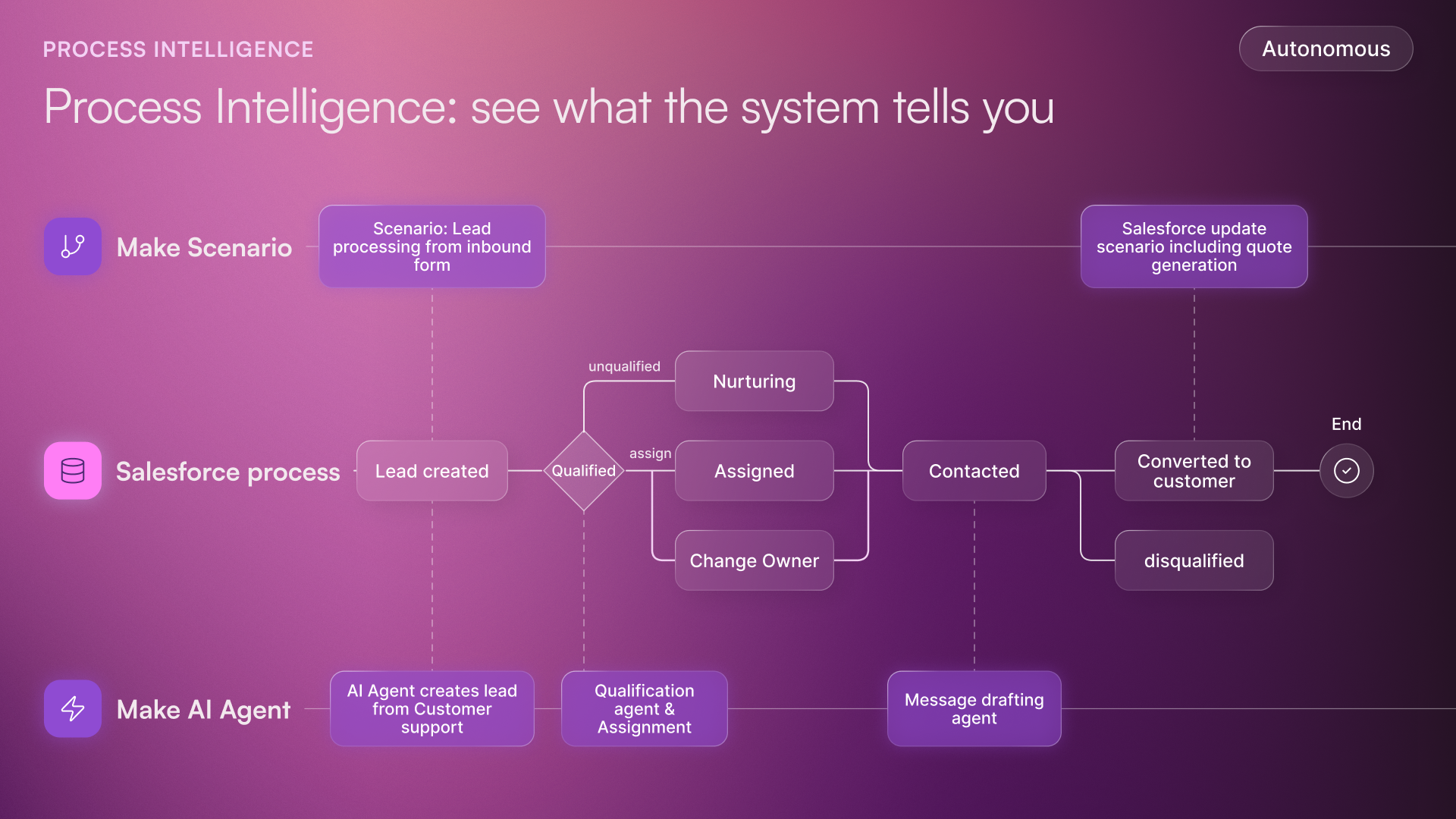
Think of your operations as a busy city. When bottlenecks and traffic jams slow everything down, you rely on a GPS to find the fastest route.
Process Intelligence is that operational GPS. Powered by Celonis Process Intelligence technology, recognized by Gartner as a category leader, it maps your workflows to uncover bottlenecks, eliminate rework, and pinpoint your highest-value automations.
It also serves as the context layer for your business. By providing humans and autonomous agents with a shared operational grounding, it ensures both can collaborate smoothly and execute together.
It starts by zooming out beyond isolated workflows. Instead of inspecting dozens of subscenarios one by one, you need a live view of where scenarios stall, loop, or leak value. Building that complete operational map requires capturing work at two critical levels: Process Mining tracks the transaction data running inside your core systems, while Task Mining captures the user actions happening across desktop screens.
Join the waitlist now!
Task Mining
- Find the manual work nobody wrote down. Task Mining shows how your teams really work, on the desktop and in the browser, and groups it into tasks and subtasks.
- Prioritise what's worth automating. See which tasks repeat most and where work waits, then turn an opportunity into a scenario with Maia.
Process Mining
- See the whole process. Process Mining builds a live map of how work runs across systems, AI agents, and people.
- Ask it questions. Find out in natural language why a case is delayed or where you lose the most time.
- Build the workflows with foundation. Integrate your existing systems with automations and AI agents, feeding deep operational knowledge straight into your processes.
Find the manual work nobody wrote down
A lot of operational work leaves no trace in any system. People do it by hand, between tools, and it never shows up in a log or a dashboard. So teams pick automation candidates from hearsay and build from a remembered version of the steps.
Task Mining brings that work into view. It records how your teams work on the desktop and in the browser, shows which apps they move between, and uses AI to group those interactions into tasks and subtasks. Instead of a workshop's best guess, you get the real picture of where your team's time goes.
You can see which tasks repeat most, how long each one takes, and where work sits waiting. The next thing you automate is the one that matters most to your team, your operations, and your business, not the one with the loudest complaint.
Turn what you find into the next thing you build
Knowing where the time goes only matters if it leads to a decision. Automation Opportunities puts the scenarios worth building in front of you, each with its monthly manual runs and how likely an AI agent would fit instead of manual work. Select Build with Maia, and what you build turns operational evidence into proven workflows.
Privacy is built in, not bolted on
Because Task Mining captures how people work, enterprise-grade privacy is built in from the ground up. The focus is the work and its patterns, not the individuals doing it. You choose which apps Task Mining looks at, and nothing outside them is collected. You also choose how much it captures from those apps, from only the fact that an app was used to window titles, with text input and screenshots switched off entirely.
Personal details such as usernames are hashed, filtering happens on the employee's computer before data leaves the device, and role-based access controls who sees the results. Employees can see that Task Mining is running, check what it captures, and pause it. Every organization has its own privacy laws and policies, so you configure Task Mining to match yours.
What this looks like in practice
Imagine a startup in its earliest days: five people, a single shared spreadsheet, and complete visibility into their sales process. If a deal fell through, anyone could open the sheet, look at a row, and instantly see exactly what went wrong.
Fast-forward four years. That same company has exploded to over a hundred people. The sales team has grown, new departments have formed, and everyone is relying on a sprawling mix of different apps, helpdesks, and AI agents. With that growth, the big picture vanished. Answering why a lead didn't convert now means digging through five separate tools, with no single system showing what actually happened.
This is exactly why Process Intelligence exists. When your work is scattered across isolated platforms and autonomous handoffs, individual systems only report their own local metrics, leaving leadership blind to systemic friction.
Process Intelligence steps in to connect the dots. It traces how work flows across your people, your software, and your AI agents, turning all that hidden activity into one clear, living map. Instead of guessing why a process is stalling, you can diagnose root causes in real time, validating where a human needs to step in, and exactly where you should build your next automation.
Join the waitlist now!
FAQ
Where does Task Mining work
Task Mining runs natively on, and in the browser through a dedicated Google Chrome extension.
What's the difference between Task Mining and Process Mining?
Task Mining captures how people work on the desktop and in the browser. AI Task Discovery, part of Task Mining, groups those interactions into tasks and subtasks, so you can see which tasks repeat most, how long they take, and where work waits. Process Mining builds a live model of how work runs across systems, AI agents, and people, using event data from your systems of record. You can ask questions in natural language, such as why a case is delayed, and track the productivity savings of what you have built.
What does Task Mining capture, and who can see it?
You choose which apps are in scope and which details are captured. Employees can see what's captured, and role-based access limits who views the analysis. See "Privacy is built in, not bolted on" above.
Who is it for?
Leaders who own the company-wide AI and automation agenda, and the buyers who sign off on the investment, get evidence for where automation will have the most impact. Process owners and operations specialists see what is critical, where the process leaks, and what it costs.
Related blogs
Tool and strategies modern teams need to help their companies grow.
AI
Plan and build better workflows with Maia by Make, upgraded
Your visual co-worker just got an upgrade on Waves 2026! Maia can now plan first, remember your preferences with Memory, and resolve errors for you. Here’s what’s new and how each update fits your work.

Andrés García Raffo
October 20, 2026
Inside Make
The execution layer for agents: How to get reliable work from your agentic automation
Code it can run, systems it can reach, knowledge it can use, and lines it can't cross.

Valery Mezencev
October 19, 2026

AI
Waves '26: The glass box for the agentic era
Everything we announced today to build a more transparent future for AI agents in business.

Irina Vasilkova
October 20, 2026