The real reason your AI projects stall – and what hundreds of companies taught us about fixing it
Discover why mid-market AI projects stall despite having ideas and tools, and learn the one organizational move that correlates with dramatically higher AI maturity, based on data from hundreds of companies.

Most conversations about AI adoption focus on tools: which model to pick, which platform to connect, which workflow to automate first. And for solo practitioners and very small teams, that framing makes sense – figuring out what to build is the first hurdle.
But for mid-market companies, the data tells a different story. The biggest obstacle to AI adoption has nothing to do with the technology. It has to do with the organization around it.
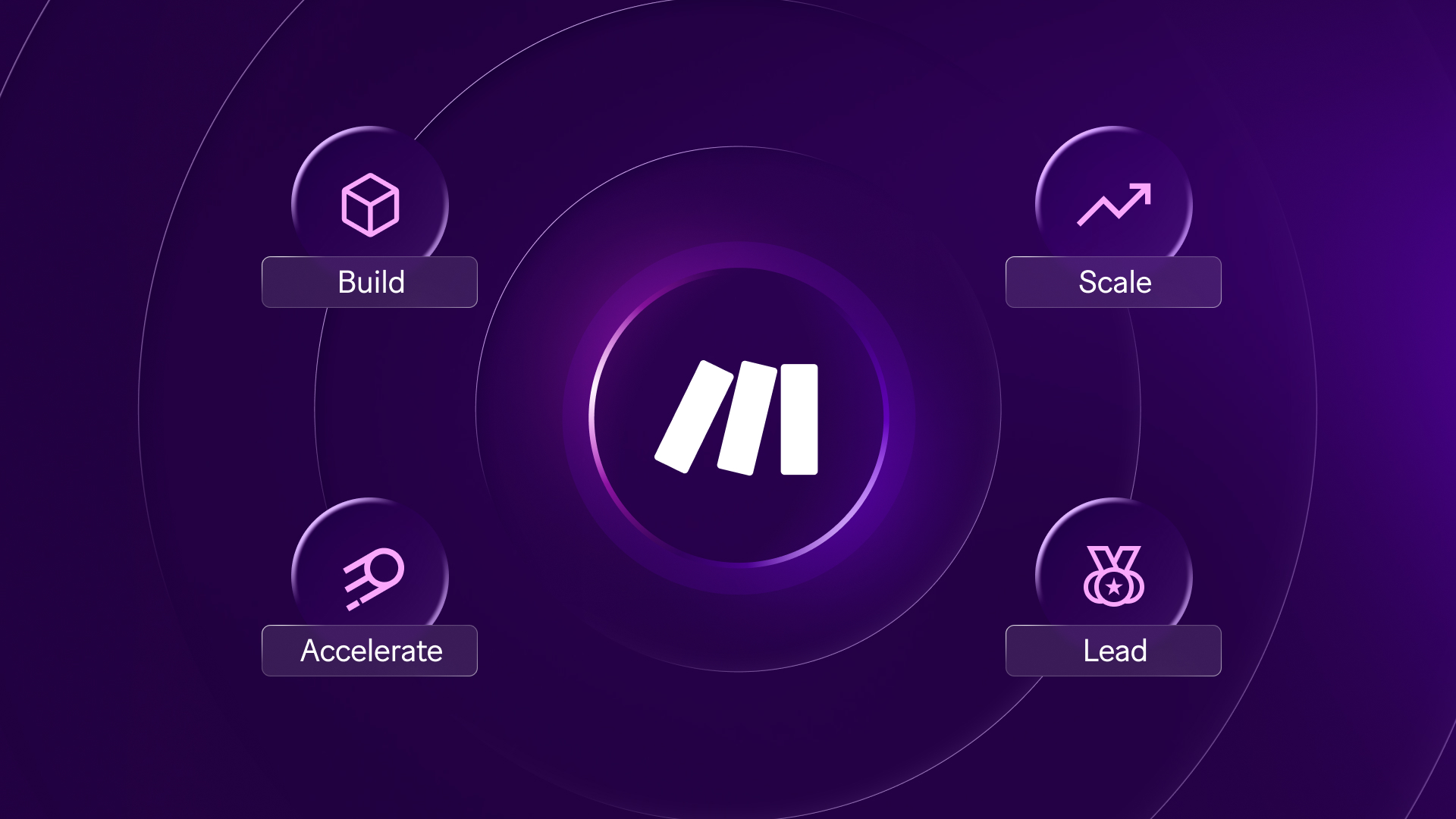
We built the Make AI Playbook to help companies understand where they stand with AI – across five dimensions: ownership, project execution, business alignment, skills, and infrastructure. Hundreds of organizations have now completed the assessment. Here’s what stood out.
Mid-market companies are further along than they think
Organizations with 11 to 1,000 employees scored nearly twice as high on AI maturity as solo practitioners and micro-teams. Almost half (42%) have already moved past the initial exploration stage into what the Playbook calls Accelerate: repeatable automation solutions, appointed AI leads, and early governance structures in place.
That’s a significant gap. While the broader audience is still overwhelmingly in Build mode – experimenting, exploring, figuring out where AI fits – the mid-market has moved on. They have working pilots. They’ve assigned people. They’re running real projects.
So why does it still feel like things aren’t moving fast enough?
The blocker nobody talks about
When we asked respondents what’s holding them back, the answer from mid-market companies was clear – and surprising. The number one barrier wasn’t technology limitations. It wasn’t a lack of ideas or use cases. It was competing priorities.
31% of mid-market companies at the Accelerate stage said they’re focused on other business demands right now. Another 22% pointed to unclear long-term business value. And 22% cited people gaps – not enough headcount or the right expertise to move AI forward.
Systems and infrastructure? Only 11%.
Compare that to solo practitioners, where the number one blocker is a lack of inspiration – they literally don’t know what to automate. Or micro-teams (two to 10 people), where the question shifts to whether AI is worth investing in at all.
These are fundamentally different problems. A solo user asking “What should I build?” needs use case libraries and templates. A 200-person company asking “How do we make AI a priority when everything else is on fire?” needs a business case, executive buy-in, and a structured adoption plan.
One move that changes the trajectory
Across every cohort in the data, one pattern kept showing up: organizations that appointed someone responsible for AI – a dedicated lead, a cross-functional team, or even distributed ownership across departments – were dramatically further along.
Among mid-market companies at the Accelerate stage, 86% had formal AI ownership in place. 78% were actively running projects across departments or already deploying production automations.
The flip side is stark. 67% of all mid-market respondents reported zero AI training within their teams. Even at the Accelerate stage, 58% said nobody has been trained. Ownership gets appointed, but the support structure doesn’t follow.
This suggests that designating an AI lead is the unlock – it moves the needle more than any other single action. But appointing someone is the starting line, not the finish. Without skills investment, those leads end up as bottlenecks rather than accelerators.
Where AI is moving first (and where it’s lagging)
The department breakdown was revealing. Operations teams are the early movers – they represent the highest share of companies that have progressed past the exploration phase. Executive and C-suite respondents also index high, which makes sense: leadership tends to see the ROI argument most clearly in production, logistics, and process-heavy functions.
Marketing and Sales, on the other hand, are still mostly in Build mode. About 60% of marketing and Sales respondents are still at the exploration stage. The return on automating creative, campaign, or CRM workflows is harder to quantify than, say, cutting 15 hours of manual order processing per week.
The implication for companies trying to scale AI adoption: start where ROI is visible and measurable. Let early wins in operations build the internal credibility and executive confidence that make broader rollout possible.
Enterprise flips the script
One of the more interesting patterns in the data came from larger organizations (1,000+ employees). While the sample is small, the direction is consistent: enterprise builds the organizational scaffolding first – governance, policies, ownership structures – and then hits a wall when they try to actually execute. Their number one blocker is systems: IT infrastructure, data access, and internal policies.
Mid-market companies do the opposite. They run scrappy pilots, get something working, and worry about governance later.
Neither approach is wrong, but they require different playbooks. And if you’re a mid-market leader wondering why your enterprise peers seem slower despite bigger budgets, this is probably why.
What you can do right now
If any of this sounds familiar, here’s where to start:
Appoint someone. Give a person or a small team explicit responsibility for AI adoption. The data is unambiguous: this single move correlates with higher maturity across every other dimension.
Separate the priority conversation from the technology conversation. If your blocker is “we’re too busy,” the fix isn’t a better tool – it’s an executive-level decision to protect time and resources for AI work.
Invest in skills, especially early on. Zero training was the norm across nearly every segment we looked at. Even a small, structured upskilling program makes the difference between an AI lead who drives progress and one who gets stuck.
Start with operations. Build your business case where the numbers are cleanest. Then expand.
The Make AI Playbook assessment maps your organization across the five dimensions that matter most for AI adoption. Find out where you stand – and where to focus next.
Take the assessment at playbook.make.com
Related blogs
Tool and strategies modern teams need to help their companies grow.
AI
Get a tailored AI automation strategy with Make AI Playbook
Discover how to move your organization from scattered AI experiments to a structured implementation strategy with a free maturity assessment, personalized roadmap, and actionable frameworks that deliver 3-5x higher ROI.

Natalia Mrazova
January 20, 2026

AI
Where does your organization really stand on AI?
Daria Hvizdalova, Head of AI Adoption at Make, outlines the key stages of AI adoption and introduces the Make AI Playbook - a new resource to help companies wherever they are on their AI journey.

Daria Hvizdalova
February 2, 2026
AI
AI integration: How to connect AI to your business workflows
AI integration is the process of connecting your AI models directly to your business systems, turning isolated prompts into repeatable, observable workflows. This guide explains how to turn this promise into a reality.