
Connect Airtable and Telegram Bot integrations
Integrate Airtable and Telegram Bot to automate workflows, triggering actions and sending notifications in real-time without coding, for smooth communication and better productivity.

Returns all newly created or updated records in a view (requires "Created Time" or "Last Modified Time" fields).
Triggers when a new response is submitted.

Sends answer to an inline query.
Creates an additional invite link for a chat.
Deletes a message. A message can only be deleted if it was sent less than 48 hours ago.
Downloads a file from the Telegram server.
Edits a non-primary invite link created by the bot.
Edits photo or video messages.
Edits a caption of a message.
Edits text or game messages.
Forwards messages of any kind. This module can be used to forward messages only within Telegram.
Use this module to get the number of members in a chat. Returns Int on success.
Use this method to kick a user from a group, a supergroup or a channel. The bot must be an administrator in the chat for this to work and must have the appropriate admin rights.
Performs an arbitrary authorized API call.
Pins a message.
Use this method to promote or demote a user in a supergroup or a channel. The bot must be an administrator in the chat for this to work and must have the appropriate admin rights.
Use this method to restrict a user in a supergroup.
Revokes an invite link created by the bot.
Sends a document or an image to your Telegram Desktop application.
Sends a group of photos or videos as an album.
Sends an audio file to your Telegram Desktop application.
Sends an invoice.
Sends a photo to your Telegram Desktop application.
Sends a .webp sticker to your Telegram Desktop application.
Sends a text message or a reply to your Telegram Desktop application.
Sends a video file to your Telegram Desktop application.
As of v.4.0, Telegram clients support rounded square mp4 videos of up to 1 minute long. Use this method to send video messages.
Sends a voice message
Sends a file (document, photo, video, audio, ...) by HTTP URL or by ID that exists on the Telegram servers.
Unpins a message.
Use this modules to get a list of administrators in a chat.
List available Telegram chats. By default, chats starting with the earliest unconfirmed update are returned. If you want to list more, you need to set the offset. This module cannot be used with webhooks. To use this module, you must switch off and remove all your Telegram webhooks.
Retrieves a list of updates from the Telegram server. By default, updates starting with the earliest unconfirmed update are returned. If you want to list more, you need to set the offset. This module cannot be used with webhooks. To use this module, you must switch off and remove all your Telegram webhooks.
Trusted by thousands of fast-scaling organizations around the globe





Automate your work. Build something new.
Just drag and drop apps to automate existing workflows or build new complex processes. Solve problems across all areas and teams.
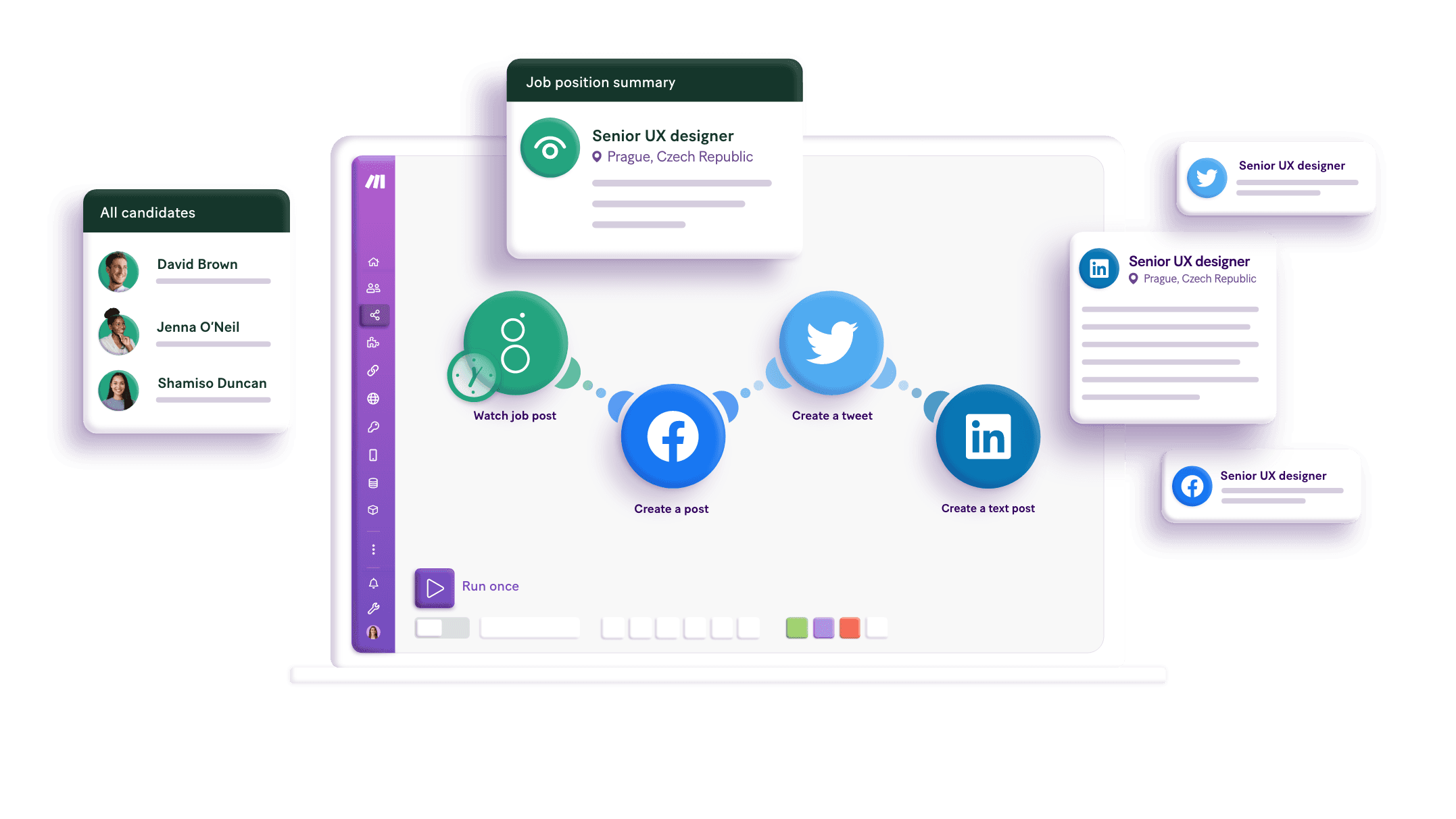
Build your Airtable and Telegram Bot integrations.
Integrate Airtable and Telegram Bot with Make to automate your workflows. Use Airtable as a trigger to initiate actions when records are updated or added, and employ Telegram Bot as an action to send automated notifications or messages. This integration allows you to facilitate communication and manage tasks, without needing any coding skills. Improve your data management by using Airtable's real-time updates to trigger actions in Telegram Bot, enabling synchronization and improved productivity.
Sends answer to an inline query.
Сreates multiple records.
Deletes multiple records.
Updates multiple existing records.
Upserts multiple records.
Creates an additional invite link for a chat.
Creates a new record in Airtable.
Deletes a message. A message can only be deleted if it was sent less than 48 hours ago.
Deletes a record by its ID.
Popular Airtable and Telegram Bot workflows.
Discover popular Airtable and Telegram Bot integrations to improve communication, organize data, and manage project workflows. Find automation for efficient and time-saving solutions, elevating your team's productivity.
How to setup Airtable and Telegram Bot in 5 easy steps
Choose your Airtable connection method
Decide between using OAuth or a personal access token to connect Airtable to Make, based on your preference.
Connect Airtable with OAuth
Select the Airtable OAuth option in Make, and choose which Airtable base you'd like to access.
Set up Airtable with a token
Create a personal access token in Airtable and input it into Make for a secure connection.
Prepare your Telegram bot
Create and configure a Telegram bot using BotFather to act as a bridge.
Automate tasks with Telegram in Make
Build a scenario in Make with the Telegram Bot module and customize it using triggers and actions.
Maximize productivity with Airtable and Telegram Bot integration
Integrating Airtable and Telegram Bot fosters improved team communication, streamlines data management, and automates project workflows, eliminating manual data entry and boosting efficiency.
Automatically send Telegram messages for new Airtable records to keep your team informed.
Capture all Telegram updates in Airtable for streamlined tracking and management.
Ensure every Telegram notification is organized in Airtable to improve project workflows.
Eliminate manual data entry by automating the creation of Airtable records from Telegram.


FAQ
Integrating Airtable and Telegram Bot using Make allows you to automate workflows, such as updating Airtable records when your Telegram Bot receives new messages, or notifying your team on Telegram of updates to your Airtable projects. This integration improves efficiency by connecting your databases and communication channels smoothly.
Make is designed with user-friendliness in mind, offering a no-code interface that allows drag-and-drop setup of integrations. You can easily connect Airtable and Telegram Bot, with step-by-step guidance and templates to simplify the integration process, even if you have no technical background.
Yes, by automating tasks between Airtable and Telegram Bot, you reduce manual input, minimize errors, and free up time to focus on more critical tasks. For instance, you can automatically send reminders or status updates from your Airtable database to your Telegram Bot, keeping your team informed and productive.
Make provides flexibility and scalability for integrations, allowing you to tailor and expand your workflows as needed. You can connect Airtable not only with Telegram Bot but also with other applications like Twitter, Instagram, and calendars, creating a comprehensive ecosystem that supports your business objectives.
A scenario represents a workflow or a project of your own creation, and it is made up of a series of modules that automate apps and services. Creating a scenario allows you to transfer and transform data between apps and services via these modules to automate anything and improve the way you work.
Modules are the main building blocks of automation in Make. Modules represent actions that Make performs with an app, like creating, updating, or deleting data.
How it works
Traditional no-code iPaaS platforms are linear and non-intuitive. Make allows you to visually create, build, and automate without limits.
Trusted by 350,000+ customers
"Make really helped us to scale our operations, take the friction out of our processes, reduce costs, and relieved our support team. It is difficult to not become a fan."

Philipp Weidenbach
Head of Operations at Teleclinic
"Make drives unprecedented efficiency within our business in ways we never imagined. It’s having an extra employee (or 10) for a fraction of the cost."

Cayden Phipps
COO at Shop Accelerator Martech
"The simplicity, flexibility and ability to build real complex automations without any knowledge of programming makes it the best thing since sliced bread."

Erkki Markus
Product Owner at Smaily
"True citizen development in the entire company. Make is present in every department, empowering the company to offer a unique customer experience."

Andreas Stryz
CTO & Co-founder at FINN
"I can't count the number of hours I've saved by using Make. Every single day is simpler because of Make's automation."

Kimberly D
Owner of Media Production