
Connect Anthropic Claude and Figma integrations
Transform your design workflow by connecting Anthropic Claude's AI-powered language processing with Figma's creative canvas through Make. Automatically sync AI-generated content, update design copy, and populate text elements in real-time—eliminating manual copy-paste and letting intelligent automation bridge the gap between ideation and visualization.

Creates a new prompt based on a structured list of input messages.
Creates a new Skill.
Creates a new Skill version.
Deletes an existing file.
Deletes an existing Skill.
Deletes an existing Skill version.
Downloads a Claude-generated file.
Retrieves an existing file's metadata.
Retrieves an existing Skill.
Retrieves an existing Skill version.
Performs an arbitrary authorized API call.
Generates text responses from prompts without requiring an account or connection.
Uploads a new file.

Performs an arbitrary authorized API call.
Posts a comment to a file.
Lists all comments left on a file.
Lists the version history of a file.
Lists the project files in a given project.
Lists all the projects of a certain team.
Trusted by thousands of fast-scaling organizations around the globe





Automate your work. Build something new.
Just drag and drop apps to automate existing workflows or build new complex processes. Solve problems across all areas and teams.
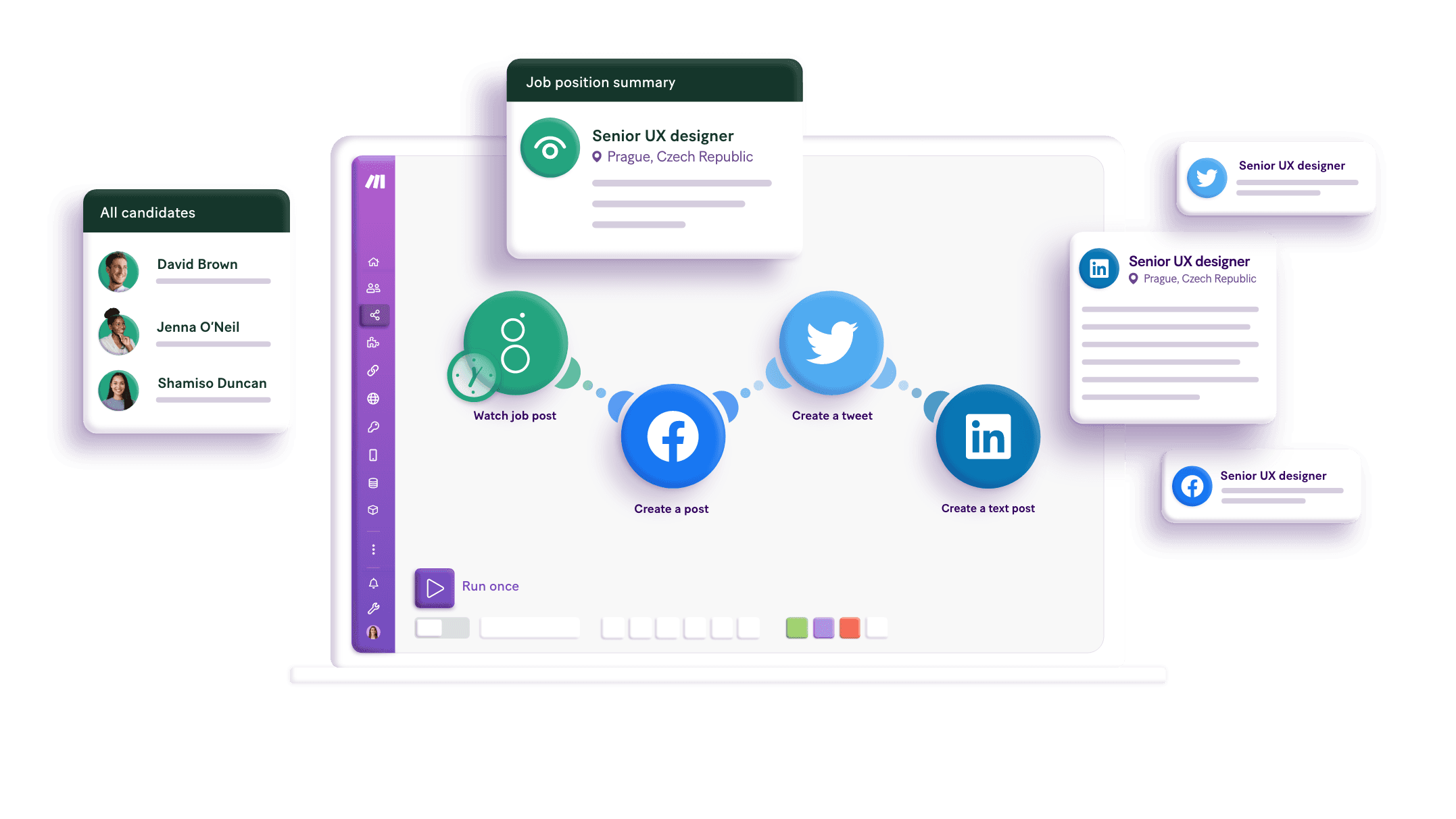
Build your Anthropic Claude and Figma integrations.
Connect Figma as a trigger and Anthropic Claude as an action through Make's integration platform to automate your design workflow. When Figma generates AI-powered content or processes language requests, it triggers automated actions in Anthropic Claude, such as updating design copy, syncing AI-generated content with your visual projects, or populating text elements within your designs. This trigger-action integration enables you to automatically transfer content from Figma's language processing directly into Anthropic Claude's design environment without manual intervention, improving the process of incorporating AI-generated text into your design work.
Creates a new prompt based on a structured list of input messages.
Creates a new Skill.
Creates a new Skill version.
Deletes an existing file.
Deletes an existing Skill.
Deletes an existing Skill version.
Downloads a Claude-generated file.
Retrieves an existing file's metadata.
Retrieves an existing Skill.
Popular Anthropic Claude and Figma workflows.
Looking to get more out of Anthropic Claude and Figma? With Make you can visually integrate Anthropic Claude and Figma into any workflow to save time and resources — no coding required. Try any of these templates in just a few clicks.
How to setup Anthropic Claude and Figma in 5 easy steps
Get your connection credentials from the source app
Log into the application you want to connect (like Anthropic Claude or Figma) and find the section where connection credentials are created. Look for areas labeled API keys, developer settings, or integrations. Click the button to create new credentials and give them a memorable name like 'Make Integration.' Copy the information provided (such as API key, Client ID, or Client Secret) and store it safely in a password manager, as you'll need these details to complete the connection in Make.
Add the callback URL if needed
Some applications require a callback URL to complete the connection process. This is a specific web address that Make provides in the connection instructions, typically looking like 'https://www.integromat.com/oauth/cb/figma.' Copy this URL exactly as shown and paste it into the designated field in your source application's settings. This step helps your browser know where to return after you authorize the connection, ensuring the setup process completes smoothly.
Open Make and add your application module
Log into your Make account and either create a new scenario or open an existing one where you want to use the connected application. Search for and add a module for the app you're connecting, such as an Anthropic Claude module or a Figma module. When you add the module for the first time, Make will notice you haven't connected that application yet and will prompt you to create a connection by clicking a 'Create a connection' button.
Set up your connection in Make
In the connection setup window that appears, you can optionally give your connection a descriptive name like 'My Anthropic Claude Account' to help you identify it later. Then, paste the credentials you saved earlier from your source application into the appropriate fields in Make's form. For Anthropic Claude, this means entering your API key, while for Figma you'll enter both your Client ID and Client Secret. Make sure to paste these values exactly as provided without adding extra spaces.
Save and test your connection
After entering all the required credentials, click the 'Save' button to establish the connection between Make and your application. Make will verify the credentials with the source application to ensure everything is correct. Once you see a confirmation message that the connection was successful, you're ready to start building automations using that application's modules in your Make scenarios. You can always return to the connection settings later if you need to make any changes.
AI-powered design automation with Anthropic Claude and Figma
Integrate Anthropic Claude and Figma to automate design feedback, generate documentation, create intelligent copy, and improve review workflows with AI-powered automation that optimizes your design process.
Automatically send Figma designs to Claude for intelligent feedback on UI/UX, accessibility, and design best practices without manual review processes.
Extract design elements from Figma and use Claude to automatically generate comprehensive design documentation, style guides, and component descriptions.
Monitor Figma file changes and use Claude to analyze updates, suggest design system improvements, and maintain consistency across projects.
Generate AI-powered copy, microcopy, and placeholder text with Claude that automatically populates into Figma designs based on design context and requirements.


FAQ
By integrating Anthropic Claude and Figma through Make, you can automate design documentation, generate component descriptions, create design system guidelines, and even analyze design files using Claude's 100K+ token context window. Make's visual automation platform allows you to build workflows where Claude can process design feedback, generate copy for UI elements, or create comprehensive design specifications directly from your Figma files—all without writing code.
Connecting Claude to Figma via Make enables you to automate repetitive tasks like generating design documentation, creating accessibility descriptions, translating UI copy across multiple languages, and producing consistent design specs. Claude's Constitutional AI ensures brand-safe outputs, while its large context window can analyze entire design systems at once. Make allows you to trigger these AI processes automatically when Figma files are updated, saving hours of manual work and ensuring consistency across your design operations.
Yes, it's secure. Anthropic Claude offers best-in-class data retention policies and guarantees that your data won't be used for training their models, making it ideal for handling sensitive design information. Make provides enterprise-grade security for connecting these applications, allowing you to automate workflows between Figma and Claude while maintaining full control over your proprietary design assets. This combination ensures your design IP remains protected while you benefit from AI-powered automation.
No coding skills are required. Make provides a visual, drag-and-drop interface that makes it straightforward to connect Figma and Anthropic Claude. You can create sophisticated automation scenarios—such as automatically generating design documentation when a Figma file is updated, or using Claude to review and suggest improvements to design components—by configuring pre-built modules and defining your workflow logic visually. This allows designers and non-technical team members to build powerful AI-enhanced design workflows in minutes.
A scenario represents a workflow or a project of your own creation, and it is made up of a series of modules that automate apps and services. Creating a scenario allows you to transfer and transform data between apps and services via these modules to automate anything and improve the way you work.
Modules are the main building blocks of automation in Make. Modules represent actions that Make performs with an app, like creating, updating, or deleting data.
How it works
Traditional no-code iPaaS platforms are linear and non-intuitive. Make allows you to visually create, build, and automate without limits.
Trusted by 350,000+ customers
"Make really helped us to scale our operations, take the friction out of our processes, reduce costs, and relieved our support team. It is difficult to not become a fan."

Philipp Weidenbach
Head of Operations at Teleclinic
"Make drives unprecedented efficiency within our business in ways we never imagined. It’s having an extra employee (or 10) for a fraction of the cost."

Cayden Phipps
COO at Shop Accelerator Martech
"The simplicity, flexibility and ability to build real complex automations without any knowledge of programming makes it the best thing since sliced bread."

Erkki Markus
Product Owner at Smaily
"True citizen development in the entire company. Make is present in every department, empowering the company to offer a unique customer experience."

Andreas Stryz
CTO & Co-founder at FINN
"I can't count the number of hours I've saved by using Make. Every single day is simpler because of Make's automation."

Kimberly D
Owner of Media Production