
Connect Browse AI and Google Docs integrations
Automatically transform web data into polished documents by connecting Browse AI and Google Docs—monitor competitor sites, track prices, and extract insights that instantly populate your reports and templates without manual work. Eliminate copy-pasting forever as real-time web scraping triggers automatic document generation, keeping your Google Docs always updated with the freshest data from across the web.

Triggers when task is finished.

Creates a new Google document by adding the content of HTML format.
Creates a copy of an existing template document and replaces any tags e.g. {{!notfound:name}}, {{!notfound:email}}. This module also allows users to replace images by new images with URLs.
Deletes a document.
Downloads a document to a required format.
Gets a content of a document.
Inserts a new image with URL to a document. The original size of the image is entered or the image is resized as required by the user. The original image ratio is maintained.
Inserts or appends a new paragraph to an existing document.
Makes all links in a document clickable.
Performs an arbitrary authorized API call.
Replaces an existing image with a new image with URL in the document. In order to fill the original image's bounds, the new image may be scaled or cropped.
Replaces an old text by a new text in a document.
Retrieves a list of documents.
Trusted by thousands of fast-scaling organizations around the globe





Automate your work. Build something new.
Just drag and drop apps to automate existing workflows or build new complex processes. Solve problems across all areas and teams.
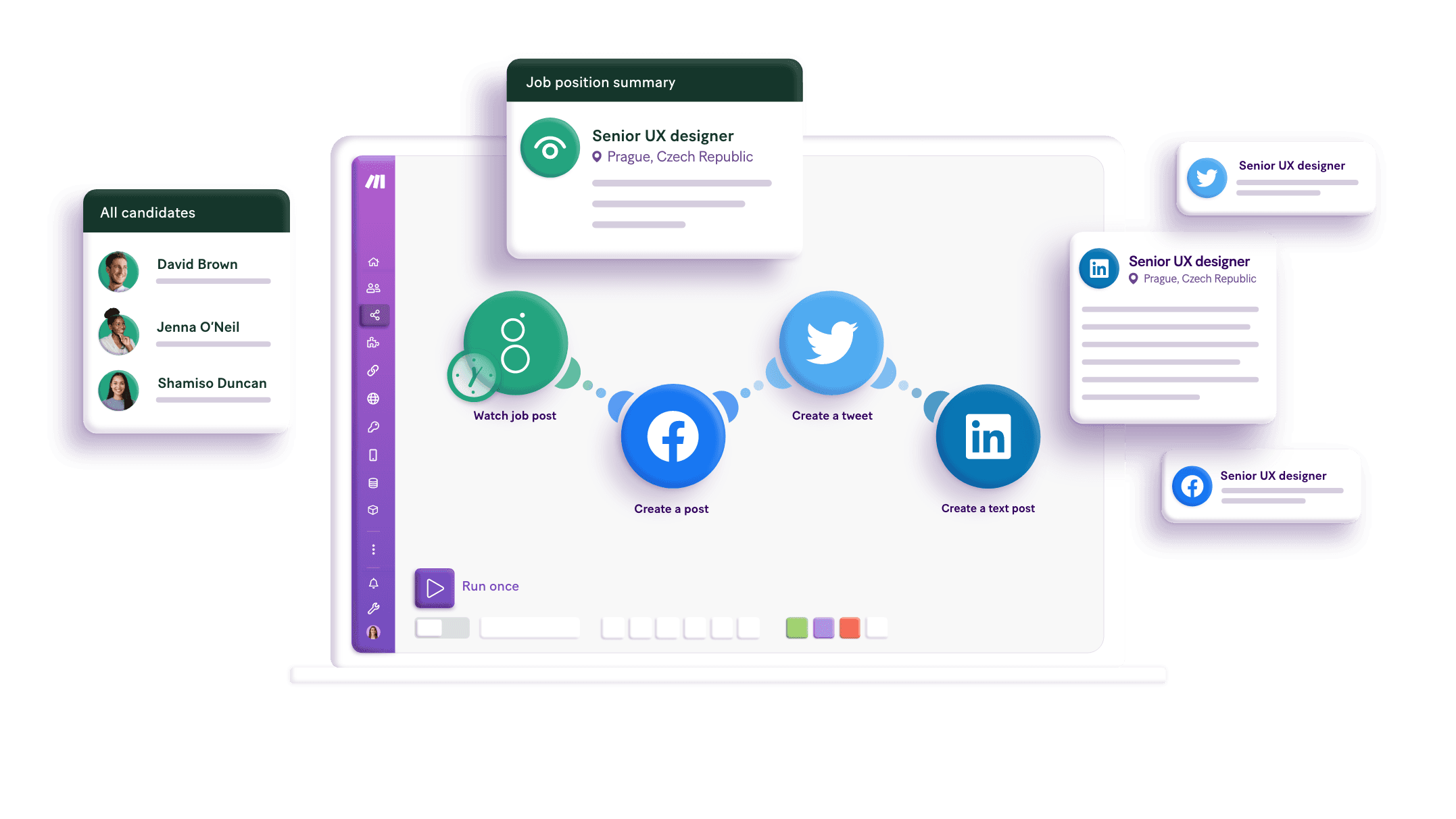
Build your Browse AI and Google Docs integrations.
Google Docs functions as a trigger by monitoring competitor websites, tracking product prices, or extracting structured data from web pages, capturing real-time web information that initiates the automation workflow. When Google Docs detects or extracts new data, it triggers actions in Browse AI, which automatically creates formatted documents, populates templates, generates reports, or updates existing documents with the fresh extracted data. This trigger-action integration eliminates manual copy-pasting by automatically transferring information from Google Docs's web scraping directly into Browse AI, syncing web data extraction with document generation through custom triggers and actions.
Creates a new Google document by adding the content of HTML format.
Creates a copy of an existing template document and replaces any tags e.g. {{!notfound:name}}, {{!notfound:email}}. This module also allows users to replace images by new images with URLs.
Deletes a document.
Downloads a document to a required format.
Gets a content of a document.
Inserts or appends a new paragraph to an existing document.
Inserts a new image with URL to a document. The original size of the image is entered or the image is resized as required by the user. The original image ratio is maintained.
Retrieves a list of documents.
Makes all links in a document clickable.
Popular Browse AI and Google Docs workflows.
Looking to get more out of Browse AI and Google Docs? With Make you can visually integrate Browse AI and Google Docs into any workflow to save time and resources — no coding required. Try any of these templates in just a few clicks.
How to setup Browse AI and Google Docs in 5 easy steps
Log in to Make and start your automation
Begin by signing into your Make account, which is the platform that will help Browse AI and Google Docs work together automatically. Once you're logged in, you'll be ready to create a new scenario, which is an automated workflow that connects your apps so they can share information without you having to do it manually.
Add your first app to the workflow
Select either Browse AI or Google Docs from the list of available apps and add it to your scenario. This creates a module, which is a building block representing an action from that app. Think of this as placing the first piece of your automation puzzle that will eventually connect both applications together.
Create and name your connection
Click the 'Create a connection' button to start linking Make with your chosen app. You'll have the option to give your connection a custom name, which is helpful for staying organized if you plan to set up multiple automations. Choose a name that makes sense to you so you can easily identify it later.
Log in and grant permission to Make
You'll be prompted to log into the app you're connecting, whether it's Browse AI or Google Docs. After entering your credentials, you'll need to approve the permissions that allow Make to access certain features of your app, such as reading or creating documents. This step ensures Make can perform the automated tasks you want it to do on your behalf.
Confirm and repeat for the second app
Once you see a confirmation message that your first connection was successful, you're ready to repeat the same process for your second app. Follow the identical steps to connect the other application, and both Browse AI and Google Docs will be linked to Make, allowing them to work together in your automated workflow.
Automate web data extraction and documentation with Browse AI and Google Docs
Connect Browse AI and Google Docs to automatically extract website data and generate formatted reports. Eliminate manual copying, monitor changes in real-time, and create scalable documentation workflows.
Automatically extract data from any website using Browse AI and instantly populate Google Docs with structured, formatted reports without manual copying.
Monitor website changes with Browse AI and automatically generate updated Google Docs reports whenever new data is detected, keeping stakeholders informed.
Extract data from multiple websites simultaneously through Browse AI and consolidate all information into organized Google Docs for convenient sharing and collaboration.
Set up automated schedules to scrape competitor websites with Browse AI and deliver formatted intelligence reports directly to Google Docs on a regular basis.


FAQ
With Make, you can create automated workflows that connect Browse AI and Google Docs. Whenever Browse AI extracts data from a website you're monitoring, Make can automatically format and append that information to a Google Doc of your choice. This eliminates manual copy-pasting and ensures your data is organized and accessible in real-time, perfect for research reports, competitor analysis, or market monitoring.
Yes! Make allows you to set up sophisticated automation workflows where Browse AI monitors multiple websites simultaneously, and all extracted data flows into a consolidated Google Docs report. You can customize how the data is structured, add timestamps, create separate sections for different sources, and even schedule regular updates. This makes it incredibly convenient to maintain comprehensive monitoring reports without any manual effort.
Make's visual interface enables you to build powerful workflows between Browse AI and Google Docs without writing any code. You can automatically extract product prices, job listings, news articles, or any web data, then create formatted documents with tables, headers, and organized sections. Common use cases include generating daily competitor pricing reports, compiling industry news summaries, tracking real estate listings, or building lead databases—all updated automatically in Google Docs.
Manual data extraction and documentation can take hours daily. With Make connecting Browse AI and Google Docs, you set up your workflow once and it runs automatically forever. Browse AI handles the web scraping while Make instantly transfers that data to Google Docs in your preferred format. Users typically save 10-20 hours per week on data collection and reporting tasks, allowing them to focus on analysis and decision-making instead of repetitive manual work.
A scenario represents a workflow or a project of your own creation, and it is made up of a series of modules that automate apps and services. Creating a scenario allows you to transfer and transform data between apps and services via these modules to automate anything and improve the way you work.
Modules are the main building blocks of automation in Make. Modules represent actions that Make performs with an app, like creating, updating, or deleting data.
How it works
Traditional no-code iPaaS platforms are linear and non-intuitive. Make allows you to visually create, build, and automate without limits.
Trusted by 350,000+ customers
"Make really helped us to scale our operations, take the friction out of our processes, reduce costs, and relieved our support team. It is difficult to not become a fan."

Philipp Weidenbach
Head of Operations at Teleclinic
"Make drives unprecedented efficiency within our business in ways we never imagined. It’s having an extra employee (or 10) for a fraction of the cost."

Cayden Phipps
COO at Shop Accelerator Martech
"The simplicity, flexibility and ability to build real complex automations without any knowledge of programming makes it the best thing since sliced bread."

Erkki Markus
Product Owner at Smaily
"True citizen development in the entire company. Make is present in every department, empowering the company to offer a unique customer experience."

Andreas Stryz
CTO & Co-founder at FINN
"I can't count the number of hours I've saved by using Make. Every single day is simpler because of Make's automation."

Kimberly D
Owner of Media Production