Connect ElevenLabs and Google Drive integrations
Transform your audio content workflow by automatically syncing ElevenLabs voice generations directly to Google Drive through Make's no-code platform. Create automation that instantly backs up, organizes, and shares your AI-generated audio files across your team—no manual uploads required.

Watch new events.
Listens to function call from ElevenLabs. Creates the Tool definition in ElevenLabs during setup.

Makes a copy of an existing file.
Creates a new file or folder shortcut.
Creates a file from a text plain.
Creates a new folder.
Creates a new shared drive.
Permanently deletes a file or folder owned by the user without moving it to the trash.
Deletes a file's revision.
Deletes a shared drive without any content.
Downloads a file.
Retrieves a file or folder path for an ID.
Gets a specified file's revision.
Gets a shared drive's metadata by ID.
Gets a share link for file or folder.
Performs an arbitrary authorized API call.
Moves a file or folder to a different location in Google Drive.
Moves a file or folder to trash.
Renames an existing folder.
Revokes a file or folder access.
Updates a file's metadata and/or content.
Updates an exisitng file or folder access.
Updates an existing file's revision.
Updates an existing shared drive. For admins only.
Uploads a new file.
Retrieves a folder ID for a folder path.
Retrieves a list of file's revisions.
Searches for files or folders based on search criteria.
Searches for Google Shared Drives with query options.
Trusted by thousands of fast-scaling organizations around the globe





Automate your work. Build something new.
Just drag and drop apps to automate existing workflows or build new complex processes. Solve problems across all areas and teams.
Build your ElevenLabs and Google Drive integrations.
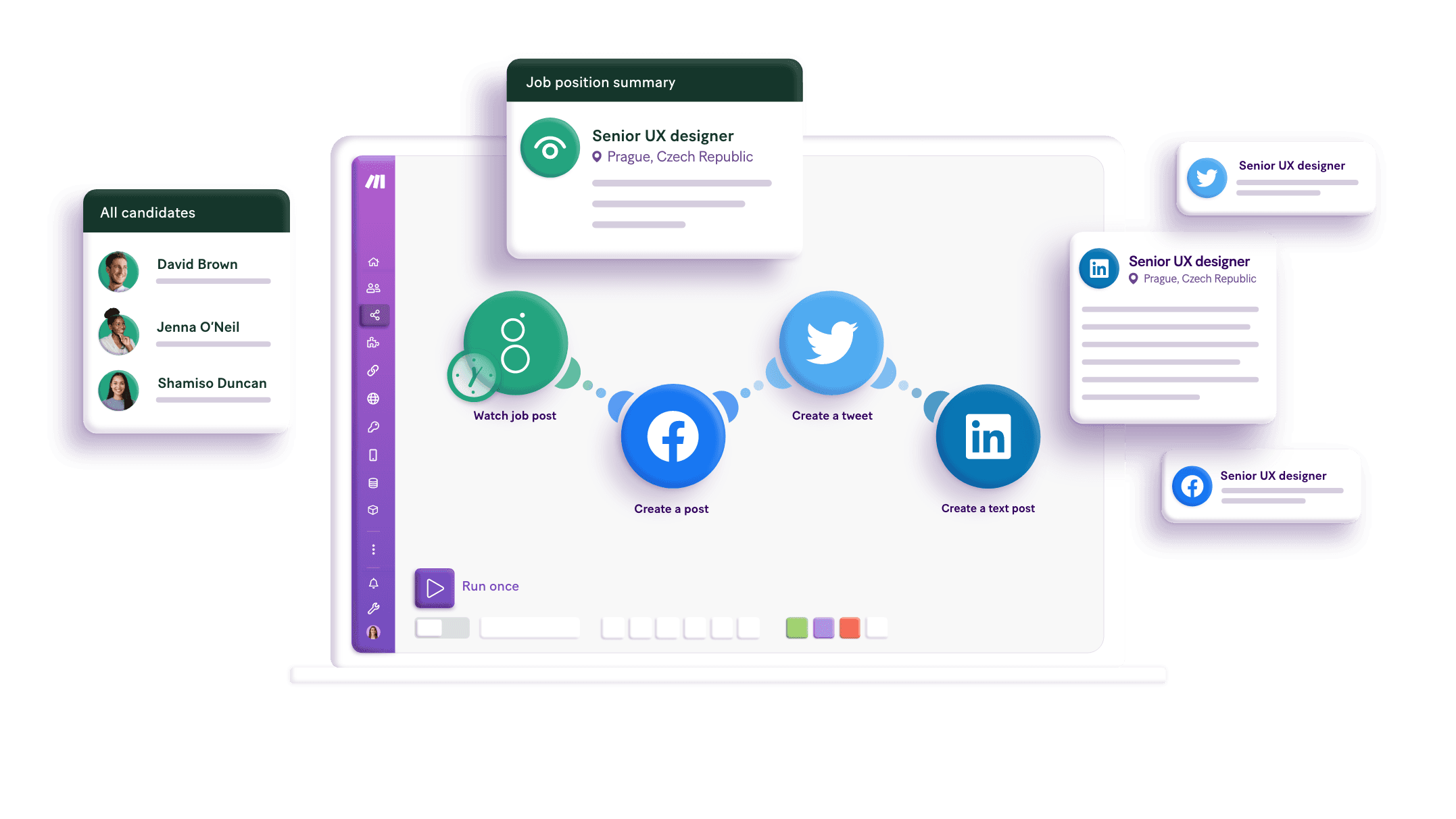
Connect Google Drive and ElevenLabs through Make's intuitive integration platform to automate your workflow. Make's visual workflow builder enables you to design custom automation scenarios where Google Drive voice generation triggers automatic file uploads to specific ElevenLabs folders, complete with organized naming conventions and metadata. When Google Drive completes audio generation, this event automatically triggers ElevenLabs to store and organize these files without manual intervention, ensuring your audio files are instantly backed up and accessible across your team.
Converts an audio recording so it is spoken in a chosen voice, preserving delivery and emotion.
Composes a music track from a text prompt.
Transcribes an audio or video file into text.
Makes a copy of an existing file.
Creates a file from a text plain.
Creates a new file or folder shortcut.
Creates a new folder.
Creates a new shared drive.
Starts an asynchronous job that dubs a video or audio file into another language.
Popular ElevenLabs and Google Drive workflows.
Automate your voice content workflow by connecting ElevenLabs with Google Drive. Generate professional AI voice overs from text and automatically store them in organized cloud folders, eliminating manual file transfers and creating a centralized audio library accessible to your entire team.
Scale your content production by converting multiple text entries into high-quality audio files that are instantly uploaded to Google Drive. This powerful integration optimizes your workflow, improves content accessibility, and ensures all your AI-generated voice overs are securely stored and ready to share.
How to setup ElevenLabs and Google Drive in 5 easy steps
Get your ElevenLabs API key
Sign into your ElevenLabs account and click on your profile icon in the top-right corner. On your profile page, you'll find your API key - click the eye icon to reveal it, then copy and save this key as you'll need it to connect ElevenLabs to Make.
Connect ElevenLabs to Make
In your Make account, add an ElevenLabs module to your workflow and click 'Create a connection'. Paste the API key you copied from ElevenLabs into the API Key field and click 'Save' to complete the connection.
Add Google Drive to your Make scenario
Add a Google Drive module to your Make scenario and click 'Create a connection' to start the setup process. You can give your connection a descriptive name to help identify it later if you have multiple Google Drive connections.
Sign in and authorize Google Drive
Click 'Sign in with Google' and enter your Google credentials when redirected to Google's login page. After signing in, review and approve the permissions that Make needs to access your Google Drive files and folders.
Start automating between both apps
Once both connections are established, you'll see confirmation messages in Make. You can now create automated workflows that move data and trigger actions between ElevenLabs and Google Drive to optimize your work processes.
Improve audio content creation and storage with automated workflows
Integrate ElevenLabs and Google Drive to automatically convert text into professional voice overs and store them in the cloud. Eliminate manual tasks and build an organized audio library.
Automatically generate voice overs from text content using ElevenLabs and store them in Google Drive without manual file transfers.
Create an organized, cloud-based repository of all your AI-generated audio files in Google Drive for quick access and sharing across teams.
Transform written content into professional audio files and store them in designated Google Drive folders automatically, eliminating repetitive manual tasks.
Process multiple text entries in bulk from spreadsheets, convert them to audio with ElevenLabs, and upload all files to Google Drive in one automated workflow.


FAQ
By connecting ElevenLabs and Google Drive in Make, you can automatically generate high-quality AI voice content and save it directly to your Google Drive folders. For example, you can create workflows that convert text documents from Google Drive into natural-sounding audio files using ElevenLabs, then automatically save the generated audio back to a designated Drive folder. This eliminates manual file transfers and creates an efficient content production pipeline for podcasts, audiobooks, video voiceovers, or accessibility features.
Make eliminates repetitive manual work by automating the entire process. Instead of downloading audio files from ElevenLabs and manually uploading them to Google Drive, Make handles everything automatically in the background. You can set up triggers that monitor specific Drive folders for new text content, automatically send it to ElevenLabs for voice generation, and store the results in organized folders with proper naming conventions. This saves hours of work, reduces errors, ensures consistency, and allows you to focus on content creation rather than file management.
No coding skills are required. Make provides a visual, drag-and-drop interface that makes it accessible for anyone to build integrations between ElevenLabs and Google Drive. You select the apps, choose triggers and actions, and connect them visually. Make offers pre-built modules for both applications with clear configuration options. You can start with ready-made templates or build custom workflows step-by-step using the intuitive scenario builder. Make handles all the technical API connections behind the scenes, so you can focus on designing your automation logic.
Absolutely. Make's powerful automation capabilities allow you to create sophisticated workflows that process multiple files in batch. You can set up scenarios that monitor a Google Drive folder, detect when multiple text files are added, and automatically send each one to ElevenLabs for voice conversion in sequence or parallel. Make supports iterations, filters, and routers that let you handle different file types, apply conditional logic, organize outputs into different folders based on criteria, and even send notifications when batches are complete. This makes Make ideal for large-scale content production workflows.
A scenario represents a workflow or a project of your own creation, and it is made up of a series of modules that automate apps and services. Creating a scenario allows you to transfer and transform data between apps and services via these modules to automate anything and improve the way you work.
Modules are the main building blocks of automation in Make. Modules represent actions that Make performs with an app, like creating, updating, or deleting data.
How it works
Traditional no-code iPaaS platforms are linear and non-intuitive. Make allows you to visually create, build, and automate without limits.
Trusted by 350,000+ customers
"Make really helped us to scale our operations, take the friction out of our processes, reduce costs, and relieved our support team. It is difficult to not become a fan."

Philipp Weidenbach
Head of Operations at Teleclinic
"Make drives unprecedented efficiency within our business in ways we never imagined. It’s having an extra employee (or 10) for a fraction of the cost."

Cayden Phipps
COO at Shop Accelerator Martech
"The simplicity, flexibility and ability to build real complex automations without any knowledge of programming makes it the best thing since sliced bread."

Erkki Markus
Product Owner at Smaily
"True citizen development in the entire company. Make is present in every department, empowering the company to offer a unique customer experience."

Andreas Stryz
CTO & Co-founder at FINN
"I can't count the number of hours I've saved by using Make. Every single day is simpler because of Make's automation."

Kimberly D
Owner of Media Production