
Connect Google Gemini AI and Gemini Enterprise Agent Platform integrations
Harness the power of intelligent automation by connecting Google Gemini AI as a trigger with Gemini Enterprise Agent Platform as an action through Make. Watch as AI-detected events automatically activate sophisticated AI models and data processing tasks, creating workflows that respond dynamically to real-time conditions without manual intervention.

Triggers when a long running task has finished.

Analyzes images and/or videos from the input parameters based on instructions specified in the prompt.
Creates a chat prompt to a Gemini model based on the input parameters.
Generates an answer to a question about an image you provide using a Gemini model.
Creates high quality images using Gemini image generation models with text prompts to guide the generation.
Generates a caption from an image you provide using a Gemini model.
Generates up to 3 720p videos from a text prompt or image using Gemini Omni Flash, or edits a previous video via its Interaction ID.
Generates up to 4 videos from a text prompt or image using Google Veo. Supports up to 1080p resolution and 4-8 second clips.
Performs an arbitrary authorized API call.
Trusted by thousands of fast-scaling organizations around the globe





Automate your work. Build something new.
Just drag and drop apps to automate existing workflows or build new complex processes. Solve problems across all areas and teams.
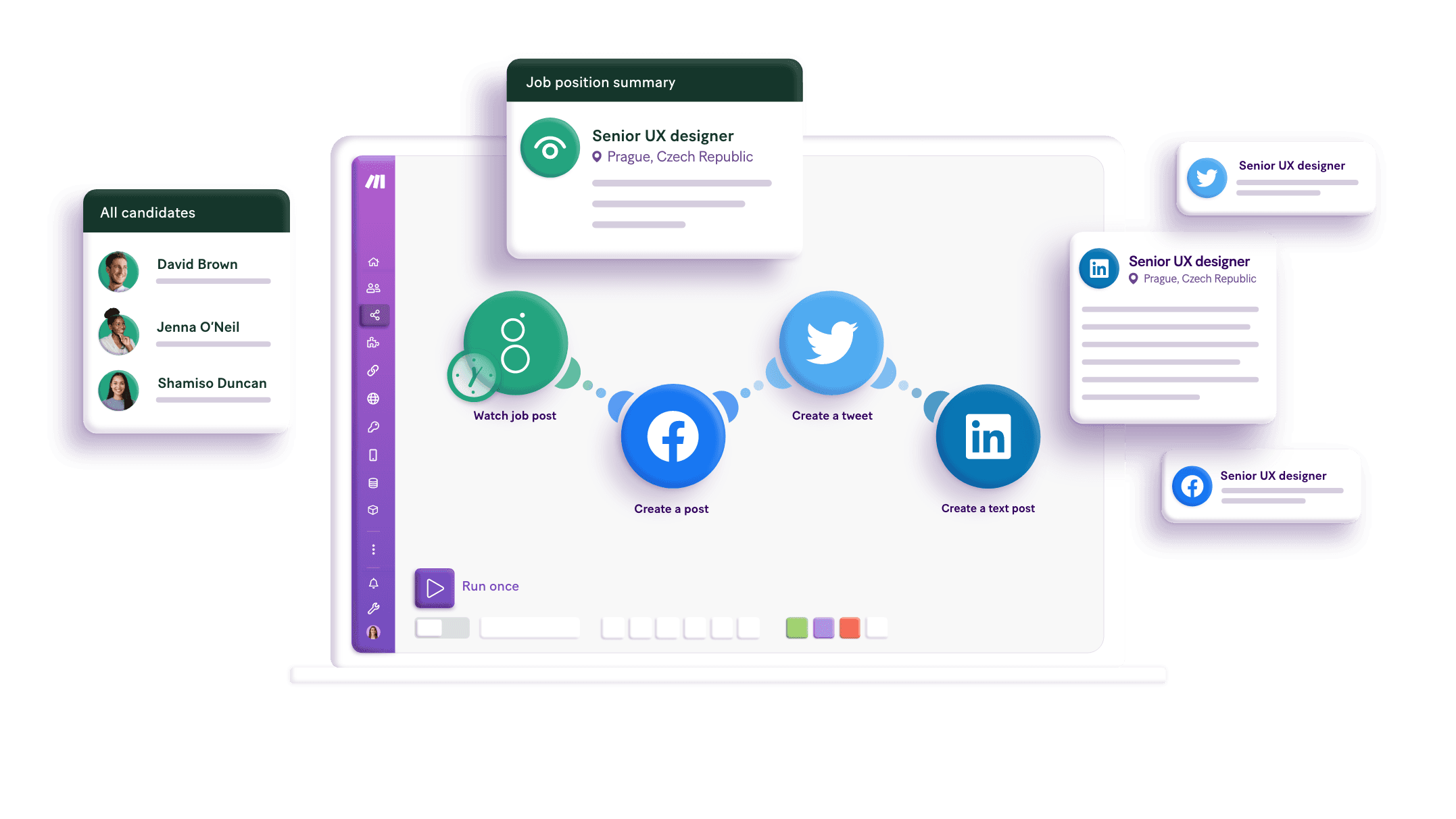
Build your Google Gemini AI and Gemini Enterprise Agent Platform integrations.
Integrate Gemini Enterprise Agent Platform as a trigger and Google Gemini AI as an action through Make's automation platform. When Gemini Enterprise Agent Platform triggers your workflow by detecting specific events or conditions, it automatically initiates Google Gemini AI to execute actions such as processing data, generating insights, or running AI models. This trigger-action integration allows you to create automated workflows where Gemini Enterprise Agent Platform monitors for designated triggers, and upon activation, Google Gemini AI performs the corresponding actions without manual intervention. By connecting Gemini Enterprise Agent Platform as a trigger with Google Gemini AI as an action, you can orchestrate intelligent automated processes that respond dynamically to AI-detected events and execute complex AI-driven tasks.
Analyzes images and/or videos from the input parameters based on instructions specified in the prompt.
Creates a chat prompt to a Gemini model based on the input parameters.
Creates a new file search store.
Deletes a file from a selected files search store.
Deletes a file search store.
Extracts structured data from text or files.
Generates up to 3 720p videos from a text prompt or image using Gemini Omni Flash, or edits a previous video via its Interaction ID.
Generates up to 4 videos from a text prompt or image using Google Veo. Supports up to 1080p resolution and 4-8 second clips.
Generates a response for the provided input.
Popular Google Gemini AI and Gemini Enterprise Agent Platform workflows.
Looking to get more out of Google Gemini AI and Gemini Enterprise Agent Platform? With Make you can visually integrate Google Gemini AI and Gemini Enterprise Agent Platform into any workflow to save time and resources — no coding required. Try any of these templates in just a few clicks.
How to setup Google Gemini AI and Gemini Enterprise Agent Platform in 5 easy steps
Set up your Google Cloud project
Log into Google Cloud Platform and create a new project by clicking 'Create or select a project' and then 'New project'. Give it a clear name and make sure it's selected in the top menu dropdown so you're working in the correct workspace.
Get your API credentials
For Google Gemini AI, visit Google AI Studio, click 'Get API key', then 'Create API key', select your project, and copy the key to save it. For Google Vertex AI, go to 'APIs & Services' in Google Cloud, search for 'Vertex AI Gemini API' in the Library, and click 'Enable' to activate it.
Complete billing setup if required
If you see a 'Billing required' message when enabling services, click 'Enable Billing' and follow the prompts. This step ensures your Google Cloud project has the necessary permissions to access AI services that Make will connect to.
Add your AI module in Make
Log into Make and add either the Google Gemini AI or Google Vertex AI module to your automation scenario. Click 'Create a connection' to start the process of linking Make with your chosen Google AI service.
Connect and authenticate your app
Give your connection a descriptive name to help you identify it later. For Google Gemini AI, paste your API key into the designated field. For Google Vertex AI, click 'Sign in with Google' and authenticate. Finally, click 'Save' to complete the connection.
Enterprise AI power: Google Gemini AI + Vertex AI integration benefits
Connect Google Gemini AI with Google Vertex AI to create powerful automated workflows that optimize model deployment, improve performance monitoring, and reduce costs while scaling your AI operations.
Automatically deploy and manage Gemini models from development to production by connecting Google Gemini AI's generation capabilities with Vertex AI's enterprise-grade deployment infrastructure.
Stream Gemini AI outputs directly into Vertex AI for comprehensive tracking, evaluation, and fine-tuning based on real-world performance metrics.
Use Google Gemini AI to generate, augment, or label training data that automatically feeds into Vertex AI's model training workflows for continuous improvement.
Orchestrate complex AI pipelines that use Gemini's text generation alongside Vertex AI's multi-modal capabilities for images, speech, and code in a single automated workflow.


FAQ
Google Gemini AI in Make provides direct access to Gemini's conversational AI capabilities for tasks like text generation, translation, and content creation - perfect for straightforward AI interactions. Google Vertex AI (Gemini) offers enterprise-grade features including model customization, fine-tuning, multi-modal processing (text, code, images, speech), and deployment options for production applications. Use Google Gemini AI for quick AI-powered automations and content workflows, or choose Vertex AI when you need advanced customization, multi-modal capabilities, or enterprise-level ML operations. Make allows you to integrate both, so you can start with Gemini AI and scale to Vertex AI as your needs grow.
Absolutely! Make's visual automation builder lets you combine both Google Gemini AI and Vertex AI (Gemini) in the same workflow, allowing you to use the strengths of each platform. For example, you could use Google Gemini AI for initial content generation or customer interactions, then pass complex tasks requiring custom models, image analysis, or code generation to Vertex AI. This hybrid approach gives you flexibility to optimize costs and performance - using the simpler Gemini AI for routine tasks while reserving Vertex AI's advanced capabilities for specialized operations. With Make's drag-and-drop interface, connecting these Google AI services with your other business applications requires no coding.
Make simplifies the integration process significantly, even for users without technical backgrounds. For Google Gemini AI, you simply connect your Google account, select pre-built modules for tasks like 'Generate Text' or 'Create Chat Completion,' and configure your prompts. Vertex AI setup is similarly straightforward - Make provides ready-made modules for model predictions, text generation, and multi-modal operations. You don't need to understand APIs, write code, or manage authentication complexities. Make's visual interface guides you through each step, and you can test your workflows in real-time. Plus, Make offers templates and documentation specifically for Google AI integrations, so you can start automating AI-powered processes within minutes rather than days of development work.
Integrating Google's AI platforms through Make opens powerful automation possibilities across your business. You can build intelligent content pipelines that generate marketing copy with Gemini AI, analyze customer sentiment from multiple channels, and route insights to your CRM. For customer support, automatically classify incoming tickets using Vertex AI's custom models, generate response drafts with Gemini, and update your helpdesk system - all without human intervention. E-commerce businesses can automate product description generation, image analysis for quality control, and personalized recommendation engines. Development teams can set up code review automation, documentation generation, and bug report analysis. Make connects these AI capabilities with 1,500+ apps including Slack, Google Sheets, Salesforce, and Shopify, enabling you to embed AI intelligence throughout your existing tech stack and eliminate repetitive manual work.
A scenario represents a workflow or a project of your own creation, and it is made up of a series of modules that automate apps and services. Creating a scenario allows you to transfer and transform data between apps and services via these modules to automate anything and improve the way you work.
Modules are the main building blocks of automation in Make. Modules represent actions that Make performs with an app, like creating, updating, or deleting data.
How it works
Traditional no-code iPaaS platforms are linear and non-intuitive. Make allows you to visually create, build, and automate without limits.
Trusted by 350,000+ customers
"Make really helped us to scale our operations, take the friction out of our processes, reduce costs, and relieved our support team. It is difficult to not become a fan."

Philipp Weidenbach
Head of Operations at Teleclinic
"Make drives unprecedented efficiency within our business in ways we never imagined. It’s having an extra employee (or 10) for a fraction of the cost."

Cayden Phipps
COO at Shop Accelerator Martech
"The simplicity, flexibility and ability to build real complex automations without any knowledge of programming makes it the best thing since sliced bread."

Erkki Markus
Product Owner at Smaily
"True citizen development in the entire company. Make is present in every department, empowering the company to offer a unique customer experience."

Andreas Stryz
CTO & Co-founder at FINN
"I can't count the number of hours I've saved by using Make. Every single day is simpler because of Make's automation."

Kimberly D
Owner of Media Production