
Connect Google Gemini AI and Microsoft Power BI integrations
Transform your data intelligence by automatically connecting Google Gemini AI insights to Microsoft Power BI dashboards through Make's no-code automation platform. Eliminate manual data transfers and reduce errors with real-time, AI-powered visualizations that accelerate decision-making—all set up in minutes without writing a single line of code.

Triggers when a long running task has finished.

Adds or deletes rows of a specified push dataset table.
Copies an existing report.
Creates a new dashboard.
Creates a new dataset.
Deletes a dataset.
Deletes a report.
Gets metadata of a specified dashboard.
Gets metadata of a specified dashboard tile.
Gets metadata of a specified dataset.
Gets metadata of a specified app.
Gets metadata of a specified app's dashboard.
Gets metadata of a specified app's report.
Gets metadata of a specified report.
Performs an arbitrary authorized API call.
Refreshes a specified dataset.
Retrieves a list of all apps installed.
Retrieves a list of dashboards from a specified app.
Retrieves a list of reports from the specified app.
Retrieves a list of dashboards.
Retrieves a list of dashboard tiles.
Retrieves a list of datasets.
Retrieve a list of a specified dataset's users. This can be used by admin.
Retrieves a list of reports.
Trusted by thousands of fast-scaling organizations around the globe





Automate your work. Build something new.
Just drag and drop apps to automate existing workflows or build new complex processes. Solve problems across all areas and teams.
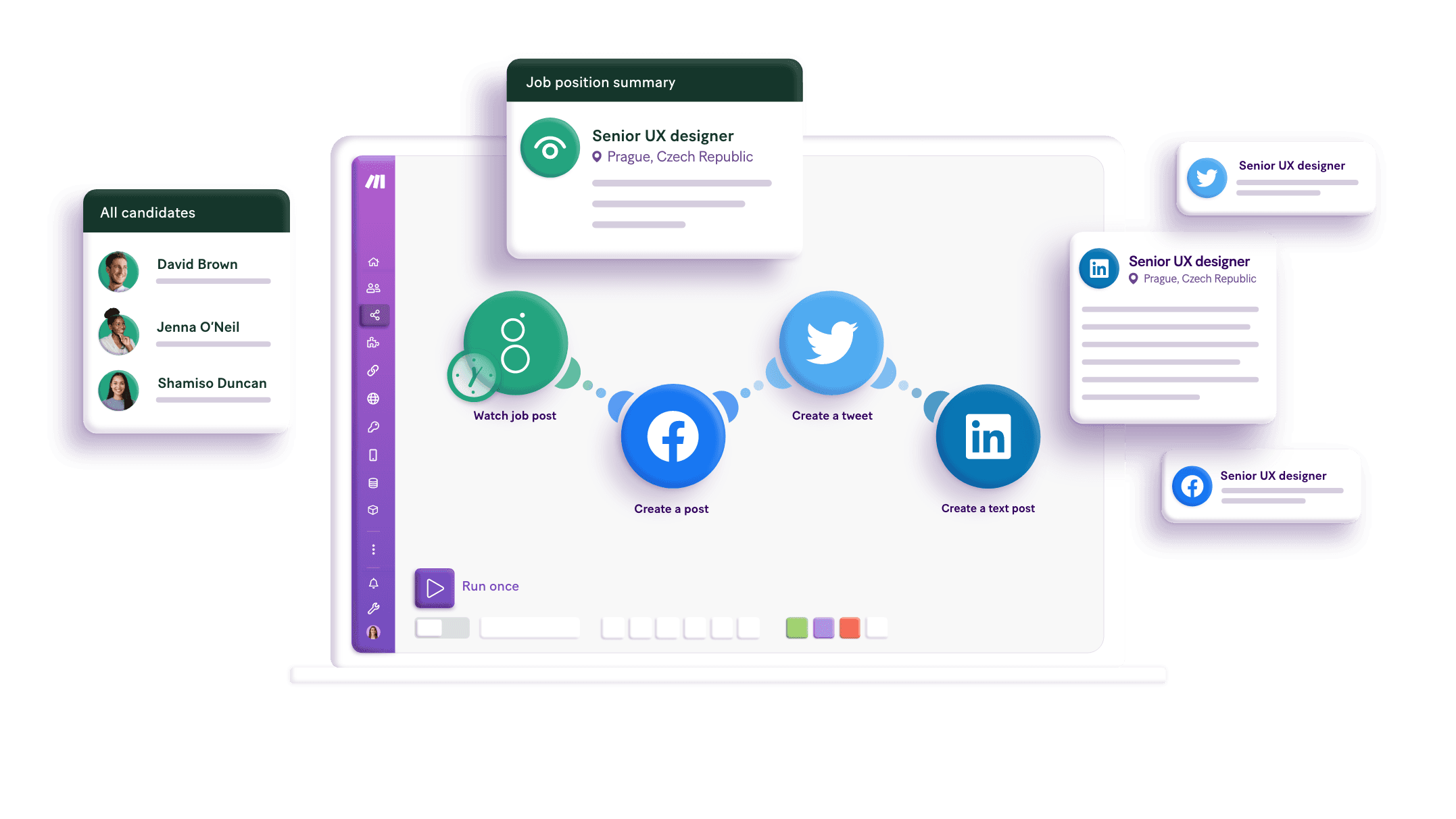
Build your Google Gemini AI and Microsoft Power BI integrations.
Connect Microsoft Power BI and Google Gemini AI through Make's intelligent automation platform to harness the power of AI-driven analytics. With Make, you can bridge the gap between Microsoft Power BI's advanced artificial intelligence capabilities as a trigger and Google Gemini AI's robust data visualization tools as an action, creating automated workflows that transform how your business processes information. Automatically feed insights generated by Microsoft Power BI directly into your Google Gemini AI dashboards, eliminating manual data transfers and reducing the risk of human error. Make empowers you to build sophisticated integrations where Microsoft Power BI triggers automated updates to Google Gemini AI without writing a single line of code, using an intuitive visual interface that connects these powerful applications in minutes. Transform your data workflow by automating the connection where Microsoft Power BI acts as the trigger and Google Gemini AI responds as the action, saving countless hours while improving accuracy and decision-making speed.
Adds or deletes rows of a specified push dataset table.
Copies an existing report.
Creates a new dashboard.
Creates a new dataset.
Creates a new file search store.
Deletes a dataset.
Deletes a report.
Deletes a file from a selected files search store.
Deletes a file search store.
Popular Google Gemini AI and Microsoft Power BI workflows.
Looking to get more out of Google Gemini AI and Microsoft Power BI? With Make you can visually integrate Google Gemini AI and Microsoft Power BI into any workflow to save time and resources — no coding required. Try any of these templates in just a few clicks.
How to setup Google Gemini AI and Microsoft Power BI in 5 easy steps
Understanding how Make connects your apps
To automate tasks between your favorite applications and Make, you first need to create a connection that acts like a secure bridge. This connection allows Make to safely access your apps and perform actions on your behalf. Each app requires specific credentials - think of these as keys that verify your identity and give Make permission to work with your data.
Setting up Google Cloud Platform for Gemini AI
Before connecting Google Gemini AI to Make, you'll need to create a project in Google Cloud Platform. Simply log in with your Google account, click 'Create or select a project,' and then choose 'New project.' Give your project a name, select its location, and click 'Create.' Make sure your new project is selected at the top of the page before continuing to the next step.
Getting your API key from Google AI Studio
Once your Google Cloud project is ready, you'll need to obtain an API key which serves as your unique password for connecting. Log in to Google AI Studio, click 'Get API key,' and select 'Create API key.' Choose your existing Google Cloud project from the dropdown list and click to create the key. Copy this key and save it in a safe place - you'll need it to complete your connection in Make.
Registering an application for Microsoft Power BI
To connect Microsoft Power BI to Make, you need to register an application in the Microsoft Entra ID section of the Azure portal. Click on 'App registrations' and then 'New registration.' Enter a name for your application and use this specific callback URL: 'https://www.integromat.com/oauth/cb/microsoft-power-bi.' After filling in these details, click 'Register' to create your application credentials.
Completing your connection in Make
With your credentials ready, open Make and add your chosen app module to your workflow. Click 'Create a connection' and enter the credentials you collected earlier - for Gemini AI, paste your API key, or for Power BI, enter your Client ID, Tenant ID, and Client Secret. Click save and follow any on-screen prompts to authenticate. Once complete, your connection is ready and you can start building automated workflows with your connected applications.
AI-powered business intelligence with Google Gemini AI and Microsoft Power BI
Connect Google Gemini AI with Microsoft Power BI to transform raw data into intelligent insights. Automate report generation, create conversational dashboards, and generate executive summaries.
Automatically generate natural language insights and summaries from Power BI data using Gemini's advanced language capabilities.
Use Gemini to analyze Power BI datasets and create automated interpretations of trends, anomalies, and patterns without manual intervention.
Use Gemini to translate natural language requests into Power BI dashboard configurations, making business intelligence accessible to non-technical users.
Transform complex Power BI visualizations and metrics into executive-ready narratives and reports using Gemini's text generation capabilities.


FAQ
By integrating Google Gemini AI with Power BI through Make, you can automatically generate natural language insights, summaries, and explanations of your Power BI data. Gemini can analyze complex datasets, create narrative reports, translate technical metrics into business-friendly language, and even generate predictive insights. This integration allows you to automate the creation of executive summaries, answer ad-hoc questions about your data in plain language, and make your Power BI dashboards more accessible to non-technical stakeholders. Make handles the connection, letting you trigger Gemini analysis based on Power BI events or schedules without any coding required.
With Make, you can create powerful automated workflows such as: automatically generating written analysis reports when new Power BI data is refreshed, creating natural language alerts when metrics reach certain thresholds, translating dashboard insights into multiple languages for global teams, generating personalized data summaries for different stakeholders, creating predictive narratives based on trend analysis, and automating the generation of presentation-ready content from your Power BI reports. Make's visual workflow builder allows you to set up these automations in minutes by simply connecting triggers and actions between both applications, with no programming knowledge needed.
Not at all! Make is designed specifically for users without technical backgrounds. The platform provides a visual, drag-and-drop interface where you can connect Google Gemini AI and Power BI in just a few clicks. Make offers pre-built modules for both applications, so you simply select the triggers (like when a Power BI report updates) and actions (like asking Gemini to analyze the data) you want. You can start with Make's templates or build custom workflows step-by-step with guided instructions. Most users can create their first integration in under 30 minutes, and Make's extensive documentation and support community are available if you need help along the way.
Automating the integration between Google Gemini AI and Power BI through Make can save significant time and resources. Tasks that typically take analysts hours—such as writing data summaries, creating narrative reports, translating insights for different audiences, or responding to routine data questions—can be automated to run in seconds. Organizations report saving 10-20 hours per week per analyst by automating repetitive reporting tasks. Make's pricing is transparent and scales with your usage, starting with a free tier that includes 1,000 operations per month, which is often sufficient for small to medium workflows. By reducing manual work, your team can focus on strategic analysis rather than routine reporting, while ensuring consistent, timely insights are delivered automatically to stakeholders.
A scenario represents a workflow or a project of your own creation, and it is made up of a series of modules that automate apps and services. Creating a scenario allows you to transfer and transform data between apps and services via these modules to automate anything and improve the way you work.
Modules are the main building blocks of automation in Make. Modules represent actions that Make performs with an app, like creating, updating, or deleting data.
How it works
Traditional no-code iPaaS platforms are linear and non-intuitive. Make allows you to visually create, build, and automate without limits.
Trusted by 350,000+ customers
"Make really helped us to scale our operations, take the friction out of our processes, reduce costs, and relieved our support team. It is difficult to not become a fan."

Philipp Weidenbach
Head of Operations at Teleclinic
"Make drives unprecedented efficiency within our business in ways we never imagined. It’s having an extra employee (or 10) for a fraction of the cost."

Cayden Phipps
COO at Shop Accelerator Martech
"The simplicity, flexibility and ability to build real complex automations without any knowledge of programming makes it the best thing since sliced bread."

Erkki Markus
Product Owner at Smaily
"True citizen development in the entire company. Make is present in every department, empowering the company to offer a unique customer experience."

Andreas Stryz
CTO & Co-founder at FINN
"I can't count the number of hours I've saved by using Make. Every single day is simpler because of Make's automation."

Kimberly D
Owner of Media Production