
Connect Gmail and Mailchimp integrations

Triggers when a new email is received to be processed according to specified criteria.

Adds a new member to a static segment.
Adds a new event to the member.
Adds or removes tags from a list member.
Adds or updates a list member.
Adds an email address to a subscriber list.
Creates a new campaign.
Creates a new list.
Creates a new merge field.
Creates a new order.
Deletes a campaign.
Deletes a list.
Deletes an existing merge field.
Archives or permanently deletes a subscriber.
Edits a defined content area of a custom HTML template.
Edits an existing subscriber.
Gets metadata of a specified campaign.
Gets a campaign report.
Retrives an existing click report.
Gets metadata of a specified list.
Retrieves an existing merge field.
Gets metadata of a subsciber by email.
Performs an arbitrary authorized API call.
Performs a campaign action.
Removes a member from the specified static segment.
Updates an existing campaign.
Updates an existing list.
Updates an existing merge field.
Lists all campaign open details.
Lists all click reports.
Get the last 50 events of a member's activity on a specific list.
Retrieves up to the previous 180 days of daily detailed aggregated activity stats for a list.
Retireves a list of all member tags
Retrieves a list of all segment members.
Searches for the campaigns.
Searches for the lists.
Searches for merge fields or lists them all.
Searches for the subscribers.
Trusted by thousands of fast-scaling organizations around the globe





Automate your work. Build something new.
Just drag and drop apps to automate existing workflows or build new complex processes. Solve problems across all areas and teams.
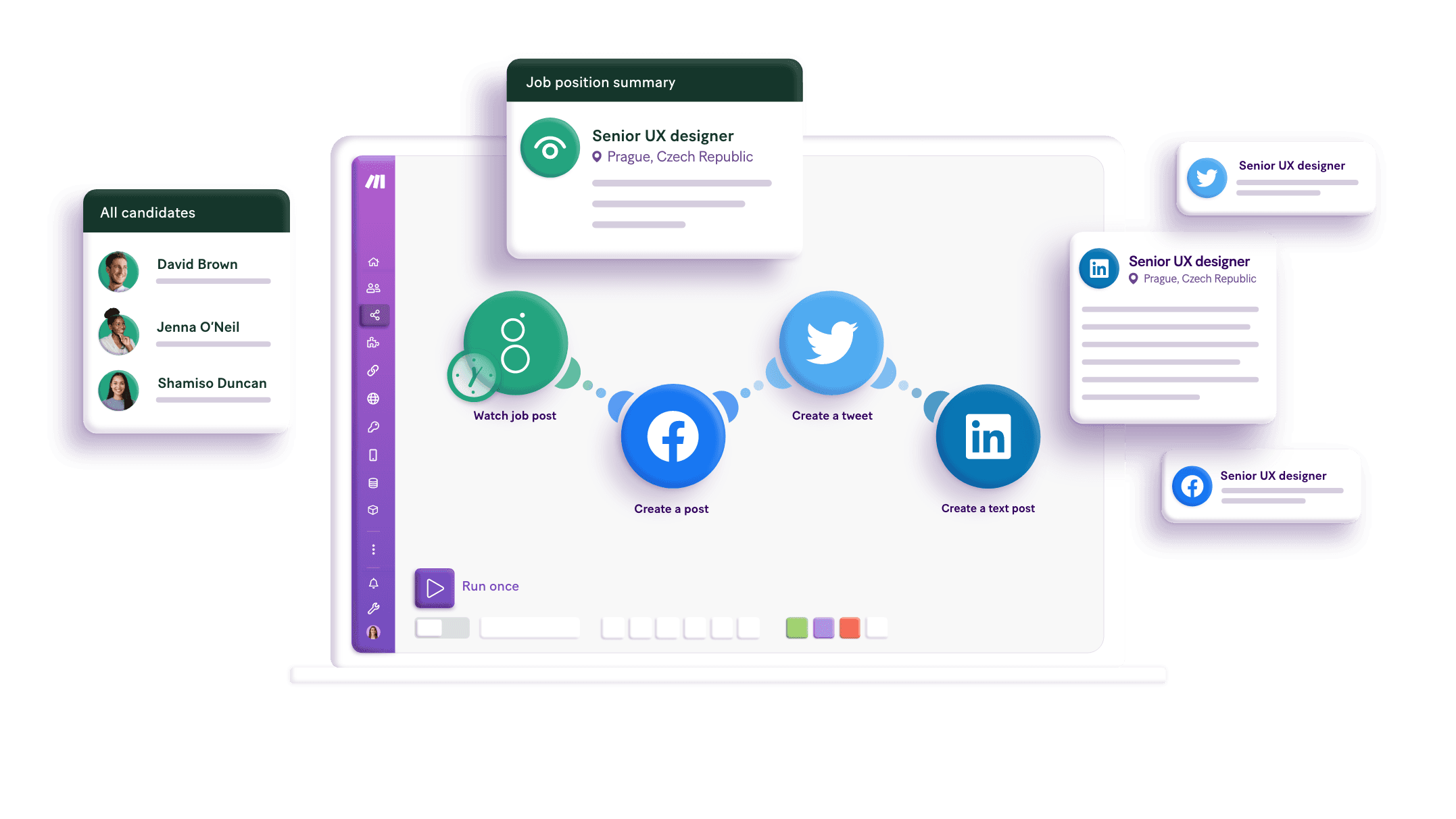
Build your Gmail and Mailchimp integrations.
By connecting Gmail and Mailchimp, you can automate workflows using Gmail as a trigger and Mailchimp as an action. Set up triggers in Gmail, such as receiving new emails or specific label assignments, to initiate actions in Mailchimp like adding subscribers, updating lists, or sending personalized messages. This integration improves subscriber management and campaign targeting, enhancing your email marketing efficiency by aligning efforts with real-time data.
Adds a new member to a static segment.
Adds a new event to the member.
Adds or removes tags from a list member.
Adds or updates a list member.
Adds an email address to a subscriber list.
Copies an email or a draft into a selected folder.
Creates a new campaign.
Creates a new draft and adds it to a selected folder.
Creates a new list.
Popular Gmail and Mailchimp workflows.
Experience direct communication and better subscriber engagement by automating Gmail with Mailchimp. Optimize your workflow and improve efficiency with popular integrations for automatic welcome emails and more.
How to setup Gmail and Mailchimp in 5 easy steps
Start by accessing your Make account
Log into your Make account to start setting up the connections between applications.
Add Gmail to your setup
Choose to add Gmail in Make, which will let you connect it with Google Email for new tasks.
Connect Gmail with Make
Sign in using your Google account and give permission for Make to access your Gmail.
Add Mailchimp to the mix
Open the Mailchimp option in Make and initiate the connection setup.
Authorize Mailchimp access
Log into your Mailchimp account and allow Make to connect with it, completing the setup.
Maximize efficiency by integrating Gmail and Mailchimp
Harness the power of Gmail and Mailchimp integration to automate welcome emails, improve subscriber engagement, and streamline communication for better efficiency and effective email outreach.
Instantly send personalized welcome emails to new Mailchimp subscribers via Gmail.
Connect Mailchimp and Gmail to ensure prompt communication with subscribers.
Engage subscribers with automatic messages when they join your Mailchimp list.
Integrate Gmail and Mailchimp to automate your email outreach processes.


FAQ
Integrating Gmail with Make allows you to automate workflows by connecting it with other applications like Slack, Telegram Bot, ClickUp, Google Drive, Airtable, and more. This means you can simplify processes, improve productivity, and eliminate repetitive tasks by setting up automations that trigger actions across these platforms through email interactions.
By integrating Mailchimp with Make, you can automate tasks such as adding new subscribers to your Mailchimp list from other apps, triggering email campaigns based on specific actions like form submissions, or syncing data between Mailchimp and CRM systems. This helps improve your marketing efforts, ensuring timely and relevant communications with your audience.
Make is designed to be user-friendly, even for those without technical expertise. It offers a straightforward interface with pre-built templates and a drag-and-drop setup, making it easier to create complex workflows. You can quickly start automating your processes without deep knowledge of coding or IT support.
Make allows for dynamic and personalized automations that can improve your email management and marketing strategies. For example, you can set up scenarios where specific Gmail triggers initiate Mailchimp actions, like sending a newsletter, updating contact lists or tagging subscribers based on email content or sender information. This interconnected setup provides a cohesive experience that helps you stay on top of email communications and marketing tasks effectively.
A scenario represents a workflow or a project of your own creation, and it is made up of a series of modules that automate apps and services. Creating a scenario allows you to transfer and transform data between apps and services via these modules to automate anything and improve the way you work.
Modules are the main building blocks of automation in Make. Modules represent actions that Make performs with an app, like creating, updating, or deleting data.
How it works
Traditional no-code iPaaS platforms are linear and non-intuitive. Make allows you to visually create, build, and automate without limits.
Trusted by 350,000+ customers
"Make really helped us to scale our operations, take the friction out of our processes, reduce costs, and relieved our support team. It is difficult to not become a fan."

Philipp Weidenbach
Head of Operations at Teleclinic
"Make drives unprecedented efficiency within our business in ways we never imagined. It’s having an extra employee (or 10) for a fraction of the cost."

Cayden Phipps
COO at Shop Accelerator Martech
"The simplicity, flexibility and ability to build real complex automations without any knowledge of programming makes it the best thing since sliced bread."

Erkki Markus
Product Owner at Smaily
"True citizen development in the entire company. Make is present in every department, empowering the company to offer a unique customer experience."

Andreas Stryz
CTO & Co-founder at FINN
"I can't count the number of hours I've saved by using Make. Every single day is simpler because of Make's automation."

Kimberly D
Owner of Media Production