
Connect MySQL and Slack integrations


Adds a reaction to a message.
Adds a star to a channel.
Archives a channel.
Creates a channel.
Creates a reminder.
Deletes a file.
Removes a message.
Edits a message.
Returns details about a channel.
Returns details about a file.
Returns a message with a given ID from a specified private channel.
Returns a message with a given ID from a specified public channel.
Returns details about a member of a workspace.
Invites 1-30 users to a public or private channel.
Joins to an existing channel.
Removes a user from a channel.
Leaves a channel.
Performs an arbitrary authorized API call.
Pins a message to a channel.
Removes a reaction from a message.
Removes a star from a channel.
Removes a saved item.
Adds an Item to saved items.
Sends a file message.
Sends a message.
Update a user's current status.
Changes the purpose of a channel.
Changes the topic of a channel.
Unarchives a channel.
Unpins a message from a channel.
Creates or uploads a file.
Returns a list of channels in a workspace.
Returns a list of files within a team.
Retrieves IDs of members in a channel.
Returns reactions a user made.
Retrieves a thread of messages posted to a conversation.
Returns a list of all users in a workspace.
Returns messages matching a search query.
Retrieves a single user by looking them up by their registered email address.
Trusted by thousands of fast-scaling organizations around the globe





Automate your work. Build something new.
Just drag and drop apps to automate existing workflows or build new complex processes. Solve problems across all areas and teams.
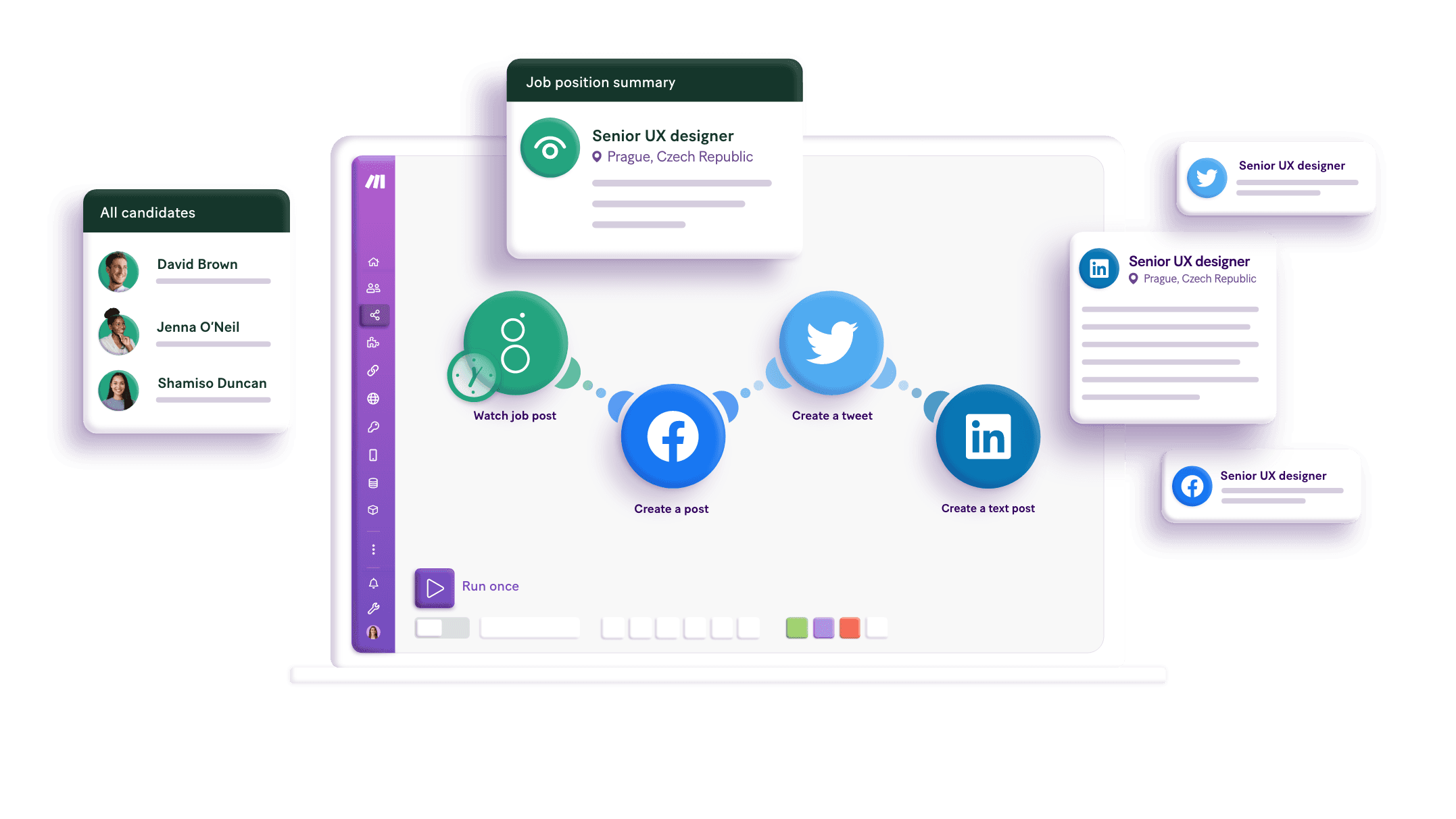
Build your MySQL and Slack integrations.
Integrate MySQL and Slack using Make to create automated workflows where updates in a MySQL database trigger messages in Slack, keeping your team informed without manual intervention. This automation minimizes errors and saves time, allowing focus on strategic tasks. Explore the integration today to improve communication and workflow efficiency.
Adds a reaction to a message.
Adds a star to a channel.
Archives a channel.
Creates a channel.
Creates a reminder.
Deletes a file.
Removes a message.
Edits a message.
Popular MySQL and Slack workflows.
Looking to get more out of MySQL and Slack? With Make you can visually integrate MySQL and Slack into any workflow to save time and resources — no coding required. Try any of these templates in just a few clicks.
How to setup MySQL and Slack in 5 easy steps
Set up your MySQL connection
Start by giving a unique name to your MySQL connection and provide the necessary server information like address and port number.
Enter database credentials
Fill in the required username and password to enable access to your MySQL server.
Verify MySQL access
Ensure that your MySQL server allows external access and that the appropriate permissions are configured.
Integrate Slack with Make
Add Slack to your automation by including its module in your Make scenario and establishing a new connection.
Authenticate and customize Slack
Log into your Slack account to finalize the connection, then expand your automation capabilities by adding more Slack actions.
Integrate MySQL and Slack for real-time notifications
Experience integration by automating MySQL and Slack, allowing real-time notifications, automated reporting, and error monitoring for better team collaboration.
Receive instant Slack alerts for any MySQL database changes to stay up to date with your data.
Generate and send MySQL reports directly to Slack channels to streamline data sharing.
Improve team efficiency by automatically sharing database updates with relevant team members in Slack.
Use Slack commands to trigger specific MySQL queries, reducing the need for manual data retrieval.


FAQ
By integrating MySQL and Slack with Make, users can automate the flow of data between their databases and their team communication platform. This ensures that updates in your database can instantly trigger notifications or messages in Slack, facilitating real-time collaboration and decision-making. It improves workflow and eliminates manual data entry errors, optimizing overall efficiency.
Make enables clear communication and updates by automatically pushing crucial database changes from MySQL to selected Slack channels or direct messages. This reduces the time spent on communicating changes manually, allowing teams to focus on more strategic tasks, respond to changes faster, and enhance productivity with minimal disruption.
One key challenge is ensuring timely communication across teams regarding database changes. Integrating MySQL and Slack through Make ensures that changes in the database are automatically communicated to relevant team members, reducing the risk of miscommunication or delays in action. This integration can significantly improve project management and accountability.
Make provides a user-friendly interface with powerful automation capabilities, allowing for complex workflows and integrations without needing extensive programming knowledge. Users can easily set triggers and actions between MySQL and Slack, tailoring the process to fit their specific business needs. This flexibility, combined with the ability to track and adjust workflows in real-time, makes it distinct in optimizing integrated system performance.
A scenario represents a workflow or a project of your own creation, and it is made up of a series of modules that automate apps and services. Creating a scenario allows you to transfer and transform data between apps and services via these modules to automate anything and improve the way you work.
Modules are the main building blocks of automation in Make. Modules represent actions that Make performs with an app, like creating, updating, or deleting data.
How it works
Traditional no-code iPaaS platforms are linear and non-intuitive. Make allows you to visually create, build, and automate without limits.
Trusted by 350,000+ customers
"Make really helped us to scale our operations, take the friction out of our processes, reduce costs, and relieved our support team. It is difficult to not become a fan."

Philipp Weidenbach
Head of Operations at Teleclinic
"Make drives unprecedented efficiency within our business in ways we never imagined. It’s having an extra employee (or 10) for a fraction of the cost."

Cayden Phipps
COO at Shop Accelerator Martech
"The simplicity, flexibility and ability to build real complex automations without any knowledge of programming makes it the best thing since sliced bread."

Erkki Markus
Product Owner at Smaily
"True citizen development in the entire company. Make is present in every department, empowering the company to offer a unique customer experience."

Andreas Stryz
CTO & Co-founder at FINN
"I can't count the number of hours I've saved by using Make. Every single day is simpler because of Make's automation."

Kimberly D
Owner of Media Production