
Connect RingCentral and Vapi integrations
Transform your business communications by connecting RingCentral and Vapi through Make's powerful automation platform. Automatically trigger intelligent voice AI agents for every incoming call, eliminate manual workflows, and deliver 24/7 conversational AI responses—all through an intuitive drag-and-drop interface that requires no coding expertise.

Triggers when any new call appears in the system.
Triggers when a new incoming call has been picked up.
Returns new call recordings since the last check.
Triggers when there is a new incoming or outgoing call.
Triggers when there is a new missed call.
Triggers when a new fax has been received.
Watches for new messages.
Triggers when a new Outbound SMS message is created or updated.
Triggers when a new SMS message received.
Triggers when a new voice message has been received.

Sends a client-generated event or object to the VAPI platform. Commonly used for live updates or user actions.
Creates a new voice assistant with a specified configuration (name, voice, model, etc.).
Starts a new call session using an assistant or a squad. Often used to simulate or initiate interactions.
Creates a group of assistants (a squad) where the first available assistant responds to a call.
Defines a new tool that can be invoked by an assistant (e.g., API calls, function tools, DTMF).
Deletes a specific assistant by ID.
Deletes call metadata and logs for a particular conversation.
Deletes a selected file from the knowledge base.
Fetches details for a specific file by ID.
Retrieves information about a specific squad, including its members.
Fetches the details of a tool, such as its configuration and endpoint.
Performs an arbitrary authorized API call.
Returns the response to the function call be it error or result.
Sends a message from the VAPI server to the client app. Often used to trigger UI changes or sync data.
Updates the configuration of an existing assistant.
Allows updates to a specific call session (e.g., tagging, note-taking).
Updates the configuration of an existing file.
Updates members or configuration of a squad.
Modifies an existing tool's logic or structure.
Upload a file to use with the knowledge base.
Fetches details for a specific assistant by ID.
Retrieves a call's metadata, including transcript, participants, and timestamps.
Lists all assistants in your VAPI account.
Shows the history of past calls, including assistant used and call duration.
Retrieve all files in your knowledge base.
Returns the list of Twilio or Vonage numbers connected to your account.
Lists all squads and their associated assistants.
List Tools.
Trusted by thousands of fast-scaling organizations around the globe





Automate your work. Build something new.
Just drag and drop apps to automate existing workflows or build new complex processes. Solve problems across all areas and teams.
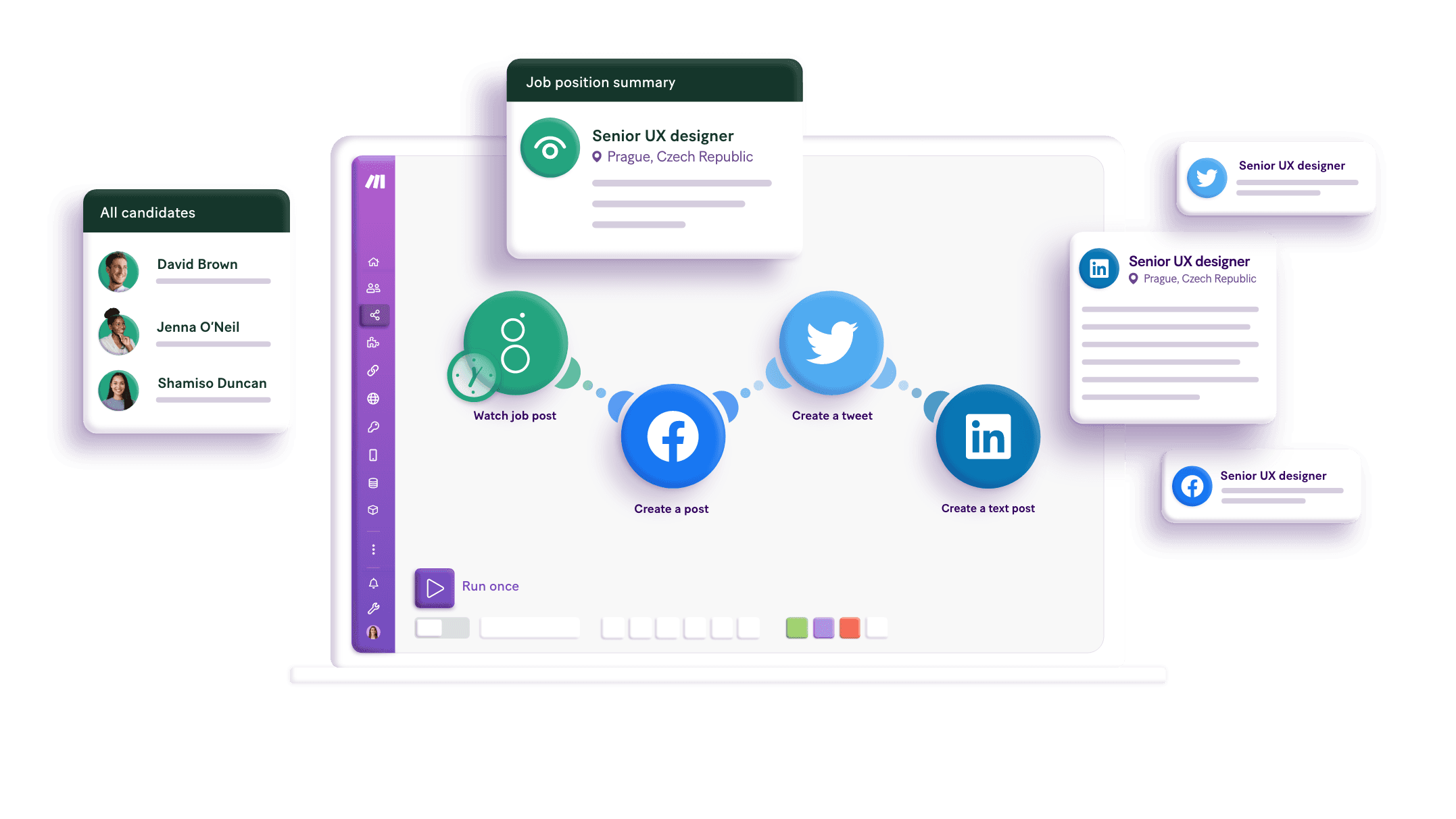
Build your RingCentral and Vapi integrations.
Connect Vapi and RingCentral through Make's intuitive integration platform to automate communication and voice AI workflows. Make empowers businesses to automatically trigger RingCentral voice agents when Vapi receives calls, eliminating manual data transfers and reducing operational inefficiencies. The drag-and-drop interface enables you to map data fields and establish real-time synchronization, where Vapi acts as the trigger to initiate actions in RingCentral, ensuring your communication workflows run smoothly 24/7. By integrating these powerful applications through Make, you can create intelligent automated responses that use Vapi's telephony events to activate RingCentral's conversational AI technology.
Sends a client-generated event or object to the VAPI platform. Commonly used for live updates or user actions.
Creates a new voice assistant with a specified configuration (name, voice, model, etc.).
Starts a new call session using an assistant or a squad. Often used to simulate or initiate interactions.
Creates a group of assistants (a squad) where the first available assistant responds to a call.
Defines a new tool that can be invoked by an assistant (e.g., API calls, function tools, DTMF).
Creates a new contact
Deletes a specific assistant by ID.
Deletes call metadata and logs for a particular conversation.
Deletes a selected file from the knowledge base.
Popular RingCentral and Vapi workflows.
Looking to get more out of RingCentral and Vapi? With Make you can visually integrate RingCentral and Vapi into any workflow to save time and resources — no coding required. Try any of these templates in just a few clicks.
How to setup RingCentral and Vapi in 5 easy steps
Gather your connection credentials
Before connecting RingCentral or Vapi to Make, you need special credentials that act like passwords allowing the apps to communicate securely. For RingCentral, you'll get these from their Developer Console by creating an app, while for Vapi, you'll find an API key in your account settings. Think of these credentials as special keys that grant Make the ability to work with your other applications.
Get your RingCentral credentials
Log into RingCentral and go to the Developer Console where you'll create a new REST API App. During setup, you'll need to enter a specific callback URL: https://www.integromat.com/oauth/cb/ringcentral. Once created, RingCentral will display your Client ID and Client Secret on the screen—copy both and save them securely as you'll need them to complete your Make connection.
Get your Vapi API key
Log into your Vapi account and click 'Build' in the left sidebar, then select 'Vapi API Keys' to access your credentials section. Locate and copy your Private Key, which is what Make needs to connect to your Vapi account. Store this key safely because you won't be able to view it again later, and you'll need it when setting up the connection in Make.
Add a module and start the connection
In your Make account, add either a RingCentral or Vapi module to your automation scenario. When you add the module, you'll see a 'Create a connection' button—click it to open a form. This form is where you'll enter the credentials you gathered earlier, allowing Make to establish a secure link with your chosen application.
Complete and save your connection
In the connection form, paste the credentials you copied earlier into the appropriate fields—Client ID and Client Client Secret for RingCentral, or API Key for Vapi. You can give your connection a descriptive name to help you remember its purpose. Click 'Save' to finalize the connection, and if prompted, confirm that you want to allow Make to access the other application—your connection is now ready to use in your automations.
Powerful communication automation with RingCentral and Vapi integration
Integrate RingCentral and Vapi to automate call logging, enable intelligent AI-powered call routing, and create multi-channel customer engagement workflows that improve communication efficiency.
Automatically log Vapi call details and outcomes directly into RingCentral or connected CRM systems for comprehensive customer interaction tracking.
Trigger Vapi AI calls automatically when specific RingCentral events occur, such as missed calls or voicemails, ensuring no customer inquiry goes unanswered.
Connect Vapi webhook events with RingCentral to instantly notify teams via SMS or call when important AI call interactions require human follow-up.
Combine RingCentral's communication platform with Vapi's AI calling capabilities to create sophisticated automated customer engagement workflows across voice channels.


FAQ
By integrating RingCentral with Vapi through Make, you can automate your entire voice communication pipeline. RingCentral's robust calling infrastructure combined with Vapi's AI-powered voice agents creates an automated system. You can automatically trigger Vapi AI calls when specific events occur in RingCentral, log call data across both platforms, and route conversations intelligently. Make acts as the bridge, requiring no coding skills, allowing you to set up sophisticated automation workflows in minutes that would typically require expensive custom development.
The integration possibilities are extensive. You can automatically initiate Vapi AI-powered calls when a RingCentral call is missed or goes to voicemail, ensuring no customer inquiry goes unaddressed. You can capture Vapi webhook events and create corresponding records or tasks in RingCentral, maintaining comprehensive communication logs. Additionally, you can trigger follow-up sequences where RingCentral sends notifications to your team based on specific outcomes from Vapi AI calls, or automatically schedule callback appointments in RingCentral when Vapi detects customer interest. Make's visual workflow builder lets you design these scenarios without writing a single line of code.
Not at all. Make is specifically designed for users without technical backgrounds. The platform provides a visual, drag-and-drop interface where you can connect RingCentral and Vapi in minutes. Authenticate both applications through Make's secure connection process, select the triggers and actions you want to automate, and map the data fields between the two platforms. Make offers pre-built templates and an intuitive workflow builder that guides you through each step. You can start with a free Make account to test the integration, and their extensive documentation and support resources ensure you're never stuck. Most users create their first working automation within 15-30 minutes.
Make eliminates the need for expensive developers, ongoing maintenance costs, and technical complexity. Direct API integrations between RingCentral and Vapi would require significant coding expertise, server infrastructure, and continuous monitoring. With Make, you get a reliable, hosted solution that handles all the technical heavy lifting. You also gain flexibility—Make connects to 1000+ other applications, meaning you can extend your RingCentral-Vapi automation to include CRMs like Salesforce, e-commerce platforms like Shopify, email tools like Gmail, and databases. This creates a comprehensive automation ecosystem that grows with your business needs, all manageable from one central platform without writing or maintaining any code.
A scenario represents a workflow or a project of your own creation, and it is made up of a series of modules that automate apps and services. Creating a scenario allows you to transfer and transform data between apps and services via these modules to automate anything and improve the way you work.
Modules are the main building blocks of automation in Make. Modules represent actions that Make performs with an app, like creating, updating, or deleting data.
How it works
Traditional no-code iPaaS platforms are linear and non-intuitive. Make allows you to visually create, build, and automate without limits.
Trusted by 350,000+ customers
"Make really helped us to scale our operations, take the friction out of our processes, reduce costs, and relieved our support team. It is difficult to not become a fan."

Philipp Weidenbach
Head of Operations at Teleclinic
"Make drives unprecedented efficiency within our business in ways we never imagined. It’s having an extra employee (or 10) for a fraction of the cost."

Cayden Phipps
COO at Shop Accelerator Martech
"The simplicity, flexibility and ability to build real complex automations without any knowledge of programming makes it the best thing since sliced bread."

Erkki Markus
Product Owner at Smaily
"True citizen development in the entire company. Make is present in every department, empowering the company to offer a unique customer experience."

Andreas Stryz
CTO & Co-founder at FINN
"I can't count the number of hours I've saved by using Make. Every single day is simpler because of Make's automation."

Kimberly D
Owner of Media Production