
Connect Slack and Asana integrations

Triggers when a new message is added to a direct message channel.
Triggers when a new file is added.
Triggers when a new message is added to a multiparty direct message channel.
Triggers when a new message or another event is created.
Triggers when a new message is added to a private channel.
Triggers when a new message is added to a public channel.
Triggers when a new user is added or an existing user has changed. Only emit the latest change since the last scenario run.

Creates an enumeration option for a custom field.
Adds a comment to a task.
Adds a task to a project or section at a specific location.
Adds a user to a team.
Adds the specified list of users as members of the portfolio.
Creates a (workspace) custom field.
Creates a portfolio.
Creates a project.
Creates a project section.
Creates a project status.
Creates a tag.
Creates a task or a subtask.
Creates a team.
Deletes a custom field.
Deletes an attachment.
Deletes a portfolio.
Deletes a project.
Deletes a project section.
Deletes a project status.
Deletes a story.
Deletes a task.
Duplicates a project.
Duplicates a task.
Retrieves a (workspace) custom field.
Retrieves a goal.
Retrieves an attachment.
Retrieves a portfolio.
Retrieves a project.
Retrieves a project custom field.
Retrieves a project section.
Retrieves the task count of a project.
Retrieves a project status.
Retrieves a (task) story
Retrieves a tag.
Retrieves a task.
Retrieves a team.
Retrieves a user.
Retrieves a workspace.
Performs an arbitrary authorized API call.
Moves a project section relative to other project sections in the project's board view.
Removes a task from a project.
Removes a user from a team.
Removes the specified list of users from members of the portfolio.
Updates a custom field.
Updates an enumeration option.
Updates a portfolio.
Updates a project.
Updates the custom fields of a project.
Updates a project Section.
Updates a Story.
Updates a tag.
Updates a task.
Updates the dependencies of a task. A task can have maximum 15 dependencies.
Updates the dependents of a task. A task can have maximum 30 dependents.
Updates the followers of a task.
Updates the parent task of a task.
Updates a tag of a task.
Updates the users of a workspace.
Uploads an attachment to a task.
Retrieves all the custom fields of a project.
Retrieves all sections of a project.
Retrieves all attachments of a task.
Retrieves all the dependencies of a task.
Retrieves all the dependents of a task.
Retrieves the projects of a task.
Retrieves the stories of a task.
Retrieves the subtasks of a task.
Retrieves all the tags of a task.
Retrieves the users in a team.
Retrieves all teams of a user.
Retrieves all custom fields of a workspace.
Retrieves all teams in an organization.
Retrieves all users in an organization.
Retrieves all goals.
Retrieves all portfolios.
Retrieves all projects.
Retrieves the history of project statuses of a project.
Retrieves all tags.
Retrieves tasks of a workspace, project, tag or assignee.
Retrieves all users.
Retrieves all registered webhooks.
Retrieves all workspaces.
Trusted by thousands of fast-scaling organizations around the globe





Automate your work. Build something new.
Just drag and drop apps to automate existing workflows or build new complex processes. Solve problems across all areas and teams.
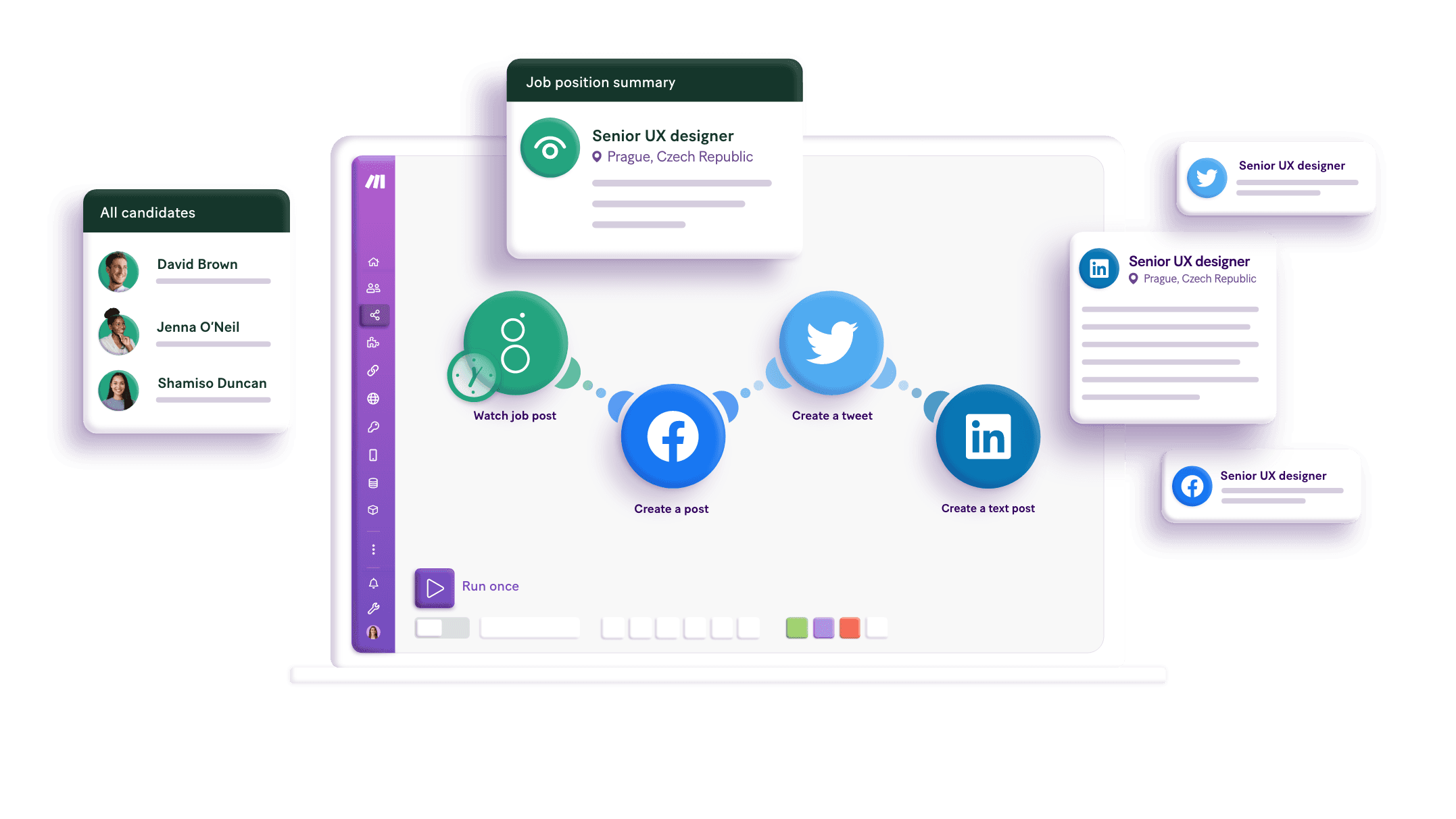
Build your Slack and Asana integrations.
Integrate Asana as a trigger and Slack as an action with Make to transform your workflow efficiency. Imagine creating seamless workflows where messages or events in Asana automatically trigger corresponding actions in Slack, such as creating tasks, updating projects, or assigning team members. This integration allows you to automate repetitive tasks, synchronize team updates, and enhance your team's collaboration and project tracking. Say goodbye to manual data entry and experience the magic of automated processes that save you time and ensure nothing falls through the cracks. Try Make today and effortlessly connect Asana and Slack for streamlined, automated operations.
Adds the specified list of users as members of the portfolio.
Adds a reaction to a message.
Adds a star to a channel.
Adds a comment to a task.
Adds a task to a project or section at a specific location.
Adds a user to a team.
Creates an enumeration option for a custom field.
Archives a channel.
Creates a channel.
Popular Slack and Asana workflows.
Boost Team Productivity with Slack and Asana Integration. Automate tasks, track progress, and get real-time updates seamlessly.
How to setup Slack and Asana in 5 easy steps
Log in to Make
Start by logging into your Make account to set up the integration.
Connect Slack
Add a Slack module in Make and follow the prompts to authorize access to your Slack account.
Connect Asana
Incorporate an Asana module in Make and follow the given instructions to connect it to your Asana account.
Verify Connections
Check that both Slack and Asana are correctly connected in Make.
Customize Workflow
Adjust your workflow in Make to include actions and interactions between Slack and Asana.
Boost Productivity by Integrating Slack and Asana for Seamless Automation
Integrating Slack and Asana through Make enhances task management by automating task creation, ensuring real-time updates, and providing instant notifications for improved team collaboration.
Automatically create Asana tasks from Slack messages to ensure no task is forgotten.
Receive Slack notifications with lists of Asana tasks due tomorrow to keep teams prepared.
Get daily Slack updates on completed Asana tasks to track progress efficiently.
Inform team members instantly via Slack when Asana tasks or subtasks are created.


FAQ
Integrating Slack and Asana using Make allows for seamless communication and task management. You can automatically send Slack notifications for new tasks in Asana, update team members on project progress, and ensure everyone stays informed in real-time. This integration enhances workflow efficiency and reduces the manual effort of updating team members on project statuses.
No, integrating Slack and Asana through Make is designed to be user-friendly and does not require any coding knowledge. Make provides an intuitive drag-and-drop interface, pre-built templates, and step-by-step guides that make it easy for anyone to set up and manage integrations between these applications.
By integrating Asana with Slack through Make, you can create automated workflows that keep your team aligned and projects on track. For instance, you can automatically post updates in a Slack channel whenever a task is completed in Asana or remind team members about upcoming deadlines. This real-time synchronization helps maintain transparency and ensures timely updates without manual intervention.
Make offers advanced automation capabilities such as multi-step workflows, data transformations, and custom triggers/actions that can be tailored to specific business needs. This flexibility allows you to create highly personalized automation scenarios beyond basic task updates, such as conditional logic workflows where specific actions depend on task attributes, enhancing the overall integration experience.
A scenario represents a workflow or a project of your own creation, and it is made up of a series of modules that automate apps and services. Creating a scenario allows you to transfer and transform data between apps and services via these modules to automate anything and improve the way you work.
Modules are the main building blocks of automation in Make. Modules represent actions that Make performs with an app, like creating, updating, or deleting data.
How it works
Traditional no-code iPaaS platforms are linear and non-intuitive. Make allows you to visually create, build, and automate without limits.
Trusted by 350,000+ customers
"Make really helped us to scale our operations, take the friction out of our processes, reduce costs, and relieved our support team. It is difficult to not become a fan."

Philipp Weidenbach
Head of Operations at Teleclinic
"Make drives unprecedented efficiency within our business in ways we never imagined. It’s having an extra employee (or 10) for a fraction of the cost."

Cayden Phipps
COO at Shop Accelerator Martech
"The simplicity, flexibility and ability to build real complex automations without any knowledge of programming makes it the best thing since sliced bread."

Erkki Markus
Product Owner at Smaily
"True citizen development in the entire company. Make is present in every department, empowering the company to offer a unique customer experience."

Andreas Stryz
CTO & Co-founder at FINN
"I can't count the number of hours I've saved by using Make. Every single day is simpler because of Make's automation."

Kimberly D
Owner of Media Production