Mar 31, 2026 | 5 minutes
How Make helps FINN’s Automation and AI Lead empower teams to innovate at speed
Read how Maxi Gebhard, Business Automation and AI Lead at FINN, created a culture of experimentation where people fluent in both business and technology drive innovation quickly – with a customer demand in mind.
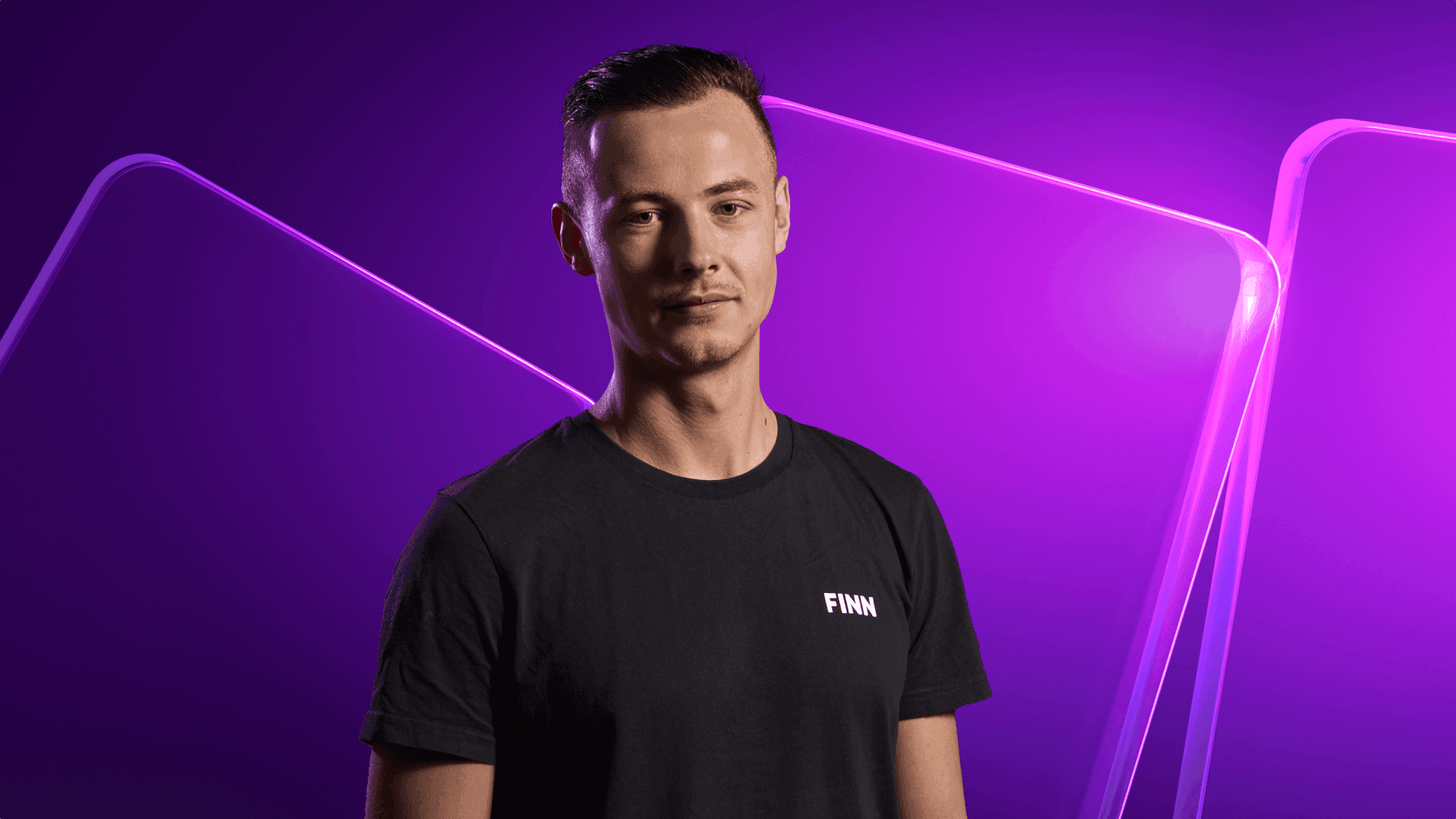
When Maxi Gebhard, a Business Automation and AI Lead at a car subscription provider FINN, joined the company as an intern in 2020, he walked into a startup with an unusual problem.
They were inventing an entirely new type of business.
Car subscription services didn't exist. There was no industry playbook to copy and no established best practices to implement. No proven processes to scale.
"FINN is a car subscription business. There's a lot of unknowns, a lot of uncertainties. There was no blueprint out there in the industry that we could follow."
Five years later, FINN has over 300 employees and more than 40,000 customers. Real innovation lies in how they achieved this so quickly. Two key steps set them apart from other fast-growth organisations.
First, FINN teaches every employee how to use automation to solve their own problems.
Second, they established "BAAMs" – a team of Business Automation and AI Managers led by Maxi. Ten professionals throughout the company, managing their automation and AI. Each has both deep business understanding and technical capabilities.
“Looping in business is crucial to success. Otherwise, you're building the product behind the scenes, not knowing what you truly need to focus on."
Why is this powerful? It brings together engineering, product, and business functions into a single role. Enabling teams to iterate and build FINN’s product faster, to meet and capitalize on consumer demand.
This is the story of how they made this happen.
The challenge: Building trust without a blueprint
Companies in established industries have a big advantage: countless other businesses operate on the same model. They know what works because someone else figured it out first. They can hire consultants who've solved similar problems and implement proven processes.
Operating within a new category to capture a new market, FINN had none of that.
The company had grown quickly, but FINN knew that to scale beyond this, they needed to gain credibility, too. They had to get customers unfamiliar with the car subscription model to trust them.
“The hardest thing about scaling quickly is not breaking trust in the process.”
The challenge surfaced: How do you scale fast growth? How do you quickly develop a service while ensuring it delivers reliably to the growing number of customers?
For most companies, that tension forces a choice. You can be fast and scrappy, or you can be reliable and structured.
Pick one.
FINN refused that trade-off. But to achieve both speed and structure, they needed to invent a new way of working. Without siloed teams and slow development processes.
Make was the answer. It provided a powerful, visual AI automation tool that empowered the entire company to innovate in a structured, yet speedy, way.
The solution: Scaling through democratization
FINN also built their culture differently. They gave everyone access to automation tools from day one. Every new employee gets a Make onboarding. Everyone can see scenarios, edit them, understand what's happening, and work out their own issues.
"The culture and mindset are to democratize technology as much as possible, which is one of the greatest advantages of no-code. Everybody can solve their own problems."
As well as that, the invention of Maxi’s team of Business Automation and AI Managers (BAAMs) defied traditional software product development.
Instead of the split between product and engineering, where business stakeholders define requirements, product managers refine them, and engineers implement them, BAAMs combine all three functions into a single role. Each BAAM member both understands the business problem and can build the technical solution. This removed the disconnection among business functions. There's no waiting for handoffs between teams. No context is lost in translation between business and tech. Each BAAM works independently and builds products that both work technically and solve real customer needs.
"We are business and tech combined in one role. We can make things happen immediately and drive value fast without needing to talk to engineers."
Make’s visual interface made this hybrid product-business-engineering development possible. It helps everyone understand abstract, complex concepts much more easily, letting them clearly see the logic behind the workflows they are building.
"What Make does extremely well is abstracting complexity. You get a very nice UI that's super easy to understand. You can pick modules, you can pick actions, you can build routes in a visual way that takes away technical complications nobody wants to deal with."
No fear to fail: Building a culture of experimentation
FINN scaled successfully. They built fast while maintaining quality because this structure empowered them to iterate quickly. This shift created a culture of experimentation.
BAAMs can learn.
They can test and iterate.
They can experiment without fear
"I love that we can, first of all, have the freedom to move fast. We can iterate, we can also make mistakes, and we can learn. There's no fear to fail."
Automation & AI together: Defying the status quo
With the addition of AI, FINN discovered something powerful: AI and automation work most effectively when they work together. Automation defines the purpose, and AI expands what is possible.
"With AI, we can add advanced reasoning and decision-making to our automation. It's a very nice hybrid working, expanding what wasn’t previously possible."
A perfect example: FINN needed current car images from manufacturer websites like BMW's car configurator, where visitors can customize vehicles and see what they'd look like.
The traditional approach would be to build a bot to navigate the website and grab images. But manufacturer websites constantly update their code and design. Every time BMW changed something on its configurator, the automation would break. Maintaining it meant weeks of developer time fixing the same process over and over.
With Make’s AI, the solution became simple. Instead of coding specific instructions for every button and element on the page, they can now tell the AI: "Get the car image from this configurator." The AI interprets the page, figures out how to navigate it, and retrieves the image, even when the website structure changes.
AI as an enabler of automation changed how people thought about problems – executing bold ideas rather than dismissing them as too complicated or time-consuming.
"Before AI and automation, people often settled on the status quo. Automation inspires them to solve problems, and AI inspires them to solve them differently."
The results: The future belongs to those who make it happen
Today, 300+ employees serve over 40,000 customers in an industry FINN is still shaping. Maxi's team of "advocates for efficiency" helped FINN become one of the most efficient companies on the market, all by enabling people to innovate at speed.
"We're part of a movement. I had multiple calls with companies that said, 'We wish we had somebody like you. Digital natives that understand cutting-edge technologies, that work at the intersection of business and tech, that have the mindset just to ship stuff and get stuff done.' I think it's going to be the future."
The innovation goes beyond job descriptions. It became cultural. No one waits for permission or files tickets, hoping someone will eventually solve their problem. Employees can identify issues and solve them by themselves.
In hours instead of weeks.
Even engineers, people who spent years learning to code, embrace the platform. They're seeing the benefit of moving fast and prototyping quicker than ever before.
"We don't make a distinction like engineers just build full code, and other teams just build no-code. We build with whatever tool is best to solve the current problem. A lot of engineers are building and maintaining automations in Make, and they came to love it.”
“Automation is a mindset.”
When asked what advice he'd give to growing companies hesitant about no-code platforms, Maxi is direct. It’s not a question of if. The biggest challenge is how to bring no-code and low-code into enterprises effectively.
Many enterprise-stage companies want to become quicker and faster at shipping and leverage AI more. But they restrict themselves to a "security first, compliance first" mindset. For Maxi & FINN, these challenges are surmountable. And the benefit of making the tools available to those best placed to solve the problem makes it well worth it.
"Just don't fear too much. Let people try. Democratize technology and put it in the hands of people who actually know the real pain points or are very close to business."
According to Maxi, automation is a mindset. Companies need to simply get started, build the culture, and learn how to use it to their best advantage.
Because when automation drives innovation at speed, that’s when you make it happen.
Ready to make the automation revolution happen?