Jul 17, 2026 | 6 minutes
The AI maturity payoff: Why 'AI saved us time' is the least useful sentence in your business case
A stage-by-stage look at how AI payoff actually gets measured, once "hours saved" stops telling the truth.
Here's an uncomfortable truth: there's no single formula that tells you whether AI is paying off in your business.
Businesses make the same mistake constantly.
They take an easy number, "AI saves us 2 hours a week on admin," and jump to a conclusion it can't support: "AI makes us more productive."
AI can speed up output, but the time saved tells you nothing about whether that time went anywhere productive.
Productivity is also only one of four things that actually surface when AI takes hold.
The other three – growth, trust, and insight – take longer to surface, which is exactly why most companies never get that far.
I recently led a research study at Make that looked into exactly this question: why do so many mid-market companies get stuck on the way to real AI value?
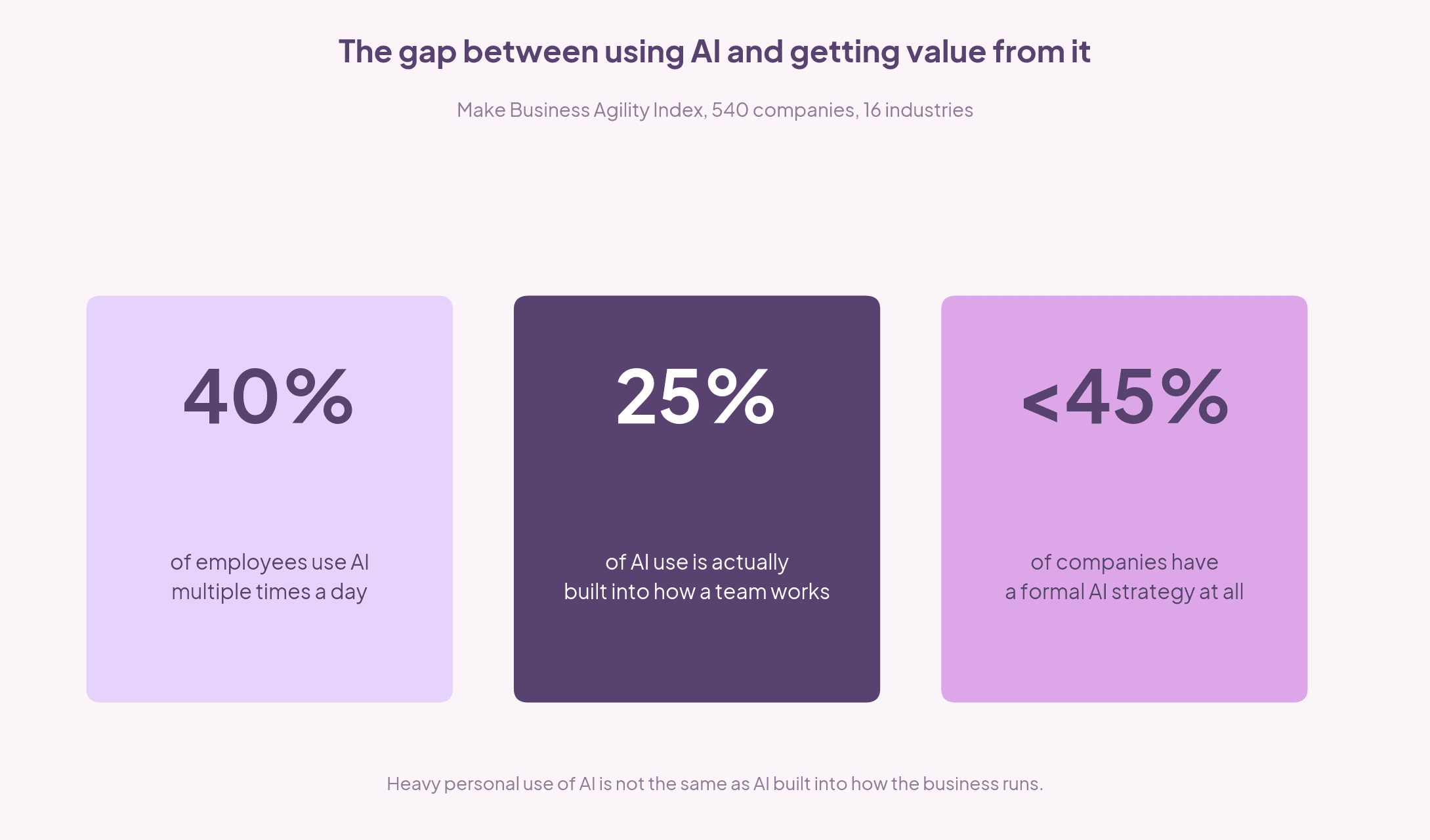
One statistic from that research stood out. Across 540 companies in 16 industries, 40% of employees now use AI multiple times a day, but only 25% use it at an organizational level.
Fewer than half of companies have a formal AI strategy at all.
That's the real gap.
Nearly everyone has "adopted" AI. The space that matters is between using AI constantly and having anything to show for it beyond a personal habit.
Lack of ownership, governance, and how ROI gets measured are usually why that space stays open.
The logic of AI ROI measurement is still immature: The answer changes depending on who's asking and whose product is being measured, with independent surveys landing far more objective than vendor-commissioned studies. Daron Acemoglu's (Nobel Prize laureate) caution about how the AI payoff not being there yet in economics extends naturally to ROI claims. The payback figure produced by the vendor is less reliable than one produced by an unbiased CEO in a survey who has no stake in the outcome.
Without someone accountable for a workflow's actual outcome, time saved is the only number anyone bothers to produce.
But if "hours saved" was never the point, what is?
For me, it comes down to measuring impact from the growth of new opportunities that couldn't be seen and unlocked before.
Everything else is a means to this one end.
Why early metrics stop telling the full story
Time saving is tangible and easy to determine. I understand why so many businesses fall into this pattern. After all, 95% of mid-market companies still point to time savings as the primary benefit of AI adoption.
There are three fundamental problems with it, though:
Hours saved is a metric that stops making sense once the AI use moves from individual automations
Most of the numbers are estimates without means to measure them
If they are measured, they aren’t always measured against a real business baseline
Time saved tends to be a standalone number: “We saved 2 hours.”
It also tends to be a generic statement: “We saved 2 hours; therefore, we have more time.”
But it rarely shows the real impact: “We saved 2 hours; therefore, we increased employee satisfaction and helped prevent employee churn that slows us down.”
The assumption of the generic statement is that time saved is always used for something more productive, and therefore is always useful. That isn’t necessarily the case.
That sort of an assumption-based payoff is never the right baseline to measure against. An hour saved that isn't connected to a measurable outcome and a real bottleneck is not really a saving.
Shifting from a guessing game to tangible measurement is what unlocks the scale and turns early gains into real profit.
From 50% to 30%: How the AI healed physicians’ burnout
Recently, I stumbled upon U.S. healthcare's use of AI for clinical documentation and patient visit transcripts. The general assumption was: “Our doctors save an hour of their time, so they are more productive.”
Ironically, only around 16 minutes were saved with AI automation per 8 hours of patient care.
The metric that yields actual results was much harder to identify, especially early in the AI adoption stage.
It was a reduction of physician burnout.
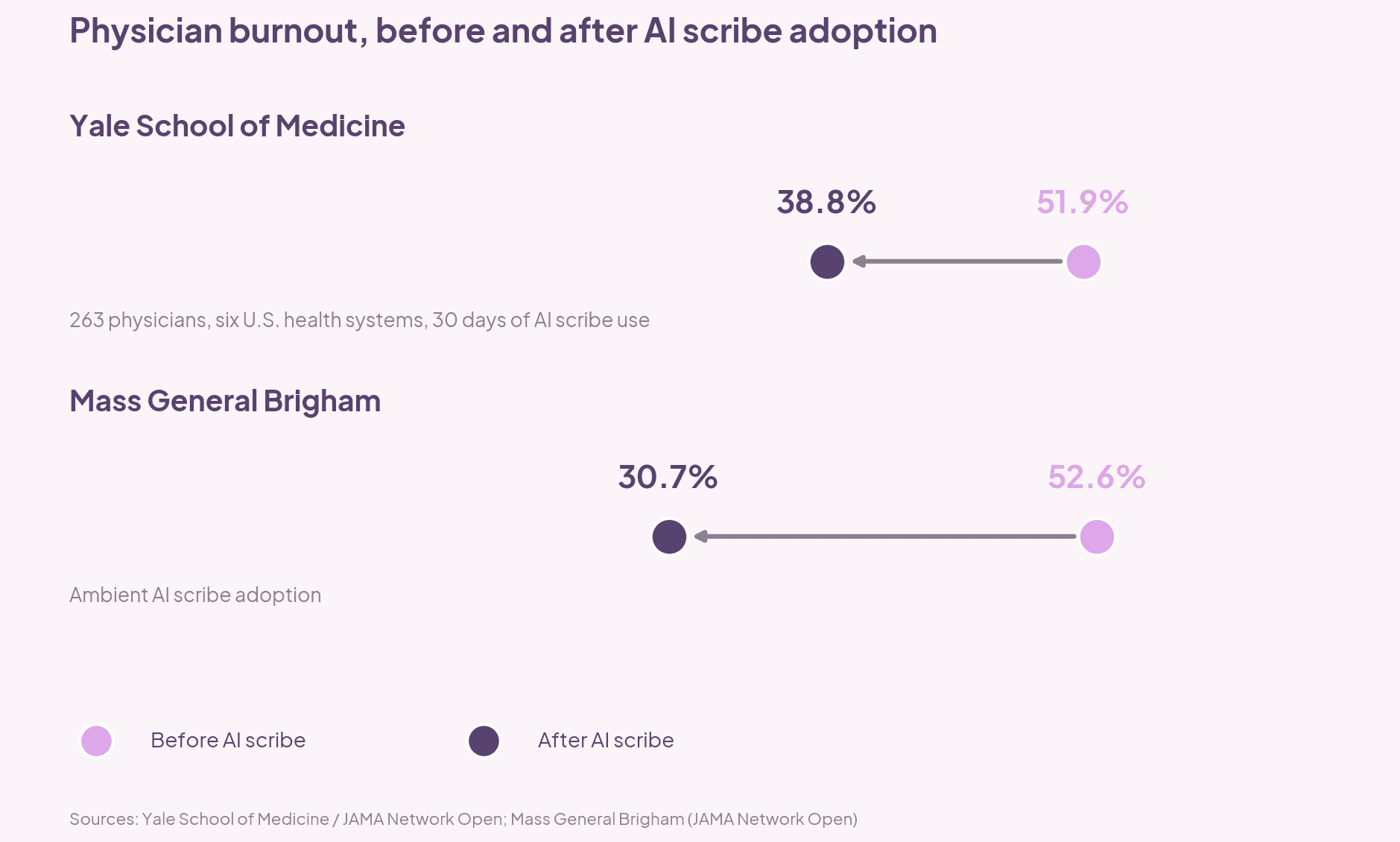
A Yale School of Medicine study found physician burnout dropped from 51.9% to 38.8% after 30 days of using the AI scribe automation. Mass General Brigham saw burnout prevalence fall from 52.6% to 30.7% after ambient AI scribe adoption.
Without the proper reporting, healthcare would focus on an AI measurement strategy that would eventually divert into something fundamentally useless.
What changes once AI moves into shared workflows
The doctor example works because burnout doesn't stay contained to one person. Less burnout meant doctors stayed longer. Staying longer meant less spending on recruiting replacements. Patients noticed too, and satisfaction went up along with it.
One metric affected three departments.
Four areas actually move when AI transformation reaches a more advanced stage:
teams’ productivity
AI adoption growth
business’ and employees’ trust in AI
insight into the impact of AI
Productivity shows up first, which is why most companies stop measuring there. Growth, trust, and insight take longer to surface and compound in the background.
A company that only ever checks productivity will report success and miss three-quarters of what actually happened.
An AI maturity map: How measurements need to evolve with adoption
You can’t attempt to increase your AI ROI without knowing where you stand right now. The values below help you identify your current stage of AI maturity.
Here is how measurements can match with adoption levels, from lowest to highest maturity, step-by-step:
Efficiency: The AI processes start to transform from personal automations to organizational workflows. This is where measuring hours saved still makes sense, together with basic metrics like the number of tasks completed.
Workflow value: Here is the point where AI stops being personal and starts being organizational. Pilots turn to repeatable processes. At this stage, I’d advise mainly focusing on process quality, handoff decline, and error reduction.
Expansion value: AI is no longer tied to one department. It spreads company-wide, with named process owners setting standards. Metrics shift toward scaling success after an acquisition, workload vs. headcount ratio, and faster product feedback loops.
Vendor substitution: Businesses start noticing tools they no longer have to pay for because AI does the job. It gives tangible proof of where AI’s actual impact lies.
Organizational learning: AI Agents start performing complex roles inside a process, managing CRM updates, drafting follow-ups, freeing people to apply judgment. What matters the most here is organizational learning: knowledge reuse, decision velocity, and capability compounding across teams.

Winning businesses rely on these underrated AI payoff measurement strategies
Before I wrap up, I’d like to stress what most companies do wrong. They identify their AI maturity stage and start sprinting up the mountain without a trekking guide.
If you want to avoid falling, I recommend first:
Choose a named owner and a sponsor: One person answers for the initiative; one senior person backs it. Without both, a promising pilot has no one to defend it past the first budget review.
Set up your team right: Not a committee but front-line people who actually build, measure, and adjust the process.
Shift from activity metrics to specific before/after comparison: Most businesses measure what they put into the AI project, like licenses bought, people logged in, hours spent setting up. Not what came out as a result. And when they do check results, they compare AI to some imagined perfect version of itself, instead of comparing it to what the team was actually doing before AI showed up. A useful formula to get this right: Net value = time removed + leakage avoided + revenue protected + quality gained, minus the cost of the model, the integration, the human review, and the failures. If checking the AI's work eats more time than it saves, it’s not a valuable automation.
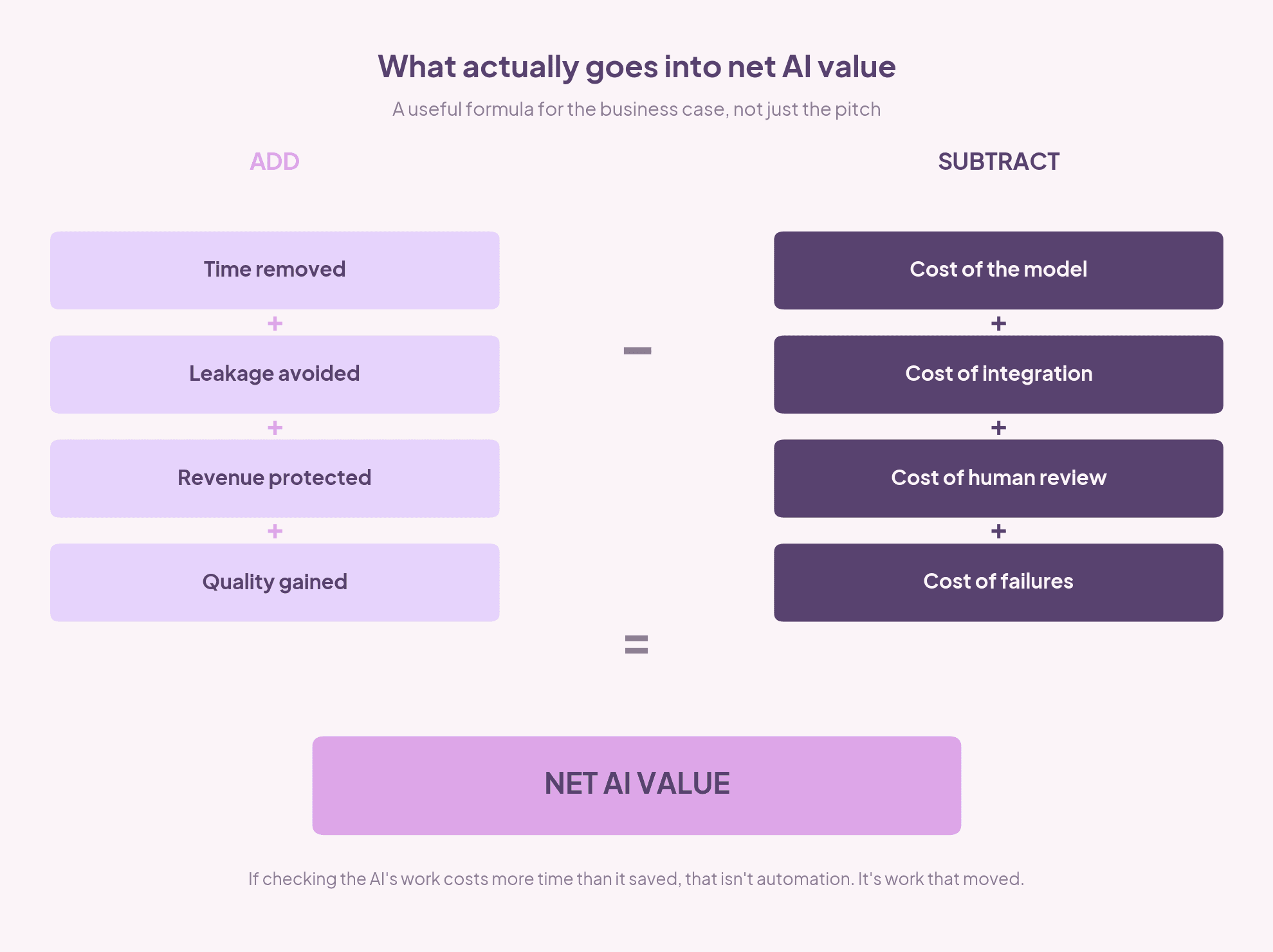
Tie the metric to a specific outcome: Four things are worth quantifying here: - cost avoided - revenue generated - risk reduced - productivity gained A clean way to structure any single use case: Define where the workflow starts and ends, the specific outcome you expect to change, what the AI can decide on its own versus what needs a human, what data it can and can't touch, and who owns the result.
Count the cost of the entire operation, not just the AI licenses.
Score what you can't put a dollar on. Organizational learning, talent attraction, competitive position, and so on, are also real outcomes. Rate them, don't guess a number for them.
Set a realistic payback window and know it depends on the use case. Risk-focused use cases often have the shortest payback period of 9 to 18 months, since baseline losses are already quantified and the AI intervention can be directly measured. Revenue-driven use cases can take 18 to 36 months because revenue is harder to attribute clearly to AI alone.
Change management is your biggest lever. The difference between weak and strong adoption can swing a project's return three to four times over.
Don't forget what it costs to do nothing in terms of opportunity and employee satisfaction costs. Competitors keep moving. So does your best talent, toward whoever gives them better tools.
The payoff shift: What do current trends tell us about the future?
It’s impossible to predict with certainty what ROI metrics will matter in the future. The AI space evolves daily and is too fast to make definite conclusions.
There are three shifts, though, that I consider relevant.
First, revenue per employee seems to be emerging as a clear signal of AI success. According to SaaSMag, median revenue per employee for SaaS companies reached around $150k in 2025. That’s $25k more than the year before.
In 2026, however, the best AI-native companies already operate at $300-$450k per employee.
The reason is structural: AI-native companies can automate more of their product development and customer support workflows, which compresses operating costs without compressing revenue growth.
This efficiency advantage is still early, but it is widening.
The second shift: companies that replaced a large number of employees with AI are shifting from great layoffs towards great rehiring, and anticipated savings turned into unnecessary spending.
It turned out that AI by itself can’t do everything humans can. It lacks what only people can do.
Apply subjective judgement, for example, in customer support. While AI handles the volume of 700 people, it can’t reliably anticipate the nuances in customers’ emotions. Instead, companies get the same job done at a lower quality.
PwC's 2026 Global AI Job Barometer analyzed a billion job postings across six continents and found that the top 20% of most AI-exposed companies reached labor productivity growth of 163% relative to 2018, alongside headcount growth of 52%, compared to just 36% at the least AI-exposed businesses.
Interestingly, using AI is growing the workforce.
This once again shows that efficiency alone isn't a good enough indicator of success.
More and more companies realized that the actual payoff comes from adapting job positions to current needs.
Cut headcount thoughtlessly in the name of efficiency and growth, and the gain everyone expected may never show up.
To close this article, by all means, keep investing in AI. The cost of waiting is real, even if it's tricky to put a number on it.
The real question shouldn’t be whether to invest.
It should be to ask which metrics actually shape an AI strategy that pays off, for the stage you're actually in.
Ready to make the automation revolution happen?