
Connect Airtable and Calendly integrations

Returns all newly created or updated records in a view (requires "Created Time" or "Last Modified Time" fields).
Triggers when a new response is submitted.

Cancels an event.
Creates a new booking for an event invitee. Requires a Calendly paid plan.
Creates a new event type.
Creates a new invitee no show.
Creates a new single-use scheduling link.
Deletes an invitee no show. This action cannot be undone.
Returns information about a specific event.
Returns information about a specific invitee.
Returns information about a specific event type.
Returns information about a specific invitee no show.
Returns information about a user's organization membership.
Returns information of user availability schedule.
Invites a user to an organization.
Sends a custom API call to Calendly. You can use this to call endpoints that aren’t covered by existing modules.
Updates an event type.
Updates an event type availability schedule.
Returns a list of invitees for a specific event.
Returns a list of events.
Returns a list of availability schedules for an event type.
Returns a list of available times for an event type within a specified date range.
Returns all event types associated with a specified user.
Returns a list of organization memberships.
Returns a list of availability schedules for the specified user.
Returns an ascending list of user internal and external scheduled events within a specified date range.
Returns a list of a user's configured meeting locations.
Trusted by thousands of fast-scaling organizations around the globe





Automate your work. Build something new.
Just drag and drop apps to automate existing workflows or build new complex processes. Solve problems across all areas and teams.
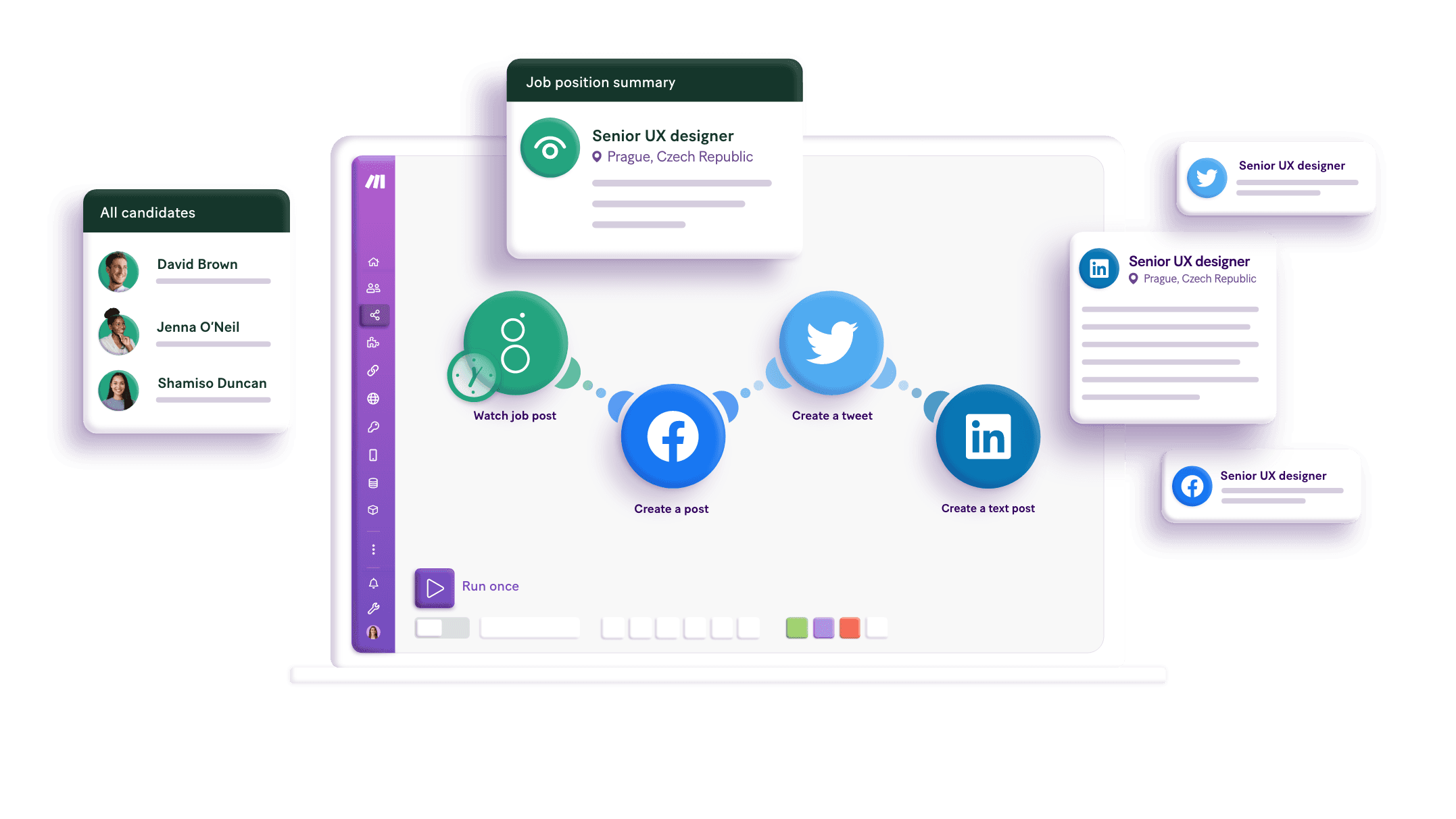
Build your Airtable and Calendly integrations.
Experience seamless automation by integrating Calendly and Airtable on the Make platform. With Calendly functioning as a trigger, any updates or new records can automatically initiate actions in Airtable, such as scheduling appointments. This integration ensures your data is continuously updated and your scheduling is managed effortlessly, saving time and enhancing accuracy across both applications. Transform your workflows by connecting Calendly and Airtable today with Make.
Сreates multiple records.
Deletes multiple records.
Updates multiple existing records.
Upserts multiple records.
Cancels an event.
Creates a new record in Airtable.
Creates a new single-use scheduling link.
Creates a new booking for an event invitee. Requires a Calendly paid plan.
Creates a new event type.
Popular Airtable and Calendly workflows.
Boost efficiency with popular Airtable and Calendly integrations. Automate tasks, streamline onboarding, and keep records up-to-date.
How to setup Airtable and Calendly in 5 easy steps
Log in to Make
Start by logging into your Make account to get started.
Setup Airtable Connection
Go to the Airtable module in Make and click the 'Add' button to create a new connection.
Choose Connection Method
Select whether you want to connect via OAuth, a Personal Access Token, or an API Key.
Set Up Calendly Connection
Navigate to the Calendly module on the Make platform.
Grant Calendly Access
Enter the connection name and confirm access on the Calendly website.
Unlock Efficiency: Integrate Airtable and Calendly for Seamless Automation
Experience effortless automation by integrating Airtable and Calendly. Automatically create and update records, streamline onboarding, prepare for meetings, and manage exit interviews efficiently.
Automatically create new records in Airtable whenever a Calendly event is scheduled, saving time and reducing manual data entry.
Ensure your Airtable records are always current by updating them with changes and cancellations from Calendly, keeping all event-related data accurate.
Kickstart the onboarding process by sending a Calendly link for scheduling induction sessions as soon as a designated Airtable field is ticked.
Create Google Docs meeting notes and Google Calendar events directly from new Calendly events, ensuring all necessary documentation is ready ahead of time.


FAQ
Integrating Airtable and Calendly through Make allows you to automate workflows between your scheduling and your data management systems. For example, you can automatically populate Airtable with new meeting data from Calendly, saving time and ensuring all your information stays up-to-date without manual entry.
Make allows you to set up automated workflows that sync data in real-time between Airtable and Calendly. This consistency reduces the risk of errors and ensures that your scheduling and data management always reflect the latest information.
No, you don’t need advanced technical skills to integrate Airtable and Calendly using Make. The platform provides a user-friendly interface and pre-built templates to help you set up integrations with simple drag-and-drop actions. This makes it accessible for users of all technical levels.
Yes, Make offers a high degree of customization for workflows between Airtable and Calendly. You can create tailored automation rules, define specific actions and conditions, and customize the data flows to fit your unique business needs. This flexibility ensures that the integration works exactly how you want it to.
A scenario represents a workflow or a project of your own creation, and it is made up of a series of modules that automate apps and services. Creating a scenario allows you to transfer and transform data between apps and services via these modules to automate anything and improve the way you work.
Modules are the main building blocks of automation in Make. Modules represent actions that Make performs with an app, like creating, updating, or deleting data.
How it works
Traditional no-code iPaaS platforms are linear and non-intuitive. Make allows you to visually create, build, and automate without limits.
Trusted by 350,000+ customers
"Make really helped us to scale our operations, take the friction out of our processes, reduce costs, and relieved our support team. It is difficult to not become a fan."

Philipp Weidenbach
Head of Operations at Teleclinic
"Make drives unprecedented efficiency within our business in ways we never imagined. It’s having an extra employee (or 10) for a fraction of the cost."

Cayden Phipps
COO at Shop Accelerator Martech
"The simplicity, flexibility and ability to build real complex automations without any knowledge of programming makes it the best thing since sliced bread."

Erkki Markus
Product Owner at Smaily
"True citizen development in the entire company. Make is present in every department, empowering the company to offer a unique customer experience."

Andreas Stryz
CTO & Co-founder at FINN
"I can't count the number of hours I've saved by using Make. Every single day is simpler because of Make's automation."

Kimberly D
Owner of Media Production