Connect Anthropic Claude and Dropbox integrations
Automatically save and organize AI-generated content from Anthropic Claude directly into Dropbox through trigger-action automation. Transform Claude's outputs into instantly organized cloud files, eliminating manual transfers and optimizing your workflow with Make's powerful integration platform.

Creates a new prompt based on a structured list of input messages.
Creates a new Skill.
Creates a new Skill version.
Deletes an existing file.
Deletes an existing Skill.
Deletes an existing Skill version.
Downloads a Claude-generated file.
Retrieves an existing file's metadata.
Retrieves an existing Skill.
Retrieves an existing Skill version.
Performs an arbitrary authorized API call.
Generates text responses from prompts without requiring an account or connection.
Uploads a new file.

Copies a file or folder to a different location in the user's Dropbox. If the source path is a folder all its contents will be copied.
Creates a file request.
Creates a new folder.
Creates a public share link to a file or folder (allows to share the file or folder with anyone).
Creates a new text file(.doc) or overwrite an existing text file(.doc) with the provided content as plain text.
Permanently removes a file/folder from the server.
Deletes selected file requests.
Downloads a file from a specified folder.
Retrieves specified file request.
Performs an arbitrary authorized API call.
Moves a file or folder to a different location in the user's Dropbox.
Renames a file/folder in the user's Dropbox.
Restores a previous file version.
Updates a file request.
Updates or revokes a share link for a file or folder.
Uploads a file to a selected folder.
Retrieves a list of files or subforders in a specified folder.
Returns a list of file requests owned by this user.
Retrieves a list of file revisions needed to recover previous content.
Searches for files and folders by name.
Trusted by thousands of fast-scaling organizations around the globe





Automate your work. Build something new.
Just drag and drop apps to automate existing workflows or build new complex processes. Solve problems across all areas and teams.
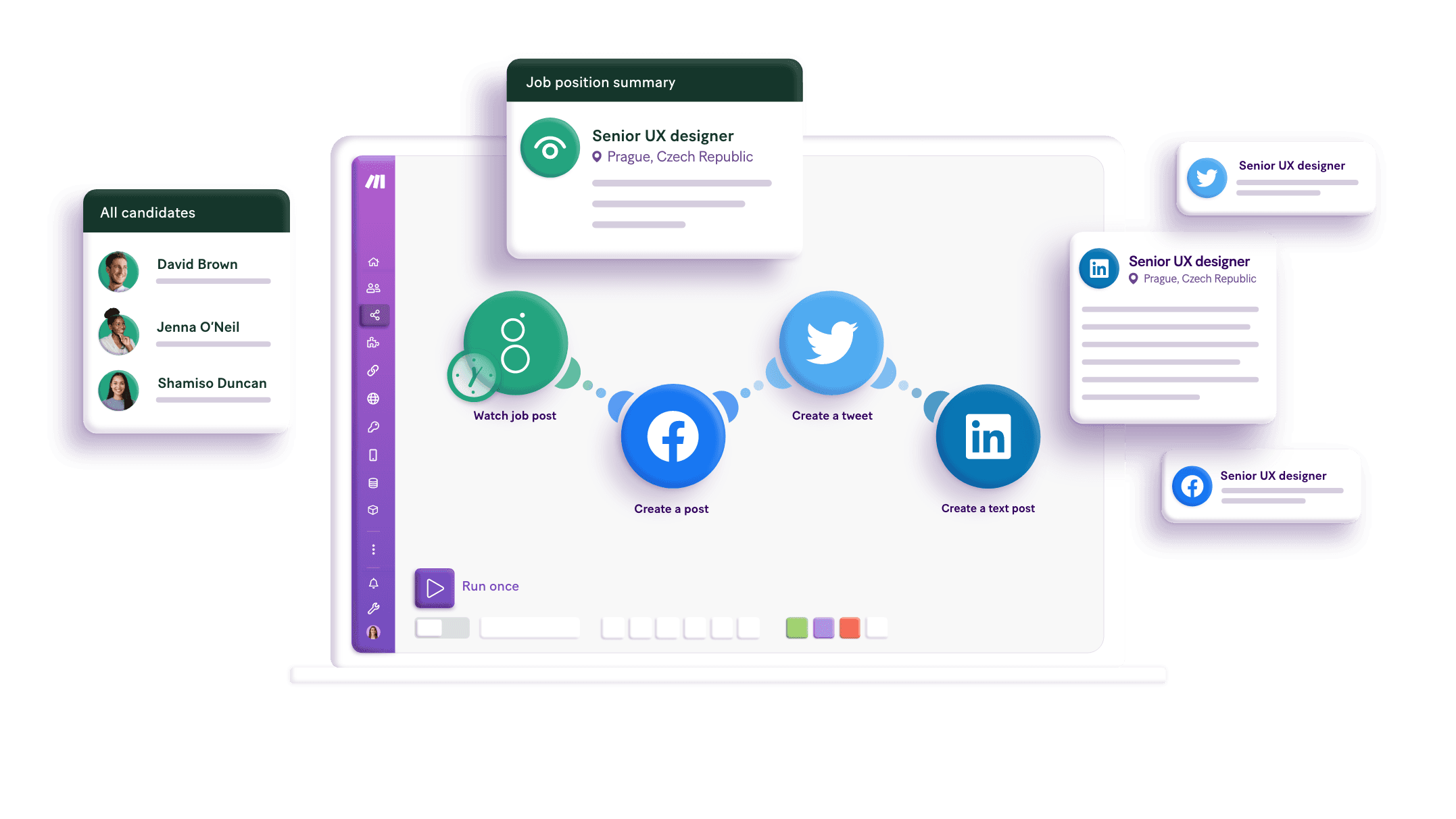
Build your Anthropic Claude and Dropbox integrations.
Integrate Dropbox as a trigger and Anthropic Claude as an action through Make's automation platform. When Dropbox generates content or completes a process, it triggers an automated workflow that performs actions in Anthropic Claude, such as saving the AI-generated content directly into your Anthropic Claude folders or organizing documents in designated locations. This trigger-action integration enables you to automatically sync content from Dropbox to Anthropic Claude, creating efficient processes where Claude's output triggers the storage and organization of files in your cloud storage system.
Copies a file or folder to a different location in the user's Dropbox. If the source path is a folder all its contents will be copied.
Creates a file request.
Creates a new folder.
Creates a new prompt based on a structured list of input messages.
Creates a public share link to a file or folder (allows to share the file or folder with anyone).
Creates a new Skill.
Creates a new Skill version.
Creates a new text file(.doc) or overwrite an existing text file(.doc) with the provided content as plain text.
Deletes selected file requests.
Popular Anthropic Claude and Dropbox workflows.
Looking to get more out of Anthropic Claude and Dropbox? With Make you can visually integrate Anthropic Claude and Dropbox into any workflow to save time and resources — no coding required. Try any of these templates in just a few clicks.
How to setup Anthropic Claude and Dropbox in 5 easy steps
Get your API key from the app you want to connect
An API key is like a special password that allows Make to safely access your app. Log into the app you want to connect (like Anthropic Claude or Dropbox), go to your account settings, and look for the API key or developer section. Create a new key, give it a name you'll remember, and immediately copy it to a safe place like a password manager since you'll only see it once.
Open your Make scenario and add the app module
Log into your Make account and open the workflow (called a scenario) where you want to use your connected app. Click to add a new module and select the app you want to connect, such as Anthropic Claude or Dropbox. When you add the module, you'll see a button or option to create a new connection—click on it to start setting up the link between Make and your app.
Enter your API key in Make
In the connection form that appears, paste the API key you copied earlier into the designated field. Make sure you paste the entire key without any extra spaces or missing characters, as this is what allows Make to communicate securely with your app. You can also give your connection a memorable name like 'My Claude Connection' to help you identify it later if you have multiple connections.
Save and authorize the connection
Click the 'Save' button to store your connection settings in Make. You might be taken to your app's website to confirm that you're giving Make permission to access your account—simply follow the prompts to complete this step. This authorization process ensures that the connection between Make and your app is secure and properly established.
Start building your automated workflow
Once your connection is successfully created, you can now use all the features from your connected app within Make scenarios. The connection will stay active for all future workflows, so you won't need to set it up again. You can now create automated tasks that combine Make with your connected apps like Anthropic Claude and Dropbox to save time and optimize your work.
Optimize document intelligence with Claude and Dropbox automation
Connect Anthropic Claude and Dropbox through Make to automate document processing, content generation, and intelligent file organization while maintaining enterprise-grade security for your workflows.
Automatically analyze and extract insights from thousands of Dropbox files using Claude's 100K+ token window to process large documents without manual intervention.
Generate reports, summaries, or documentation with Claude and automatically save the output to organized Dropbox folders for team access.
Use Claude to intelligently categorize, rename, and tag Dropbox files based on their content, maintaining a well-organized file structure.
Use Claude's industry-leading data retention policies to analyze sensitive Dropbox files while ensuring your confidential information is never stored or used for training.


FAQ
By integrating Anthropic Claude with Dropbox through Make, you can automatically process, analyze, and extract insights from documents stored in your Dropbox folders. Claude's 100K+ token window allows it to handle lengthy documents, contracts, or reports, while Make enables automation—such as triggering Claude to summarize new files added to Dropbox, generate content based on stored templates, or extract key information from PDFs. This integration eliminates manual document review and accelerates decision-making without compromising data security, as Claude offers best-in-class data retention with no training on your files.
Make's integration provides enhanced security by combining Claude's Constitutional AI framework with Dropbox's secure file storage, all while maintaining strict data handling protocols. Claude is specifically designed to reduce brand risk and comes with best-in-class data retention policies that ensure your data is never used for training. When you connect these applications through Make, your sensitive files remain protected in Dropbox while Claude processes them according to your instructions, with all workflows managed through Make's secure automation platform. This three-layer security approach gives you peace of mind when automating sensitive document operations.
Absolutely! Make's visual automation platform allows you to create custom workflows that perfectly align with your business needs. You can personalize Claude to speak in your brand voice and handle your specific use cases, while configuring triggers based on Dropbox events like new file uploads, folder changes, or specific file types. For example, you could automatically route marketing materials through Claude for brand compliance checking, have legal documents summarized and stored in designated folders, or trigger multi-step content creation workflows. Make's intuitive interface requires no coding, making it easier to design, test, and modify your integration as your needs evolve.
This integration creates an intelligent file management system that goes beyond storage. Make can automate workflows where Claude analyzes incoming Dropbox files, extracts key insights, generates summaries, and even creates metadata or organized reports that are stored back in Dropbox in structured folders. You'll never lose track of files because Claude can tag, categorize, and create searchable summaries of complex documents automatically. Additionally, Make can connect this integration with other apps like Gmail or Google Drive, ensuring that important insights from your Dropbox files are automatically distributed to the right team members or systems, creating a comprehensive knowledge management ecosystem.
A scenario represents a workflow or a project of your own creation, and it is made up of a series of modules that automate apps and services. Creating a scenario allows you to transfer and transform data between apps and services via these modules to automate anything and improve the way you work.
Modules are the main building blocks of automation in Make. Modules represent actions that Make performs with an app, like creating, updating, or deleting data.
How it works
Traditional no-code iPaaS platforms are linear and non-intuitive. Make allows you to visually create, build, and automate without limits.
Trusted by 350,000+ customers
"Make really helped us to scale our operations, take the friction out of our processes, reduce costs, and relieved our support team. It is difficult to not become a fan."

Philipp Weidenbach
Head of Operations at Teleclinic
"Make drives unprecedented efficiency within our business in ways we never imagined. It’s having an extra employee (or 10) for a fraction of the cost."

Cayden Phipps
COO at Shop Accelerator Martech
"The simplicity, flexibility and ability to build real complex automations without any knowledge of programming makes it the best thing since sliced bread."

Erkki Markus
Product Owner at Smaily
"True citizen development in the entire company. Make is present in every department, empowering the company to offer a unique customer experience."

Andreas Stryz
CTO & Co-founder at FINN
"I can't count the number of hours I've saved by using Make. Every single day is simpler because of Make's automation."

Kimberly D
Owner of Media Production