
Connect AppSheet and OpenAI (ChatGPT, Whisper) integrations
Transform your AppSheet applications into AI-powered engines by automatically connecting form submissions and database updates to OpenAI's ChatGPT, DALL-E, and Whisper through Make. Generate intelligent insights, create dynamic visuals, and transcribe audio—all triggered from your mobile and web apps without manual intervention.

Adds a new record.
Deletes a record specified by key fields.
Updates a record specified by key fields.
Retrieves a single record specified by the number of the row.
Invokes a custom action available for your table.
Performs an arbitary authorized API call.

Analyzes images according to specified instructions.
Cancels an "in-progress" batch. The batch will be in status "cancelling" for up to 10 minutes, before changing to "cancelled", where it will have partial results (if any) available in the output file.
Creates and executes a batch of API calls.
Creates a new skill.
Creates a new immutable skill version.
Creates a new vector store and optionally adds files to it, or adds files to an existing vector store.
Deletes an existing conversation.
Deletes an existing model response.
Deletes a skill. This action cannot be undone.
Deletes a skill version. This action cannot be undone.
Deletes a vector store. This action cannot be undone.
Downloads a file from a container.
Downloads a skill as a ZIP file using its ID.
Downloads a skill version as a ZIP file.
Creates an edited or extended image given one or more source images and a prompt.
Generates a chat completion.
Qualifies whether the provided image or text(s) contains violent, hateful, illicit or adult content.
Creates an embedding vector representing the input text.
Generates a response.
Transcribes an audio to text.
Translates an audio to English.
Generates images using GPT Image.
Generates an audio file based on text input and settings.
Retrieves details of the specified batch.
Retrieves an existing model response.
Returns information about a specific skill by its ID.
Returns information about a specific skill version.
Performs an arbitrary authorized API call.
Generates text responses from prompts without requiring an account or connection.
Identifies information in a prompt's text and returns it as structured data.
Updates the default version pointer for a skill.
Uploads a file to be used across the OpenAI platform.
Retrieves a list of batches.
Lists input items.
Returns a list of skills.
Returns a list of skill versions.
Returns a list of vector stores.
Searches a vector store and returns the file content chunks that match your query.
Trusted by thousands of fast-scaling organizations around the globe





Automate your work. Build something new.
Just drag and drop apps to automate existing workflows or build new complex processes. Solve problems across all areas and teams.
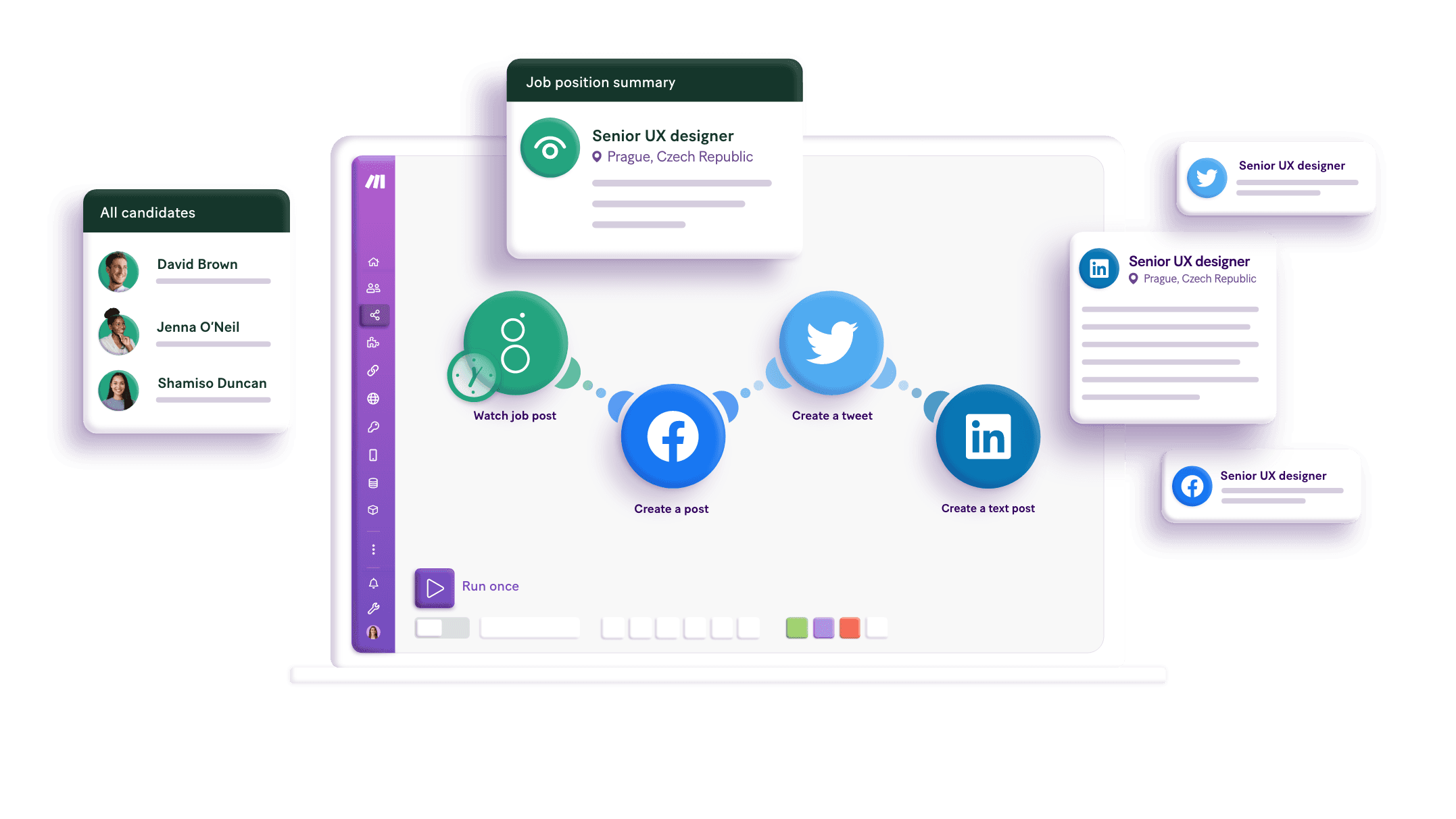
Build your AppSheet and OpenAI (ChatGPT, Whisper) integrations.
Connect OpenAI (ChatGPT, Whisper) as a trigger with AppSheet as an action through Make's automation platform. When events occur in your OpenAI (ChatGPT, Whisper) applications—such as new form submissions, database updates, or user inputs—these triggers automatically initiate actions in OpenAI services. OpenAI (ChatGPT, Whisper) triggers can send data to ChatGPT for intelligent text processing and insights generation, to DALL-E for creating visual content based on your application data, or to Whisper for transcribing audio inputs from your forms. This integration enables your OpenAI (ChatGPT, Whisper) mobile and web applications to automatically process information through OpenAI's AI capabilities, enriching databases with generated content, creating dynamic visuals, and processing conversational data whenever specified events occur in OpenAI (ChatGPT, Whisper).
Analyzes images according to specified instructions.
Cancels an "in-progress" batch. The batch will be in status "cancelling" for up to 10 minutes, before changing to "cancelled", where it will have partial results (if any) available in the output file.
Adds a new record.
Creates and executes a batch of API calls.
Creates a new skill.
Creates a new immutable skill version.
Creates a new vector store and optionally adds files to it, or adds files to an existing vector store.
Deletes a record specified by key fields.
Deletes an existing conversation.
Popular AppSheet and OpenAI (ChatGPT, Whisper) workflows.
Looking to get more out of AppSheet and OpenAI (ChatGPT, Whisper)? With Make you can visually integrate AppSheet and OpenAI (ChatGPT, Whisper) into any workflow to save time and resources — no coding required. Try any of these templates in just a few clicks.
How to setup AppSheet and OpenAI (ChatGPT, Whisper) in 5 easy steps
Get your AppSheet connection details
Open your AppSheet account and go to your app editor. Navigate to the Manage tab and click on Integrations. Here you'll find two important pieces of information: your Application Access Key (which works like a password) and your App ID (which identifies your specific app). Copy both of these carefully as you'll need them to connect to Make.
Open your Make scenario
Log into your Make account and open the scenario where you want to use AppSheet. A scenario is a workflow that automates tasks between different apps. This is where you'll set up the connection between Make and your AppSheet application so they can work together.
Add an AppSheet module
In your Make scenario, add an AppSheet module by selecting it from the available apps. This module represents the actions or triggers you want AppSheet to perform in your automated workflow. Once added, you'll see an option to create a connection between Make and AppSheet.
Create the connection
Click the 'Create a connection' button in your AppSheet module. You'll be prompted to give your connection a name, which helps you identify it later if you have multiple connections. Naming it something descriptive like 'My AppSheet App Connection' makes it easier to manage your workflows.
Enter your credentials
Paste the Application Access Key and App ID you copied from AppSheet into the appropriate fields in Make. Once you submit this information, Make will verify these credentials and establish a secure connection. Your AppSheet app and Make can now communicate and share data to automate your workflows.
Transform your AppSheet apps with OpenAI's intelligent automation
Integrate AppSheet and OpenAI to build smarter no-code applications with AI-powered conversations, automated content generation, intelligent data analysis, and voice-to-text capabilities.
Add OpenAI's natural language processing and generation capabilities to AppSheet applications to create intelligent, conversational interfaces without writing complex code.
Automatically generate app content, descriptions, help text, and user communications using GPT models triggered by AppSheet events or data changes.
Process and analyze spreadsheet data from AppSheet's connected sources using OpenAI to extract insights, categorize information, and generate summaries automatically.
Integrate DALL-E to automatically generate custom images and visual assets for AppSheet applications based on user inputs or data triggers.


FAQ
By integrating AppSheet with OpenAI through Make, you can add powerful AI capabilities to your no-code applications without writing complex code. You can automatically generate content, analyze user inputs with GPT-4, create images with DALL-E based on app data, transcribe audio with Whisper, or provide intelligent chatbot responses within your AppSheet apps. This means your mobile, tablet, and web applications built on spreadsheet data can now include advanced AI features like automated report generation, smart data analysis, image creation, and natural language processing—all orchestrated through Make's visual automation platform.
Make enables you to create numerous powerful workflows between AppSheet and OpenAI. For example, you can automatically send form submissions from AppSheet to ChatGPT for content analysis or classification, generate AI-powered summaries of data entries, create custom images with DALL-E based on AppSheet records, transcribe voice notes captured in AppSheet using Whisper, or use GPT-4 to enrich your spreadsheet data with additional insights. You can also set up workflows that trigger OpenAI actions when specific conditions are met in your AppSheet database, such as automatically generating product descriptions, customer communications, or data quality checks—all without manual intervention.
No programming skills are required! This is one of the key advantages of using Make to integrate AppSheet with OpenAI. Make provides a visual, drag-and-drop interface where you can connect both applications and design automation workflows using pre-built modules. AppSheet is already a no-code platform for building apps, and Make extends this no-code approach to integration. You simply select triggers from AppSheet (like new row added or form submitted), choose OpenAI actions (like create chat completion or generate image), and map the data between them using Make's intuitive interface. This makes advanced AI integration accessible to business users, entrepreneurs, and teams without technical backgrounds.
Connecting AppSheet with OpenAI through Make delivers significant business value by transforming static data into intelligent, actionable insights. You can automate customer service by routing AppSheet form submissions through ChatGPT for instant, personalized responses; improve product catalogs by automatically generating descriptions and images from basic data inputs; strengthen data quality through AI-powered validation and enrichment; create automated reporting where GPT-4 analyzes your AppSheet data and generates executive summaries; and build intelligent mobile apps that use your existing Google Sheets or Excel data while adding cutting-edge AI features. This integration reduces manual work, accelerates content creation, improves decision-making, and allows you to offer more sophisticated solutions to your customers—all while maintaining the simplicity of no-code development.
A scenario represents a workflow or a project of your own creation, and it is made up of a series of modules that automate apps and services. Creating a scenario allows you to transfer and transform data between apps and services via these modules to automate anything and improve the way you work.
Modules are the main building blocks of automation in Make. Modules represent actions that Make performs with an app, like creating, updating, or deleting data.
How it works
Traditional no-code iPaaS platforms are linear and non-intuitive. Make allows you to visually create, build, and automate without limits.
Trusted by 350,000+ customers
"Make really helped us to scale our operations, take the friction out of our processes, reduce costs, and relieved our support team. It is difficult to not become a fan."

Philipp Weidenbach
Head of Operations at Teleclinic
"Make drives unprecedented efficiency within our business in ways we never imagined. It’s having an extra employee (or 10) for a fraction of the cost."

Cayden Phipps
COO at Shop Accelerator Martech
"The simplicity, flexibility and ability to build real complex automations without any knowledge of programming makes it the best thing since sliced bread."

Erkki Markus
Product Owner at Smaily
"True citizen development in the entire company. Make is present in every department, empowering the company to offer a unique customer experience."

Andreas Stryz
CTO & Co-founder at FINN
"I can't count the number of hours I've saved by using Make. Every single day is simpler because of Make's automation."

Kimberly D
Owner of Media Production