
Connect Calendly and lemlist integrations

Triggers when an event is created or canceled.

Adds a lead in the unsubscribed list.
Adds a lead in a specific campaign.
Deletes a lead in the unsubscribed list.
Deletes a lead from a specific campaign.
Enrich lead data with email addresses, phone numbers and Linkedin data.
Downloads a CSV file that contains all the statistics or leads of a campaign.
Find your lead's email address using waterfall enrichment. Provide the available lead information as input, and the module will use over five data providers to find the email.
Find your lead's phone number using waterfall enrichment. Provide the available lead information as input, and the module will use over five data providers to find the phone number.
Retrieves all the information of a specific lead using it's email.
This module provides campaign statistics, including the number of leads, opens, replies, and more.
This module retrieves credits left in the team.
This module retrieves information of your team, such as the list of users.
Performs an arbitrary authorized API call.
This module enables users to upload an audio file to a linkedIn voice message step for each lead.
Verify your lead' email address to avoid bounces.
This module retrieves a lead by their email address or id.
This module retrieves a list of all senders in the team along with their associated campaigns. This information is useful for tracking campaign participation and channel utilization by different team members.
List all campaigns.
Retrieves a list of all campaigns.
Retrieves a list of all people who are unsubscribed.
This modules pauses a specific lead using its email or an id in all campaigns.
This module retrieves the last activities based on the filtered parameters.
This module starts a specific lead using its email or an id in all campaigns.
Trusted by thousands of fast-scaling organizations around the globe





Automate your work. Build something new.
Just drag and drop apps to automate existing workflows or build new complex processes. Solve problems across all areas and teams.
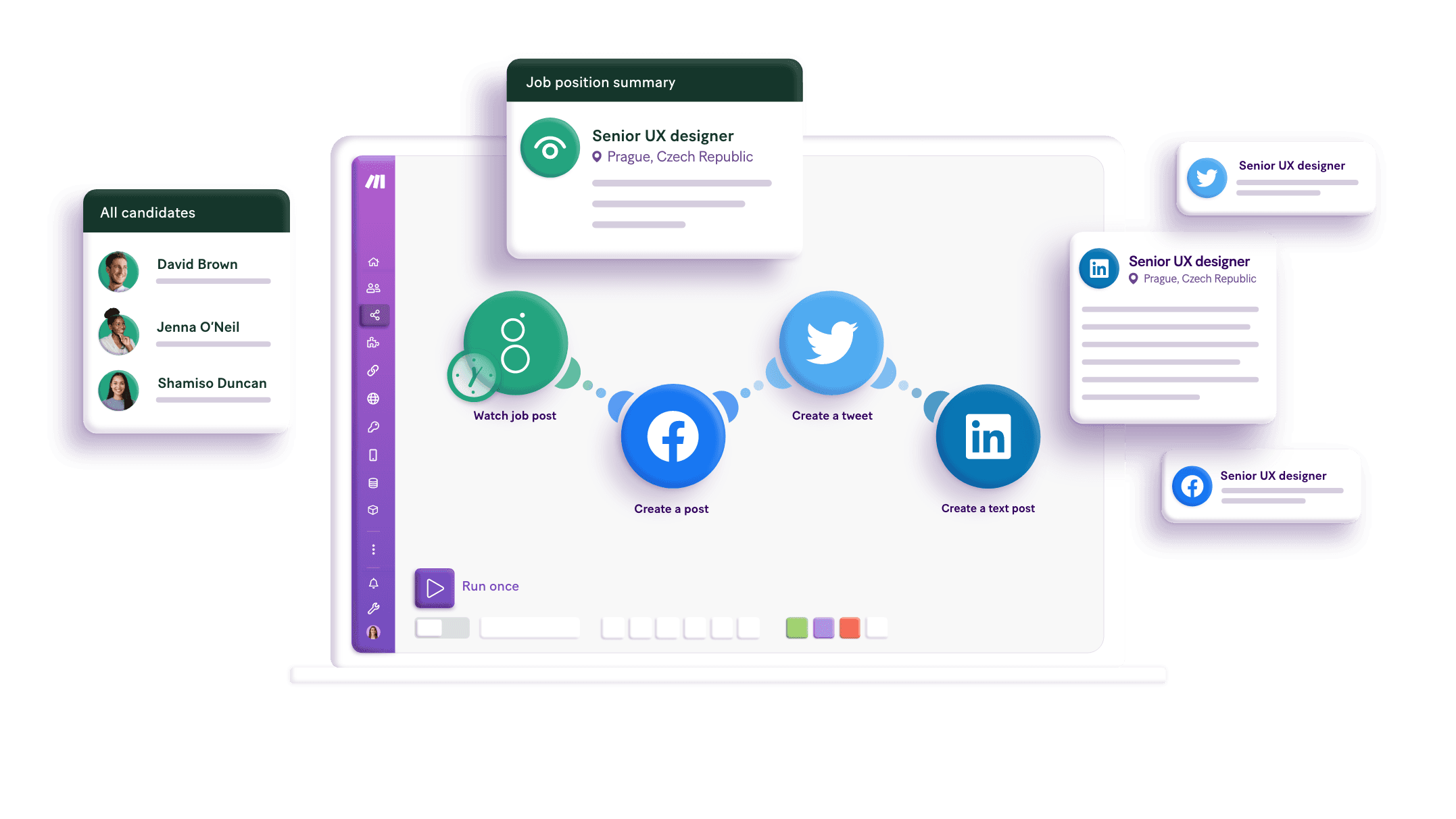
Build your Calendly and lemlist integrations.
Elevate your business efficiency by integrating lemlist and Calendly with Make. With this setup, your meeting schedules from lemlist can automatically trigger personalized email campaigns in Calendly, synchronizing appointment scheduling and email outreach seamlessly. This integration ensures that no lead slips through the cracks, streamlining your tasks and improving client engagement effortlessly.
Adds a lead in the unsubscribed list.
Adds a lead in a specific campaign.
Cancels an event.
Creates a new single-use scheduling link.
Creates a new booking for an event invitee. Requires a Calendly paid plan.
Creates a new event type.
Creates a new invitee no show.
Deletes a lead from a specific campaign.
Deletes a lead in the unsubscribed list.
Popular Calendly and lemlist workflows.
Explore Popular Calendly and lemlist Integrations for Automated, Efficient Lead Management. Enhance your workflow and streamline meeting coordination with powerful automation.
How to setup Calendly and lemlist in 5 easy steps
Open Make Automation Platform
Go to the Make platform to begin setting up the application connections.
Create a Calendly Connection
Find and select the option to connect Calendly, then name the connection.
Authorize Calendly Access
Approve Make's access to your Calendly data on the Calendly website.
Set Up Lemlist Integration
In your Lemlist settings, find the API key.
Complete Lemlist Connection
In Make, paste the Lemlist API key and finalize the connection setup.
Maximize Efficiency with Calendly and lemlist Integration for Lead Management
Boost your productivity by integrating Calendly and lemlist to automate lead generation, streamline meeting scheduling, and enhance your workflow efficiency.
Automatically add new leads to Lemlist campaigns whenever a Calendly event is scheduled.
Instantly create Zoom meetings in response to new Calendly bookings, streamlining the scheduling process.
Eliminate manual data entry and reduce administrative tasks with automated integrations.
Ensure that all leads are consistently and accurately tracked in Lemlist campaigns.


FAQ
Integrating Calendly and lemlist through Make can streamline your scheduling and email outreach processes. This integration allows you to automatically sync scheduled meetings from Calendly with your email campaigns in lemlist, ensuring timely and personalized communication with leads and clients.
Make offers a user-friendly interface with a drag-and-drop builder, allowing you to create workflows without any coding knowledge. By using Make, you can easily set up automated tasks and triggers between Calendly and lemlist, saving time and reducing the risk of manual errors.
One unique feature is the ability to trigger custom follow-up emails based on actions taken in Calendly, like scheduling or rescheduling an appointment. This ensures that your contacts receive personalized and relevant messages from lemlist, improving engagement rates and overall campaign effectiveness.
A potential challenge might be ensuring that all data syncing is accurate and timely between the platforms. Make mitigates this concern by offering real-time monitoring and error notifications, ensuring that any issues are quickly identified and resolved, providing a seamless integration experience.
A scenario represents a workflow or a project of your own creation, and it is made up of a series of modules that automate apps and services. Creating a scenario allows you to transfer and transform data between apps and services via these modules to automate anything and improve the way you work.
Modules are the main building blocks of automation in Make. Modules represent actions that Make performs with an app, like creating, updating, or deleting data.
How it works
Traditional no-code iPaaS platforms are linear and non-intuitive. Make allows you to visually create, build, and automate without limits.
Trusted by 350,000+ customers
"Make really helped us to scale our operations, take the friction out of our processes, reduce costs, and relieved our support team. It is difficult to not become a fan."

Philipp Weidenbach
Head of Operations at Teleclinic
"Make drives unprecedented efficiency within our business in ways we never imagined. It’s having an extra employee (or 10) for a fraction of the cost."

Cayden Phipps
COO at Shop Accelerator Martech
"The simplicity, flexibility and ability to build real complex automations without any knowledge of programming makes it the best thing since sliced bread."

Erkki Markus
Product Owner at Smaily
"True citizen development in the entire company. Make is present in every department, empowering the company to offer a unique customer experience."

Andreas Stryz
CTO & Co-founder at FINN
"I can't count the number of hours I've saved by using Make. Every single day is simpler because of Make's automation."

Kimberly D
Owner of Media Production