
Connect Facebook Messenger and OpenAI (ChatGPT, Whisper) integrations
Transform your Facebook Messenger into an AI-powered communication hub by connecting it with OpenAI (ChatGPT, Whisper) through Make. Automatically respond to messages, generate personalized content, create stunning images, transcribe voice messages, and produce video content—all triggered instantly when your customers reach out.

Triggers when a new message is received.

Analyzes images according to specified instructions.
Cancels an "in-progress" batch. The batch will be in status "cancelling" for up to 10 minutes, before changing to "cancelled", where it will have partial results (if any) available in the output file.
Creates and executes a batch of API calls.
Creates a new skill.
Creates a new immutable skill version.
Creates a new vector store and optionally adds files to it, or adds files to an existing vector store.
Deletes an existing conversation.
Deletes an existing model response.
Deletes a skill. This action cannot be undone.
Deletes a skill version. This action cannot be undone.
Deletes a vector store. This action cannot be undone.
Downloads a file from a container.
Downloads a skill as a ZIP file using its ID.
Downloads a skill version as a ZIP file.
Creates an edited or extended image given one or more source images and a prompt.
Generates a chat completion.
Qualifies whether the provided image or text(s) contains violent, hateful, illicit or adult content.
Creates an embedding vector representing the input text.
Generates a response.
Transcribes an audio to text.
Translates an audio to English.
Generates images using GPT Image.
Generates an audio file based on text input and settings.
Retrieves details of the specified batch.
Retrieves an existing model response.
Returns information about a specific skill by its ID.
Returns information about a specific skill version.
Performs an arbitrary authorized API call.
Generates text responses from prompts without requiring an account or connection.
Identifies information in a prompt's text and returns it as structured data.
Updates the default version pointer for a skill.
Uploads a file to be used across the OpenAI platform.
Retrieves a list of batches.
Lists input items.
Returns a list of skills.
Returns a list of skill versions.
Returns a list of vector stores.
Searches a vector store and returns the file content chunks that match your query.
Trusted by thousands of fast-scaling organizations around the globe





Automate your work. Build something new.
Just drag and drop apps to automate existing workflows or build new complex processes. Solve problems across all areas and teams.
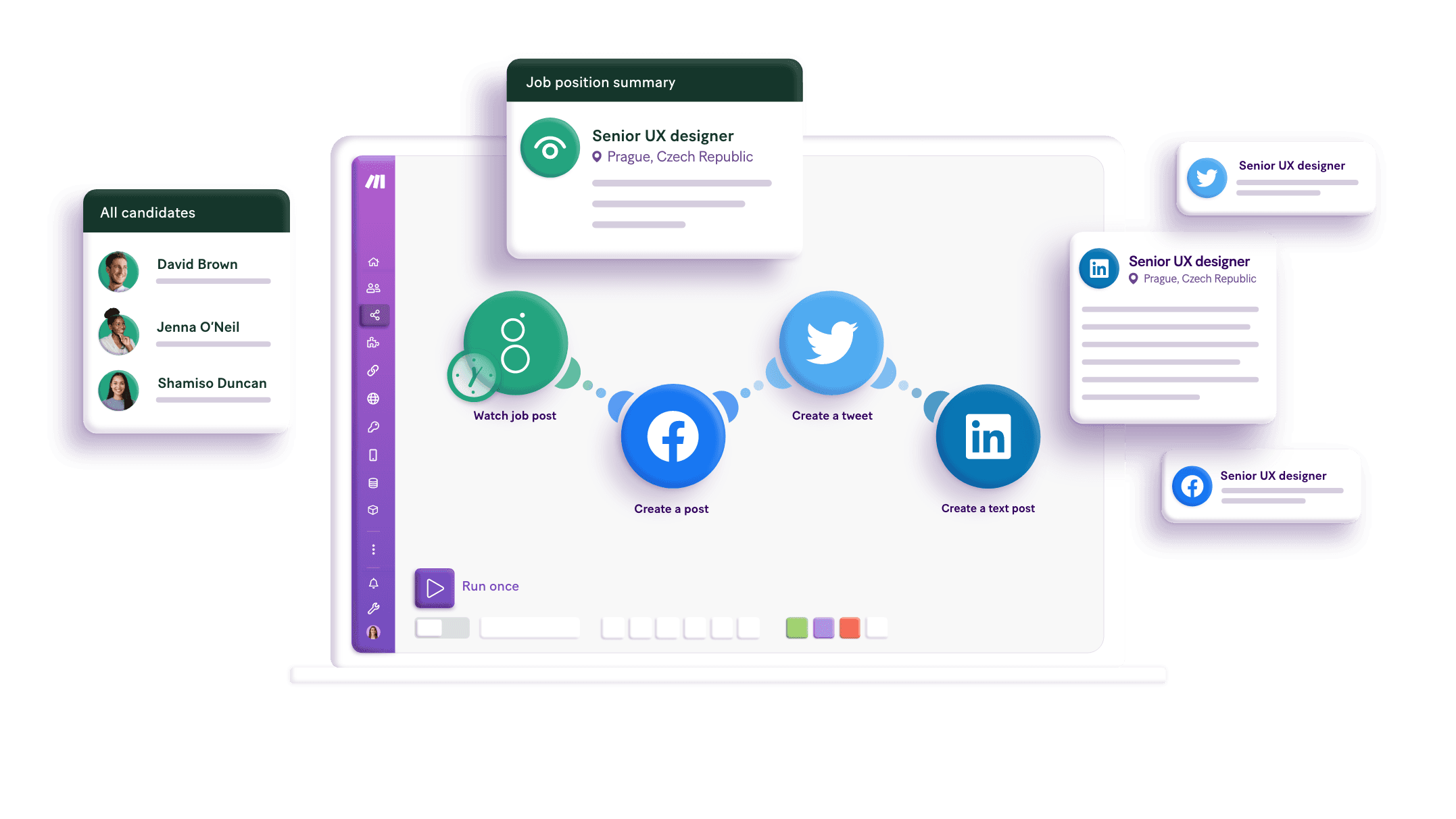
Build your Facebook Messenger and OpenAI (ChatGPT, Whisper) integrations.
Connect OpenAI (ChatGPT, Whisper) as a trigger and Facebook Messenger as an action through Make's automation platform. When OpenAI (ChatGPT, Whisper) receives an inquiry, it triggers Facebook Messenger to automatically respond to messages, generate personalized content, create images with DALL-E, transcribe voice messages using Whisper, or produce video content through Sora. This integration enables OpenAI (ChatGPT, Whisper) triggers to activate Facebook Messenger actions, allowing you to automate responses and generate AI-powered content based on incoming OpenAI (ChatGPT, Whisper) interactions.
Analyzes images according to specified instructions.
Cancels an "in-progress" batch. The batch will be in status "cancelling" for up to 10 minutes, before changing to "cancelled", where it will have partial results (if any) available in the output file.
Creates and executes a batch of API calls.
Creates a new skill.
Creates a new immutable skill version.
Creates a new vector store and optionally adds files to it, or adds files to an existing vector store.
Deletes an existing conversation.
Deletes an existing model response.
Deletes a skill. This action cannot be undone.
Popular Facebook Messenger and OpenAI (ChatGPT, Whisper) workflows.
Connect Facebook Messenger with OpenAI to automate customer conversations using ChatGPT's intelligent responses. Deliver instant, personalized support 24/7 while reducing costs and scaling efficiently.
Transform your messaging with AI-powered automation that handles unlimited conversations simultaneously, ensures immediate response times, and creates engaging customer interactions without manual intervention.
How to setup Facebook Messenger and OpenAI (ChatGPT, Whisper) in 5 easy steps
Set up your Facebook app for Messenger
Start by logging into the Facebook Developer Portal and creating a new app. Choose 'Other' as your use case, give your app a name, and add your contact email. Once created, find 'Messenger' in the products list and click 'Set up' to enable messaging capabilities. This establishes the foundation that allows your Facebook page to communicate with Make's automation platform.
Create your automation scenario in Make
Open Make in your web browser and log into your account. Create a new scenario, which is simply Make's name for an automated workflow. Add the 'Facebook Messenger > Watch messages' module as your starting point - this acts as a listener that monitors incoming messages from your Facebook page. This module will be the bridge that receives messages from Facebook and triggers your automation.
Generate and configure your webhook
Within the Watch messages module in Make, click 'Create a webhook' and give it a descriptive name. You'll need to create a 'Verify Token' - think of this as a password that confirms Facebook and Make are talking to each other securely. Make will generate a unique webhook URL for you. Copy this URL as you'll need it in the next step to complete the connection between Facebook and Make.
Connect Facebook to Make using the webhook
Return to your Facebook Developer Portal and navigate to the webhooks configuration section. Paste the webhook URL you copied from Make into the 'Callback URL' field, and enter the same Verify Token you created earlier. Click 'Verify and Save' to establish the connection. This step completes the pathway that allows Facebook Messenger to send incoming message data directly to your Make scenario.
Create your Facebook Messenger connection in Make
Back in the Facebook Developer Portal, generate an access token for your Facebook page - this is like a special key that gives Make permission to send messages on behalf of your page. Copy this token, then return to Make and add a 'Send a Message' module to your scenario. Click 'Create a connection', paste your access token, and save. Your Facebook Messenger is now fully connected to Make and ready to send automated messages.
Transform customer engagement with AI-powered Messenger automation
Connect Facebook Messenger with OpenAI to automate customer conversations using ChatGPT. Deliver instant, personalized responses 24/7 while reducing costs and scaling efficiently.
Automatically respond to Facebook Messenger inquiries with intelligent ChatGPT-generated answers, providing 24/7 customer support without manual intervention.
Deliver immediate replies to customer messages by leveraging OpenAI's language models, reducing wait times and improving customer satisfaction.
Handle unlimited simultaneous conversations on Facebook Messenger with AI assistance, eliminating staffing constraints and scaling during peak times.
Generate contextually relevant and personalized responses for each customer inquiry, creating more engaging and human-like conversations at scale.


FAQ
With Make, you can create automated workflows that connect Facebook Messenger with OpenAI's ChatGPT to provide intelligent, context-aware responses to your messages. When someone sends you a message on Facebook Messenger, Make can automatically trigger ChatGPT to generate a relevant response based on the conversation context, then send it back through Messenger. This is perfect for customer support, lead qualification, or maintaining engagement when you're unavailable. You can customize the AI's tone, style, and instructions to match your brand voice, creating a natural automated communication experience.
Integrating Facebook Messenger with OpenAI through Make opens up powerful automation capabilities: generate AI responses with ChatGPT for conversations, create custom images with DALL-E based on message requests, transcribe voice messages using Whisper, and even analyze sentiment or translate messages. This integration allows you to scale your communication, provide 24/7 support, handle multiple conversations simultaneously, and offer creative services directly through Messenger. Make's visual workflow builder means you don't need coding skills to set up these sophisticated automations, saving time and reducing operational costs while improving response quality and customer satisfaction.
Not at all! Make is specifically designed for users without coding experience. The platform provides a visual, drag-and-drop interface where you can connect Facebook Messenger and OpenAI with pre-built modules. You simply authenticate both applications, define your trigger (like 'when a new message is received'), add the OpenAI action (like 'create a chat completion'), and map the data between them. Make offers templates and step-by-step guidance to help you get started quickly. Most users can create their first working integration in under 30 minutes. Plus, Make's extensive documentation and community support are available if you need assistance along the way.
Yes, Make gives you complete control over your automation costs and usage. You can set specific conditions for when OpenAI is triggered, such as only responding to certain keywords, filtering by user type, or limiting responses to business hours. Make allows you to implement safeguards like maximum execution limits, error handling, and approval steps before costly operations run. You can also choose which OpenAI model to use based on your needs—using more affordable models like GPT-3.5 for routine tasks and reserving GPT-4 for complex requests. Make's execution history lets you monitor usage and costs in real-time, helping you optimize your workflows and stay within budget while maximizing the value of your Facebook Messenger automation.
A scenario represents a workflow or a project of your own creation, and it is made up of a series of modules that automate apps and services. Creating a scenario allows you to transfer and transform data between apps and services via these modules to automate anything and improve the way you work.
Modules are the main building blocks of automation in Make. Modules represent actions that Make performs with an app, like creating, updating, or deleting data.
How it works
Traditional no-code iPaaS platforms are linear and non-intuitive. Make allows you to visually create, build, and automate without limits.
Trusted by 350,000+ customers
"Make really helped us to scale our operations, take the friction out of our processes, reduce costs, and relieved our support team. It is difficult to not become a fan."

Philipp Weidenbach
Head of Operations at Teleclinic
"Make drives unprecedented efficiency within our business in ways we never imagined. It’s having an extra employee (or 10) for a fraction of the cost."

Cayden Phipps
COO at Shop Accelerator Martech
"The simplicity, flexibility and ability to build real complex automations without any knowledge of programming makes it the best thing since sliced bread."

Erkki Markus
Product Owner at Smaily
"True citizen development in the entire company. Make is present in every department, empowering the company to offer a unique customer experience."

Andreas Stryz
CTO & Co-founder at FINN
"I can't count the number of hours I've saved by using Make. Every single day is simpler because of Make's automation."

Kimberly D
Owner of Media Production