
Connect Freshdesk and Slack integrations

Triggers when a contact is created or updated.
Triggers when an event occurs to a ticket.
Triggers when a ticket is created or updated.

Adds a reaction to a message.
Adds a star to a channel.
Archives a channel.
Creates a channel.
Creates a reminder.
Deletes a file.
Removes a message.
Edits a message.
Returns details about a channel.
Returns details about a file.
Returns a message with a given ID from a specified private channel.
Returns a message with a given ID from a specified public channel.
Returns details about a member of a workspace.
Invites 1-30 users to a public or private channel.
Joins to an existing channel.
Removes a user from a channel.
Leaves a channel.
Performs an arbitrary authorized API call.
Pins a message to a channel.
Removes a reaction from a message.
Removes a star from a channel.
Removes a saved item.
Adds an Item to saved items.
Sends a file message.
Sends a message.
Update a user's current status.
Changes the purpose of a channel.
Changes the topic of a channel.
Unarchives a channel.
Unpins a message from a channel.
Creates or uploads a file.
Returns a list of channels in a workspace.
Returns a list of files within a team.
Retrieves IDs of members in a channel.
Returns reactions a user made.
Retrieves a thread of messages posted to a conversation.
Returns a list of all users in a workspace.
Returns messages matching a search query.
Retrieves a single user by looking them up by their registered email address.
Trusted by thousands of fast-scaling organizations around the globe





Automate your work. Build something new.
Just drag and drop apps to automate existing workflows or build new complex processes. Solve problems across all areas and teams.
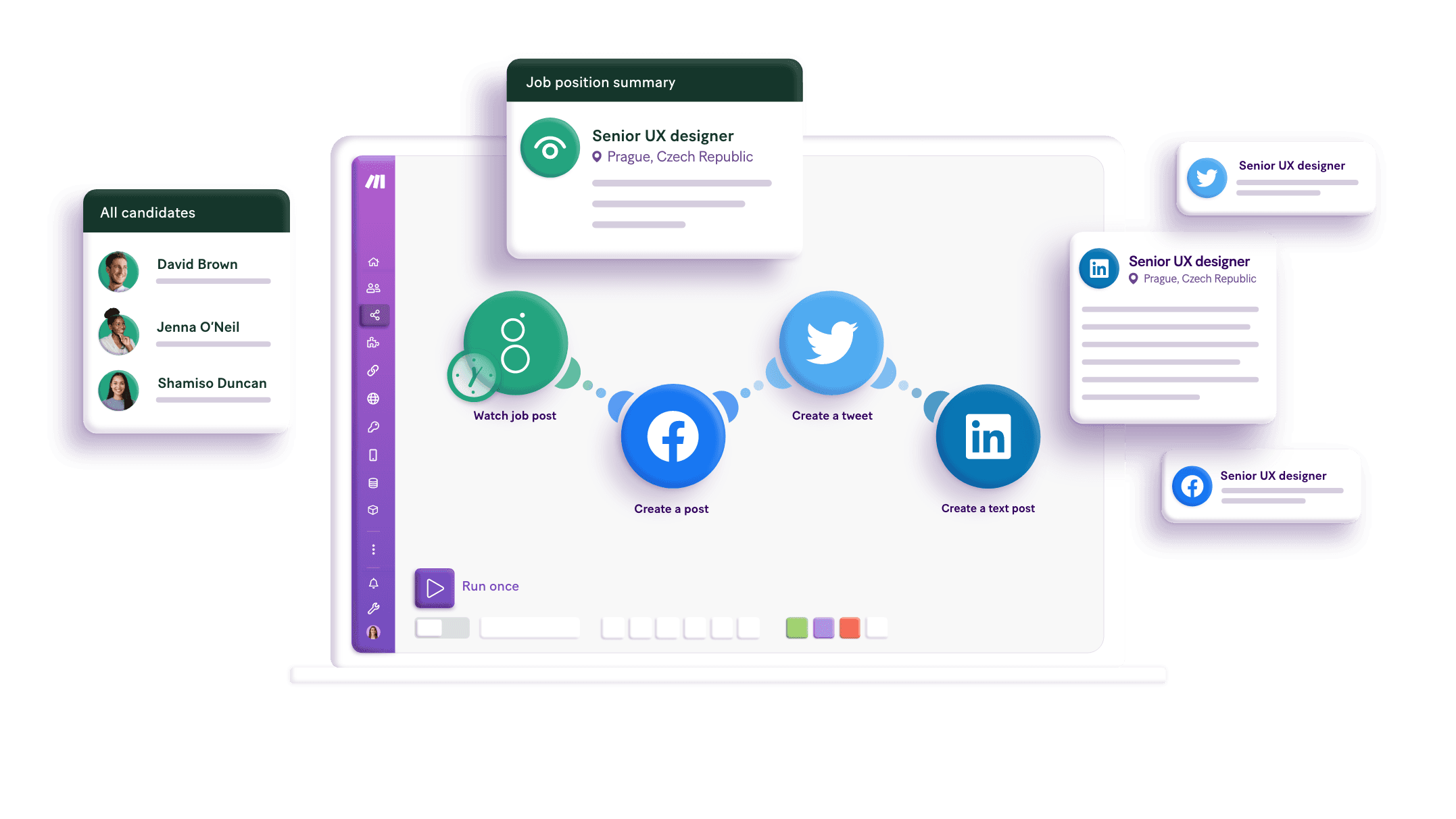
Build your Freshdesk and Slack integrations.
Integrate Freshdesk as a trigger and Slack as an action with the Make automation platform for optimized business workflows. Use Freshdesk to trigger updates on ticket activities, which automatically notify your team via Slack. This integration ensures real-time alerts about customer issues, improving response times and enhancing collaboration. Optimize communication and service quality by setting Freshdesk to trigger Slack notifications, facilitating better team productivity and efficient customer support.
Adds a reaction to a message.
Adds a star to a channel.
Archives a channel.
Creates a channel.
Creates a new company.
Creates a new contact.
Creates a new forum.
Creates a new forum category.
Creates a new forum topic.
Popular Freshdesk and Slack workflows.
Discover how integrating Freshdesk with Slack through the Make platform improves communication, boosts responsiveness, and enhances team collaboration.
How to setup Freshdesk and Slack in 5 easy steps
Access your Freshdesk account
Start by logging into your Freshdesk account to gather the details needed for connecting it with Make.
Find and use your Freshdesk API key
Go to your Freshdesk Profile Settings to find and copy your API key, which you will need for the connection.
Connect Freshdesk to Make
In Make, add a Freshdesk module to your scenario and input your Freshdesk API key and company name to establish the connection.
Authenticate Slack in Make
Log into your Make account and initiate the Slack connection by choosing whether you want a user or bot setup and following the provided prompts.
Complete and verify connections
Ensure both Freshdesk and Slack are connected to Make by saving your settings and confirming everything is functioning correctly.
Maximize efficiency and collaboration by integrating Freshdesk and Slack
Integrating Freshdesk and Slack connects ticket updates with communication, facilitates quick responses from Slack to tickets, and reduces manual data transfers.
Automatically update Freshdesk tickets with relevant Slack discussions to keep all team communication in one place.
Enable swift customer support by transforming Slack messages into ticket responses quickly.
Reduce the manual effort needed to copy information between Slack and Freshdesk, saving time.
Facilitate better cross-platform collaboration by linking Slack conversations to customer support actions in Freshdesk.


FAQ
Integrating Freshdesk and Slack with Make ensures direct communication between your support team and other parts of your organization. Make allows you to automate notifications for new tickets, responses, or changes in Freshdesk directly into your Slack channels, resulting in timely updates and improved collaboration.
By automating routine tasks like notifying team members about urgent support tickets directly onto Slack, your team can respond faster and decrease manual workload. This minimizes the need to check multiple platforms constantly, allowing your team to focus more on resolving issues rather than tracking them.
Make offers flexibility in workflow automation, allowing you to customize triggers and actions specific to your team's needs. For instance, you can set up workflows where any Freshdesk ticket categorized as 'Priority' triggers a direct Slack message to a specific team member, preventing delays in escalations.
The Make platform is user-friendly and offers extensive documentation, a supportive community, and customer service to assist you through setup and troubleshooting. Additionally, Make provides numerous pre-built templates that can simplify your initial setup and can be customized further to suit your specific requirements.
A scenario represents a workflow or a project of your own creation, and it is made up of a series of modules that automate apps and services. Creating a scenario allows you to transfer and transform data between apps and services via these modules to automate anything and improve the way you work.
Modules are the main building blocks of automation in Make. Modules represent actions that Make performs with an app, like creating, updating, or deleting data.
How it works
Traditional no-code iPaaS platforms are linear and non-intuitive. Make allows you to visually create, build, and automate without limits.
Trusted by 350,000+ customers
"Make really helped us to scale our operations, take the friction out of our processes, reduce costs, and relieved our support team. It is difficult to not become a fan."

Philipp Weidenbach
Head of Operations at Teleclinic
"Make drives unprecedented efficiency within our business in ways we never imagined. It’s having an extra employee (or 10) for a fraction of the cost."

Cayden Phipps
COO at Shop Accelerator Martech
"The simplicity, flexibility and ability to build real complex automations without any knowledge of programming makes it the best thing since sliced bread."

Erkki Markus
Product Owner at Smaily
"True citizen development in the entire company. Make is present in every department, empowering the company to offer a unique customer experience."

Andreas Stryz
CTO & Co-founder at FINN
"I can't count the number of hours I've saved by using Make. Every single day is simpler because of Make's automation."

Kimberly D
Owner of Media Production