
Connect Jira Cloud Platform and Perplexity AI integrations
Transform your project management into an intelligent powerhouse by connecting Jira Cloud Platform and Perplexity AI. Automatically trigger AI-powered insights, summaries, and recommendations every time your Jira Cloud Platform tickets update—turning routine project changes into actionable intelligence that accelerates decision-making and improves your entire workflow

Triggers when a ticket event occurs.
Triggers when an issue is created or updated.

Creates a chat completions with the chosen model.
Generate a response for the provided input with optional web search and reasoning.
Generate contextualized embeddings for document chunks. Chunks from the same document share context awareness, improving retrieval quality for document-based applications.
Generate vector representations (embeddings) for the text you provide.
Performs an arbitrary authorized API call.
Returns the ranked search results from Perplexity's continously refreshed index.
Trusted by thousands of fast-scaling organizations around the globe





Automate your work. Build something new.
Just drag and drop apps to automate existing workflows or build new complex processes. Solve problems across all areas and teams.
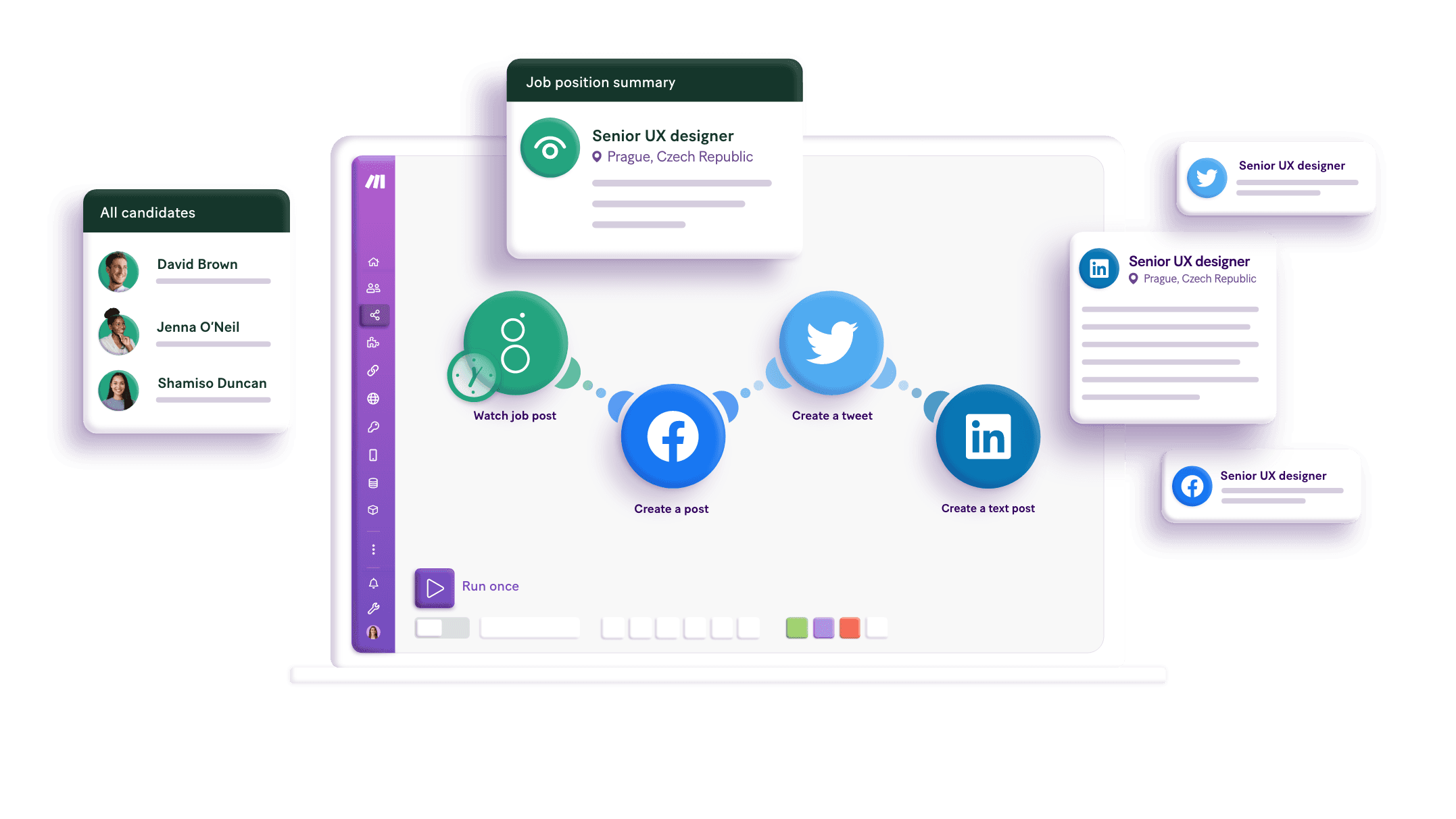
Build your Jira Cloud Platform and Perplexity AI integrations.
Perplexity AI serves as a trigger by monitoring events such as ticket updates, new issues, or status changes within your project management workspace. When these specified events occur in Perplexity AI, they automatically initiate workflows that connect to Jira Cloud Platform as an action. Jira Cloud Platform then processes the triggered data to generate AI-powered insights, analyze project information, create intelligent summaries, or produce actionable recommendations based on the Perplexity AI events. This trigger-action integration enables automated responses where changes in Perplexity AI directly activate Jira Cloud Platform's artificial intelligence capabilities to improve decision-making and optimize your workflow processes
Adds a user as a watcher to an issue.
Adds a new attachment to a ticket.
Adds a comment to an issue.
Assigns an issue to a user.
Creates options for a custom select field.
Creates a component.
Creates a project version.
Creates a chat completions with the chosen model.
Creates a new issue.
Popular Jira Cloud Platform and Perplexity AI workflows.
Looking to get more out of Jira Cloud Platform and Perplexity AI? With Make you can visually integrate Jira Cloud Platform and Perplexity AI into any workflow to save time and resources — no coding required. Try any of these templates in just a few clicks.
How to setup Jira Cloud Platform and Perplexity AI in 5 easy steps
Get your API token from JIRA
Before you can connect JIRA to Make, you'll need an API token that acts like a secure password for the connection. Log into Atlassian's website, navigate to the API tokens section, and create a new token with a name you'll remember. Copy this token immediately and save it somewhere safe, because you won't be able to see it again once you close the window.
Connect JIRA to Make
Open Make and add a JIRA module to your automation scenario. Click the 'Add' button in the connection field and fill in your JIRA instance address, your email address, and paste the API token you saved earlier. Give your connection a memorable name and click 'Save' to complete the setup.
Get your API key from Perplexity AI
To connect Perplexity AI to Make, you'll need to obtain an API key from your Perplexity AI account. Log into Perplexity AI, go to Settings, select the API section, and create a new API key. Copy this key immediately and store it securely, as it's required for Make to communicate with your Perplexity AI account.
Connect Perplexity AI to Make
Return to Make and add a Perplexity AI module to your scenario. Click 'Create a connection' within the module and paste your Perplexity AI API key into the designated field. You can also add a descriptive connection name to help identify it later, then click 'Save' to establish the connection.
Build your automation workflow
With both JIRA and Perplexity AI now connected to Make, you can create automated workflows between them. For example, you could set up an automation where new JIRA issues trigger Perplexity AI to generate relevant information, or use AI responses to automatically update your JIRA tickets. Explore the available options in each app's modules to design automations that match your specific workflow needs.
AI-powered project management: Jira Cloud Platform + Perplexity AI
Integrate Jira Cloud Platform with Perplexity AI to transform issue resolution with automated research, intelligent documentation, and smart classification for improved productivity with AI-driven insights.
Automatically enrich Jira tickets with AI-powered research from Perplexity to provide context and solutions for faster issue resolution.
Generate comprehensive project documentation by querying Perplexity AI based on Jira project data and automatically attach insights to relevant issues.
Use Perplexity AI to analyze and categorize incoming Jira issues with added context, ensuring proper assignment and prioritization.
Trigger automatic Perplexity searches when specific Jira issue types are created, delivering relevant technical knowledge directly to your team.

![The Easiest Way to Integrate GitHub and Jira [Step-by-Step Guide]](/_next/image?url=https%3A%2F%2Fwww.make.com%2F_next%2Fimage%3Furl%3Dhttps%253A%252F%252Fimages.ctfassets.net%252Fun655fb9wln6%252Fblog-image-4234%252F11db22f2933d7fd503b9d03019ab1243%252Fgithub-jira-integration.png%26w%3D1920%26q%3D75&w=3840&q=75)
FAQ
By connecting Jira Cloud Platform with Perplexity AI through Make, you can automatically enhance your project documentation and issue tracking with AI-powered research capabilities. For example, when new issues are created in Jira, Make can trigger Perplexity AI to gather relevant technical information, best practices, or solution suggestions, then automatically add this context to your Jira tickets. This saves your team hours of manual research and ensures every issue has comprehensive background information for faster resolution.
Make enables powerful automation scenarios between Jira and Perplexity AI without coding. You can automatically generate project summaries by having Perplexity AI analyze completed Jira sprints, create intelligent bug report enrichment where Perplexity researches error messages and suggests fixes, build automated release notes by having Perplexity summarize ticket changes, or set up smart ticket triaging where Perplexity analyzes issue descriptions and recommends appropriate labels, priorities, or assignments. These automations run 24/7 once configured, dramatically improving team efficiency.
No programming skills are required. Make provides a visual, drag-and-drop interface that makes it straightforward to connect Jira Cloud Platform and Perplexity AI. You select triggers (like 'New Issue in Jira'), actions (like 'Query Perplexity AI'), and map the data between them using Make's intuitive interface. Make handles all the technical complexity of API connections, authentication, and data formatting automatically. You can have your first integration running in minutes, and Make offers templates and step-by-step guidance to help you get started quickly.
Make offers significant advantages over custom development: you can deploy integrations in minutes instead of weeks, with zero maintenance burden as Make handles all API updates and infrastructure automatically. You get built-in error handling, logging, and monitoring tools to ensure reliability. Make also allows you to modify or expand your workflows as needs change, and you can connect additional apps beyond just Jira and Perplexity AI to create comprehensive automation ecosystems. Plus, Make's free tier lets you start experimenting immediately without upfront investment, and you only scale costs as your automation usage grows.
A scenario represents a workflow or a project of your own creation, and it is made up of a series of modules that automate apps and services. Creating a scenario allows you to transfer and transform data between apps and services via these modules to automate anything and improve the way you work.
Modules are the main building blocks of automation in Make. Modules represent actions that Make performs with an app, like creating, updating, or deleting data.
How it works
Traditional no-code iPaaS platforms are linear and non-intuitive. Make allows you to visually create, build, and automate without limits.
Trusted by 350,000+ customers
"Make really helped us to scale our operations, take the friction out of our processes, reduce costs, and relieved our support team. It is difficult to not become a fan."

Philipp Weidenbach
Head of Operations at Teleclinic
"Make drives unprecedented efficiency within our business in ways we never imagined. It’s having an extra employee (or 10) for a fraction of the cost."

Cayden Phipps
COO at Shop Accelerator Martech
"The simplicity, flexibility and ability to build real complex automations without any knowledge of programming makes it the best thing since sliced bread."

Erkki Markus
Product Owner at Smaily
"True citizen development in the entire company. Make is present in every department, empowering the company to offer a unique customer experience."

Andreas Stryz
CTO & Co-founder at FINN
"I can't count the number of hours I've saved by using Make. Every single day is simpler because of Make's automation."

Kimberly D
Owner of Media Production