
Connect Make and Browse AI integrations

Triggers when a scenario is created or updated in the specified folder.

Performs an arbitrary authorized API call.
Runs a task.
Trusted by thousands of fast-scaling organizations around the globe





Automate your work. Build something new.
Just drag and drop apps to automate existing workflows or build new complex processes. Solve problems across all areas and teams.
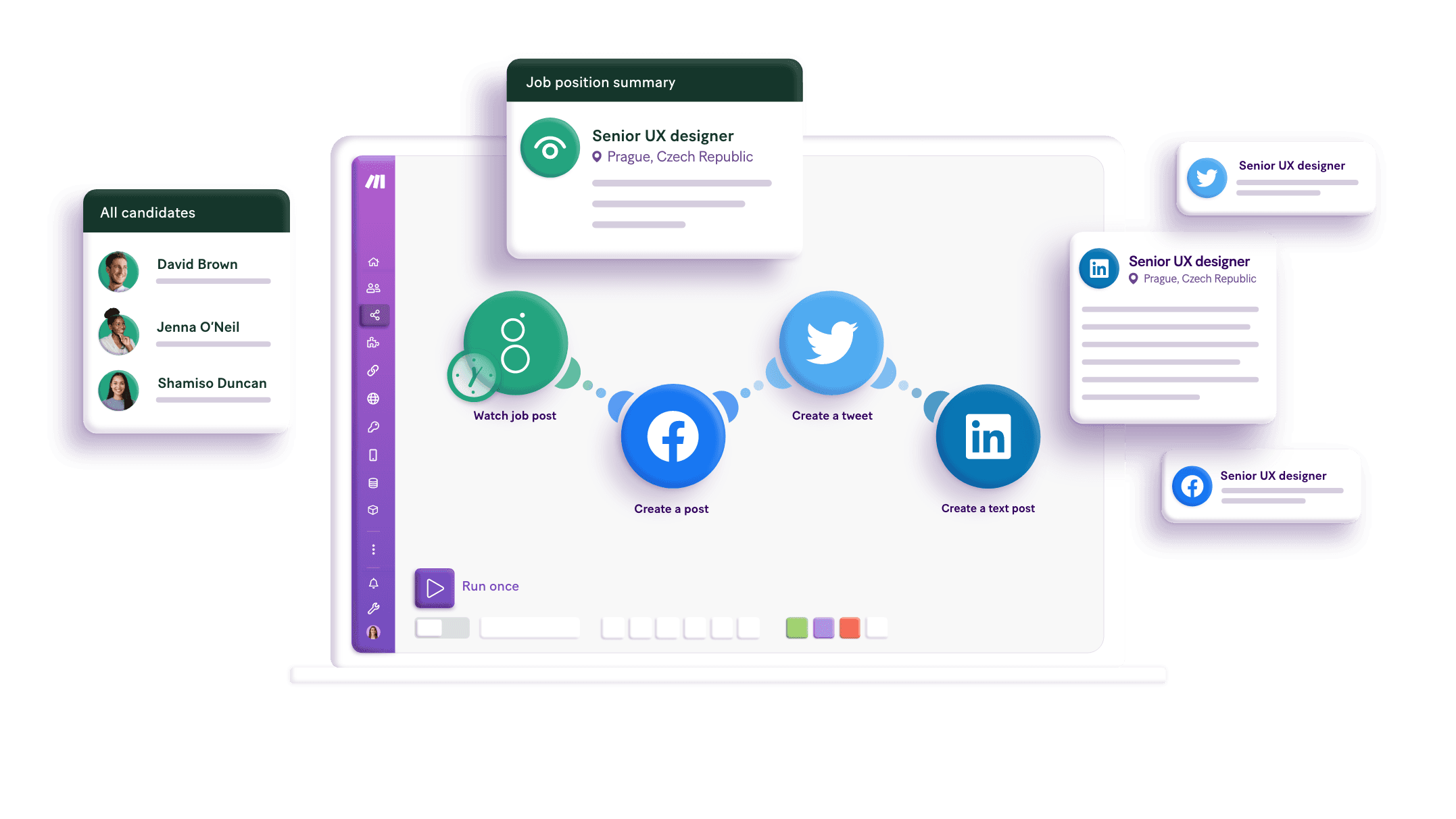
Build your Make and Browse AI integrations.
Browse AI serves as a trigger to initiate automated workflows that execute Make actions for web data extraction and monitoring. When specific triggers activate in Browse AI's visual workflow builder, they automatically prompt Make to perform actions such as scraping web content, monitoring competitor websites, tracking product prices, or gathering lead information. This trigger-action integration enables you to set up intelligent automations where Browse AI's triggers respond to scheduled intervals or specific conditions, then automatically execute Make's data extraction actions, ensuring your teams receive fresh web data exactly when needed without manual intervention.
Creates a new scenario.
Creates a new scenario folder.
Creates a new team.
Creates or updates a connection in a custom app.
Creates or updates a custom IML function in a custom app.
Creates a custom app.
Creates or updates a module in a custom app.
Creates or updates a webhook in a custom app.
Creates or updates an RPC in a custom app.
Popular Make and Browse AI workflows.
Looking to get more out of Make and Browse AI? With Make you can visually integrate Make and Browse AI into any workflow to save time and resources — no coding required. Try any of these templates in just a few clicks.
How to setup Make and Browse AI in 5 easy steps
Add your application module to Make
Log into your Make account and open your automation scenario. Find the app you want to connect, such as Browse AI, and add its module to your workspace. This module serves as the building block that allows Make to communicate with your chosen application and begin the connection process.
Start creating the connection
Once your module is in place, click the 'Create a connection' button that appears within the module. This button initiates the linking process between Make and your application. Give your connection a memorable name so you can easily identify it later when managing multiple automations in your workspace.
Choose how you want to connect
Make offers two ways to authenticate your connection: OAuth2 or API key. OAuth2 provides a quick authorization process where you log in and grant permission. The API key method gives you more direct control by using a special code from your Make profile. Select the method that feels most comfortable for you.
Enter your Make environment details
In the connection setup, you'll need to provide your Make environment URL, which is the web address where your Make account lives, such as 'https://eu1.make.com'. If you chose the API key method, you'll also paste in your API key, which you can find by clicking your profile icon, selecting 'Profile', and navigating to the 'API' tab to copy or create a new token.
Save and complete your connection
Click the 'Save' button to finalize all your connection settings. Depending on your chosen authentication method, you may be redirected to confirm your account access and grant the necessary permissions. Once you complete this final security step, your connection is active and you can start building automations that move data between your connected applications.
Powerful benefits of connecting Make with Browse AI
Integrate Make and Browse AI to automate data extraction workflows, receive real-time monitoring alerts, and distribute scraped web data across multiple platforms and databases.
Automatically trigger actions in other apps whenever Browse AI extracts new data from websites, eliminating manual data transfer.
Set up instant notifications across multiple channels when Browse AI detects changes on monitored websites.
Sync extracted website data from Browse AI directly into spreadsheets, databases, or CRM systems without coding.
Route scraped data from Browse AI to multiple applications simultaneously, ensuring all teams have access to the latest information.


FAQ
Make enables you to connect Browse AI with thousands of other apps to create powerful automated workflows. When Browse AI extracts data from websites, Make can automatically trigger actions like sending that data to Google Sheets, creating tasks in project management tools, updating CRM records, sending notifications via email or Slack, or storing information in databases. This eliminates manual data transfer and ensures your extracted web data flows directly into your business processes without any coding required.
Integrating Browse AI through Make transforms raw web data into actionable business intelligence. You can automatically monitor competitor pricing and update your own pricing systems, track product availability and alert your sales team, extract leads from websites and add them directly to your CRM, monitor news or social media and trigger marketing campaigns, or scrape job postings and populate your recruitment database. Make's visual workflow builder makes it quick to set up these integrations in minutes, with no programming knowledge needed, while offering advanced features like data filtering, formatting, and conditional logic.
Not at all. Make provides an intuitive drag-and-drop interface that makes integration setup straightforward, even for non-technical users. You select Browse AI as your trigger app to watch for new data, then choose the action apps where you want to send that data. Make offers pre-built templates for common workflows and provides step-by-step guidance throughout the process. You can test each step of your workflow before activating it, and Make's extensive documentation and active community support are available if you need help. Most users can create their first automation in under 15 minutes.
Absolutely. Make offers powerful data transformation capabilities that allow you to customize how Browse AI extracts are processed before reaching their destination. You can filter data based on specific conditions, reformat text and numbers, combine data from multiple sources, split or merge fields, perform calculations, and apply conditional logic to route data to different apps based on criteria you define. This flexibility ensures that the web data extracted by Browse AI is perfectly formatted and relevant for each of your connected applications, maximizing the value of your automated workflows.
A scenario represents a workflow or a project of your own creation, and it is made up of a series of modules that automate apps and services. Creating a scenario allows you to transfer and transform data between apps and services via these modules to automate anything and improve the way you work.
Modules are the main building blocks of automation in Make. Modules represent actions that Make performs with an app, like creating, updating, or deleting data.
How it works
Traditional no-code iPaaS platforms are linear and non-intuitive. Make allows you to visually create, build, and automate without limits.
Trusted by 350,000+ customers
"Make really helped us to scale our operations, take the friction out of our processes, reduce costs, and relieved our support team. It is difficult to not become a fan."

Philipp Weidenbach
Head of Operations at Teleclinic
"Make drives unprecedented efficiency within our business in ways we never imagined. It’s having an extra employee (or 10) for a fraction of the cost."

Cayden Phipps
COO at Shop Accelerator Martech
"The simplicity, flexibility and ability to build real complex automations without any knowledge of programming makes it the best thing since sliced bread."

Erkki Markus
Product Owner at Smaily
"True citizen development in the entire company. Make is present in every department, empowering the company to offer a unique customer experience."

Andreas Stryz
CTO & Co-founder at FINN
"I can't count the number of hours I've saved by using Make. Every single day is simpler because of Make's automation."

Kimberly D
Owner of Media Production