
Connect Microsoft 365 Email (Outlook) and Vapi integrations
Transform your inbox into an intelligent voice automation hub by connecting Microsoft 365 Email (Outlook) and Vapi through Make's no-code platform. Automatically trigger AI-powered voice calls and conversations the moment emails arrive, eliminating repetitive tasks and improving your communication workflow with code-free integration.

Triggers when a new email is sent or received.

Sends a client-generated event or object to the VAPI platform. Commonly used for live updates or user actions.
Creates a new voice assistant with a specified configuration (name, voice, model, etc.).
Starts a new call session using an assistant or a squad. Often used to simulate or initiate interactions.
Creates a group of assistants (a squad) where the first available assistant responds to a call.
Defines a new tool that can be invoked by an assistant (e.g., API calls, function tools, DTMF).
Deletes a specific assistant by ID.
Deletes call metadata and logs for a particular conversation.
Deletes a selected file from the knowledge base.
Fetches details for a specific file by ID.
Retrieves information about a specific squad, including its members.
Fetches the details of a tool, such as its configuration and endpoint.
Performs an arbitrary authorized API call.
Returns the response to the function call be it error or result.
Sends a message from the VAPI server to the client app. Often used to trigger UI changes or sync data.
Updates the configuration of an existing assistant.
Allows updates to a specific call session (e.g., tagging, note-taking).
Updates the configuration of an existing file.
Updates members or configuration of a squad.
Modifies an existing tool's logic or structure.
Upload a file to use with the knowledge base.
Fetches details for a specific assistant by ID.
Retrieves a call's metadata, including transcript, participants, and timestamps.
Lists all assistants in your VAPI account.
Shows the history of past calls, including assistant used and call duration.
Retrieve all files in your knowledge base.
Returns the list of Twilio or Vonage numbers connected to your account.
Lists all squads and their associated assistants.
List Tools.
Trusted by thousands of fast-scaling organizations around the globe





Automate your work. Build something new.
Just drag and drop apps to automate existing workflows or build new complex processes. Solve problems across all areas and teams.
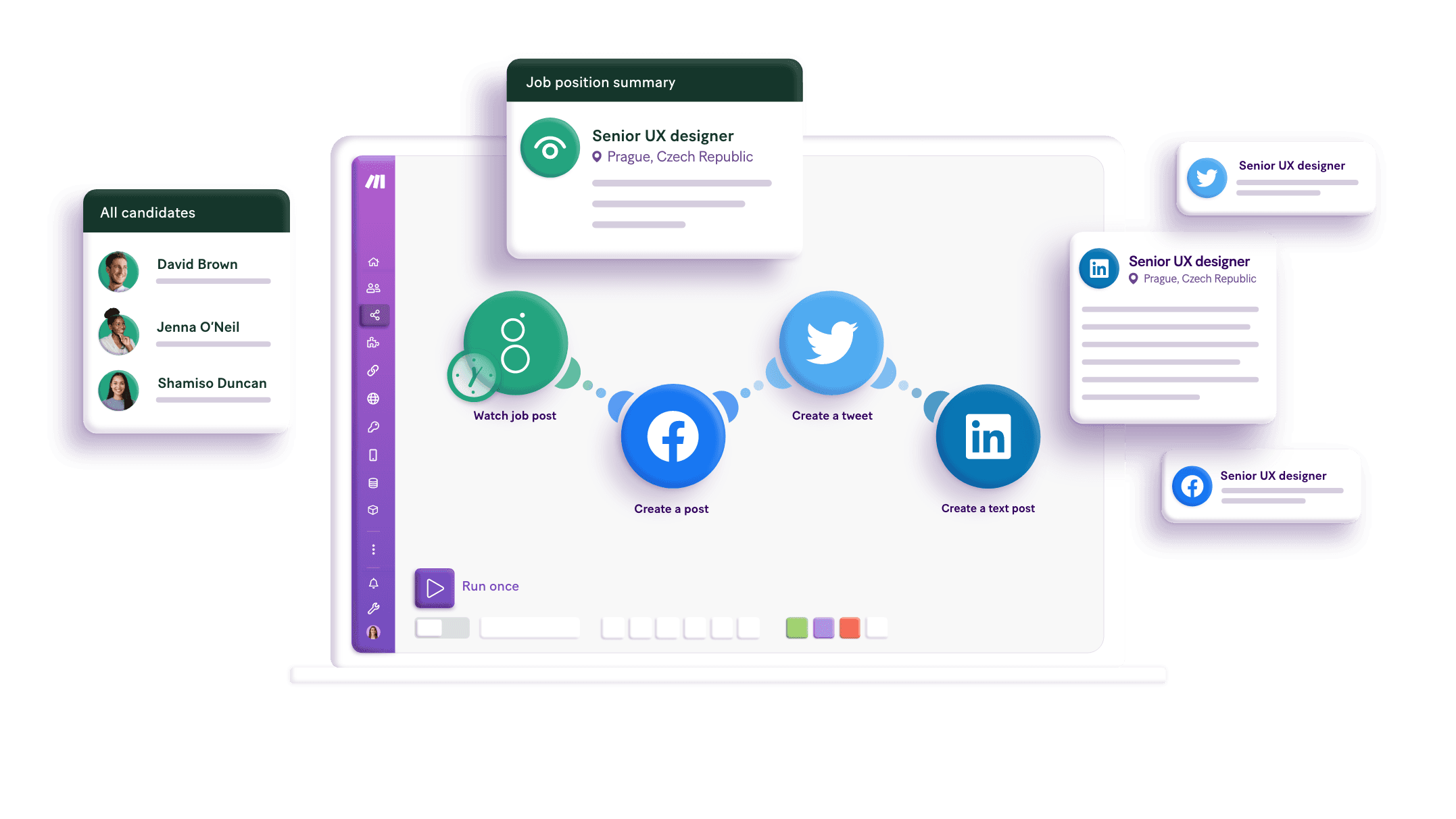
Build your Microsoft 365 Email (Outlook) and Vapi integrations.
Connect Vapi as a trigger and Microsoft 365 Email (Outlook) as an action through Make's intuitive integration platform to automate powerful workflows. When you receive incoming emails in Vapi, you can automatically trigger Microsoft 365 Email (Outlook) voice calls or voice AI conversations in response. Make's visual workflow builder empowers you to design custom automation scenarios where Vapi detects new messages and initiates Microsoft 365 Email (Outlook) actions without writing a single line of code. The platform's flexible architecture supports multi-step workflows and conditional logic, ensuring your Vapi trigger activates Microsoft 365 Email (Outlook) actions exactly as you need. Start building your automated workflows today and discover how using Vapi as a trigger with Microsoft 365 Email (Outlook) as an action through Make can transform your business operations and save countless hours of repetitive work.
Adds a large attachment to an email.
Sends a client-generated event or object to the VAPI platform. Commonly used for live updates or user actions.
Creates a new voice assistant with a specified configuration (name, voice, model, etc.).
Starts a new call session using an assistant or a squad. Often used to simulate or initiate interactions.
Creates a group of assistants (a squad) where the first available assistant responds to a call.
Defines a new tool that can be invoked by an assistant (e.g., API calls, function tools, DTMF).
Creates a new draft email.
Deletes a specific assistant by ID.
Deletes call metadata and logs for a particular conversation.
Popular Microsoft 365 Email (Outlook) and Vapi workflows.
Looking to get more out of Microsoft 365 Email (Outlook) and Vapi? With Make you can visually integrate Microsoft 365 Email (Outlook) and Vapi into any workflow to save time and resources — no coding required. Try any of these templates in just a few clicks.
How to setup Microsoft 365 Email (Outlook) and Vapi in 5 easy steps
Add your app module and start creating a connection
Log into your Make account and open your workflow scenario. Add the module for the application you want to connect (Microsoft 365 Email or Vapi). When the module appears, you'll see a prompt to create a new connection - click on the 'Create a connection' button to begin linking your app to Make.
Give your connection a memorable name
In the connection setup window, you'll have the option to name your connection. While this is optional, choosing a descriptive name helps you easily identify this connection later, especially when working with multiple connections. Pick a name that clearly indicates which account or purpose this connection serves.
Get your Vapi API key from your account
If you're connecting Vapi, you'll need to retrieve your API key first. Log into your Vapi account, click on 'Build' in the left sidebar, then select 'Vapi API Keys'. Copy your Private Key and keep it handy. If you don't have a key yet, you can create one by clicking 'Add Key'.
Enter your credentials to establish the connection
For Vapi, paste your Private Key into the API Key field in Make's connection window. For Microsoft 365 Email, click 'Save' and you'll be redirected to Microsoft's login page where you'll sign in with your account. After logging in to Microsoft, review and confirm the permissions Make is requesting to access your email.
Save and start using your connected apps
Once you've entered your credentials or completed the authentication process, click the 'Save' button to finalize your connection. Your app is now connected to Make and ready to use in your automation workflows. You can begin building scenarios that automate tasks between your connected applications.
Improve communication with Microsoft 365 Email and Vapi integration
Automate call follow-ups, receive real-time notifications, and centralize documentation by connecting Microsoft 365 Email (Outlook) with Vapi through Make's powerful integration platform.
Automatically send follow-up emails through Outlook after Vapi.ai calls complete, ensuring timely communication without manual intervention.
Receive instant email alerts in your Outlook inbox when specific Vapi webhook events trigger, keeping your team informed of important call activities.
Capture call transcripts and outcomes from Vapi.ai and automatically log them in email threads or send summaries to relevant stakeholders via Outlook.
Trigger Vapi.ai calls based on Outlook calendar events or email triggers, automating appointment confirmations and reminders.


FAQ
By connecting Microsoft 365 Email with Vapi.ai on Make, you can automate call-to-email workflows. For example, when Vapi.ai receives or completes a call, Make can automatically send email summaries, transcripts, or follow-up messages through Outlook. This integration eliminates manual data entry, ensures timely communication with clients, and creates a unified record of voice and email interactions. You can set up triggers based on Vapi webhook events to instantly notify your team via email about important calls, schedule follow-ups, or log call details directly into your email system.
The integration enables powerful automation scenarios such as: automatically sending email confirmations after Vapi.ai completes a customer call, forwarding call transcripts to specific team members via Outlook, creating email alerts when certain keywords are detected in calls, scheduling follow-up emails based on call outcomes, and attaching call recordings or summaries to emails sent to your CRM contacts. Make's visual workflow builder lets you create these automations without coding, connecting Vapi's webhook events directly to Outlook's email actions, giving you complete control over how voice interactions trigger email communications.
No advanced technical skills are required. Make provides an intuitive drag-and-drop interface that allows you to connect Vapi.ai and Microsoft 365 Email visually. You simply select triggers from Vapi (like call completed or webhook received) and actions from Outlook (like send email or create draft), then map the data between them. Make offers pre-built modules for both applications, templates to get started quickly, and comprehensive documentation. Most users can create their first automation in minutes. The platform handles all the complex API connections behind the scenes, so you can focus on designing the workflow that meets your business needs.
Automating this integration through Make can save significant time and reduce operational costs. Instead of manually sending follow-up emails after each call, checking call logs, or copying information between systems, your workflows run automatically 24/7. Businesses typically save 10-20 hours per week on administrative tasks related to call management and email follow-ups. Make's free tier allows you to test the integration with 1,000 operations per month, and paid plans scale affordably as your needs grow. The reduction in human error, faster response times to customers, and ability to handle higher call volumes without additional staff creates immediate ROI that justifies the investment in automation.
A scenario represents a workflow or a project of your own creation, and it is made up of a series of modules that automate apps and services. Creating a scenario allows you to transfer and transform data between apps and services via these modules to automate anything and improve the way you work.
Modules are the main building blocks of automation in Make. Modules represent actions that Make performs with an app, like creating, updating, or deleting data.
How it works
Traditional no-code iPaaS platforms are linear and non-intuitive. Make allows you to visually create, build, and automate without limits.
Trusted by 350,000+ customers
"Make really helped us to scale our operations, take the friction out of our processes, reduce costs, and relieved our support team. It is difficult to not become a fan."

Philipp Weidenbach
Head of Operations at Teleclinic
"Make drives unprecedented efficiency within our business in ways we never imagined. It’s having an extra employee (or 10) for a fraction of the cost."

Cayden Phipps
COO at Shop Accelerator Martech
"The simplicity, flexibility and ability to build real complex automations without any knowledge of programming makes it the best thing since sliced bread."

Erkki Markus
Product Owner at Smaily
"True citizen development in the entire company. Make is present in every department, empowering the company to offer a unique customer experience."

Andreas Stryz
CTO & Co-founder at FINN
"I can't count the number of hours I've saved by using Make. Every single day is simpler because of Make's automation."

Kimberly D
Owner of Media Production