
Connect Mistral AI and OpenAI (ChatGPT, Whisper) integrations
Transform Mistral AI outputs into instant action across OpenAI's powerful suite—ChatGPT, DALL-E, Whisper, and Sora—with no-code automation through Make. Let one AI trigger the next, creating intelligent workflows that automatically generate content, design images, transcribe audio, and produce videos the moment Mistral AI completes a task.

Creates a chat completion.
Create embeddings for given text.
Performs an arbitrary authorized API call.

Analyzes images according to specified instructions.
Cancels an "in-progress" batch. The batch will be in status "cancelling" for up to 10 minutes, before changing to "cancelled", where it will have partial results (if any) available in the output file.
Creates and executes a batch of API calls.
Creates a new skill.
Creates a new immutable skill version.
Creates a new vector store and optionally adds files to it, or adds files to an existing vector store.
Deletes an existing conversation.
Deletes an existing model response.
Deletes a skill. This action cannot be undone.
Deletes a skill version. This action cannot be undone.
Deletes a vector store. This action cannot be undone.
Downloads a file from a container.
Downloads a skill as a ZIP file using its ID.
Downloads a skill version as a ZIP file.
Creates an edited or extended image given one or more source images and a prompt.
Generates a chat completion.
Qualifies whether the provided image or text(s) contains violent, hateful, illicit or adult content.
Creates an embedding vector representing the input text.
Generates a response.
Transcribes an audio to text.
Translates an audio to English.
Generates images using GPT Image.
Generates an audio file based on text input and settings.
Retrieves details of the specified batch.
Retrieves an existing model response.
Returns information about a specific skill by its ID.
Returns information about a specific skill version.
Performs an arbitrary authorized API call.
Generates text responses from prompts without requiring an account or connection.
Identifies information in a prompt's text and returns it as structured data.
Updates the default version pointer for a skill.
Uploads a file to be used across the OpenAI platform.
Retrieves a list of batches.
Lists input items.
Returns a list of skills.
Returns a list of skill versions.
Returns a list of vector stores.
Searches a vector store and returns the file content chunks that match your query.
Trusted by thousands of fast-scaling organizations around the globe





Automate your work. Build something new.
Just drag and drop apps to automate existing workflows or build new complex processes. Solve problems across all areas and teams.
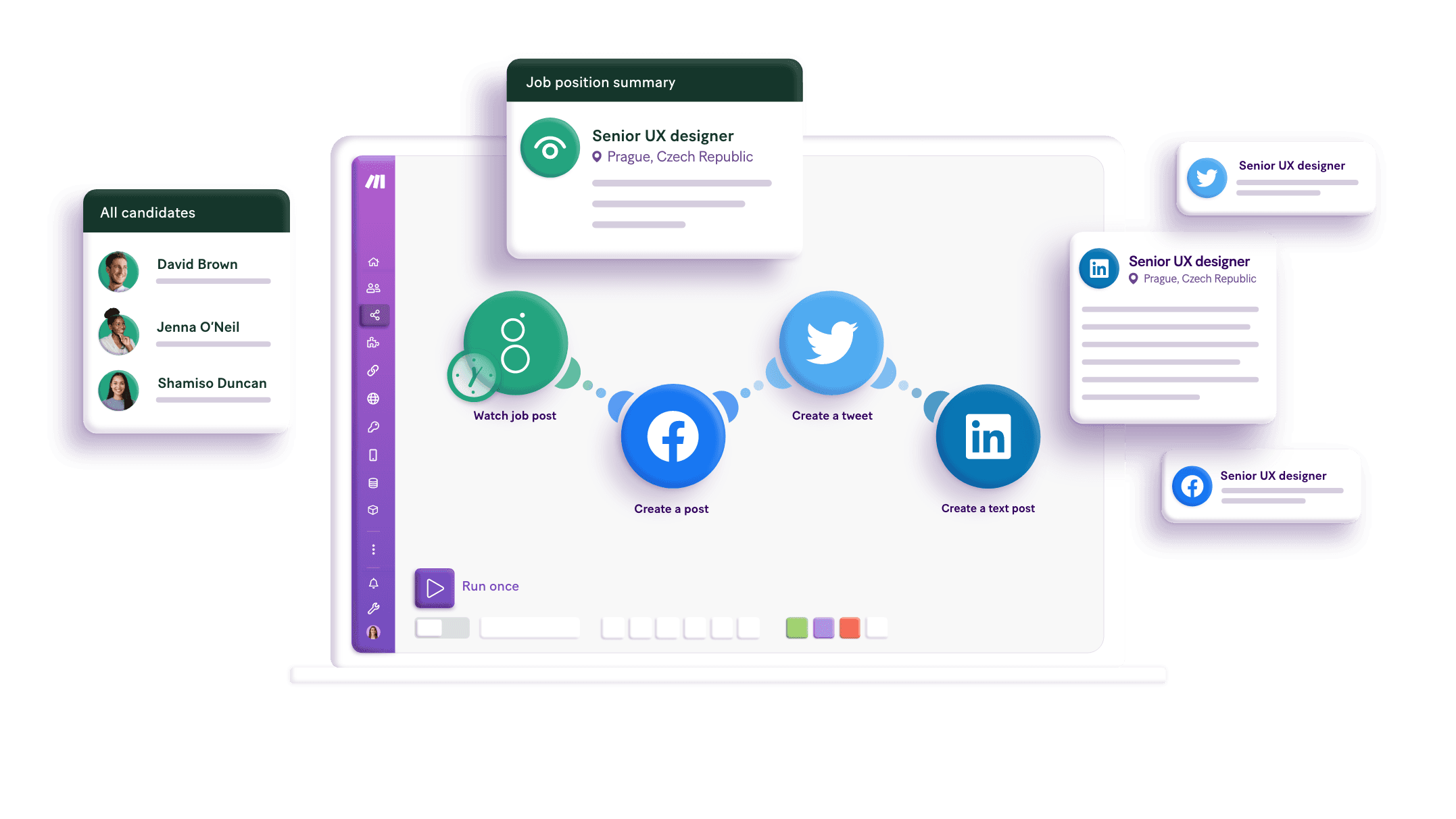
Build your Mistral AI and OpenAI (ChatGPT, Whisper) integrations.
Automate your workflow by using OpenAI (ChatGPT, Whisper) as a trigger to initiate actions in Mistral AI through Make's integration platform. When OpenAI (ChatGPT, Whisper) generates an output or completes a task, it triggers automated actions in OpenAI applications such as content generation with ChatGPT, image creation with DALL-E, audio transcription with Whisper, or video production with Sora. This trigger-action integration enables you to create sophisticated automated workflows where OpenAI (ChatGPT, Whisper)'s responses automatically initiate OpenAI's advanced capabilities for content generation, image creation, audio transcription, or video production, improving your business processes without writing code.
Analyzes images according to specified instructions.
Cancels an "in-progress" batch. The batch will be in status "cancelling" for up to 10 minutes, before changing to "cancelled", where it will have partial results (if any) available in the output file.
Create embeddings for given text.
Creates a chat completion.
Creates and executes a batch of API calls.
Creates a new skill.
Creates a new immutable skill version.
Creates a new vector store and optionally adds files to it, or adds files to an existing vector store.
Deletes an existing conversation.
Popular Mistral AI and OpenAI (ChatGPT, Whisper) workflows.
Looking to get more out of Mistral AI and OpenAI (ChatGPT, Whisper)? With Make you can visually integrate Mistral AI and OpenAI (ChatGPT, Whisper) into any workflow to save time and resources — no coding required. Try any of these templates in just a few clicks.
How to setup Mistral AI and OpenAI (ChatGPT, Whisper) in 5 easy steps
Get your API key from Mistral AI
To connect Mistral AI with Make, you first need an API key, which acts like a special password that allows Make to communicate with your Mistral AI account. Log in to your Mistral AI account, navigate to the API Keys section in the left sidebar under Workspace, and click 'Create new key' to generate your key. Give it a memorable name like 'Make Integration' so you can identify it later.
Save your API key in a secure location
Once you create your API key in Mistral AI, the system will display the key value on your screen. This is critical: copy this key immediately and store it somewhere safe, such as a password manager or secure note, because you won't be able to see this exact key again once you leave the page. Having this key ready will make the next steps easier.
Add a Mistral AI module to your Make scenario
Log in to your Make account and open the workflow scenario where you want to use Mistral AI. Add a Mistral AI module to your automation by selecting it from the available apps. When you add the module, Make will prompt you to create a new connection, which is the bridge that links Make to your Mistral AI account.
Enter your API key into Make
In the connection setup window in Make, you'll see a field labeled 'API Key' where you need to paste the key you copied from Mistral AI earlier. Make sure to paste the entire key exactly as it was copied, without adding any extra spaces before or after it. You can also give your connection a descriptive name like 'My Mistral AI Connection' to help you identify it later.
Save the connection and start automating
Click the 'Save' button to complete your connection setup between Make and Mistral AI. Make will verify that the connection works properly and ensure both services can communicate securely. Once saved, your connection is active and ready to use in any of your Make scenarios that include Mistral AI modules.
Maximize AI performance by combining Mistral AI and OpenAI
Integrate Mistral AI and OpenAI to create powerful workflows that compare outputs, reduce costs, ensure reliability through failover protection, and optimize performance across ChatGPT, DALL-E, and Whisper.
Automatically route the same prompt to both Mistral and OpenAI models to compare responses and select the best output for your specific use case.
Create automatic failover workflows that switch to Mistral when OpenAI experiences downtime or rate limits, ensuring continuous AI-powered operations.
Intelligently route queries to cost-effective Mistral models while reserving OpenAI's advanced models for complex tasks, reducing overall AI expenses.
Combine the strengths of both platforms by using Mistral for initial content drafts and OpenAI for refinement, creating a powerful automated content workflow.


FAQ
Yes! Make allows you to integrate both Mistral AI's open-source language models and OpenAI's powerful models (including GPT-4, GPT-4o, o1, DALL-E, and Whisper) in a single automated workflow without writing any code. You can use Make's visual interface to create sophisticated AI pipelines that leverage the strengths of each platform - for example, using Mistral for cost-effective text processing and OpenAI's DALL-E for image generation, all connected through drag-and-drop modules.
Integrating both platforms through Make gives you the best of both worlds: Mistral's open-source models offer transparency, cost-effectiveness, and EU data residency options, while OpenAI provides cutting-edge capabilities like GPT-4o for complex reasoning, DALL-E for image generation, Whisper for speech recognition, and Sora for video generation. With Make, you can automatically route different tasks to the most appropriate AI model based on your specific needs, budget, and compliance requirements, creating more flexible and optimized workflows than relying on a single provider.
Setting up integrations with Make is straightforward and requires no programming knowledge. You connect your Mistral AI and OpenAI accounts to Make using secure API authentication, then use Make's visual scenario builder to create your workflow by dragging and dropping modules. Make provides pre-built modules for both platforms, complete templates to get started quickly, and an intuitive interface that lets you map data between applications with just a few clicks. Most users can create their first working integration within minutes of signing up.
The possibilities are extensive! You can create workflows that: automatically generate and translate marketing content using Mistral, then create matching images with DALL-E; transcribe audio files with OpenAI's Whisper and analyze sentiment with Mistral; build intelligent customer support systems that route queries to different AI models based on complexity; generate code with GPT-4 and validate it with Mistral; create multi-language content pipelines; automate research by having different models analyze information from various angles; or build cost-optimized AI solutions that use Mistral for bulk processing and reserve OpenAI's advanced models for complex tasks. Make's platform connects with thousands of other apps, so you can trigger these AI workflows from emails, forms, databases, or any business tool you already use.
A scenario represents a workflow or a project of your own creation, and it is made up of a series of modules that automate apps and services. Creating a scenario allows you to transfer and transform data between apps and services via these modules to automate anything and improve the way you work.
Modules are the main building blocks of automation in Make. Modules represent actions that Make performs with an app, like creating, updating, or deleting data.
How it works
Traditional no-code iPaaS platforms are linear and non-intuitive. Make allows you to visually create, build, and automate without limits.
Trusted by 350,000+ customers
"Make really helped us to scale our operations, take the friction out of our processes, reduce costs, and relieved our support team. It is difficult to not become a fan."

Philipp Weidenbach
Head of Operations at Teleclinic
"Make drives unprecedented efficiency within our business in ways we never imagined. It’s having an extra employee (or 10) for a fraction of the cost."

Cayden Phipps
COO at Shop Accelerator Martech
"The simplicity, flexibility and ability to build real complex automations without any knowledge of programming makes it the best thing since sliced bread."

Erkki Markus
Product Owner at Smaily
"True citizen development in the entire company. Make is present in every department, empowering the company to offer a unique customer experience."

Andreas Stryz
CTO & Co-founder at FINN
"I can't count the number of hours I've saved by using Make. Every single day is simpler because of Make's automation."

Kimberly D
Owner of Media Production