
Connect OpenAI (ChatGPT, Whisper) and Facebook Messenger integrations
Automatically deliver OpenAI's ChatGPT responses, DALL-E images, Sora videos, and Whisper transcriptions straight to your Facebook Messenger conversations through Make's automation. Transform AI-generated content into instant messages, empowering you to engage your audience with cutting-edge text, visuals, and voice—all flowing from OpenAI to Facebook Messenger without manual intervention.

Triggers when a batch is completed.

Retrieves the details of a sender by its PSID. Must first be approved for the Business Asset User Profile Access feature.
Sends a new message or attachment by the recipient identifier.
Sends a sender action by the recipient identifier.
Uploads an attachment and gets an attachment ID.
Trusted by thousands of fast-scaling organizations around the globe





Automate your work. Build something new.
Just drag and drop apps to automate existing workflows or build new complex processes. Solve problems across all areas and teams.
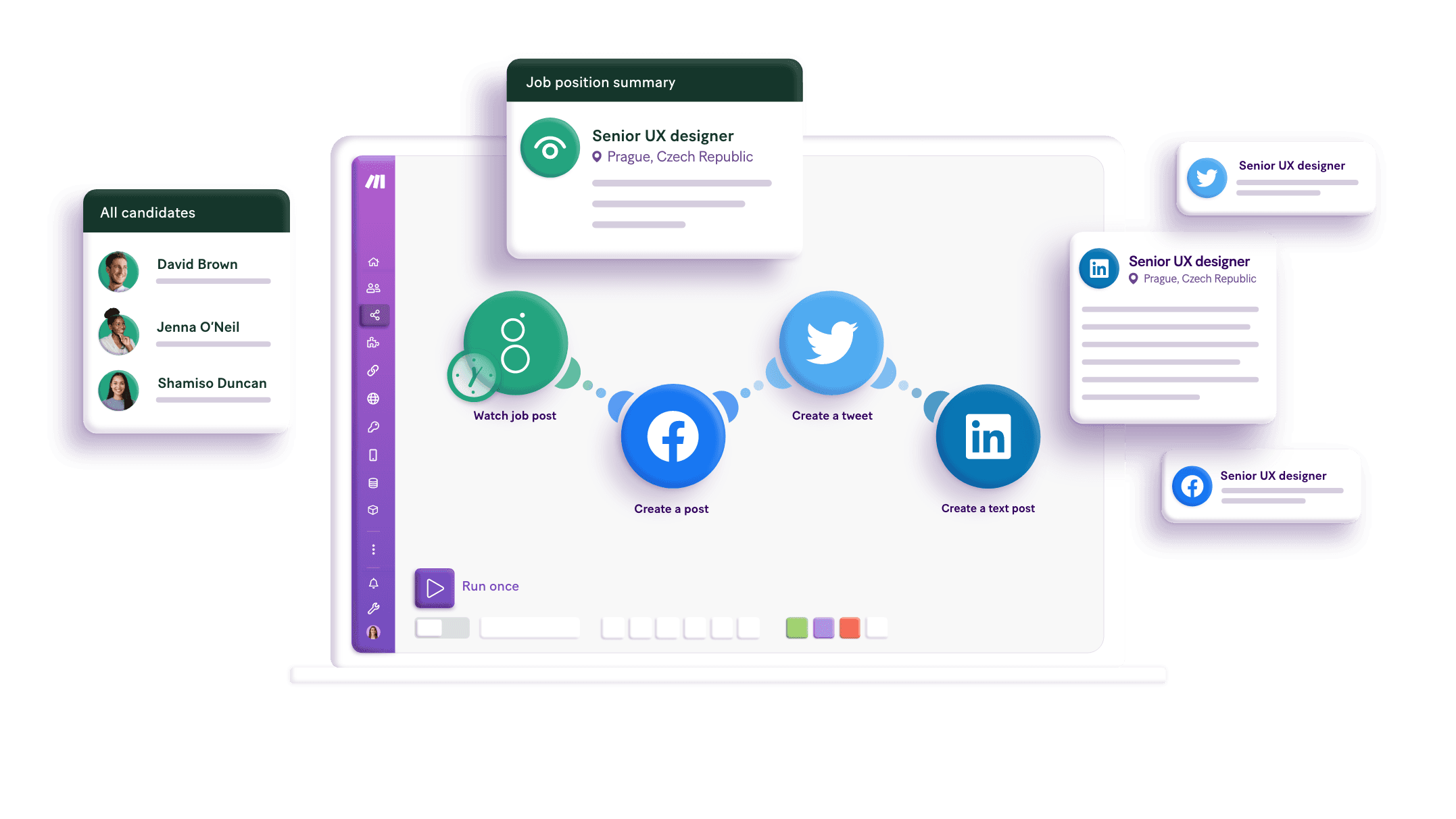
Build your OpenAI (ChatGPT, Whisper) and Facebook Messenger integrations.
Connect Facebook Messenger as a trigger and OpenAI (ChatGPT, Whisper) as an action through Make's automation platform. When OpenAI generates content—whether it's a ChatGPT conversation response, a Sora video creation, a DALL-E image generation, or a Whisper voice transcription—this trigger activates the OpenAI (ChatGPT, Whisper) action to automatically send the AI-generated content directly within your Messenger conversations. This integration enables you to deliver ChatGPT-powered replies, visual content from DALL-E, video content from Sora, or transcribed voice messages from Whisper to your OpenAI (ChatGPT, Whisper) audience automatically, transforming how OpenAI's outputs flow into your messaging workflows.
Analyzes images according to specified instructions.
Cancels an "in-progress" batch. The batch will be in status "cancelling" for up to 10 minutes, before changing to "cancelled", where it will have partial results (if any) available in the output file.
Creates and executes a batch of API calls.
Creates a new skill.
Creates a new immutable skill version.
Creates a new vector store and optionally adds files to it, or adds files to an existing vector store.
Deletes an existing conversation.
Deletes an existing model response.
Deletes a skill. This action cannot be undone.
Popular OpenAI (ChatGPT, Whisper) and Facebook Messenger workflows.
Transform your Facebook Messenger into an intelligent conversational platform by connecting it with OpenAI's advanced AI capabilities through Make's automation. Deliver instant, context-aware responses powered by ChatGPT, create engaging visual content with DALL-E, and provide 24/7 automated customer support that scales efficiently.
This powerful integration eliminates manual response delays while maintaining personalized, brand-consistent communication across unlimited conversations, letting AI handle routine inquiries so your team can focus on high-value interactions.
How to setup OpenAI (ChatGPT, Whisper) and Facebook Messenger in 5 easy steps
Set up your Facebook app
Start by logging into the Facebook Developer Portal and creating a new app. Click 'Create App' in the upper right corner, choose 'Other' as your use case, and provide an app name and contact email. Once created, add Facebook Messenger to your app by finding 'Messenger' in the Product Setup page and clicking 'Set up' to enable messaging functionality.
Configure Facebook webhooks
In your Facebook app settings, navigate to the 'Configure webhooks' section and click 'Configure', then click 'Add Callback URL'. This webhook is essential because it allows Facebook to send message notifications to Make in real-time, enabling your automation to respond to incoming messages automatically.
Create a webhook in Make
Log into Make and create a new scenario, adding the 'Facebook Messenger > Watch messages' module as your first module. Click 'Create a webhook' and enter a webhook name and verify token of your choice. Make will generate a unique URL that Facebook will use to communicate with your automation, so save the verify token for the next step.
Connect Facebook to Make
Copy the webhook URL that Make generated and return to Facebook Developer Portal. In the 'Edit Callback URL' dialog, paste the webhook URL and enter your verify token. Click 'Verify and Save' to establish the connection. Then connect your Facebook pages by selecting which pages your app can access and generate an access token for your chosen page.
Enable message sending from Make
Add a 'Send a Message' module to your Make scenario and click 'Create a connection'. Paste the access token you copied from Facebook into the 'Access Token' field and save. Configure the module by mapping the Sender ID and specifying your message text, then run your scenario to test that messages flow correctly between Facebook Messenger and Make.
Transform Facebook Messenger with AI-powered automation
Integrate OpenAI with Facebook Messenger using Make to automate intelligent responses, scale customer conversations, and deliver 24/7 AI-powered support that improves user experience.
Provide instant, AI-powered responses to Facebook Messenger inquiries without manual intervention, ensuring 24/7 customer engagement.
Handle unlimited simultaneous Messenger conversations with context-aware ChatGPT responses that maintain consistent brand voice.
Eliminate delays in customer communication by automatically generating and sending relevant replies the moment messages arrive.
Leverage advanced GPT models to provide sophisticated, nuanced answers that go beyond standard chatbot responses directly in Messenger.


FAQ
Make allows you to integrate OpenAI's ChatGPT with Facebook Messenger to create intelligent automated chat experiences. You can build scenarios where incoming Messenger messages trigger ChatGPT responses, enabling you to provide instant AI-powered customer support, answer FAQs, or engage users with conversational AI 24/7. This integration requires no coding and can be set up in minutes through Make's visual workflow builder, helping you scale your Messenger communications while maintaining personalized interactions.
Integrating OpenAI with Facebook Messenger through Make offers several powerful benefits: automated customer service that responds intelligently to inquiries at any time, personalized content generation for each user conversation, multilingual support using GPT models, and the ability to handle multiple conversations simultaneously. You can also use DALL-E to generate custom images in response to Messenger requests, or Whisper to transcribe voice messages. This automation reduces response times from hours to seconds, improves customer satisfaction, and frees your team to focus on complex issues while AI handles routine inquiries.
Not at all! Make is specifically designed for users without coding experience. The platform provides pre-built modules for both OpenAI and Facebook Messenger, allowing you to create integrations through a drag-and-drop interface. You'll find ready-made templates to get started quickly, and each module has clear configuration options where you input your API keys and set your preferences. Most users can create their first working automation in under 30 minutes. Make also offers extensive documentation, video tutorials, and an active community to support you throughout the process.
Absolutely! Make gives you complete control over your OpenAI-Facebook Messenger integration. You can choose from various OpenAI models including GPT-4o, GPT-4, GPT-3.5, and even the advanced o1 and o3 models depending on your needs and budget. You can customize prompts, set response parameters like temperature and token limits, add context from previous messages, implement conditional logic based on message content, and even combine multiple AI capabilities—like using Whisper for voice message transcription followed by ChatGPT for generating responses. This flexibility ensures your automation matches your brand voice and specific use case perfectly.
A scenario represents a workflow or a project of your own creation, and it is made up of a series of modules that automate apps and services. Creating a scenario allows you to transfer and transform data between apps and services via these modules to automate anything and improve the way you work.
Modules are the main building blocks of automation in Make. Modules represent actions that Make performs with an app, like creating, updating, or deleting data.
How it works
Traditional no-code iPaaS platforms are linear and non-intuitive. Make allows you to visually create, build, and automate without limits.
Trusted by 350,000+ customers
"Make really helped us to scale our operations, take the friction out of our processes, reduce costs, and relieved our support team. It is difficult to not become a fan."

Philipp Weidenbach
Head of Operations at Teleclinic
"Make drives unprecedented efficiency within our business in ways we never imagined. It’s having an extra employee (or 10) for a fraction of the cost."

Cayden Phipps
COO at Shop Accelerator Martech
"The simplicity, flexibility and ability to build real complex automations without any knowledge of programming makes it the best thing since sliced bread."

Erkki Markus
Product Owner at Smaily
"True citizen development in the entire company. Make is present in every department, empowering the company to offer a unique customer experience."

Andreas Stryz
CTO & Co-founder at FINN
"I can't count the number of hours I've saved by using Make. Every single day is simpler because of Make's automation."

Kimberly D
Owner of Media Production