
Connect OpenAI (ChatGPT, Whisper) and Figma integrations
Transform your design workflow by connecting OpenAI (ChatGPT, Whisper) to Figma through Make—automatically pushing AI-generated content, visuals, transcriptions, and videos directly into your design projects. Eliminate manual transfers and watch as creative briefs, design assets, and feedback flow into Figma frames the moment OpenAI produces them. Set up once, and let AI-powered automation revolutionize how your team creates and collaborates.

Triggers when a batch is completed.

Performs an arbitrary authorized API call.
Posts a comment to a file.
Lists all comments left on a file.
Lists the version history of a file.
Lists the project files in a given project.
Lists all the projects of a certain team.
Trusted by thousands of fast-scaling organizations around the globe





Automate your work. Build something new.
Just drag and drop apps to automate existing workflows or build new complex processes. Solve problems across all areas and teams.
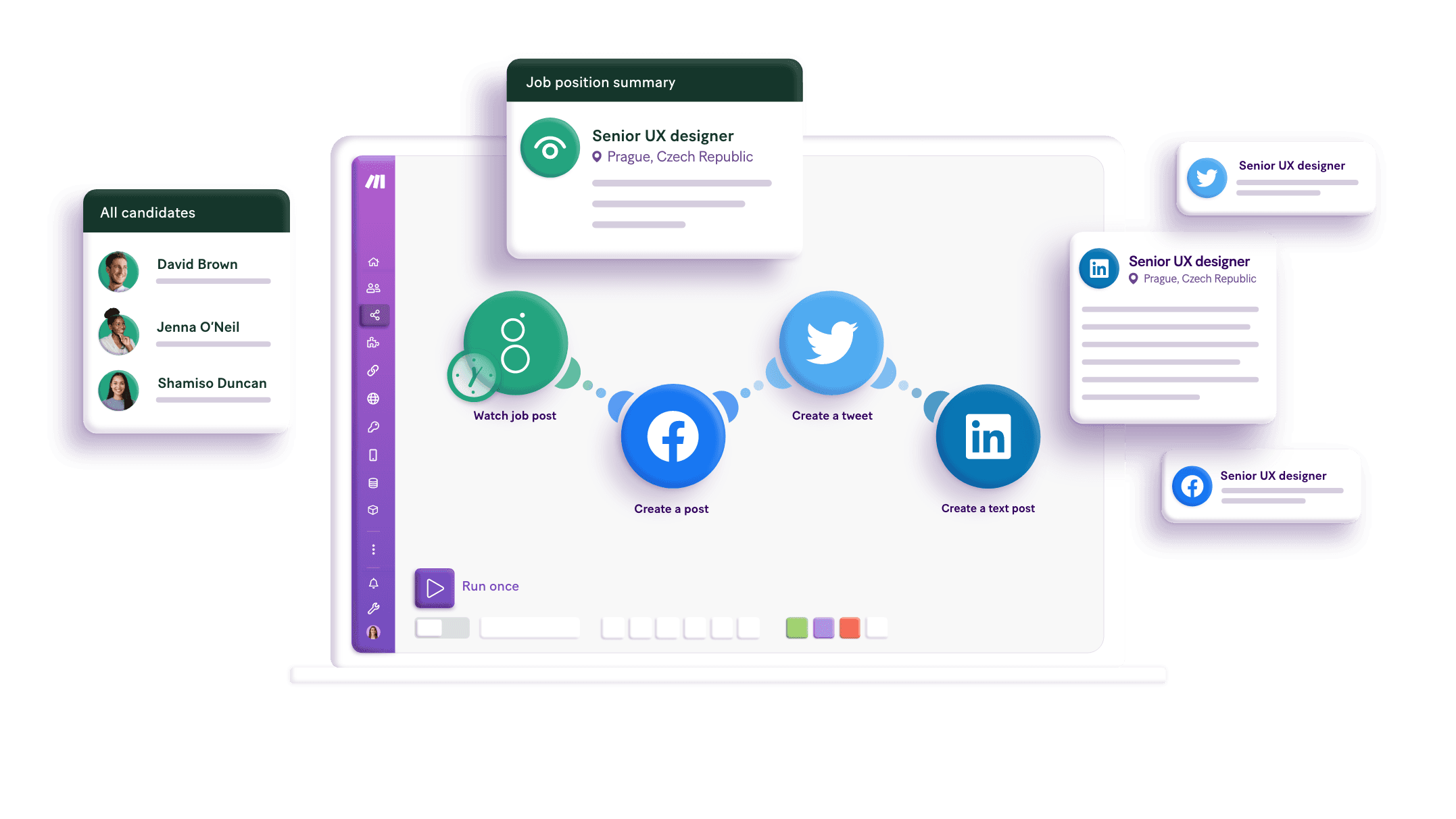
Build your OpenAI (ChatGPT, Whisper) and Figma integrations.
Connect Figma as a trigger and OpenAI (ChatGPT, Whisper) as an action through Make's integration platform. When OpenAI generates content—such as creative briefs from ChatGPT, visual assets from DALL-E, transcribed feedback from Whisper, or video content from Sora—it triggers an automated workflow that pushes this output directly into your OpenAI (ChatGPT, Whisper) projects as an action. This trigger-action integration eliminates manual transfers by automatically flowing AI-generated design content into OpenAI (ChatGPT, Whisper) frames, creating design assets, or updating project files whenever OpenAI produces new outputs. Set up Figma as the trigger point that initiates the workflow, and configure OpenAI (ChatGPT, Whisper) as the action destination that receives and implements the AI-generated content.
Analyzes images according to specified instructions.
Cancels an "in-progress" batch. The batch will be in status "cancelling" for up to 10 minutes, before changing to "cancelled", where it will have partial results (if any) available in the output file.
Creates and executes a batch of API calls.
Creates a new skill.
Creates a new immutable skill version.
Creates a new vector store and optionally adds files to it, or adds files to an existing vector store.
Deletes an existing conversation.
Deletes an existing model response.
Deletes a skill. This action cannot be undone.
Popular OpenAI (ChatGPT, Whisper) and Figma workflows.
Looking to get more out of OpenAI (ChatGPT, Whisper) and Figma? With Make you can visually integrate OpenAI (ChatGPT, Whisper) and Figma into any workflow to save time and resources — no coding required. Try any of these templates in just a few clicks.
How to setup OpenAI (ChatGPT, Whisper) and Figma in 5 easy steps
Get your security credentials from Figma
Before you can connect Figma to Make, you need to obtain special security credentials from Figma's developer page. Visit figma.com/developers/apps while logged into your Figma account, then click 'Create' to set up a new app. Name your app something memorable like 'Make Integration,' choose your team, and if prompted, enter the callback address: https://www.integromat.com/oauth/cb/figma. Figma will then provide you with a Client ID and Client Secret—these are like a username and password that allow Make to securely communicate with your Figma account. Copy both of these credentials carefully and store them somewhere safe, as you'll need them in the next steps.
Open your Make scenario
Log into your Make account and navigate to the scenario where you want to use Figma. A scenario is the workflow you're building to automate tasks between different applications. Look for the option to add a new module to your scenario and select Figma from the list of available apps. Once you've added the Figma module, you'll see an option to create a connection—this is where you'll link Make to your Figma account using the credentials you obtained earlier.
Create a new connection
When you click to create a connection in Make, a window will appear asking for your connection details. You can give your connection a descriptive name to help you remember what it's for, especially if you plan to create multiple connections later. This optional step makes it easier to manage your integrations and keep track of which connection serves which purpose in your various scenarios.
Enter your Figma credentials
In the connection window, you'll see fields asking for your Client ID and Client Secret. Paste the credentials you copied from Figma into these respective fields, being careful to ensure accuracy—even a single incorrect character will prevent the connection from working. Take your time with this step and double-check that both the Client ID and Client Secret are entered correctly before proceeding to the final step.
Establish the connection
After entering your Client ID and Client Secret, click the button to establish the connection between Make and Figma. Make will use these credentials to securely link to your Figma account, allowing the two services to communicate and share data. Once the connection is successfully established, you'll be able to use Figma's features within your Make scenarios to automate your design workflows and integrate Figma with other applications in your toolkit.
Transform your design workflow with AI-powered automation
Integrate OpenAI and Figma through Make to automate design generation, documentation, and reviews. Use ChatGPT to create UI copy, generate specifications, and organize assets within Figma.
Automatically generate design descriptions, component text, and UI copy using ChatGPT and push them into Figma frames and text layers.
Use OpenAI to analyze Figma designs and automatically generate comprehensive design specifications, style guides, and component documentation.
Automatically extract design elements from Figma and leverage GPT-4 to provide instant design critiques, accessibility suggestions, and best practice recommendations.
Transform marketing copy, product descriptions, or user stories into Figma design mockups by using OpenAI to interpret content requirements and create corresponding design elements.


FAQ
By connecting OpenAI with Figma through Make, you can automate content generation directly into your designs. For example, you can use GPT-4 to automatically generate copy for UI elements, create design descriptions, or produce alt text for images. DALL-E can generate custom graphics based on text prompts that feed directly into your Figma projects. This integration eliminates manual copying and pasting, speeds up your design iterations, and allows you to focus on creative decisions rather than repetitive tasks.
Make enables powerful automation scenarios between OpenAI and Figma. You can automatically generate design variations by having ChatGPT create different UI copy versions and populate them in Figma frames. You can use Whisper to transcribe voice feedback about designs and automatically create comment threads in Figma. You can also set up workflows where DALL-E generates custom icons or illustrations based on design requirements documented in Figma, then automatically imports them into your design files. These automations save hours of manual work and improve team collaboration.
No coding skills are required. Make provides a visual, drag-and-drop interface that allows you to connect OpenAI and Figma through pre-built modules. You simply authenticate both applications, select the actions you want to automate (like generating text with ChatGPT or updating Figma components), and map the data flow between them. Make handles all the technical API connections behind the scenes, making it accessible for designers, marketers, and business users without programming backgrounds.
Integrating OpenAI and Figma through Make transforms your design process from manual to automated, enabling significant scaling. Your team can automatically generate localized content for designs in multiple languages using GPT-4, create hundreds of personalized design variations for A/B testing, or batch-generate design assets with DALL-E based on product data. This means one designer can accomplish what previously required an entire team, reducing time-to-market and allowing your creative team to focus on strategy and high-value design decisions rather than repetitive production work.
A scenario represents a workflow or a project of your own creation, and it is made up of a series of modules that automate apps and services. Creating a scenario allows you to transfer and transform data between apps and services via these modules to automate anything and improve the way you work.
Modules are the main building blocks of automation in Make. Modules represent actions that Make performs with an app, like creating, updating, or deleting data.
How it works
Traditional no-code iPaaS platforms are linear and non-intuitive. Make allows you to visually create, build, and automate without limits.
Trusted by 350,000+ customers
"Make really helped us to scale our operations, take the friction out of our processes, reduce costs, and relieved our support team. It is difficult to not become a fan."

Philipp Weidenbach
Head of Operations at Teleclinic
"Make drives unprecedented efficiency within our business in ways we never imagined. It’s having an extra employee (or 10) for a fraction of the cost."

Cayden Phipps
COO at Shop Accelerator Martech
"The simplicity, flexibility and ability to build real complex automations without any knowledge of programming makes it the best thing since sliced bread."

Erkki Markus
Product Owner at Smaily
"True citizen development in the entire company. Make is present in every department, empowering the company to offer a unique customer experience."

Andreas Stryz
CTO & Co-founder at FINN
"I can't count the number of hours I've saved by using Make. Every single day is simpler because of Make's automation."

Kimberly D
Owner of Media Production