
Connect Supabase and OpenAI (ChatGPT, Whisper) integrations
Transform your Supabase database events into intelligent AI-powered actions with OpenAI (ChatGPT, Whisper) through Make. Automatically generate content, create images, transcribe audio, and produce videos whenever your data changes—no coding required, just automated workflows that turn database triggers into creative AI responses

Triggers when a record has been created, updated or deleted.

Analyzes images according to specified instructions.
Cancels an "in-progress" batch. The batch will be in status "cancelling" for up to 10 minutes, before changing to "cancelled", where it will have partial results (if any) available in the output file.
Creates and executes a batch of API calls.
Creates a new skill.
Creates a new immutable skill version.
Creates a new vector store and optionally adds files to it, or adds files to an existing vector store.
Deletes an existing conversation.
Deletes an existing model response.
Deletes a skill. This action cannot be undone.
Deletes a skill version. This action cannot be undone.
Deletes a vector store. This action cannot be undone.
Downloads a file from a container.
Downloads a skill as a ZIP file using its ID.
Downloads a skill version as a ZIP file.
Creates an edited or extended image given one or more source images and a prompt.
Generates a chat completion.
Qualifies whether the provided image or text(s) contains violent, hateful, illicit or adult content.
Creates an embedding vector representing the input text.
Generates a response.
Transcribes an audio to text.
Translates an audio to English.
Generates images using GPT Image.
Generates an audio file based on text input and settings.
Retrieves details of the specified batch.
Retrieves an existing model response.
Returns information about a specific skill by its ID.
Returns information about a specific skill version.
Performs an arbitrary authorized API call.
Generates text responses from prompts without requiring an account or connection.
Identifies information in a prompt's text and returns it as structured data.
Updates the default version pointer for a skill.
Uploads a file to be used across the OpenAI platform.
Retrieves a list of batches.
Lists input items.
Returns a list of skills.
Returns a list of skill versions.
Returns a list of vector stores.
Searches a vector store and returns the file content chunks that match your query.
Trusted by thousands of fast-scaling organizations around the globe





Automate your work. Build something new.
Just drag and drop apps to automate existing workflows or build new complex processes. Solve problems across all areas and teams.
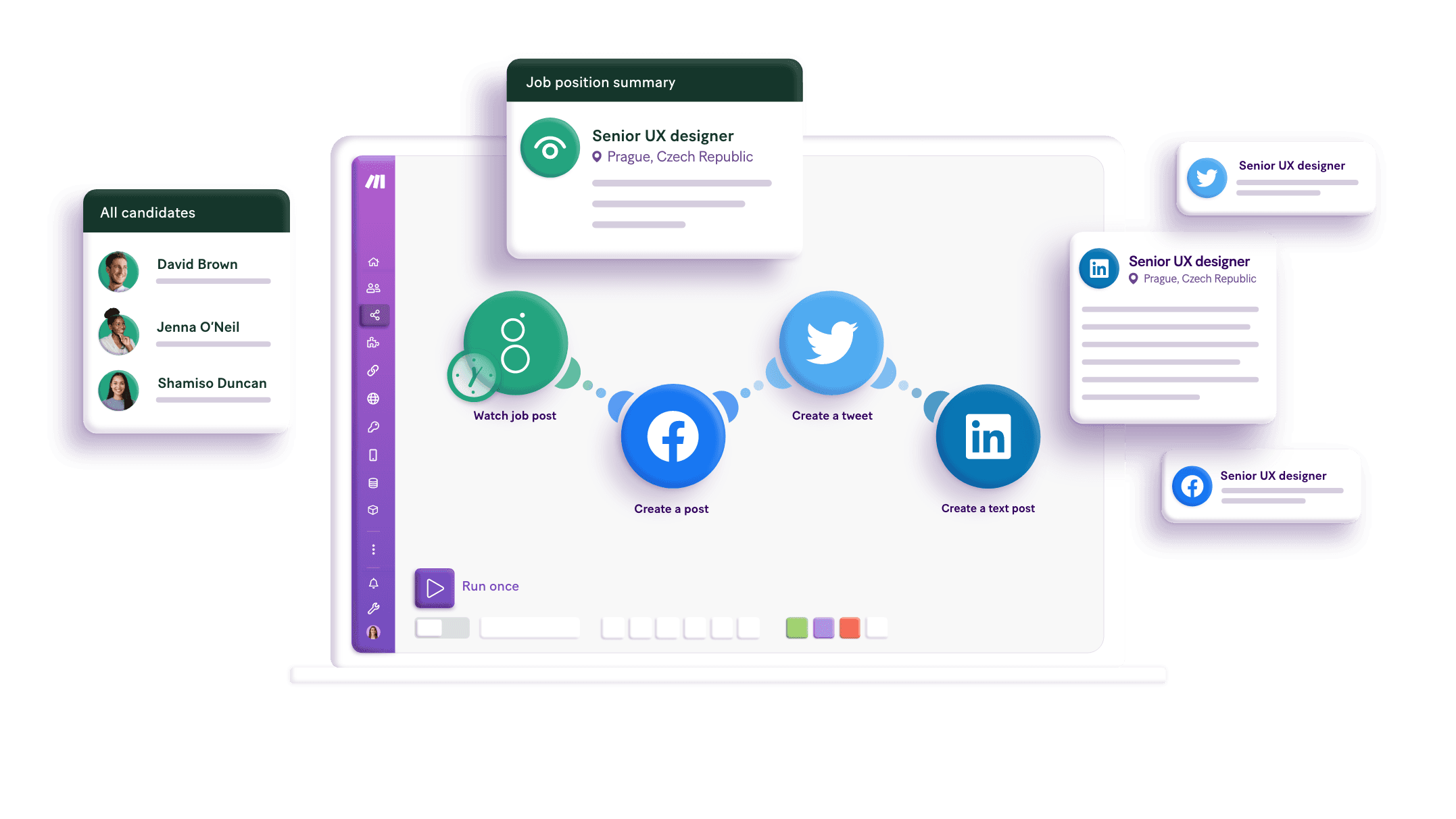
Build your Supabase and OpenAI (ChatGPT, Whisper) integrations.
Connecting OpenAI (ChatGPT, Whisper) and Supabase through Make enables you to build automated workflows where OpenAI (ChatGPT, Whisper) acts as a trigger and Supabase performs actions based on those triggers. When changes occur in your OpenAI (ChatGPT, Whisper) database, such as new records or updates, these events automatically trigger Supabase to perform actions like generating content with ChatGPT, creating images with DALL-E, transcribing audio with Whisper, or generating videos with Sora. This integration allows database events in OpenAI (ChatGPT, Whisper) to initiate AI-powered responses through Supabase, enabling you to process data intelligently and automate content creation workflows without complex coding
Analyzes images according to specified instructions.
Cancels an "in-progress" batch. The batch will be in status "cancelling" for up to 10 minutes, before changing to "cancelled", where it will have partial results (if any) available in the output file.
Creates a new storage bucket.
Creates a new row in an existing table.
Creates and executes a batch of API calls.
Creates a new skill.
Creates a new immutable skill version.
Creates a new vector store and optionally adds files to it, or adds files to an existing vector store.
Deletes all rows matching the filter.
Popular Supabase and OpenAI (ChatGPT, Whisper) workflows.
Looking to get more out of Supabase and OpenAI (ChatGPT, Whisper)? With Make you can visually integrate Supabase and OpenAI (ChatGPT, Whisper) into any workflow to save time and resources — no coding required. Try any of these templates in just a few clicks.
How to setup Supabase and OpenAI (ChatGPT, Whisper) in 5 easy steps
Get your Supabase project credentials
Log into your Supabase account and open the project you want to connect. At the bottom of the project page, you'll find two important pieces of information: your API Key and Project ID. Copy both of these and save them somewhere safe, as you'll need them to complete the connection in Make.
Open your Make scenario and add Supabase
Log into your Make account and navigate to the scenario where you want to use Supabase. Search for Supabase in the available apps list and add a Supabase module to your workflow. This module will serve as the bridge between Make and your Supabase project.
Start creating the connection
Inside the Supabase module you just added, look for the option to create a new connection. Click on 'Create a connection' to open the connection form. This is where you'll enter the credentials you copied from your Supabase project.
Enter your Supabase credentials
In the connection form, paste your Project ID into the Project ID field and your API Key into the API Key field. You can also give your connection a descriptive name to help you identify it later, especially if you plan to work with multiple Supabase projects. Make sure there are no extra spaces when pasting your credentials.
Save and complete the connection
Click the Save button to finalize your connection setup. If Make asks you to authenticate or confirm access, follow the prompts to complete the process. Once successful, your Supabase connection is ready to use, and you can now automate workflows between Supabase and other apps in your Make scenarios.
AI-powered database automation with Supabase and OpenAI
Connect Supabase and OpenAI using Make to automate intelligent database operations, generate AI-powered content, analyze data patterns, and create context-aware chatbots with integrated workflows.
Automatically generate, analyze, and optimize database queries using OpenAI's language models to interact with your Supabase Postgres database without manual SQL coding.
Generate text, images, or audio content with OpenAI models and automatically store the results in Supabase tables or storage buckets for efficient content management.
Extract data from Supabase and leverage ChatGPT to analyze patterns, generate reports, and create actionable insights from your database information.
Combine Supabase user data and authentication with OpenAI to create personalized, context-aware chatbot responses based on real-time database information.


FAQ
With Make, you can create powerful automations that combine Supabase's robust Postgres database with OpenAI's advanced AI capabilities. For example, you can set up workflows that automatically generate product descriptions, user responses, or content summaries using ChatGPT and instantly store them in your Supabase database. This integration eliminates manual data entry, ensures consistency, and lets you leverage AI-generated content at scale. Make's visual interface makes it easier to connect these services without writing complex code, allowing you to build sophisticated automations in minutes.
The integration enables numerous powerful use cases: automatically analyze user feedback stored in Supabase using OpenAI's GPT models and categorize sentiment; generate AI-powered responses to customer inquiries stored in your database; create image variations with DALL-E based on product data in Supabase; transcribe audio files with Whisper and store transcriptions in your database; or build intelligent chatbots that query your Supabase database for context before generating responses. Make allows you to chain these operations together, creating sophisticated workflows that combine real-time data storage, authentication, and AI processing capabilities without managing complex API integrations.
No coding experience is required. Make provides a visual, drag-and-drop interface that makes it easier to connect Supabase and OpenAI. You simply select the triggers (like new database entries in Supabase) and actions (like generating text with ChatGPT or images with DALL-E) you want to use, then configure them through intuitive forms. Make handles all the API authentication, data formatting, and error handling behind the scenes. While some familiarity with the concepts of databases and APIs is helpful, you can start building functional integrations immediately and learn as you go. Make also provides templates and documentation to help you get started quickly.
Make provides several features that help you control and optimize costs when integrating OpenAI with Supabase. You can set up conditional logic to only trigger OpenAI API calls when specific criteria are met in your Supabase database, avoiding unnecessary processing. Make allows you to implement rate limiting, batching multiple requests together, and adding error handling to prevent failed requests from consuming your API quota. You can also use Make's built-in filters and routers to preprocess data from Supabase before sending it to OpenAI, ensuring you only send relevant information and minimize token usage. Additionally, Make's execution history lets you monitor and analyze your automation runs, helping you identify optimization opportunities and track your actual usage patterns.
A scenario represents a workflow or a project of your own creation, and it is made up of a series of modules that automate apps and services. Creating a scenario allows you to transfer and transform data between apps and services via these modules to automate anything and improve the way you work.
Modules are the main building blocks of automation in Make. Modules represent actions that Make performs with an app, like creating, updating, or deleting data.
How it works
Traditional no-code iPaaS platforms are linear and non-intuitive. Make allows you to visually create, build, and automate without limits.
Trusted by 350,000+ customers
"Make really helped us to scale our operations, take the friction out of our processes, reduce costs, and relieved our support team. It is difficult to not become a fan."

Philipp Weidenbach
Head of Operations at Teleclinic
"Make drives unprecedented efficiency within our business in ways we never imagined. It’s having an extra employee (or 10) for a fraction of the cost."

Cayden Phipps
COO at Shop Accelerator Martech
"The simplicity, flexibility and ability to build real complex automations without any knowledge of programming makes it the best thing since sliced bread."

Erkki Markus
Product Owner at Smaily
"True citizen development in the entire company. Make is present in every department, empowering the company to offer a unique customer experience."

Andreas Stryz
CTO & Co-founder at FINN
"I can't count the number of hours I've saved by using Make. Every single day is simpler because of Make's automation."

Kimberly D
Owner of Media Production