
Connect TextCortex AI and Microsoft 365 Email (Outlook) integrations
Transform AI-generated content into instant email delivery by connecting TextCortex AI and Microsoft 365 Email (Outlook) through Make. Automate your entire workflow from content creation to distribution, eliminating manual work while powering personalized campaigns, client communications, and automated responses that flow from AI to inbox.

Uploads file to your knowledge base.

Adds a large attachment to an email.
Creates a new draft email.
Deletes an email.
Downloads an attachment from an email.
Forwards an email.
Gets the metadata of a specified email.
Performs an arbitrary authorized API call.
Moves an email to a selected folder in the mailbox.
Replies to the sender of an email.
Sends a draft email.
Sends a new MIME or S-MIME message. Requires a fully pre-built MIME message — for S/MIME, the message must already be signed or encrypted outside Make.
Creates and sends a new email immediately.
Updates an existing email.
Retrieves a list of attachment from an email.
Searches for emails.
Trusted by thousands of fast-scaling organizations around the globe





Automate your work. Build something new.
Just drag and drop apps to automate existing workflows or build new complex processes. Solve problems across all areas and teams.
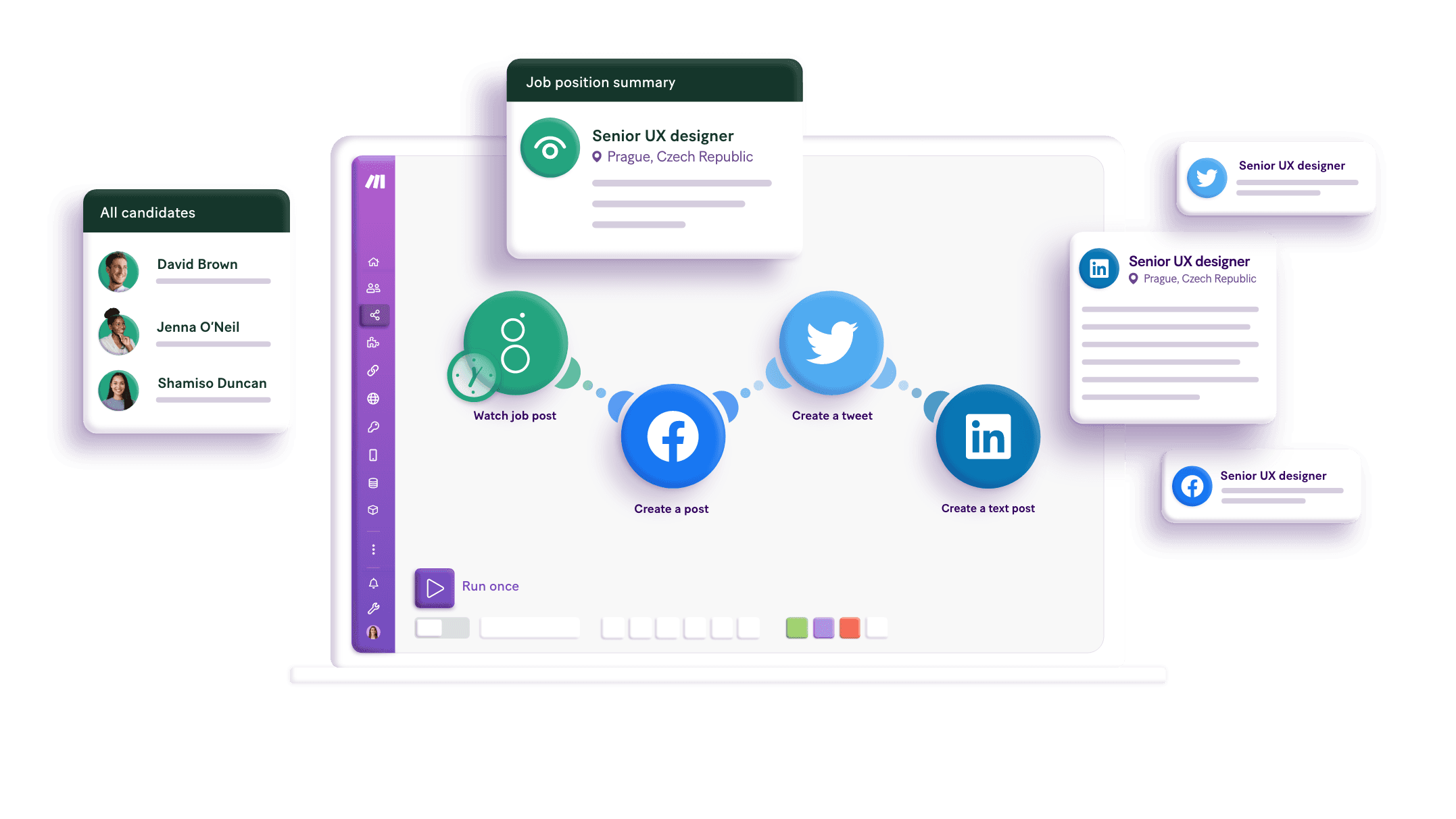
Build your TextCortex AI and Microsoft 365 Email (Outlook) integrations.
Connect Microsoft 365 Email (Outlook) as a trigger and TextCortex AI as an action through Make's automation platform. When Microsoft 365 Email (Outlook) generates content, it triggers an automated workflow that delivers the AI-powered content directly through TextCortex AI. This integration eliminates manual copying and pasting by automatically sending Microsoft 365 Email (Outlook)'s generated text via TextCortex AI, whether for personalized email campaigns, automated responses, or client communications. The workflow activates when Microsoft 365 Email (Outlook) produces content, which then flows into TextCortex AI to be distributed as emails, creating an efficient automation between content generation and email delivery.
Adds a large attachment to an email.
Sends a prompt to the TextCortex API and creates a completion.
Creates a new draft email.
Deletes an email.
Downloads an attachment from an email.
Forwards an email.
Gets the metadata of a specified email.
Retrieves a list of attachment from an email.
Performs an arbitrary authorized API call.
Popular TextCortex AI and Microsoft 365 Email (Outlook) workflows.
Looking to get more out of TextCortex AI and Microsoft 365 Email (Outlook)? With Make you can visually integrate TextCortex AI and Microsoft 365 Email (Outlook) into any workflow to save time and resources — no coding required. Try any of these templates in just a few clicks.
How to setup TextCortex AI and Microsoft 365 Email (Outlook) in 5 easy steps
Log in to Make and add your first application
Start by logging into your Make account, which is a platform that helps different applications work together automatically. Once inside, add a module for either Microsoft 365 Email or TextCortex AI to your scenario - think of this as placing the first building block of your automation workflow.
Initiate the connection process
After adding your application module to the workspace, look for and click the 'Create a connection' button. This tells Make that you want to link the application to your account, allowing the platform to communicate securely with your chosen service.
Name your connection for identification
You'll have the option to give your connection a meaningful name, which helps you stay organized, especially when managing multiple automations. Choose something descriptive that reminds you of the connection's purpose, making it easier to find and manage in your Make dashboard later.
Gather your authentication credentials
For TextCortex AI, you'll need to obtain your API Key from the TextCortex AI dashboard under API Settings - this special code acts like a secure password allowing Make to access your account. For Microsoft 365 Email, you'll authenticate directly with your Microsoft account credentials instead.
Complete and save your connection
Return to Make and enter the credentials you gathered - paste your TextCortex AI API Key or sign in with Microsoft as prompted. Click 'Save' to finalize the connection, and confirm any access permissions that appear. Once completed, your connection is ready to use in your automation scenarios.
Benefits to integrate TextCortex AI and Microsoft 365 Email (Outlook)
Discover how connecting TextCortex AI with Microsoft 365 Email (Outlook) transforms your email workflow through intelligent automation, AI-powered content creation, and smart response generation.
Automatically generate professional email replies using TextCortex AI when new messages arrive in Outlook, saving time on routine correspondence.
Instantly refine email drafts by automatically routing them through TextCortex AI for grammar correction, tone adjustment, and content improvement before sending.
Generate personalized email content at scale using TextCortex AI triggered by Outlook events or contact lists for more engaging communications.
Automatically create concise summaries of lengthy emails using TextCortex AI and save them as notes or forward them to designated recipients.


FAQ
By connecting TextCortex AI with Microsoft 365 Email through Make, you can automate the creation of professional email content based on triggers like new calendar events, incoming messages, or CRM updates. TextCortex AI can generate personalized email responses, follow-ups, or newsletters that are automatically sent through Outlook, eliminating hours of manual writing while maintaining consistent, high-quality communication with your contacts.
Yes! Make enables you to create powerful workflows where TextCortex AI generates email content using data from your CRM, project management tools, spreadsheets, or any other connected application, then automatically sends these emails through Microsoft 365 Email. For example, you can generate personalized outreach emails based on new leads in your CRM, create progress reports from project data, or draft responses based on support ticket information.
Not at all! Make's visual workflow builder makes it straightforward to connect TextCortex AI and Microsoft 365 Email without coding. You select triggers (like receiving an email or a scheduled time), add TextCortex AI to generate your content with custom prompts, and then use Microsoft 365 Email to send the result. Make offers pre-built templates and an intuitive drag-and-drop interface that lets you create your first automation in minutes, even if you have no technical background.
The integration opens up numerous possibilities: automatically generate and send weekly team newsletters, create personalized sales follow-up emails based on prospect behavior, draft and send meeting summaries after calendar events, generate customer support responses based on ticket details, create content for email marketing campaigns, or automatically reply to common inquiry types. Make allows you to customize these workflows to match your specific business needs, scaling your email communication without sacrificing quality or personalization.
A scenario represents a workflow or a project of your own creation, and it is made up of a series of modules that automate apps and services. Creating a scenario allows you to transfer and transform data between apps and services via these modules to automate anything and improve the way you work.
Modules are the main building blocks of automation in Make. Modules represent actions that Make performs with an app, like creating, updating, or deleting data.
How it works
Traditional no-code iPaaS platforms are linear and non-intuitive. Make allows you to visually create, build, and automate without limits.
Trusted by 350,000+ customers
"Make really helped us to scale our operations, take the friction out of our processes, reduce costs, and relieved our support team. It is difficult to not become a fan."

Philipp Weidenbach
Head of Operations at Teleclinic
"Make drives unprecedented efficiency within our business in ways we never imagined. It’s having an extra employee (or 10) for a fraction of the cost."

Cayden Phipps
COO at Shop Accelerator Martech
"The simplicity, flexibility and ability to build real complex automations without any knowledge of programming makes it the best thing since sliced bread."

Erkki Markus
Product Owner at Smaily
"True citizen development in the entire company. Make is present in every department, empowering the company to offer a unique customer experience."

Andreas Stryz
CTO & Co-founder at FINN
"I can't count the number of hours I've saved by using Make. Every single day is simpler because of Make's automation."

Kimberly D
Owner of Media Production