
Connect Twilio and ElevenLabs integrations
Transform incoming Twilio calls and messages into AI-powered voice responses automatically. Connect Twilio and ElevenLabs through Make to instantly generate natural-sounding, personalized audio messages that respond to every customer interaction—no manual effort required.

Webhook for status callback field in a create message action. Triggers for outgoing messages.
Triggers when a new alert (notification) is issued.
Triggers when a new call is created.
Triggers when a new message is created.
Triggers when a new recording is created.
Triggers when a new transcription is created.

Converts an audio recording so it is spoken in a chosen voice, preserving delivery and emotion.
Composes a music track from a text prompt.
Transcribes an audio or video file into text.
Starts an asynchronous job that dubs a video or audio file into another language.
Create a new agent by duplicating an existing one.
Create an agent from a config object.
Generates a sound effect from a text prompt.
Synthesizes a text into speech.
Delete an agent.
Retrieves the metadata and status of a dubbing project.
Retrieve config for an agent.
Retrieves metadata about a specific voice.
Get the details of a particular conversation.
Downloads the dubbed audio or video file for a completed dubbing project in a given language.
Gets extended information about the users subscription.
Removes background noise from an audio file, isolating the speech.
Performs an arbitrary authorized API call.
Handle an outbound call via Twilio.
Returns the response to the function call be it error or result.
Patches an agent's settings.
Lists agents and their metadata.
Get all conversations of agents that user owns. With option to restrict to a specific agent.
Gets a list of available models.
Lists all available voices for a user.
Trusted by thousands of fast-scaling organizations around the globe





Automate your work. Build something new.
Just drag and drop apps to automate existing workflows or build new complex processes. Solve problems across all areas and teams.
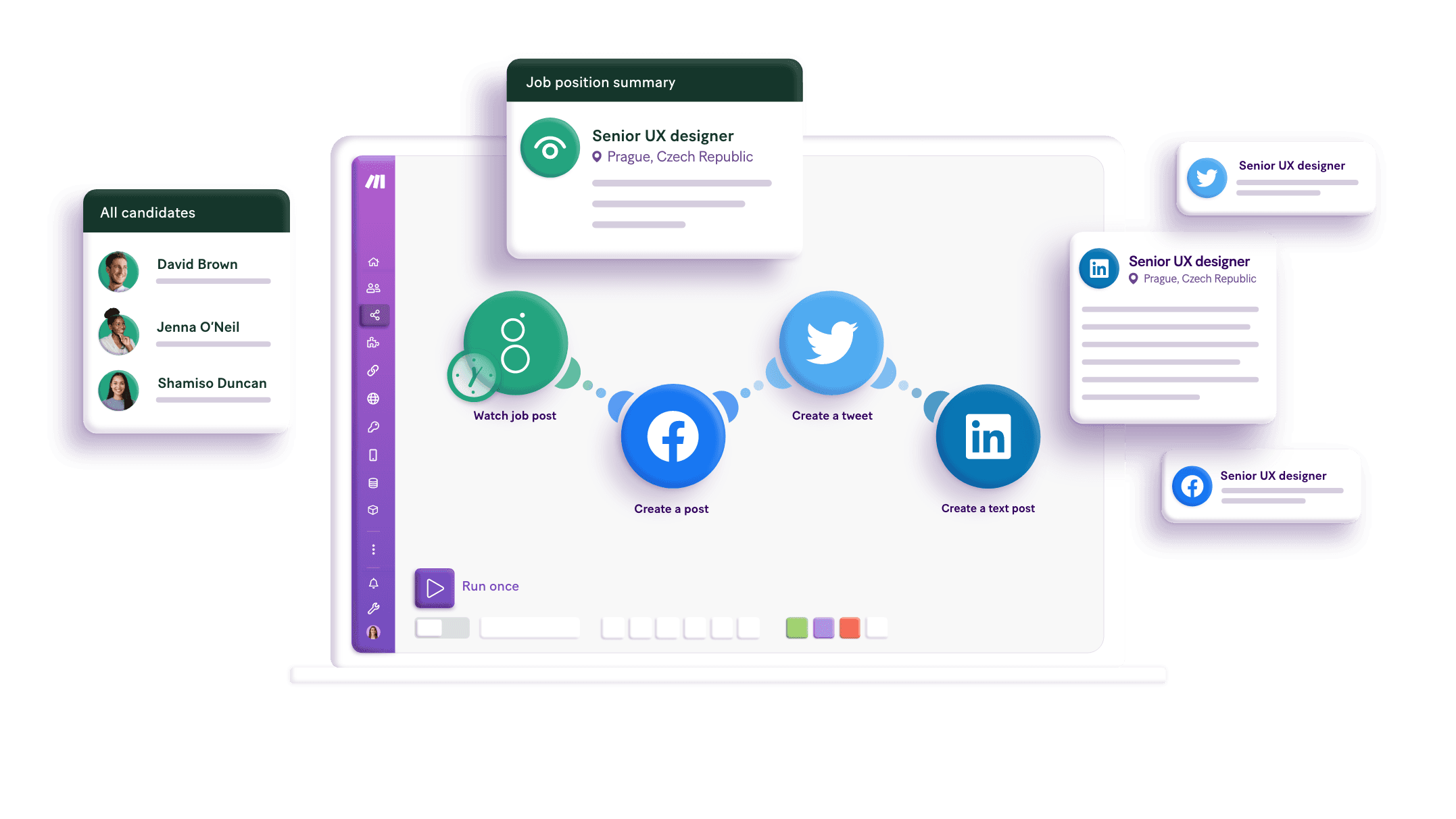
Build your Twilio and ElevenLabs integrations.
Connect ElevenLabs as a trigger and Twilio as an action through Make's integration platform to automate voice workflows. When ElevenLabs receives an incoming call or SMS, it triggers the workflow, which then activates Twilio to automatically generate natural-sounding voice messages using AI voice generation technology. This trigger-action integration allows you to create automated responses where ElevenLabs's communication events initiate Twilio' audio content creation, enabling you to automatically generate and deliver personalized voice messages based on incoming ElevenLabs interactions.
Converts an audio recording so it is spoken in a chosen voice, preserving delivery and emotion.
Composes a music track from a text prompt.
Transcribes an audio or video file into text.
Calls a specified phone number and executes specified instructions.
Sends a message.
Starts an asynchronous job that dubs a video or audio file into another language.
Create a new agent by duplicating an existing one.
Generates a sound effect from a text prompt.
Synthesizes a text into speech.
Popular Twilio and ElevenLabs workflows.
Looking to get more out of Twilio and ElevenLabs? With Make you can visually integrate Twilio and ElevenLabs into any workflow to save time and resources — no coding required. Try any of these templates in just a few clicks.
How to setup Twilio and ElevenLabs in 5 easy steps
Get your ElevenLabs API Key
Log into your ElevenLabs account and click on your profile icon in the top-right corner. Select 'Profile' from the menu, find the API Key field, and click the eye icon to reveal it. Copy this key and keep it handy—you'll need it to connect ElevenLabs to Make.
Gather your Twilio credentials
Sign into your Twilio account and go to your Dashboard. Click on the Developer tab and look for the Account info section. You'll see two important pieces of information: your Account SID and Auth Token. Copy both of these values and save them somewhere safe for the next steps.
Add an app module in Make
Log into your Make account and either create a new scenario or open an existing one. Add either an ElevenLabs or Twilio module to your scenario by searching for it in the module list. This will be the starting point for connecting your apps.
Create a new connection
When you add the module, you'll see a 'Create a connection' button—click it to open the connection form. You can optionally give your connection a descriptive name to help you identify it later, especially if you plan to create multiple connections or work with others.
Enter your credentials and save
Paste the credentials you copied earlier into the appropriate fields: your ElevenLabs API Key, or your Twilio Account SID and Auth Token. Click the Save button to complete the connection. Once confirmed, you're ready to start building automated workflows between your apps.
Automate voice communication with Twilio and ElevenLabs integration
Connect Twilio and ElevenLabs to automate voice message delivery at scale. Generate natural AI voices and send them via SMS or calls, create multilingual broadcasts, and build intelligent response systems.
Automatically generate natural-sounding voice messages with ElevenLabs and send them via Twilio SMS or voice calls without manual intervention.
Create custom AI-generated voice content for individual customers and deliver it through Twilio's messaging channels to thousands of recipients simultaneously.
Convert text alerts and notifications into realistic voice messages using ElevenLabs and distribute them instantly through Twilio's communication infrastructure.
Generate voice content in multiple languages with ElevenLabs and reach global audiences through Twilio's worldwide SMS and voice network.


FAQ
Integrating Twilio and ElevenLabs through Make enables you to create powerful voice communication workflows by combining Twilio's messaging and calling capabilities with ElevenLabs' advanced AI voice generation technology. You can automatically generate natural-sounding voice messages using ElevenLabs and deliver them through Twilio's reliable communication infrastructure, perfect for creating personalized voice notifications, automated customer service calls, or interactive voice responses without manual intervention.
No programming skills are required. Make provides a visual, no-code platform where you can connect Twilio and ElevenLabs through an intuitive drag-and-drop interface. You select triggers and actions from both applications, map the data fields between them, and Make handles all the technical integration work automatically. This means you can create sophisticated voice communication workflows in minutes rather than spending weeks on custom development.
You can create numerous automated workflows such as: generating personalized voice messages with ElevenLabs and sending them via Twilio SMS or calls for appointment reminders, creating dynamic voice alerts for important notifications, building multilingual voice broadcasting systems, automating customer outreach with natural-sounding voices, or developing voice-based content delivery systems. Make allows you to trigger these workflows based on various events from other apps in your workflow, creating complete end-to-end automation.
You can set up your first Twilio-ElevenLabs integration in under 15 minutes. Create a free Make account, connect your Twilio and ElevenLabs accounts using their API credentials, and start building your workflow using Make's pre-built modules for both services. Make's templates and intuitive scenario builder guide you through the process, and you can test your integration immediately. Once activated, your automated workflows run 24/7 without any additional maintenance required.
A scenario represents a workflow or a project of your own creation, and it is made up of a series of modules that automate apps and services. Creating a scenario allows you to transfer and transform data between apps and services via these modules to automate anything and improve the way you work.
Modules are the main building blocks of automation in Make. Modules represent actions that Make performs with an app, like creating, updating, or deleting data.
How it works
Traditional no-code iPaaS platforms are linear and non-intuitive. Make allows you to visually create, build, and automate without limits.
Trusted by 350,000+ customers
"Make really helped us to scale our operations, take the friction out of our processes, reduce costs, and relieved our support team. It is difficult to not become a fan."

Philipp Weidenbach
Head of Operations at Teleclinic
"Make drives unprecedented efficiency within our business in ways we never imagined. It’s having an extra employee (or 10) for a fraction of the cost."

Cayden Phipps
COO at Shop Accelerator Martech
"The simplicity, flexibility and ability to build real complex automations without any knowledge of programming makes it the best thing since sliced bread."

Erkki Markus
Product Owner at Smaily
"True citizen development in the entire company. Make is present in every department, empowering the company to offer a unique customer experience."

Andreas Stryz
CTO & Co-founder at FINN
"I can't count the number of hours I've saved by using Make. Every single day is simpler because of Make's automation."

Kimberly D
Owner of Media Production