Connect YouTube and OpenAI (ChatGPT, Whisper) integrations
Transform your YouTube channel management with intelligent automation that connects YouTube events directly to OpenAI's powerful suite—ChatGPT, Whisper, DALL-E, and Sora. Every upload, comment, or channel update automatically triggers AI-powered actions that generate optimized metadata, transcribe audio, analyze audience insights, and create compelling content, eliminating manual tasks so you can focus on what matters most: growing your channel.

Triggers when a new comment related to a channel or a video occurs.
Triggers when a new video appears in the search results.
Triggers when a video is published on a public channel or your channel
Triggers when a video has been added to a specified playlist.

Analyzes images according to specified instructions.
Cancels an "in-progress" batch. The batch will be in status "cancelling" for up to 10 minutes, before changing to "cancelled", where it will have partial results (if any) available in the output file.
Creates and executes a batch of API calls.
Creates a new skill.
Creates a new immutable skill version.
Creates a new vector store and optionally adds files to it, or adds files to an existing vector store.
Deletes an existing conversation.
Deletes an existing model response.
Deletes a skill. This action cannot be undone.
Deletes a skill version. This action cannot be undone.
Deletes a vector store. This action cannot be undone.
Downloads a file from a container.
Downloads a skill as a ZIP file using its ID.
Downloads a skill version as a ZIP file.
Creates an edited or extended image given one or more source images and a prompt.
Generates a chat completion.
Qualifies whether the provided image or text(s) contains violent, hateful, illicit or adult content.
Creates an embedding vector representing the input text.
Generates a response.
Transcribes an audio to text.
Translates an audio to English.
Generates images using GPT Image.
Generates an audio file based on text input and settings.
Retrieves details of the specified batch.
Retrieves an existing model response.
Returns information about a specific skill by its ID.
Returns information about a specific skill version.
Performs an arbitrary authorized API call.
Generates text responses from prompts without requiring an account or connection.
Identifies information in a prompt's text and returns it as structured data.
Updates the default version pointer for a skill.
Uploads a file to be used across the OpenAI platform.
Retrieves a list of batches.
Lists input items.
Returns a list of skills.
Returns a list of skill versions.
Returns a list of vector stores.
Searches a vector store and returns the file content chunks that match your query.
Trusted by thousands of fast-scaling organizations around the globe




Automate your work. Build something new.
Just drag and drop apps to automate existing workflows or build new complex processes. Solve problems across all areas and teams.
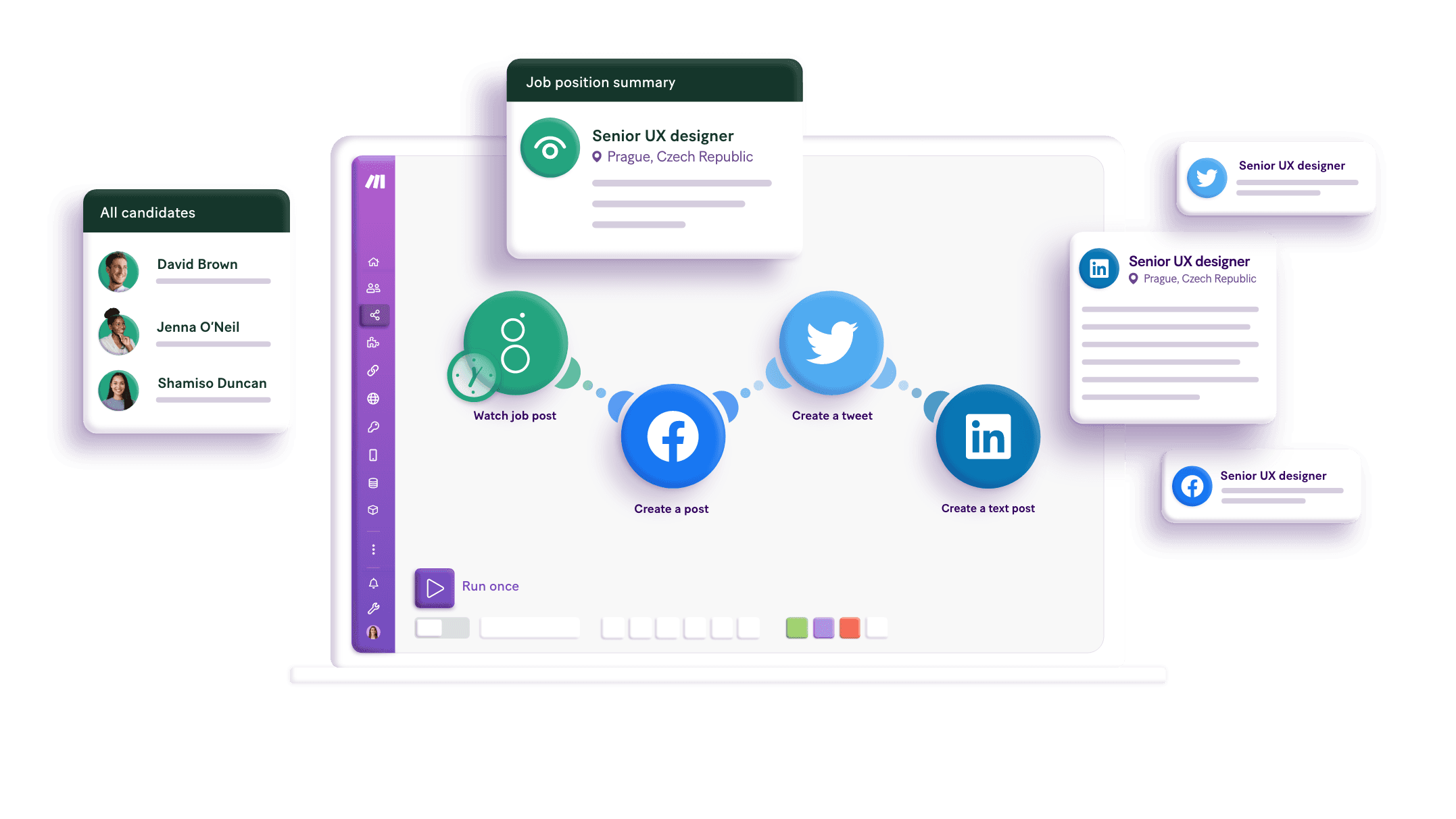
Build your YouTube and OpenAI (ChatGPT, Whisper) integrations.
When OpenAI (ChatGPT, Whisper) serves as a trigger, events such as new video uploads, comments posted, or channel updates can automatically initiate workflows that activate YouTube as an action. Once triggered by OpenAI (ChatGPT, Whisper) activity, OpenAI can automatically generate video descriptions, titles, and tags for uploads, transcribe audio content using Whisper, analyze viewer comments with ChatGPT to extract insights, or create creative assets. This trigger-action integration enables OpenAI (ChatGPT, Whisper) channel managers to automate content optimization and management tasks, where specific OpenAI (ChatGPT, Whisper) events directly prompt OpenAI to perform AI-powered actions such as generating metadata, moderating comments intelligently, or producing supporting content without manual intervention.
Adds a video to the playlist by its ID.
Analyzes images according to specified instructions.
Cancels an "in-progress" batch. The batch will be in status "cancelling" for up to 10 minutes, before changing to "cancelled", where it will have partial results (if any) available in the output file.
Creates a new playlist in a channel of the authorized account or on behalf of a content owner or their channel, if specified.
Creates and executes a batch of API calls.
Creates a new skill.
Creates a new immutable skill version.
Creates a new vector store and optionally adds files to it, or adds files to an existing vector store.
Deletes a specified playlist.
Popular YouTube and OpenAI (ChatGPT, Whisper) workflows.
Discover powerful automations that combine YouTube's video platform with OpenAI's AI capabilities. From generating optimized video descriptions and tags with ChatGPT to creating automated content summaries, these integrations improve your video workflow and discoverability.
Transform how you manage YouTube content by using AI-powered tools that handle repetitive tasks, improve SEO performance, and scale your content operations.
How to setup YouTube and OpenAI (ChatGPT, Whisper) in 5 easy steps
Add the YouTube module to your Make scenario
Log into your Make account and create a new scenario in the scenario builder. Add a YouTube module to your workflow, and you'll see an option to create a new connection. Click the 'Create a connection' button to start linking YouTube to Make.
Give your connection a name
Assign a descriptive name to your connection so you can easily identify it later. This is particularly helpful if you're working with multiple connections or different YouTube accounts. While optional, naming your connection keeps your workspace organized.
Review and accept the service terms
Before continuing, you'll need to review YouTube's Terms of Service and Google's Privacy Policy to understand how your data will be handled. Read through these documents carefully, then check the box to confirm you accept the terms.
Sign in with your Google account
Click the 'Sign in with Google' button to connect your Google account to Make. A new window will open asking for your Google credentials. Make sure you use the Google account associated with the YouTube channel you want to connect.
Grant the necessary permissions
After signing in, Google will ask you to grant Make permission to access your YouTube data. Review what access Make will have to ensure you're comfortable with the permissions. Click to approve and grant access, then you'll be redirected back to Make with your connection successfully established.
Supercharge your YouTube channel with AI-powered automation
Integrate YouTube with OpenAI to automate content creation, generate optimized video descriptions, create SEO-friendly tags, and improve your publishing workflow with ChatGPT's intelligence.
Automatically find YouTube videos by channel or keywords and generate concise summaries with ChatGPT, delivering insights directly to your inbox without manual research.
Use ChatGPT to create optimized descriptions and tags for your YouTube uploads, improving discoverability and SEO while eliminating manual copywriting tasks.
Connect cloud storage with YouTube uploads and AI content generation in one workflow, reducing time spent on repetitive video publishing tasks.
Improve your YouTube video performance by automatically generating SEO-friendly descriptions and relevant tags tailored to your content using ChatGPT's language capabilities.


FAQ
By integrating YouTube with OpenAI on Make, you can automate content creation and optimization workflows. For example, you can automatically generate video titles, descriptions, and tags using GPT-4 based on your video content, create automated transcriptions with Whisper, generate thumbnail concepts with DALL-E, or analyze comments and create AI-powered responses. This integration saves hours of manual work and helps optimize your videos for better reach and engagement without switching between platforms.
Make enables powerful automation scenarios such as: automatically transcribing new YouTube videos using Whisper and posting summaries to your blog, generating SEO-optimized video descriptions with ChatGPT when you upload new content, creating custom thumbnail designs with DALL-E based on video topics, analyzing viewer comments with GPT-4 to identify trends and sentiment, translating video descriptions into multiple languages automatically, or generating video scripts and ideas based on trending topics. These automations run in the background, allowing you to focus on creating great content while Make handles the repetitive tasks.
No coding skills are required. Make provides a visual, drag-and-drop interface that connects YouTube and OpenAI. You simply select triggers (like 'new video uploaded to YouTube'), actions (like 'generate text with ChatGPT'), and map the data between them using Make's intuitive builder. Make handles all the technical API connections, authentication, and data transfer behind the scenes. You can start with pre-built templates for common YouTube-OpenAI workflows or create custom automations in minutes, all without writing a single line of code.
Yes, Make offers a free tier to get started, allowing you to test YouTube and OpenAI integrations with 1,000 operations per month at no cost. This lets you experiment with automations before committing financially. As your needs grow, Make's pricing scales with your usage, and the time saved through automation often far exceeds the platform cost. By automating tasks like content optimization, transcription, and engagement management that would otherwise require expensive freelancers or countless manual hours, even small creators see significant ROI. Plus, you're consolidating multiple tools into one platform, reducing overall software costs.
A scenario represents a workflow or a project of your own creation, and it is made up of a series of modules that automate apps and services. Creating a scenario allows you to transfer and transform data between apps and services via these modules to automate anything and improve the way you work.
Modules are the main building blocks of automation in Make. Modules represent actions that Make performs with an app, like creating, updating, or deleting data.
How it works
Traditional no-code iPaaS platforms are linear and non-intuitive. Make allows you to visually create, build, and automate without limits.
Trusted by 350,000+ customers
"Make really helped us to scale our operations, take the friction out of our processes, reduce costs, and relieved our support team. It is difficult to not become a fan."

Philipp Weidenbach
Head of Operations at Teleclinic
"Make drives unprecedented efficiency within our business in ways we never imagined. It’s having an extra employee (or 10) for a fraction of the cost."

Cayden Phipps
COO at Shop Accelerator Martech
"The simplicity, flexibility and ability to build real complex automations without any knowledge of programming makes it the best thing since sliced bread."

Erkki Markus
Product Owner at Smaily
"True citizen development in the entire company. Make is present in every department, empowering the company to offer a unique customer experience."

Andreas Stryz
CTO & Co-founder at FINN
"I can't count the number of hours I've saved by using Make. Every single day is simpler because of Make's automation."

Kimberly D
Owner of Media Production