Dec 11, 2025 | 5 minutes
"I wouldn’t have done it without Make": How a founder automated her entire back-office to outperform big business
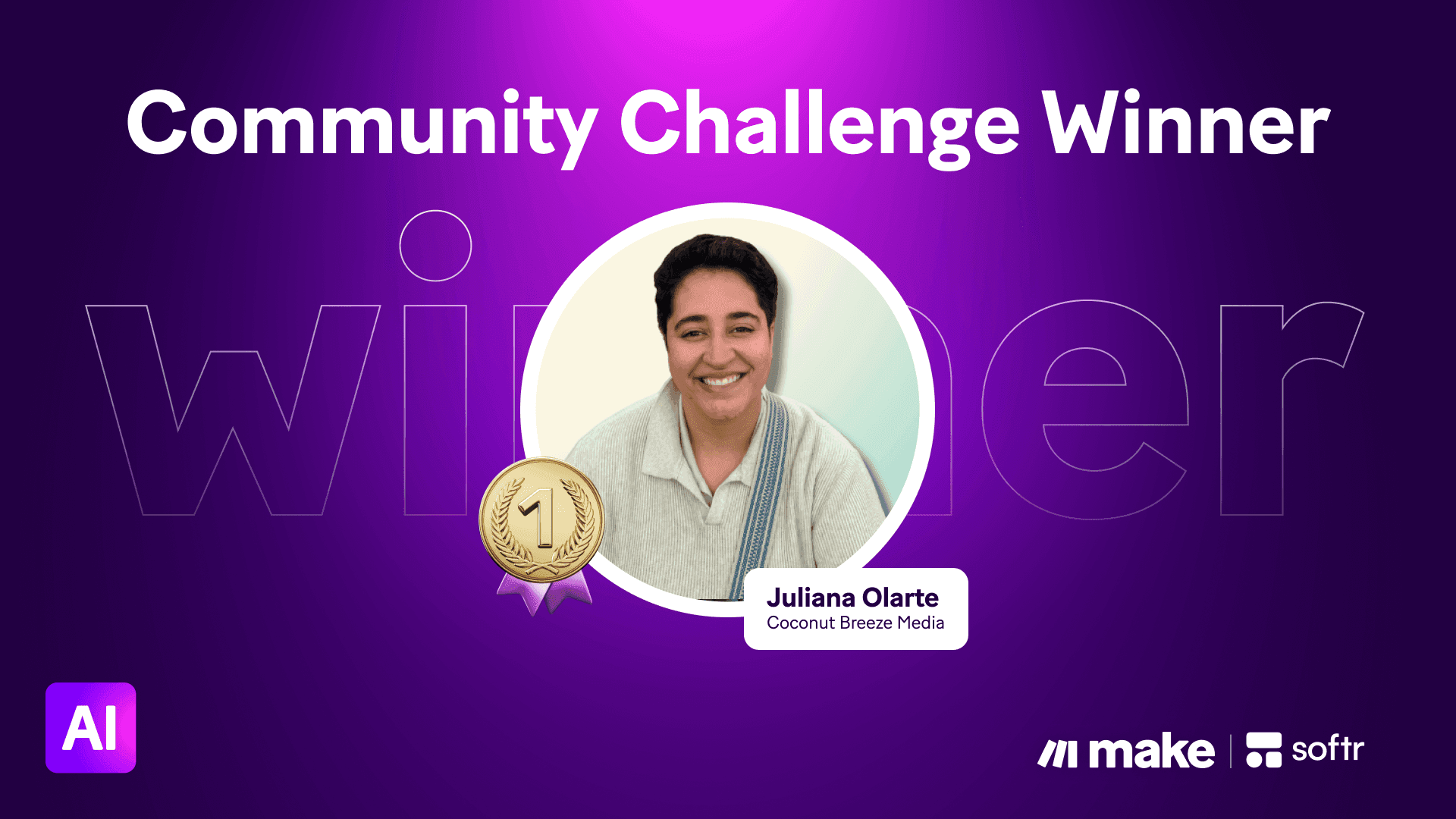
Read how Juliana Olarte, Founder and CEO of Coconut Breeze Media, used Make AI to build sophisticated automated systems that empowered her to compete with industry giants.
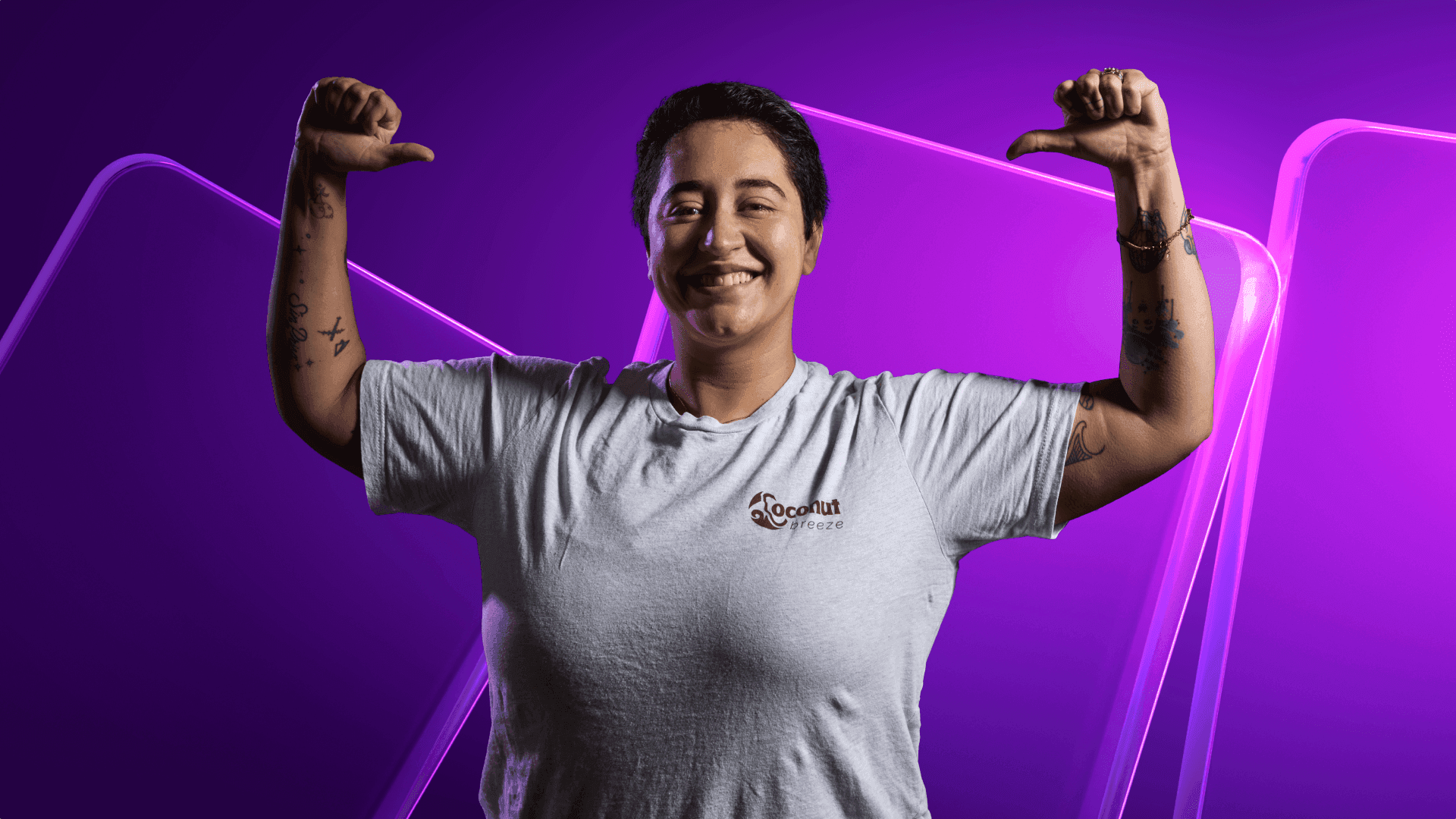
Juliana Olarte never set out to become a CEO. As a PR and marketing professional in the travel and hospitality industry, she loved her job. She loved the creativity, the client relationships, and the problem-solving. But she also saw something frustrating: small travel companies constantly struggled to compete with larger corporations that had the resources, the teams, and the systems to dominate the market.
The small company where Juliana worked faced that challenge. They couldn't afford the infrastructure that big players took for granted. It was an uneven playing field. Once their transcription system broke down, the developer was unavailable to help. So Juliana started experimenting with automation.
She opened a Make account, and everything changed.
"I was like, ‘no way that [Make] has been here this long, and I've never heard about it’. But of course, it's because I’d come from a completely different world. So now my whole world is just automations and no-code."
Over the next few years, Juliana automated 90% of her work and saw what was possible. When her mother suggested Juliana start her own business, she knew exactly what she wanted to achieve: to prove that, with the right tools, small businesses could compete with the big players.
In October 2024, the idea for Coconut Breeze Media was born: an agency specializing in automation and media solutions for the travel and hospitality industry. By January 2025, she had launched.
Make didn't just support a rapid launch. It made the entire business possible.
The challenge: It gets real, and reality hits
Launching a business driven by ambition is one thing. Keeping it running is another. Suddenly, Juliana was responsible for everything. Drafting contracts she'd never written before. Invoicing systems she'd never built. Managing processes she'd never encountered. Designing a client onboarding flow that needed to work flawlessly from day one.
"I don't come from operations. I don't come from sales. I never learned how to launch my own business. I never learned anything about payroll or how to do accounting."
The only time she'd dealt with expenses was when she'd filed them at her previous company. Now she was the company.
"Having to think of all of these little details that you normally wouldn't think about because you weren't working for yourself is definitely surprising. It kind of stunned me for a while. And it was hard to cope and manage it all by myself."
The transition was tough. From a comfortable 9-to-5 schedule to working around the clock. From defined responsibilities to running every department.
Without formal business training, Juliana faced an impossible question: How do you compress years of learning into months while simultaneously building and running a company? And more importantly, how do you grow without needing a team in an industry led by big names?
The solutions
Building operations before building a team
Juliana's advantage came from those three years she'd spent automating in her previous role. She'd already seen what Make could do. She knew the platform. And she was aware of something crucial: she could build the operational infrastructure of an established company before hiring a single person.
"With Make, I started seeing how much of your internal business operations you can automate. I was able to take this small idea, learn maybe five years' worth of sales, operations, business in a span of three months, and build out systems that I knew were going to be my assistants or my colleagues from the beginning."
Coming from a completely non-technical background of PR, marketing, and client management, Juliana had never written a line of code. She didn't know what no-code meant three years earlier. But Make's visual interface changed everything.
"Visually, it’s so easy to understand. The Make Academy, the Make community, and all the tutorials out there have made this one of the easiest automation platforms to learn for me. I wouldn’t recommend any other platform because of how easy it was for me to learn, especially as a non-technical person."
But accessibility doesn’t mean limitation. She could customize and scale as much as she wanted. And as her ambitions grew, Make grew with her.
Using Make, Juliana had automated:
Operations management: Client onboarding, project tracking, and workflow coordination
Financial systems: Invoicing, expense tracking, and payment processing
Sales processes: Proposal generation, contract creation, and follow-up sequences
Client communication: Personalized outreach, scheduling, and relationship management
Make wasn't just helping her business. It was the foundation that made running it possible.
"I don't think I would have launched my business without Make. I don't think I would have taken the plunge. I don't think it's realistic for someone who doesn’t come from a formal business training or background to do what I've done without the help of automation and AI agents."
Leveling the playing field with AI-powered automation
With automations set up, Juliana was on track to prove that small businesses could compete with industry giants and win. Adding Make AI Agents to the mix for handling complex decision-making and orchestration gave her two critical advantages: speed and scale.
Speed: Using Make, Juliana automated five years' worth of business processes in months. Instead of earning a tech degree or spending all her time mastering every business role, she built systems that gave her these capabilities immediately. When clients need demos, AI helps her build proofs of concept in minutes rather than spending hours parsing documentation. For complex client requests, AI summarizes lengthy documents into three-sentence briefs she can act on immediately.
Scale: AI and automation enabled her to operate as if she had a team of five. Where corporations rely on departments full of specialists, Juliana built intelligent systems that do the work while she orchestrates the strategy. For example, she developed BreezyBot, a custom AI chatbot platform that gives her clients the AI assistance they need without the expense of enterprise solutions.
"For a long time, the industry has been run by larger companies. They have a leg up. And I think automation and AI are evening the odds. I've seen what I can do. I’ve seen what other companies could do just by integrating AI and automation into their systems."
The results
A business built for quality, not just efficiency
Juliana isn't using automation to do less. She's using it to achieve more. To deliver faster and better.
"There sure are folks who are using automation to do the bare minimum. But folks who save time with automation and actually use it to empower themselves, to challenge themselves, take the quality of work to a whole new level."
For Juliana, that means spending more face-to-face time with clients while in the background, AI drafts follow-up emails after trade shows, identifies social media trends, and organizes content topics tailored to each client.
This also gives her space to deliver higher-quality work because she has time to review what she's producing and to be present for what matters.
A small business conquers industry giants
Today, Coconut Breeze Media operates with the sophistication of a much larger company. The systems Juliana built continue to handle the operational complexity that once kept her up at night.
Using Make AI, Coconut Breeze Media now rivals much larger agencies, but without the overhead, bureaucracy, or limitations. Juliana can respond to client needs faster, customize solutions more flexibly, and deliver enterprise-level sophistication as a solo founder. Corporations that once seemed untouchable are no longer operating with an unfair advantage. Small businesses can compete on quality, speed, and innovation. For Juliana, automation and AI proved that being small and agile is not a handicap but an advantage.
“For me, AI has been a tool that creates a brand new opportunity. It’s going to change lives in the best way possible.”
Time back for what matters
Looking ahead five years, Juliana's vision reflects a balanced ambition. She wants Coconut Breeze Media to grow, have around ten happy employees, and a solid client base. But that she knows that doesn’t mean compromising on other passions in her life.
"More importantly, I want to have time to be outside, to go scuba diving. Maybe I'll build a platform for scuba diving shops to manage their trips. But just having more time back to be with my family."
This isn't about working less or working more. It's about protecting what matters inside and outside of business.
"People often forget that we're not meant to work 24/7. Having more time to do what you love doesn’t mean doing less. With Make, it just means growing faster."
"Now is the time - get in while you can"
Make didn't just help Juliana start her business. It gave her permission to imagine a different kind of life. One where corporations don’t overpower newcomers, and passion doesn’t compete with profession. One where you can build something meaningful without sacrificing everything else. Where a marketing professional with no technical background can launch a powerful, scalable business that punches far above its weight.
Her advice is simple:
"Make is it. Now is the time to get in. Do it while you can!”
Because when ambition meets automation, that's when you make it happen.
Ready to make the automation revolution happen?