Mid-sized companies that get AI adoption right can challenge enterprises twice their size. Nobody's telling them how.
Most AI advice is built for enterprises or startups, leaving mid-sized companies stuck in pilot purgatory. Here's the playbook that helps them turn scattered AI experiments into company-wide adoption, and rival enterprises twice as big.

I've read a lot of AI reports this year, and there's a pattern I keep noticing. By the time I’m halfway through them, I realise that the 250-to-1,000-person businesses (a segment I’m working with often have disappeared from the data.
Most AI research skews toward the Fortune 500, and I see why. Easiest data to collect, and easiest pitch for a consultancy like Bain, BCG, or Deloitte to sell. Small companies get plenty of advice too, from vocal founders.
Now go looking for advice built for the mid-sized segment. Nothing from the big research houses. Nothing from the founders either, because they’re too busy running the business.
Still, mid-sized companies sit on one of the biggest structural advantages in the AI moment. I think of them as the Goldilocks zone: big enough to matter, small enough to move. With the potential of an enterprise-level scale of impact and startup-level speed of decision-making.
Still, almost nobody has written the AI playbook for this size of company.
So I did.
I recently co-authored a research report at Make. It showed me exactly why so many mid-sized companies get stuck: most of them already experiment with AI. Almost none turned those experiments into something the whole business runs on.
The article below shares some of our insights.
Pilot purgatory: Why companies get stuck
Most of the AI advice mid-sized companies get is borrowed. It's enterprise thinking, resized down. Or it's startup thinking, scaled up.
Neither fits, and this mismatch shows up in the numbers.
A Censuswide survey of 400 mid-sized company IT leaders put it plainly: 82% are already using AI in some form.
That part isn't the problem. Adoption is everywhere.
The problem is what happens next.
According to the report I co-authored, based on 540 respondents from 16 industries, only 45% of mid-sized businesses have a formal AI strategy in place.
That gap has a name in my world: pilot purgatory. Companies that have seen promising demos or proofs of concepts, but haven’t been able to bring those into production and begin realizing the actual return on investment.
And it costs real money in a way that doesn't show up on the invoice. I've watched companies sign a big enterprise contract with an AI vendor, roll licenses out to the whole company, and then wait for adoption to just happen.
It doesn't, because you can't buy adoption.
Technology is maybe 20% of the equation for AI transformation. The other 80% is getting people to actually change how they work day to day with an adoption strategy specific to each company. An institutional structure widely influences how this shift is executed. That is where mid-sized businesses get stuck between two extremes.
- An enterprise version of an AI playbook assumes infrastructure you don't have. A dedicated AI team, complete with in-house developers. A robust change-management function. A budget built for an eighteen-month rollout, a CIO who sits in every steering committee.
- The small-company version has the opposite gap. It assumes you can let anyone try anything without much planning or documentation. At ten people, nothing critical breaks if strategies shift from one day to another. The startup playbook skips formal structures like ownership: startups rarely need it yet. Mid-sized companies depend on things like ownership because it prevents chaos and lets them truly scale.
The difference between how enterprises, mid-sized companies, and small businesses operate is simply too great for a “one size fits all” approach.
AI proximity shapes the AI adoption journey
Zooming in on AI adoption and mid-sized companies. If two companies both have 400 employees, you may expect them to have a similar AI adoption journey. They usually don't, but size isn't why. How close AI sits to the center of what your business matters more. I refer to this as the company’s ‘AI proximity’.
A software company with 400 employees probably already has a culture of testing new tools, because that's the water it swims in.
A 400-person construction company with most of its workforce out in the field starts from a completely different place, and that's fine. It just needs a different plan.
A real read on where you stand looks at four things together:
- Business context
- Technology and data foundation
- Leadership mindset
- Function-by-function readiness
The “AI adoption profile” framework (below) that I helped build at Make explains what you should ask yourself to assess AI proximity, and shows you where you stand on the AI readiness spectrum.
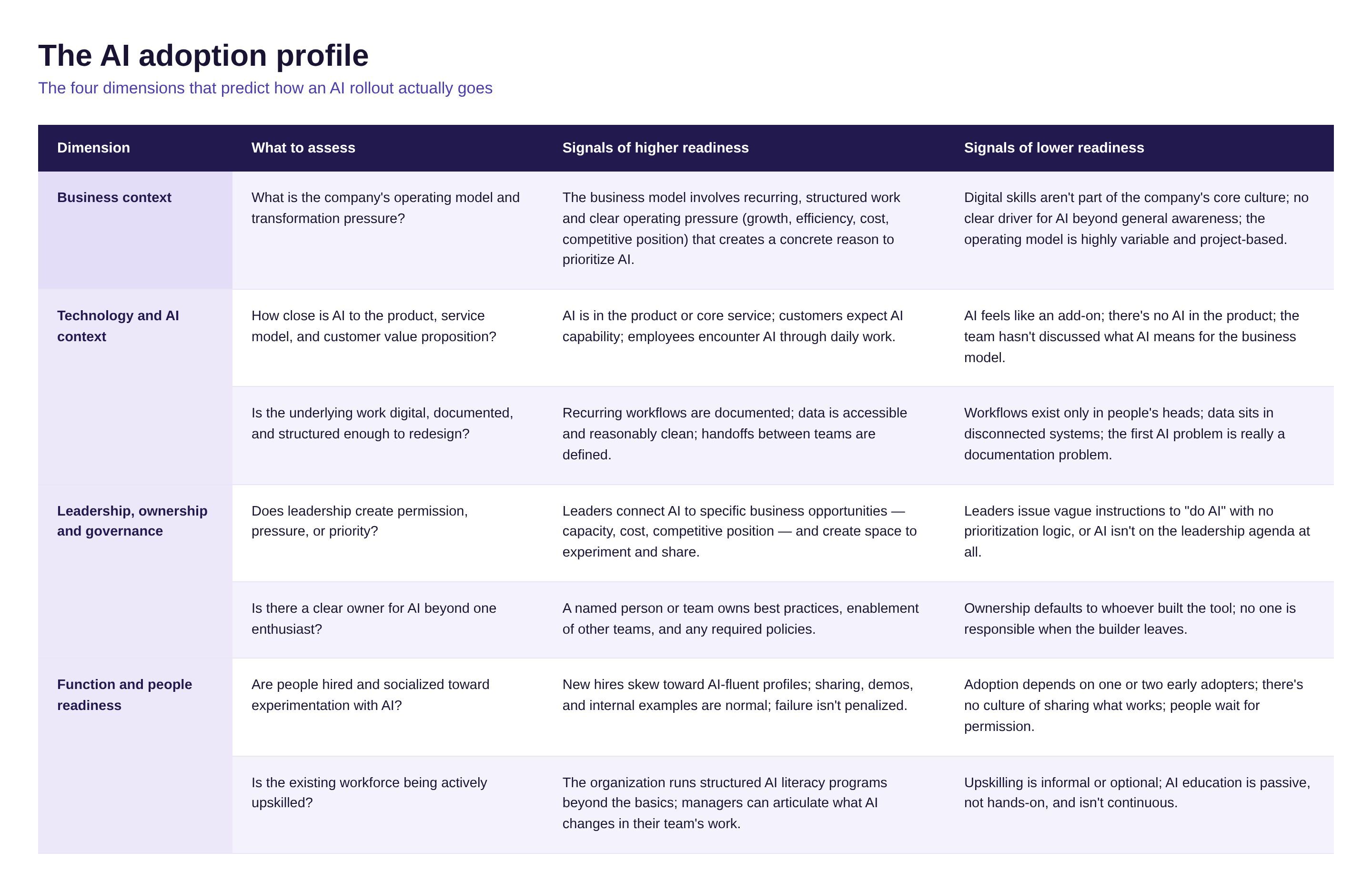
Your position within this profile tells you where to start and can predict the likely speed of AI adoption. A company with strong leadership orientation to new innovation and an existing culture of sharing can move from first experiments to scaling across departments in months.
A traditional company with weak process documentation and no clear ownership may need to solve several of these dimensions before adopting AI successfully.
A three P framework: From “let’s go” to “here’s how”
So what does the mid-size company playbook actually look like? For that, I don’t have enough space in this blog. But I'd start with a simple framework that I think of as Permission, Pressure, and Priority.
The trick is that none of these three can work in isolation.
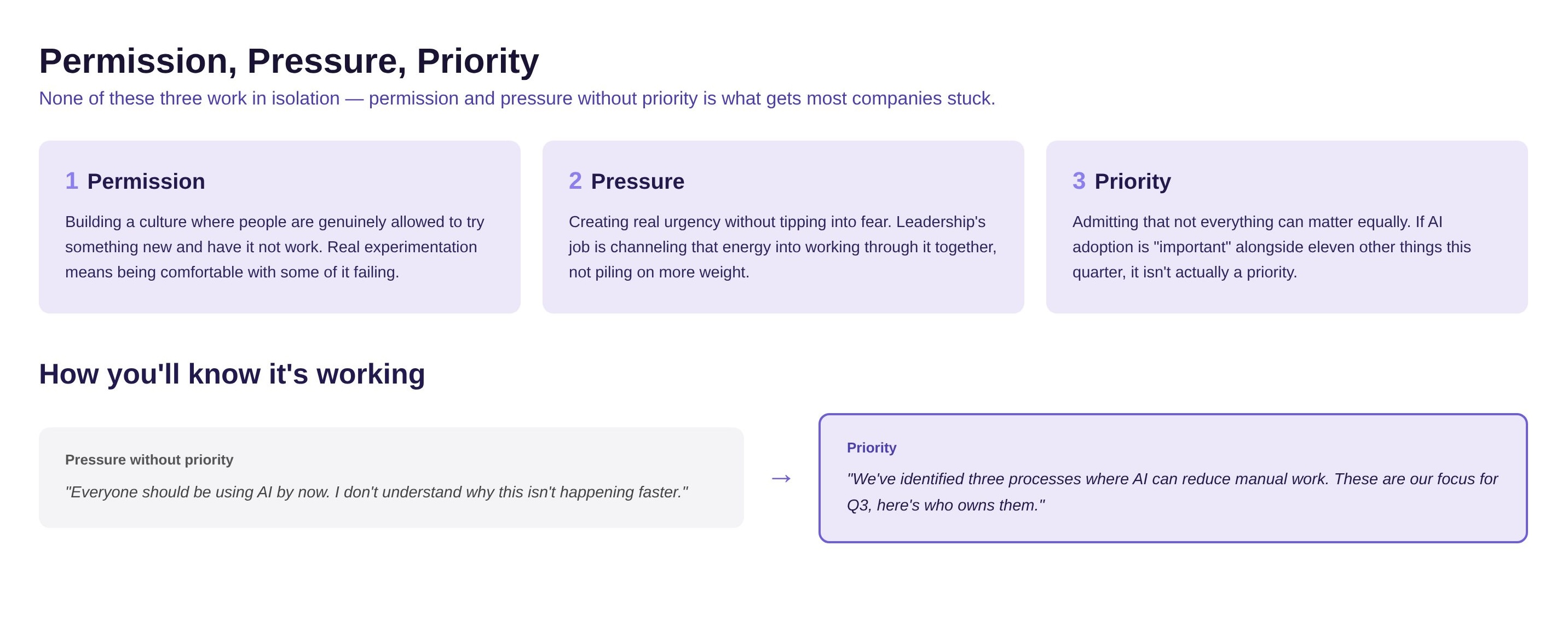
- Permission means building a culture where people are genuinely allowed to try something new and have it not work. If you want real experimentation, you have to be comfortable with some of it failing.
- Pressure means creating real urgency without tipping into fear. People already worry about falling behind. The job of leadership is to channel that energy into "let's figure this out together" rather than piling more weight onto it.
- Priority means admitting that not everything can matter equally. If AI adoption is "critically important" alongside eleven other critically important things this quarter, it isn't actually a priority. It means having a named owner in place, clear scope, and defined outcome.
It's permission and pressure without priority that gets most companies stuck: people feel free to try things, or feel the urgency to move, but nothing actually gets chosen. Priority is what makes the other two relevant.
You know you've reached it when the sentence in the room changes.
Instead of "everyone should be using AI by now, I don't understand why this isn't happening faster," it becomes: "We've identified three processes where AI can reduce manual work. These are our focus for Q3. Here's who owns them."
Stop measuring what AI can cut
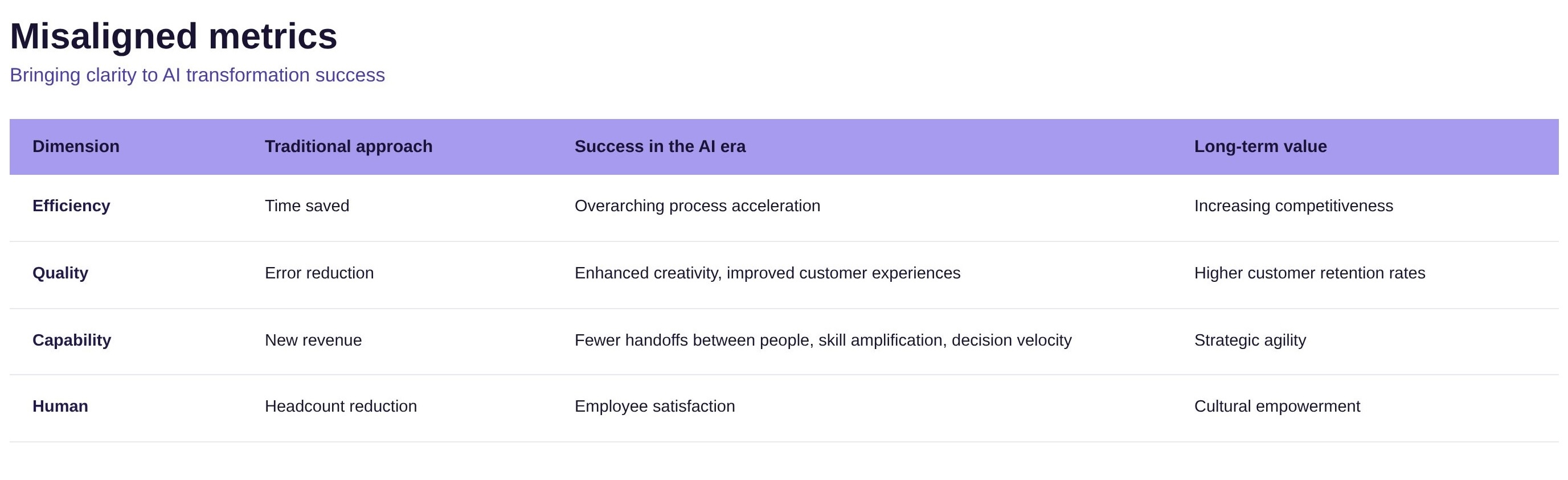
Metrics naturally show you whether your adoption strategy works and where to steer next. But most mid-sized companies are still grading this the wrong way. Their default question is "how much time did we save?"
That's a fine starting metric.
If it's still the main one you're reporting a year in, you've stalled.
Time saved is bottom-line thinking. It's about what you can cut.
I'd rather see mid-sized leaders ask top-line questions:
- What can we do now that we couldn't before?
- What capacity did we just free up?
- Did we point it at something that makes us more competitive?
I mapped the bottom-line versus top-line approach out because I kept seeing the same pattern. I call it Misaligned Metrics. What most companies default to, next to what actually matters once AI is embedded in the work.
Successful companies have this in common
Even with the same gaps in resources, some mid-sized companies just handle AI adoption better than others. I've watched it up close at companies like Dude Wipes, and in how Stellantis &You runs its dealership operations.
Different industries, same thing in common.
Somebody without a fancy title decided to move first. I call them change agents (not to be confused with AI agents). The companies getting this right simply have more of them.
Give them room, and most of the adoption follows on its own. AI will stop being the headline initiative and become the subtext, showing up in the boardroom, the weekly update, an ordinary Tuesday, without anyone announcing it.
That is when you’ll know you won.
Design for mid-sized companies, and unlock their potential
Zoom out, and the potential is to scale the impact of innovative mid-sized companies.
A mid-sized company that runs the right AI playbook stops looking mid-sized to the market. I see them quoting the same contracts as companies three times its headcount, pulling from the same pool of talent, setting a pace its bigger, slower competitors struggle to react to.
But to get there, mid-sized companies require a playbook that fits their needs. One that designs around the proximity to AI in the business. That shows what can be built with AI as well as what can be saved. And one that creates an environment for change agents to make the shift happen.
Build an AI playbook for mid-sized companies, and the scale of the company stops limiting the scale of impact.
Related blogs
Tool and strategies modern teams need to help their companies grow.
AI
The AI maturity payoff: Why 'AI saved us time' is the least useful sentence in your business case
A stage-by-stage look at how AI payoff actually gets measured, once "hours saved" stops telling the truth.

Daria Hvizdalova
July 17, 2026
AI
Most businesses run internal AI programs, few see real impact. Here’s how we scaled to 96% adoption at Make.
Most companies plateau at 16% AI adoption. Here's the internal AI adoption strategy that took Make from 8% to 96%, and the three-layer structure behind it.

Sara Maldon
August 6, 2026
Inside Make
Designing Maia by Make: A co-worker that turns words into workflows in front of you
A behind-the-scenes look at designing Maia – Make's AI co-worker that builds workflows transparently and visually on the canvas alongside you, changing plain words into AI workflows.

Hedy Lemus Bird
August 21, 2026