How Make and TypeFore help align internal operations compliance with brand policies
Most compliance failures don't show up in your dashboards. They happen on calls your QA team never reviews. Here's how to close that gap automatically with Make and TypeFore.

There’s a massive, hidden leak in most operations: the gap between what your company handbook says and what your team actually does on the phone. And the bigger you get, the wider that gap cracks. Support agents, sales representatives, and customer success teams handle hundreds or thousands of interactions every week.
Even with documented procedures, brand guidelines, and compliance requirements, mistakes happen. A required disclosure gets missed. A refund is approved outside policy. A sales commitment exceeds what internal teams can realistically deliver.
Most operations leaders have no idea it’s happening because traditional quality assurance (QA) only catches a tiny fraction of total conversations, leaving the majority unchecked. This makes it difficult to identify recurring issues before they become larger operational problems.
This is where automation steps in. By plugging conversation analysis directly into Make, you can instantly flag policy slip-ups the moment they happen, without making your QA team review thousands of hours of audio.
The hidden costs of operational misalignment
We usually blame broken workflows on technical glitches, like a failed API or a system outage. But the most expensive breakdowns actually happen when your team's day-to-day habits drift away from your strategy.
Consider these common scenarios:
Sales overpromising
A rep promises a custom Service Level Agreement (SLA) or a feature that’s not even on the roadmap just to close a deal. The ink dries, the commission is paid, and your engineering team is left holding a ticking time bomb.
Missed compliance
In finance or healthcare, a single unapproved phrase on a call can instantly turn into a massive regulatory fine.
Bypassing standard operating procedures
A support agent processes a high-value refund without following the standard operating procedure. Individually, the mistake may seem minor. Repeated across hundreds of transactions, it can become a substantial financial loss.
Standard metrics like ticket volume and resolution time tell you how fast your team is moving, but they won't tell you if they're driving off a cliff. To catch that, you need a system that reads between the lines.
Putting policy enforcement on autopilot with Make
Fixing this requires two simple things: spotting the error in a conversation and immediately addressing it. Make bridges that gap seamlessly.
Make serves as the orchestration layer that connects these capabilities.
Instead of praying your managers catch mistakes during random spot-checks, Make grabs the conversation text, hands it over to your AI auditing tool, and instantly rings the alarm if something looks off.
An auditing platform such as TypeFore can analyze customer conversations for compliance issues, procedural violations, and brand guideline adherence. Make can then route those insights to the appropriate teams and systems for action.
Instead of playing catch-up, your managers get a continuous, real-time safety net without ever having to click 'play' on a random call recording.
How Make and TypeFore support operational integrity across the business
While customer support is often the first place organizations think about quality assurance, operational misalignment can occur across nearly every department. By combining TypeFore's auditing capabilities with Make's workflow automation platform, teams can identify issues, route insights, and trigger actions automatically.
Here are several examples of how organizations can apply this approach.
Customer support: Identifying policy violations before they become patterns
A growing software company receives thousands of support conversations every month. While the company maintains detailed support procedures and compliance requirements, managers only have time to manually review a small sample of interactions.
Using TypeFore, every customer conversation can be evaluated against internal policies, brand standards, and quality benchmarks.
When TypeFore detects a potential issue, Make can automatically:
- Ping your team leads in Microsoft Teams the second a violation happens
- Drop a coaching ticket directly into Asana or ClickUp so the manager can address it
- Push high-risk transcripts straight to the top of your QA queue
- Generate trend reports for support leadership
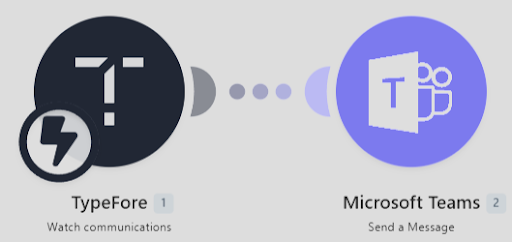
Instead of discovering recurring issues weeks later, managers gain near real-time visibility into customer-facing interactions.
Sales: Reducing the risk of overpromising
Sales reps are wired to close deals, and sometimes they color outside the lines to do it. Catching those bad promises early means your account managers won't get blindsided by a furious customer three months later.
TypeFore can analyze sales calls, emails, and meeting transcripts for potential risks such as:
- Unapproved commitments
- Misrepresented product capabilities
- Missing compliance disclosures
- Inaccurate pricing discussions
Using Make, organizations can automatically route high-risk conversations to sales leadership, update CRM records, or trigger review workflows before problems reach implementation teams.
Hiring: Creating consistency throughout the recruitment process
Left to their own devices, every manager interviews differently; some stick to the rubric, others just chat about sports. Automating this step keeps everyone tracking against the same standard and saves your recruiters from chasing down messy, handwritten notes.
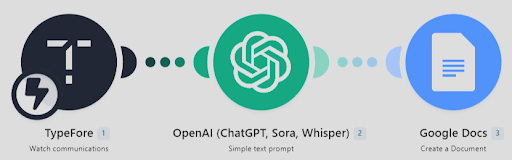
TypeFore can evaluate interview transcripts against predefined hiring criteria and communication standards.
When combined with Make, organizations can automatically:
- Generate interview scorecards
- Route candidate evaluations to hiring managers
- Create follow-up tasks
- Identify recurring bias or process deviations
Internal communications: Strengthening alignment across teams
Operational nightmares rarely start on a call with a customer; they usually start with a bad game of telephone between your own departments. When internal teams aren't shouting from the same script, projects stall and execution falls apart.
TypeFore can analyze internal communications to identify:
- Contradictory guidance
- Missing action items
- Escalation risks
- Process misunderstandings
Make can then distribute summaries, notify stakeholders, create action items, and update project systems automatically.
The result is improved visibility and stronger alignment across departments.
The payoff of automated QA
Automating quality assurance provides benefits beyond operational efficiency.
Catching fires before they spread
Instead of waiting for periodic audits, managers can identify policy violations shortly after they occur.
Coaching based on facts, not random samples
Quality assurance teams spend less time reviewing routine conversations and more time helping employees improve performance in areas that matter.
Improved compliance visibility
Organizations gain a broader view of how policies are being followed across customer interactions, helping identify patterns and recurring issues.
Consistent customer experiences
When teams consistently follow procedures and brand guidelines, customers receive a more predictable and reliable experience.
Final thought
Growth shouldn't force you to choose between speed and quality. By letting TypeFore flag the slip-ups and Make handle the alerts, you can protect your brand standards automatically, leaving your team free to focus on actually running the business.
Related guides
Tool and strategies modern teams need to help their companies grow.

AI
Agent SQL: how to build an AI agent that queries your database
Build an AI agent that turns natural language into SQL queries against your database using Make, with steps, tests and variations.

Raife Dowley
July 2, 2026

Sales
How to build an investment-grade company scoring system with Make and alternative data
Discover how to use Make to transform raw alternative data into a structured, explainable company scoring system for investing, corp dev, or GTM prioritization.

Robert Fon
March 4, 2026
How-to guides
How to build scalable web data workflows in Make with rotating proxies
Learn how to automatically collect product data from any website at scale, organize it in Google Sheets, and analyze it with AI, all while rotating proxies handle access blocks and rate limits for you.

Dovydas Vėsa
December 15, 2025