
Connect OpenAI (ChatGPT, Whisper) and Trello integrations
Transform OpenAI's intelligent outputs from ChatGPT, DALL-E, Sora, and Whisper into organized action by automatically creating and updating Trello cards with AI-generated content. Turn every AI conversation, insight, and creation into visual, trackable tasks on your Trello boards—bridging the gap between artificial intelligence and real-world project execution without manual work.

Triggers when a batch is completed.

Adds an existing label to a card.
Adds a selected member to a card.
Adds an attachment to a card.
Archives or unarchives a board.
Archives or unarchives a card.
Archives or unarchives a specific list.
Assigns a specific member to a board.
Creates a new board.
Creates a new card.
Creates a checklist on a given card.
Creates new checklist item to a specific checklist.
Creates a new comment in a specific card.
Creates a new custom field on a board.
Creates a new label on a board.
Creates a new list.
Creates a CSV export for a workspace and returns a ZIP file in the response. Is not available on the free plan.
Deletes a card.
Deletes a specified checklist.
Deletes a comment in a specific card.
Deletes a label.
Deletes an attachment from a card.
Downloads an attachment.
Edits an existing board.
Edits an existing card.
Updates an item in a checklist on a card.
Edits an existing comment in a specific card.
Edits an existing label.
Edits an existing list.
Retrieves a board by ID.
Retrieves a card by ID.
Retrieves information about a specific checklist.
Retrieves information about a specific custom field.
Gets information about a specific label.
Retrieves a list by ID.
Gets a specific attachment on a card.
Performs an arbitrary authorized API call.
Removes a label from a card.
Removes a specific member from a card.
Removes an item from checklist.
Sets or updates a custom field value on a card.
Unassigns a specific member from a specific board.
Retrieves all lists from a given board.
Retrieves all checklists for given card.
Retrieves options of dropdown custom field.
Lists attachments on a card.
Retrieves a list of comments for a card.
Retrieves all labels from a board.
Returns boards matching the search query.
Returns cards matching the search query.
Returns members matching the search query.
Returns workspaces matching the search query.
Trusted by thousands of fast-scaling organizations around the globe





Automate your work. Build something new.
Just drag and drop apps to automate existing workflows or build new complex processes. Solve problems across all areas and teams.
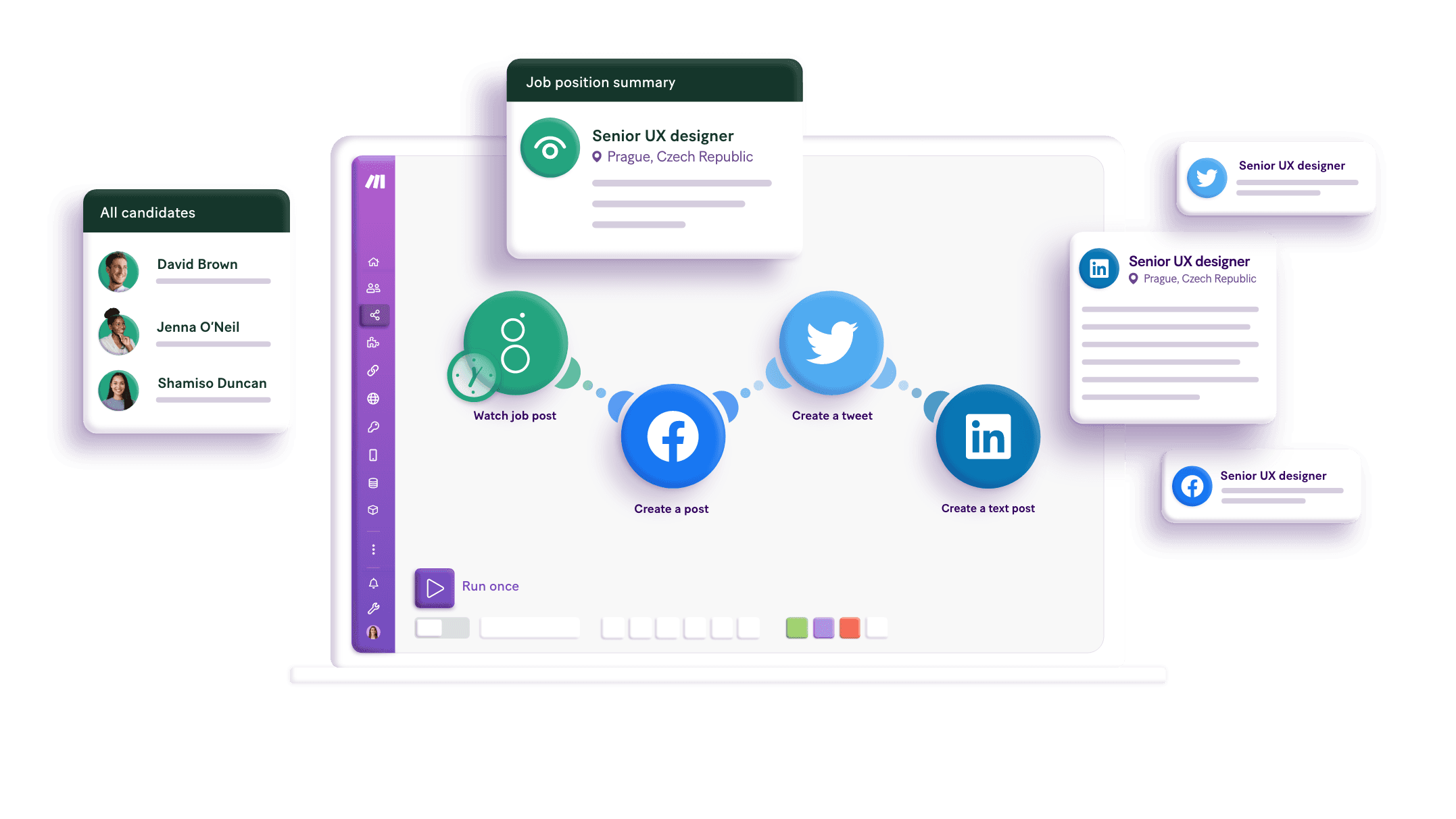
Build your OpenAI (ChatGPT, Whisper) and Trello integrations.
Connect Trello as a trigger and OpenAI (ChatGPT, Whisper) as an action to automate your workflow. When OpenAI generates content or responses, automatically create OpenAI (ChatGPT, Whisper) cards, update task descriptions with AI-generated insights, or organize information into OpenAI (ChatGPT, Whisper) boards. Use ChatGPT responses to trigger updates to project cards in OpenAI (ChatGPT, Whisper), transforming AI-generated content into actionable tasks within your visual project management system.
Adds an existing label to a card.
Adds a selected member to a card.
Adds an attachment to a card.
Analyzes images according to specified instructions.
Archives or unarchives a board.
Archives or unarchives a card.
Archives or unarchives a specific list.
Assigns a specific member to a board.
Cancels an "in-progress" batch. The batch will be in status "cancelling" for up to 10 minutes, before changing to "cancelled", where it will have partial results (if any) available in the output file.
Popular OpenAI (ChatGPT, Whisper) and Trello workflows.
Discover powerful ways to combine OpenAI's intelligent capabilities with Trello's project management. Automate content creation, transform emails into organized tasks, and generate smart documentation.
From AI-powered task categorization to automated communication drafting, these integrations improve your workflow and increase team productivity using ChatGPT's advanced features.
How to setup OpenAI (ChatGPT, Whisper) and Trello in 5 easy steps
Log in to Make and add a Trello module
Start by signing into your Make account and creating a new scenario, which is an automated workflow. Once inside, add a Trello module to your workspace by selecting it from the available options. This module represents the Trello actions you want to automate, such as creating cards or watching for updates.
Click the Add button to start connecting
After adding the Trello module, you'll see a 'Connection' field with an 'Add' button next to it. Click this button to begin linking Make with your Trello account. This step initiates the authorization process that allows Make to interact with your Trello boards and cards on your behalf.
Name your connection and save
You'll have the option to give your connection a descriptive name, which is helpful for staying organized, especially if you use multiple Trello accounts. After choosing a name or leaving it as default, click the 'Save' button to move forward. Make will then prepare to redirect you to Trello for authorization.
Log in to Trello and allow access
You'll be redirected to Trello where you may need to log in if you're not already signed in. Once logged in, Trello will ask you to confirm that you want to grant Make permission to access your account. Click the 'Allow' button to authorize Make to perform actions on your Trello boards based on your automation needs.
Complete your automation scenario
After clicking 'Allow,' you'll be redirected back to Make with your connection successfully established. Now you can select specific Trello actions for your automation, such as creating cards or managing tasks. Build out your complete scenario, test it to ensure it works correctly, then activate it to run automatically in the background.
Transform your workflow with AI-powered project management automation
Combine OpenAI and Trello to automate content creation, improve task management, and strengthen team collaboration. Generate documentation, prioritize tasks, and draft communications instantly.
Automatically generate press releases, task descriptions, and meeting notes for Trello cards using ChatGPT's AI capabilities, eliminating manual writing work.
Transform incoming emails into structured Trello cards with AI-generated summaries and actionable items, improving your inbox management.
Leverage ChatGPT to create comprehensive project briefs, user stories, and documentation directly within Trello cards, ensuring consistent quality across all tasks.
Use OpenAI to automatically analyze and categorize Trello cards based on urgency, complexity, or sentiment, optimizing your workflow organization.


FAQ
Integrating OpenAI with Trello through Make allows you to automatically generate task descriptions, create intelligent card summaries, categorize tasks using AI, and even generate project ideas directly into your Trello boards. For example, you can use ChatGPT to analyze incoming emails or messages and automatically create properly formatted Trello cards with relevant details, labels, and assignments. This saves hours of manual data entry and ensures consistent, well-structured project information across your team.
You can create powerful automations like: automatically generating meeting notes and action items as Trello cards using Whisper for transcription and GPT-4 for summarization; using DALL-E to create custom card cover images based on project descriptions; having AI analyze completed cards to generate progress reports; automatically translating Trello card content for international teams; and using ChatGPT to suggest task priorities, deadlines, or team member assignments based on project context. Make's visual workflow builder makes setting up these scenarios straightforward, even without coding experience.
No programming knowledge is required. Make provides a user-friendly, visual interface where you simply connect your OpenAI and Trello accounts through secure authentication, then drag and drop modules to build your workflow. You can start with pre-built templates for common OpenAI-Trello automations and customize them to your needs. The setup typically takes just minutes: connect both apps, define your trigger (like a new Trello card), add an OpenAI action (like generating content with ChatGPT), and specify what happens with the result. Make handles all the technical complexity behind the scenes.
Using Make eliminates the need for hiring developers, maintaining custom code, or managing API connections manually, which can cost thousands of dollars and weeks of development time. Make offers a free tier to get started, and paid plans scale with your usage. You avoid infrastructure costs, security maintenance, and ongoing updates since Make handles all of this. Additionally, you can modify and expand your automations instantly without redeployment, and you gain access to thousands of other app integrations beyond just OpenAI and Trello, making it a cost-effective solution that grows with your needs.
A scenario represents a workflow or a project of your own creation, and it is made up of a series of modules that automate apps and services. Creating a scenario allows you to transfer and transform data between apps and services via these modules to automate anything and improve the way you work.
Modules are the main building blocks of automation in Make. Modules represent actions that Make performs with an app, like creating, updating, or deleting data.
How it works
Traditional no-code iPaaS platforms are linear and non-intuitive. Make allows you to visually create, build, and automate without limits.
Trusted by 350,000+ customers
"Make really helped us to scale our operations, take the friction out of our processes, reduce costs, and relieved our support team. It is difficult to not become a fan."

Philipp Weidenbach
Head of Operations at Teleclinic
"Make drives unprecedented efficiency within our business in ways we never imagined. It’s having an extra employee (or 10) for a fraction of the cost."

Cayden Phipps
COO at Shop Accelerator Martech
"The simplicity, flexibility and ability to build real complex automations without any knowledge of programming makes it the best thing since sliced bread."

Erkki Markus
Product Owner at Smaily
"True citizen development in the entire company. Make is present in every department, empowering the company to offer a unique customer experience."

Andreas Stryz
CTO & Co-founder at FINN
"I can't count the number of hours I've saved by using Make. Every single day is simpler because of Make's automation."

Kimberly D
Owner of Media Production