Apr 28, 2026 | 5 minutes
How Make AI Agents help OPUS boost member experience by 10x
OPUS uses Make AI Agents to scale a founder community globally while preserving a hyper-personalized experience.
Industry: Professional Services - Business and Management Consulting
Use case: Knowledge Management & Self-Service Support
Country: UK
Company size: 501-1,000 employees
OPUS, a global community platform for early-stage founders, facilitates ambitious entrepreneurs to exchange ideas, help each other solve problems, attend relevant events, and meet new partners.
When the community was still counted in tens, community managers could identify the right connections or solutions based on their most recent interactions with individuals. Someone faced a specific bottleneck or showed an interest in a particular topic? The OPUS team used context from discussions to provide personalized service.
As the community grew past a few hundred members and launched internationally, it became impossible to constantly have the most up-to-date picture of members’ challenges at hand. That’s when OPUS decided to build a member intelligence
infrastructure powered by Make AI Agents. It collects member data, structures it, and uses it to interact with community members.
As a result, OPUS has further grown the community while delivering the same personalized experience.
"It feels like a completely new paradigm. Our team, plus the agent, is empowered to make every single member feel important and valued."
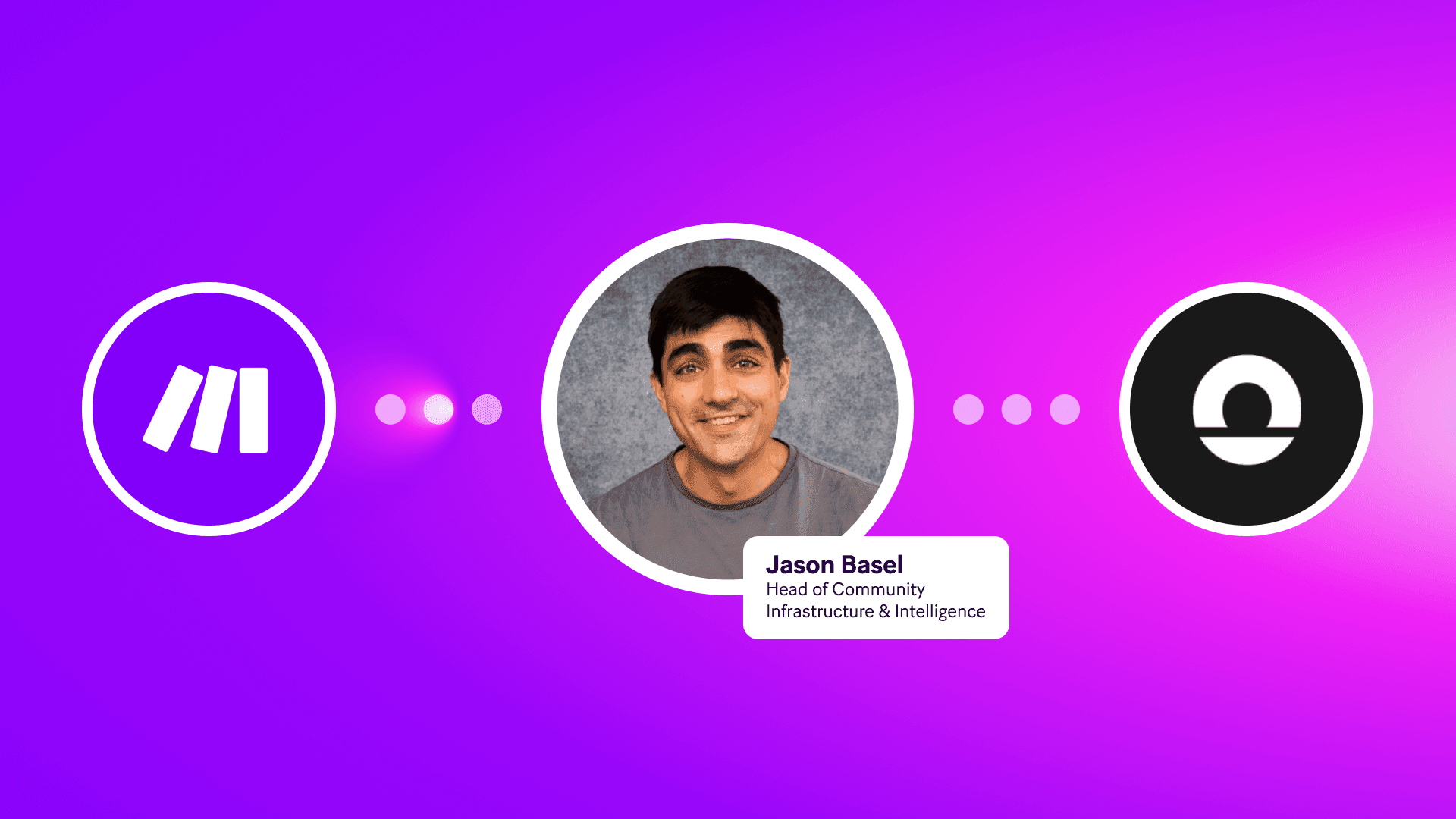
Jason Basel, Head of Community Infrastructure & Intelligence at OPUS
The challenges
Community value trapped in human memory
Like most membership organizations, OPUS relied on its team to remember each member's business challenges, interests, and life updates.
The model worked fine at 50 or 100 founders, but as the number grew higher, it became increasingly difficult to deliver a consistently personalized service.
"Communities seem to work very well when you have 50, 100, 150 members, and then once you start getting above that, it becomes impossible to know everybody and connect them in meaningful ways."
Jason Basel, Head of Community Infrastructure & Intelligence at OPUS
Individual needs lost in a mass of members
Every member wants something slightly different from a community. Some want a
co-working space. Others want curated events. Some want introductions to investors. Others just want to meet like-minded founders facing similar challenges.
This long-tail of individual value functions made it nearly impossible for the team to deliver personalized experiences to a growing membership, especially without any structured system for tracking what each member actually needed.
Connecting people without creating noise
Traditional community models push members into large group chats or forums. But the more people engage, the noisier it gets. Asking 500 people for help with a business problem when only two of them are relevant can also create frustration.
OPUS needed a way to facilitate meaningful, targeted connections without flooding the entire membership with irrelevant messages.
The solution
OPUS built a "member intelligence infrastructure" using Make, consisting of two Make AI Agents (one internal, one member-facing) and 49 automated workflows organized into three layers: data capture, data augmentation, and personalized interactions.
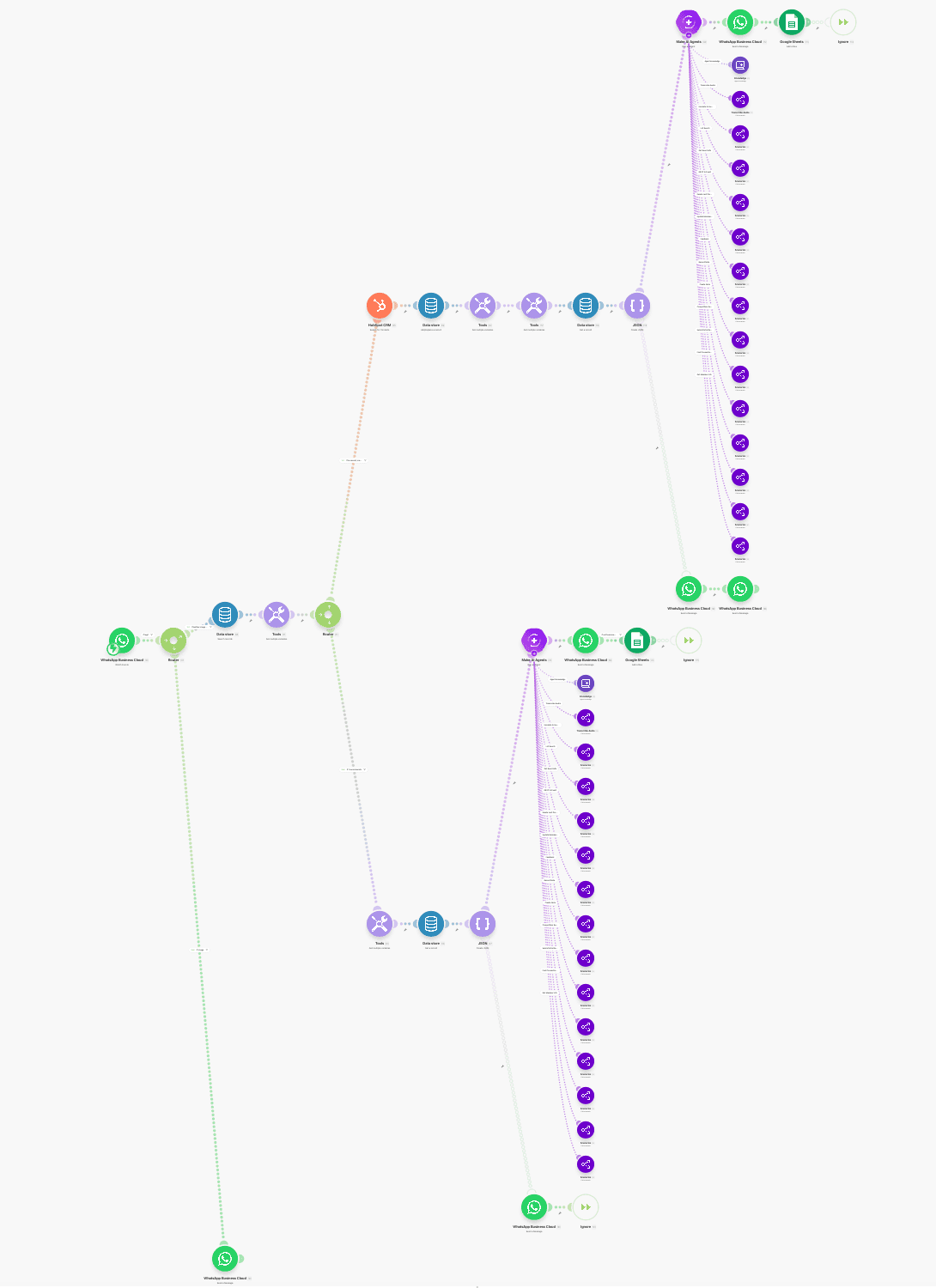
Note: The workflow showing OPUS’s two Make AI Agents
Capturing unstructured member data at scale
OPUS used a series of Make workflows and the internal Make AI Agents to collect member information from multiple sources: onboarding forms, surveys, email parsers, video call transcripts, and voice notes.
"We capture the type of stuff that you might only typically capture in a water cooler conversation. In most of the world, that information just gets forgotten. We make sure it doesn't."
Jason Basel, Head of Community Infrastructure & Intelligence at OPUS The same applies to advisory calls and check-ins with members. When AI notetakers capture transcripts from video calls, OPUS processes them through Make to extract relevant information, like business challenges, upcoming milestones, and personal updates. Then, Make feeds them into each member's profile.
Augmenting data into mathematical personas
The captured data flows into an encrypted central repository within Make data stores. No third-party databases are needed, which ensures full data privacy.
OPUS then uses Make workflows to transform this unstructured information into vector embeddings: mathematical representations of each member's challenges, expertise, personality, and other personal context.
This data is the foundation for every interaction the system delivers later on, from connection suggestions to event recommendations.
Leading hyper-personalized interactions
The member-facing AI agent, called ‘operator’, lives on WhatsApp. Members can ask the operator who they should meet, which events suit them, and other queries about what the community offers. It then uses everything OPUS’s workflows and internal AI Agent have collected and processed about its members to find the best matches.
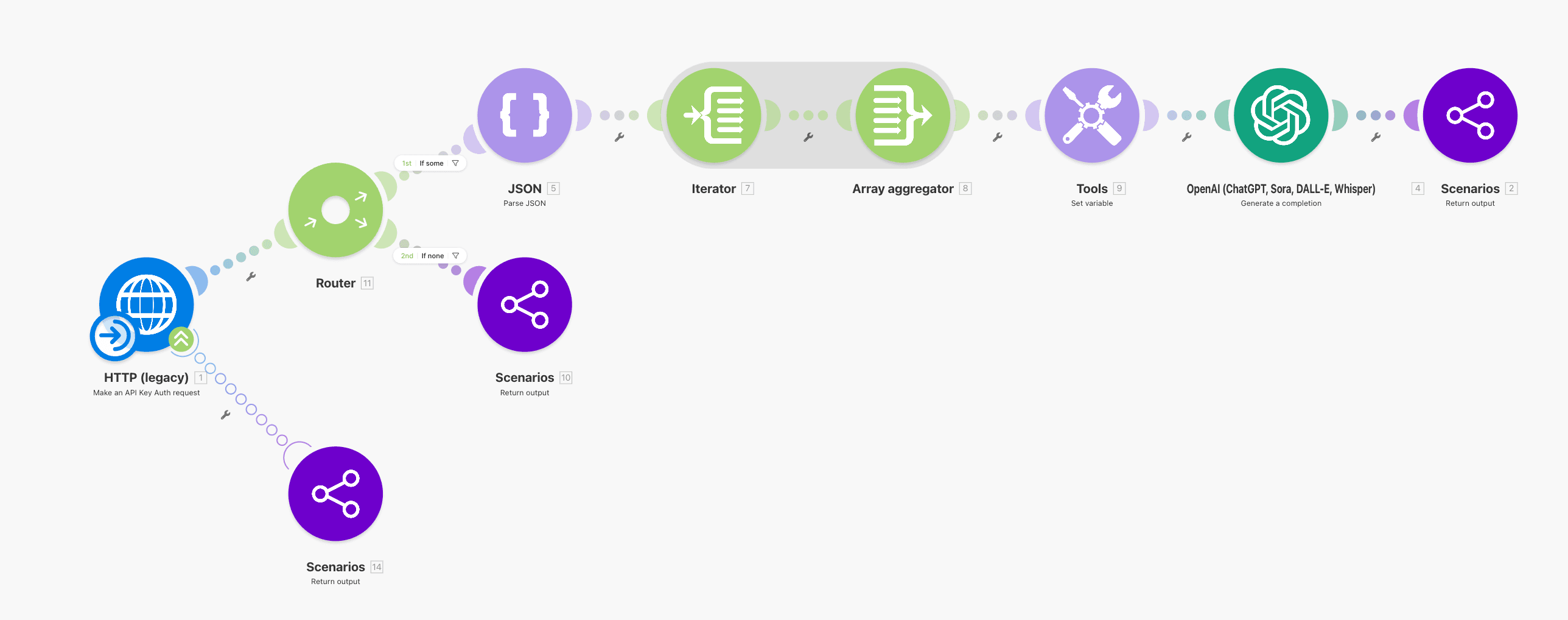
Note: Workflow that searches for and suggests upcoming events
Here’s an example. When a member asks for an introduction to another relevant member, the agent identifies the best match across the entire membership, reaches out to the other party, and, if both agree, connects them directly for a private conversation.
But OPUS doesn't stop at reactive requests. Background workflows continuously scan for the best connections, events, partners, and opportunities for each member, then proactively send personalized recommendations without the member having to ask.
This proactive approach means a member might receive a message saying, "Hey, we think you'd get a lot of value from chatting with Jason. You're having a problem with X, and Jason has expertise in exactly that."
"It's about making the community feel smaller as it gets bigger. The less information we require from the user, the better. We just provide value on a silver platter."
Jason Basel, Head of Community Infrastructure & Intelligence at OPUS
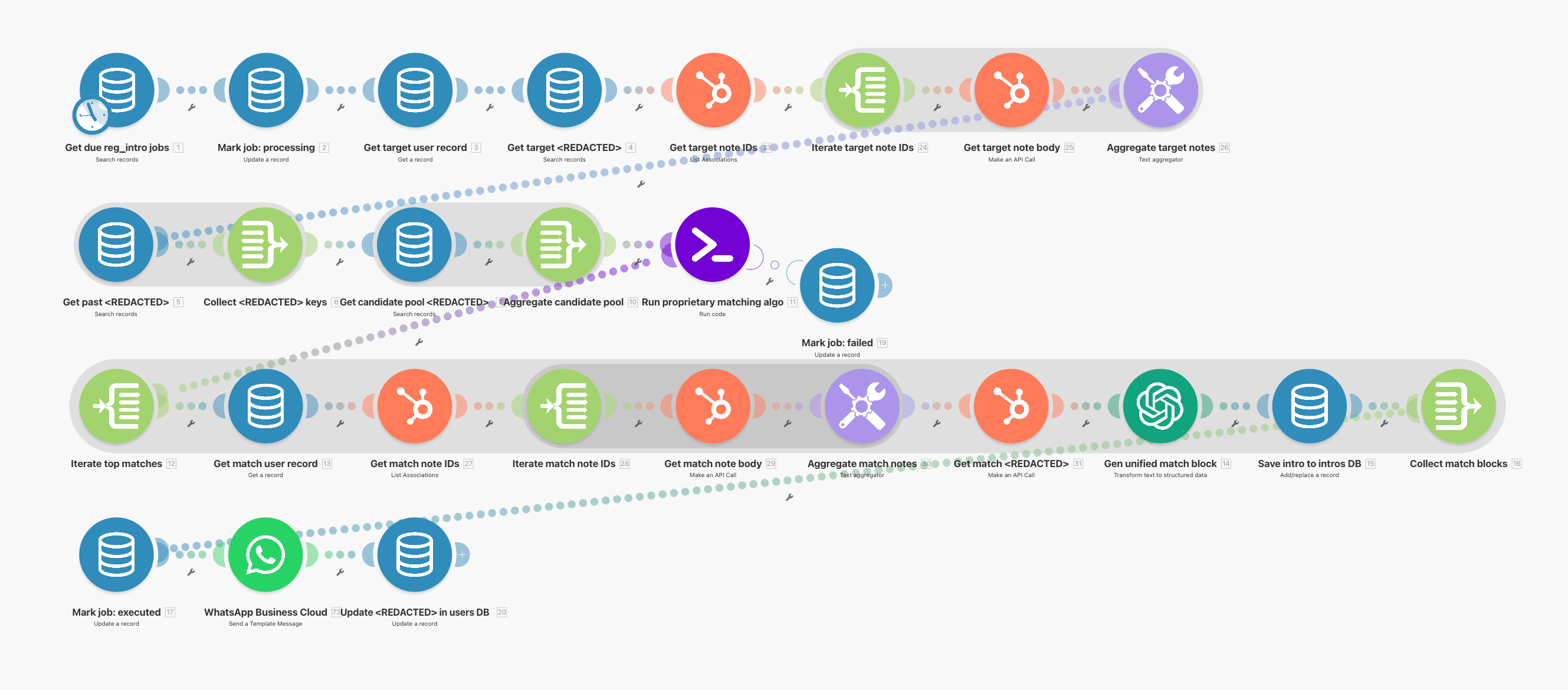
Note: Workflow for the proactive search
The results
OPUS’s Make-powered member intelligence infrastructure has delivered significant outcomes:
Providing one central place for information, where members can ask any question before being routed to the right solution for any problem, finding the right introduction, or being connected to the right partner
Delivering 24/7 service for members – with the agent always being on, members can find answers at any time that suits them
Facilitating a personalized approach at scale, with connections being created across a much larger, international membership base
“We have created valuable connections and helped members in ways we previously couldn’t have at scale, as a direct result of what we’ve been building with Make.”
Jason Basel, Head of Community Infrastructure & Intelligence at OPUS
Two AI Agents and 49 workflows operating as the community's intelligence backbone, all built and orchestrated exclusively in Make
Zero third-party databases: all data is stored securely within Make
Impressed by OPUS’s success?
Follow their journey – subscribe to their newsletter.
Scaling the previously unscalable
OPUS and Make are proving that the community, long considered impossible to scale, can do great at any size.
"It feels like a whole new world. This is a story of OPUS, but it's also a story of the community industry. From a certain threshold, it has historically been unable to scale. It no longer feels like a community. Tools like Make can change that. "
Jason Basel, Head of Community Infrastructure & Intelligence at OPUS
Make's visual interface, native AI Agents, built-in data stores, and WhatsApp integration gave OPUS everything it needed to build an entire member intelligence infrastructure without custom code or third-party tools.
But as Jason Basel, Head of Community Infrastructure & Intelligence at OPUS, says, most companies are using automation in a very limited way. They build workflows for the sake of getting back a bit of time, saving a bit of money.
OPUS chose a different approach.
“We're thinking about the automation differently. For us, it’s much less about reducing costs and more about increasing value. I think that with automation, you can enhance the entire value proposition and focus on what truly matters for members.”
Jason Basel, Head of Community Infrastructure & Intelligence at OPUS
Ready to make the automation revolution happen?