What is AI governance? A complete guide for growing teams
Rules, roles, and oversight aren't red tape. They're what let your teams and your customers trust every AI system and agent you run.
Most companies now run more AI systems and AI agents than any single team can track. Few of them can say who is responsible when one of those systems makes a decision nobody approved.
That gap is why AI governance has moved from a compliance footnote to a board-level topic. According to Deloitte's 2026 survey, only 21% of business and IT leaders say their organization has a mature governance model for agentic AI, even as agents take on more of the daily work.
So, what is AI governance? We can define it as the set of policies, roles, and controls that keep every AI system and AI agent you run safe, compliant, and effective. Done well, it does not slow AI down.
It is what lets a growing company adopt more AI, and more agents, across every team, without losing track of what any of them are doing. This guide covers what AI governance includes, why it pays off, the frameworks that define it, why agents raise the stakes, and how to build it step by step.
Key takeaways
- AI governance turns ethical principles and legal mandates into practices your teams follow.
- Governed organizations adopt AI faster and see stronger returns than ungoverned ones. Governance is the condition for AI value, not the brake on it.
- Three components anchor every framework: policies and controls, accountability, and continuous monitoring.
- NIST AI RMF, ISO/IEC 42001, and the EU AI Act are the three reference points worth knowing by name.
- AI agents multiply governance requirements because they often act without waiting for a human to approve every step.
- Governance has to cover every AI tool, model, and agent your teams use, not just the ones that got formal sign-off.
What is AI governance?
AI governance is the set of policies, roles, and controls that make sure AI systems and AI agents stay safe, compliant, and effective across their entire lifecycle.
It covers how a model gets approved, who watches it once it is live, and what happens when something goes wrong.
Think of it as the operational bridge between two things that need to work together: :
- AI ethics and AI regulation.
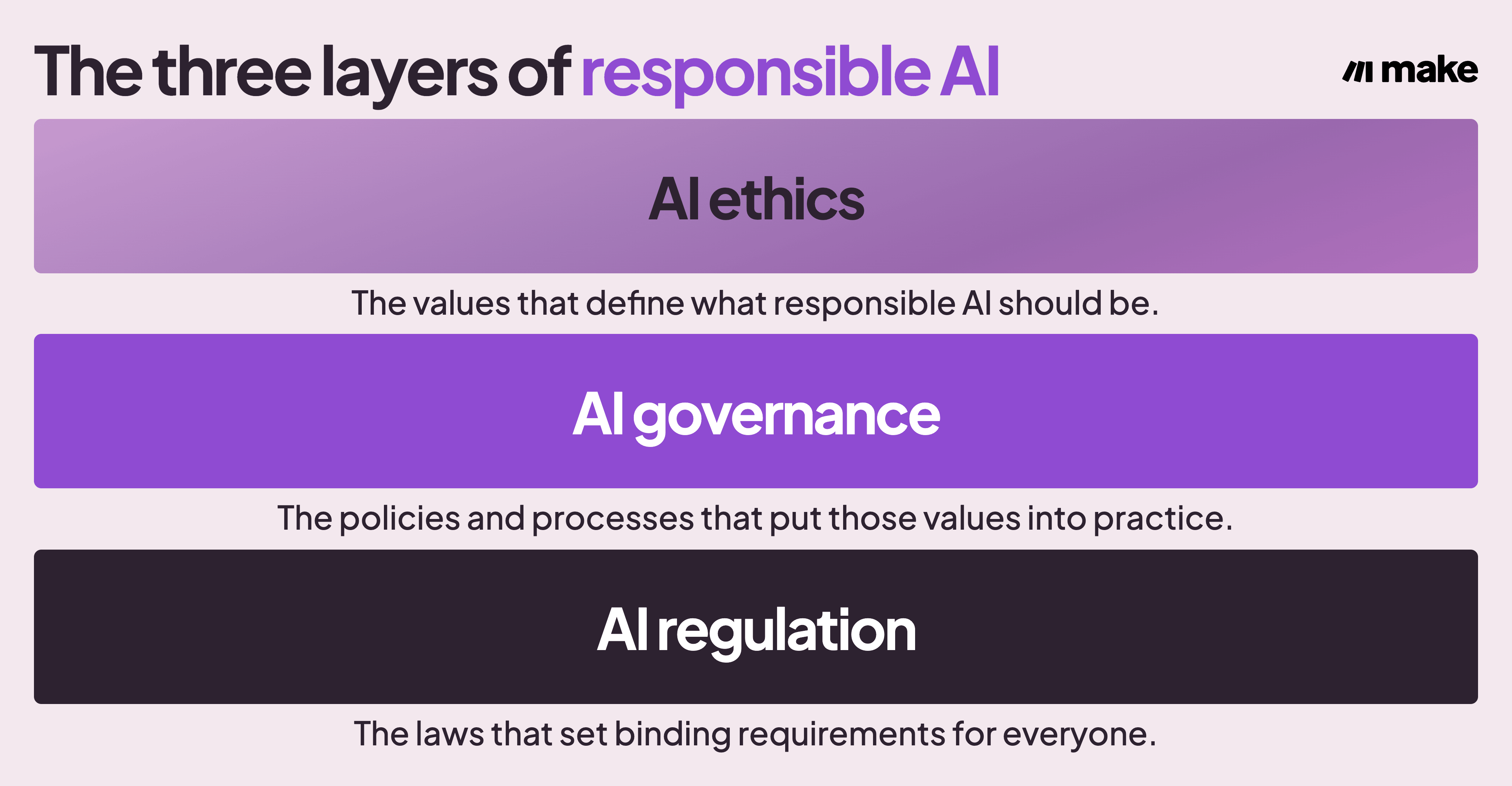
AI ethics sets the values an organization wants its AI to reflect, such as fairness or transparency, while AI regulation, like the EU AI Act, sets the legal floor a company has to meet or face penalties.
AI governance is the machinery in between. It is how a company actually lives up to its stated values and meets its legal obligations, day to day.
Meeting that legal floor in practice is what’s called AI compliance.
It’s important that you understand the distinction between AI ethics, AI governance, and AI compliance in more detail, because they often get used interchangeably. Mixing them up leaves gaps, because you need all three.
For example, a company can have a polished AI ethics statement and still have no idea which of its twelve chatbots has access to customer data because it's missing AI governance.
AI governance vs. AI ethics vs. AI compliance
The table below shows how each term answers a different question, and why governance is the one that turns the other two into practice.
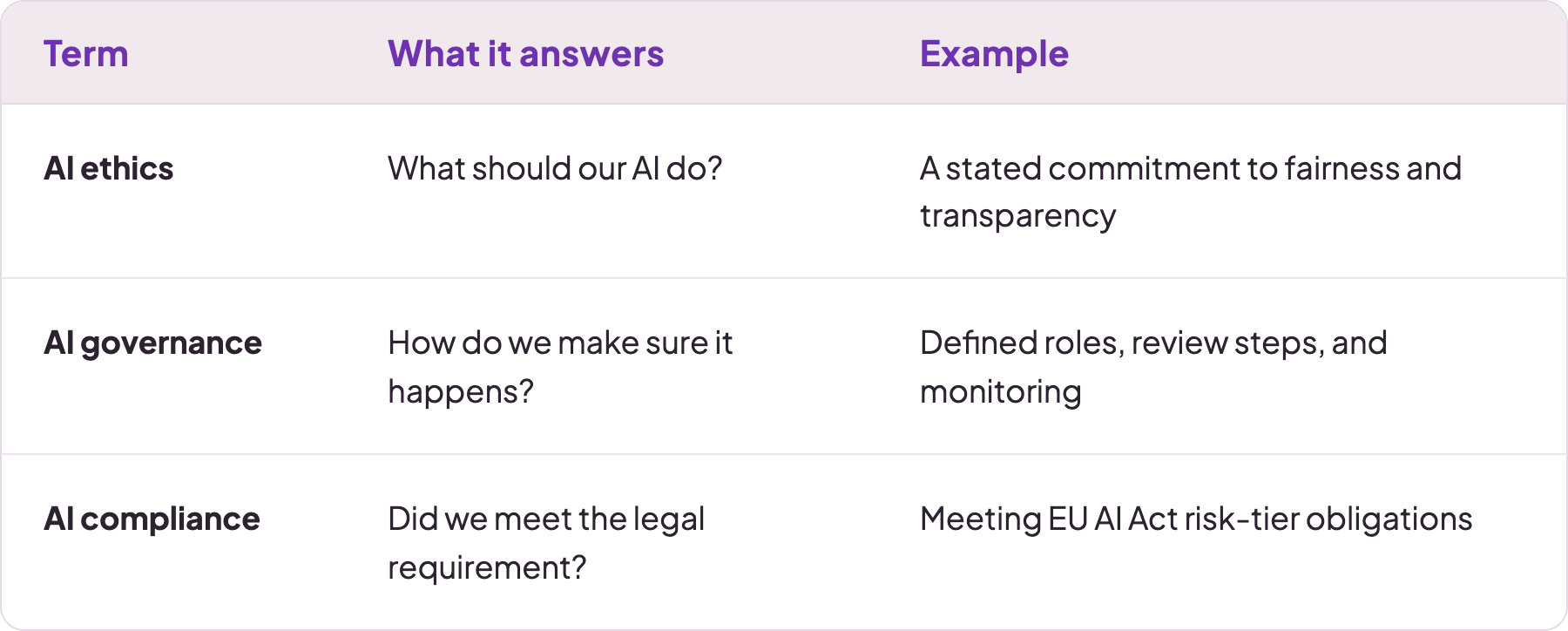
Governance sits in the middle because it is the practical layer that turns a values statement into a compliance outcome.
What are the benefits of AI governance for growing organizations?
Governance pays for itself in four concrete ways. Each one compounds as a company adds more AI systems and more agents to its stack.
Faster, more confident AI adoption
Organizations with comprehensive AI policies are more likely to report early adoption of AI agents.
In a 2025 governance survey from the Cloud Security Alliance and Google Cloud, 46% of organizations with comprehensive policies reported early adoption, against 25% with partial guidelines and 12% still developing policies.
The survey covered 300 IT and security professionals.
A likely reason is that written rules let a team check a new AI tool against the rules instead of waiting for someone to approve each request.
The survey groups organizations by how mature their policies are. The Make AI Playbook does the same for AI use overall.
The Playbook is a free assessment that places your organization in one of four AI maturity stages, with a roadmap for reaching the next stage.
Fewer costly incidents
Every ungoverned AI system is a possible future incident.The organizations paying the most for AI incidents are almost always the ones with no policy in place before the incident happened.
Stronger customer trust
When you govern your AI well, the trust benefit passes straight through to your customers.
A buyer evaluating a vendor's AI-powered workflow increasingly asks how that AI is governed before they ask what it costs.
That question is only getting more common as procurement teams add AI governance to their vendor security reviews alongside things like data handling and uptime.
Consistent decisions across teams and tools
Without governance, two teams using the same AI model can reach different conclusions about what it is allowed to do.
Consistency requires the same policies, ownership, and monitoring applied everywhere in the business, which is exactly what the next section breaks down.
What are the core components of an AI governance framework?
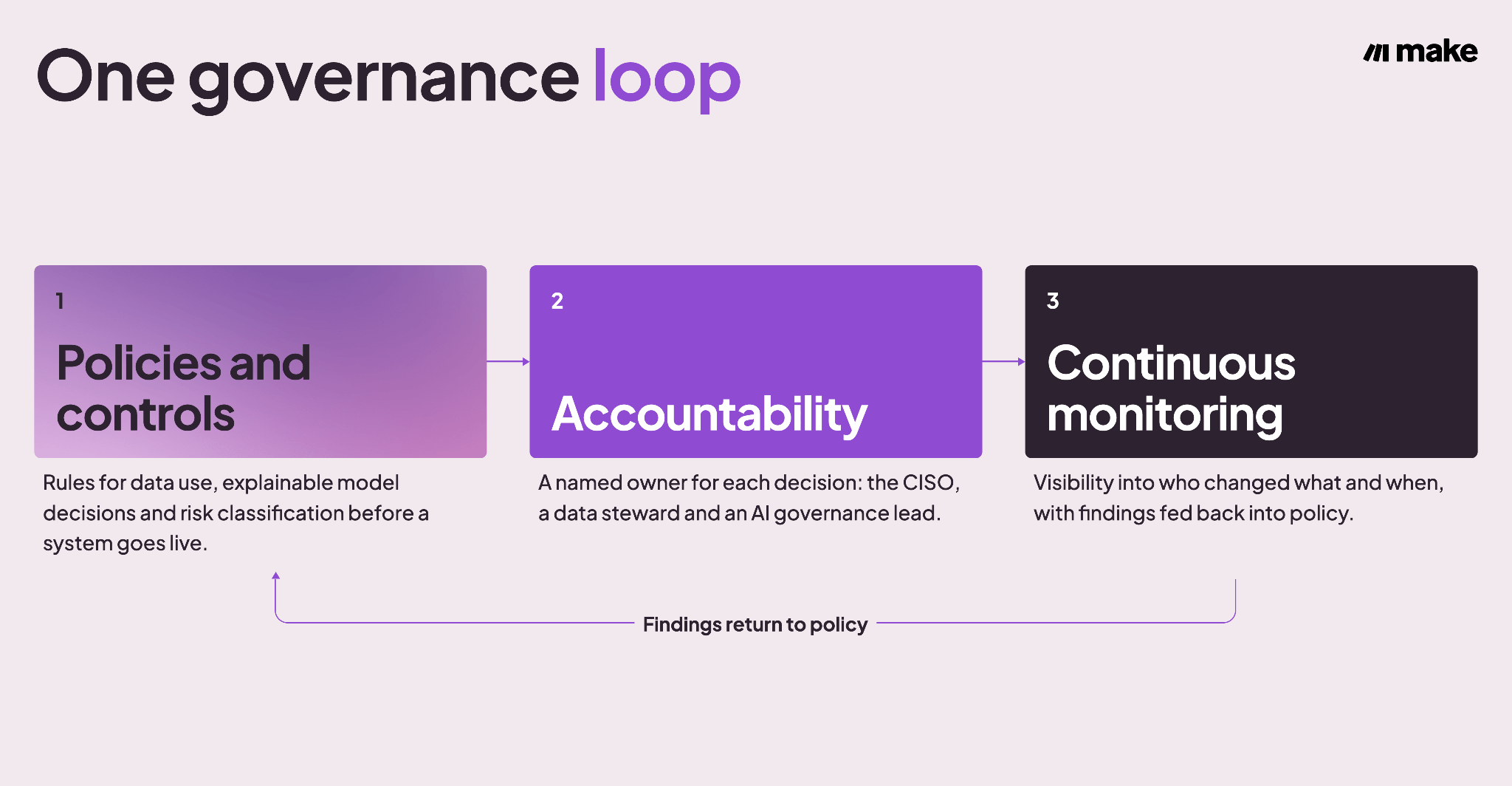
Every credible AI governance framework rests on three components: policies and controls, accountability, and continuous monitoring.
Policies and controls for data and models
Policies define the rules for how data gets used, how a model's decisions must be explainable, and how a system gets classified by risk before it goes live.
Explainability, in this context, means a human can trace why a model produced a specific output.
Without written policy, every team invents its own rules, and none of them match. That inconsistency is usually where the first real audit finding (a gap an auditor formally flags that the company then has to fix) comes from.
Clear accountability and ownership
Someone has to own each decision.
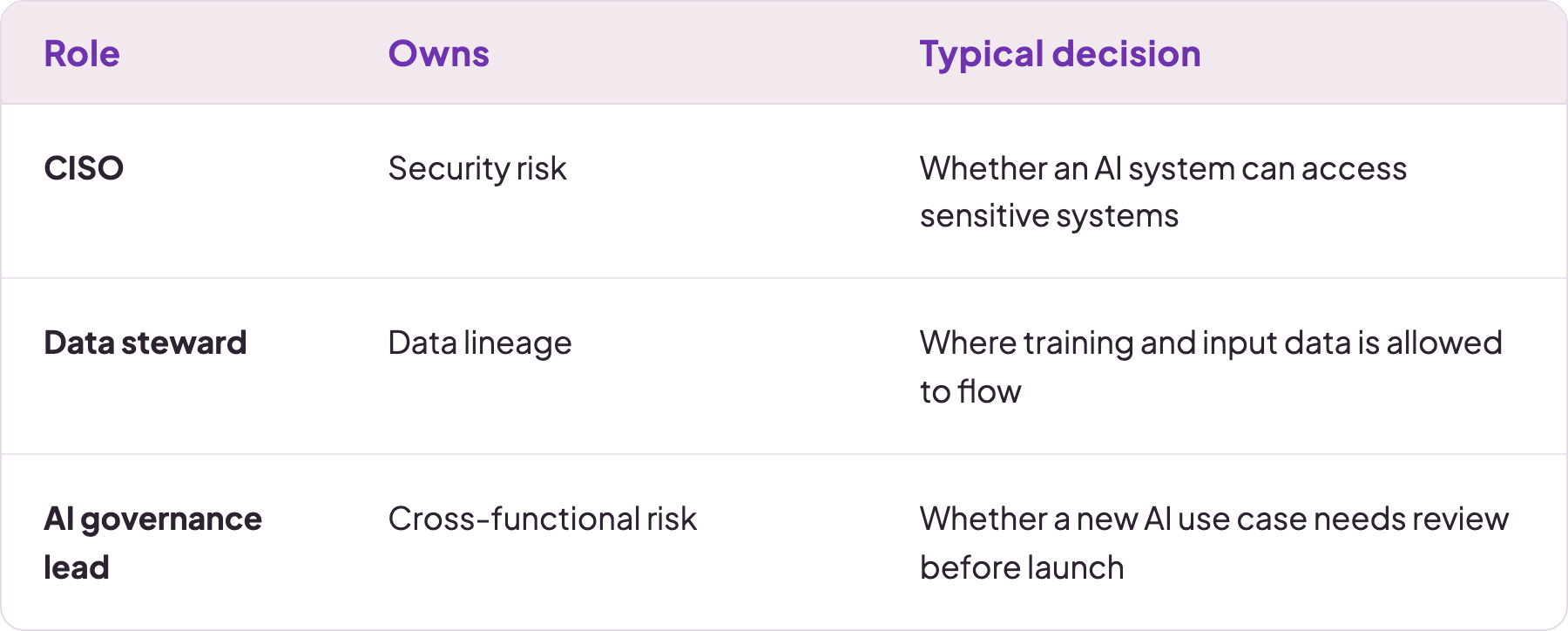
A Chief Information Security Officer (CISO) typically owns the security risk of an AI system, a data steward tracks where its training data came from and where it flows next, and an AI governance lead makes the cross-functional calls neither role can make alone.
The table below shows how those three roles typically divide the work.
Make's own approach to this is worth a look.
The governance in Make features give admins one place to see who changed what and when, which is what accountability looks like once it is operational.
Continuous monitoring for drift and bias
A model that was fair and accurate at launch will not necessarily stay that way.
Model drift is the term for a model's performance degrading, or its behavior changing, as the real-world data it sees shifts away from what it was originally trained on.
Monitoring catches that shift before a customer does. It is also the piece most companies skip, because it requires attention long after the excitement of a launch has faded.
What are the key AI governance frameworks and standards?
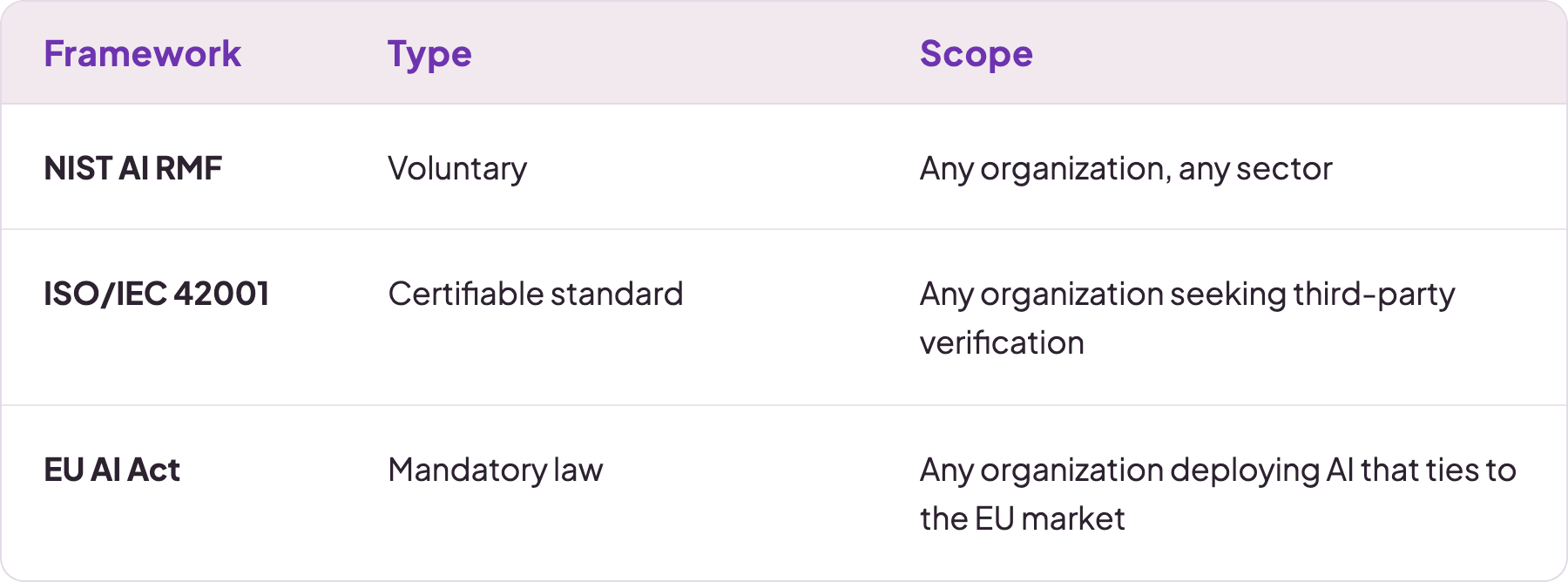
Three reference points show up in almost every serious AI governance program: a voluntary US framework, an international certification standard, and a binding EU law.
NIST AI Risk Management Framework
NIST's AI Risk Management Framework is a voluntary US standard that gives organizations a common vocabulary and process for identifying, measuring, and managing AI risk.
It carries no legal force, but it has become the default reference point auditors and regulators point to when nothing more specific applies.
Most US companies use it as a starting checklist rather than a finished policy, since it describes what good risk management looks like without prescribing exactly how to build it.
ISO/IEC 42001
ISO/IEC 42001 is the international certification standard for an AI management system, similar in spirit to how ISO 27001 works for information security. A company can be certified against it, which gives customers and partners a way to verify governance claims instead of taking them on faith.
Certification takes longer to achieve than either the NIST framework or an internal policy alone, so most companies treat it as a milestone to work toward.
EU AI Act risk tiers
The EU AI Act sorts AI systems into four risk tiers, from unacceptable to minimal, and attaches different legal obligations to each one.
A system classified as high-risk, such as one used in hiring decisions, faces far stricter documentation and oversight requirements than a low-risk chatbot.
The table below summarizes how the three frameworks differ in reach and force.
Enterprise-grade platforms increasingly build toward these expectations by default.
A Make Enterprise plan bundling role-based access and audit trails is one example of infrastructure built with this kind of framework compliance already in mind.
How do AI agents change the governance equation?
AI agents are different from traditional AI.
They take multi-step action on their own: calling tools, updating records, and triggering other systems without a person approving each move.
This is exactly what makes agents useful and exactly what governance frameworks were not originally built to handle.
Agents act without waiting for approval
A traditional AI model produces an output and a human decides what to do with it.
An agent often skips that pause entirely, so a governance framework built around reviewing outputs has nothing to review until after the action has already happened.
That is a structural gap, not a bug in any one agent. It means the review point has to move earlier, into permissions and rules set before the agent acts.
Identity and access risk multiplies with every agent
Each agent needs its own identity, permissions, and audit trail, the same way an employee would. Privilege drift is what happens when an agent accumulates more access than it was originally granted, often because nobody revisits its permissions after setup.
That same governance maturity gap referenced earlier in this guide shows up here directly: unauthorized agent permissions tend to sprawl fastest in exactly the organizations without a mature model for managing them.
Shadow agents create blind spots
A shadow agent is one a team spun up without going through any approval process, often to solve an urgent problem quickly.
It runs with real access to real systems, and nobody responsible for governance even knows it exists.
One governance layer has to cover every AI type you run
The fix is not governing agents separately from every other AI tool. It is one governance layer that treats a chatbot, a predictive model, and an AI agent the same way: inventoried, risk-classified, and monitored from a single place.
A Make AI Agents deployment is built around this idea, since every action an agent takes runs through the same scenario logic and audit trail as the rest of an automation.
An MCP versus API comparison matters here too, because visibility into what an agent actually called and why is different for each of these tools.
An agentic operating system approach, where every agent's actions are visible on one canvas instead of scattered across separate tools, is what makes this kind of unified governance realistic instead of aspirational.
How do you implement an AI governance framework?
Turning all of this into practice follows a fairly consistent sequence, whether a company has five AI tools or five hundred.
IMAGE NOTE: A six-step process graphic showing the sequence from building the governance team through the recurring review, with a short label under each step.
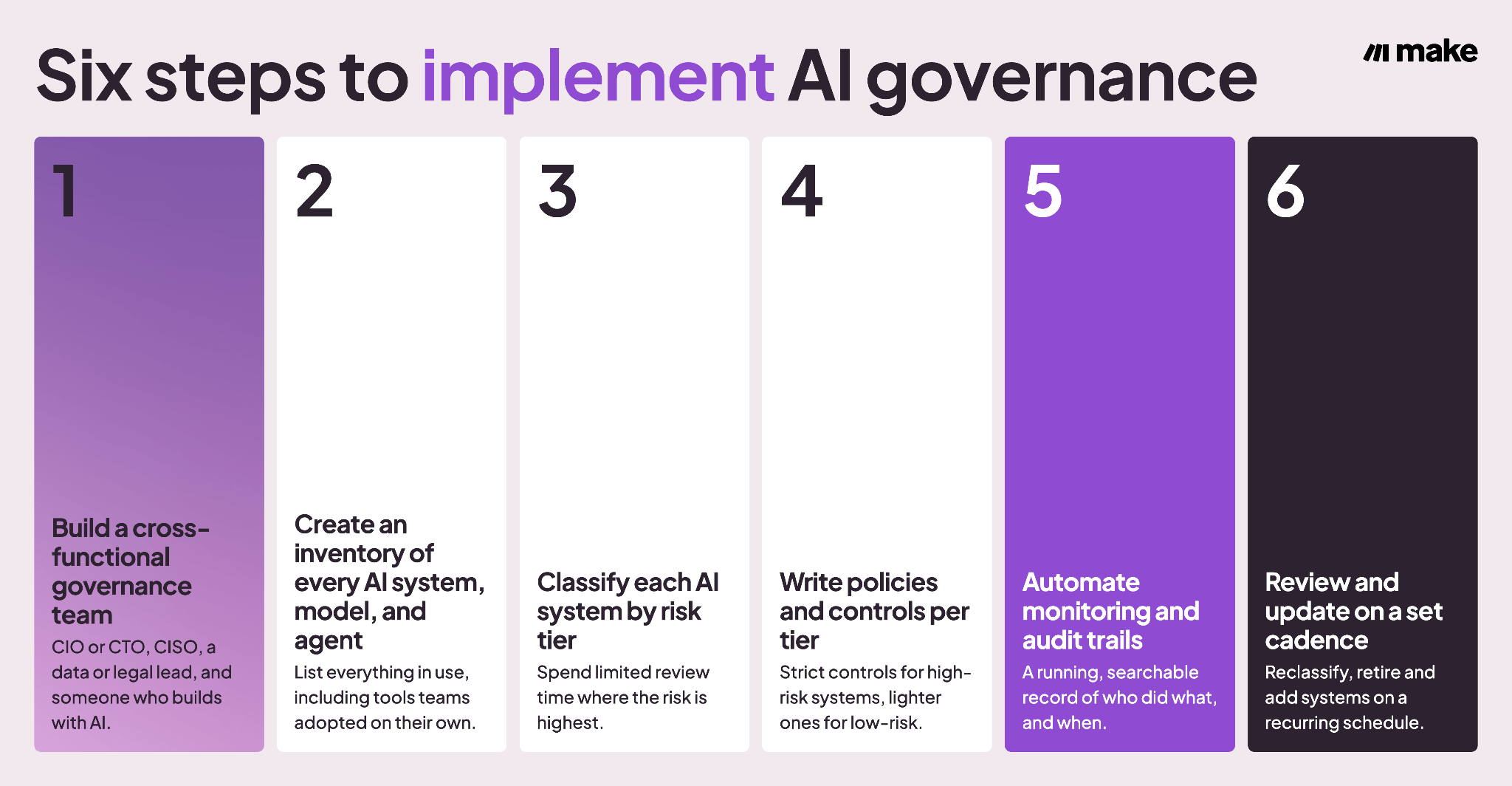
Step 1: Build a cross-functional governance team
Start with the people. A workable governance team usually includes the CIO or CTO, the CISO, a data or legal lead, and someone who actually builds with AI day to day.
Evaluating a shortlist of best AI platforms is often the team's first real task, since the tools chosen shape what governance is even possible.
Step 2: Create an inventory for every AI system, model, and agent
You can’t govern what you can’t see.
This step means listing every model, chatbot, and agent in use, including the ones individual teams adopted without asking anyone, which is usually more than leadership expects.
A short survey to every department head, asking what AI tools their team already relies on, usually turns up more tools than leadership expects.
Step 3: Classify each AI system by risk tier
Not every AI system needs the same scrutiny.
Sorting each item in the inventory into a risk tier, using the same logic as the EU AI Act tiers covered earlier, tells the team where to spend its limited review time.
Step 4: Write policies and controls per tier
High-risk systems get strict controls: mandatory human review, documented explainability, and restricted data access. Lower-risk systems get lighter ones, so the governance program does not collapse under its own weight trying to treat a low-stakes chatbot like a hiring algorithm.
Step 5: Automate monitoring and audit trails
Manual monitoring isn’t really able to scale past a handful of systems.
Make audit logs give a concrete example of what this looks like in practice: a running, searchable record of who did what, when, across every connected system, without anyone having to remember to write it down.
Step 6: Review and update on a set cadence
AI governance is not a project with an end date. Set a recurring review, quarterly is common, to reclassify systems, retire ones no longer in use, and add any new agents to the inventory before they become shadow agents.
Don’t just repeat the same review schedule forever.
Once a year, check whether quarterly reviews are still frequent enough, especially as you add more AI tools and agents.
What are the risks of having poor AI governance?
The cost of skipping governance is real, and the most recent data on it is stark.
IBM’s [2026 breach report] found that the average cost of a data breach involving AI hit $4.99 million, a new record, and that 68 percent of the organizations behind those breaches had no AI governance policy in place at all.
Shadow AI incidents, where employees use AI tools nobody approved, more than doubled to 43 percent of AI-related incidents over the same period.
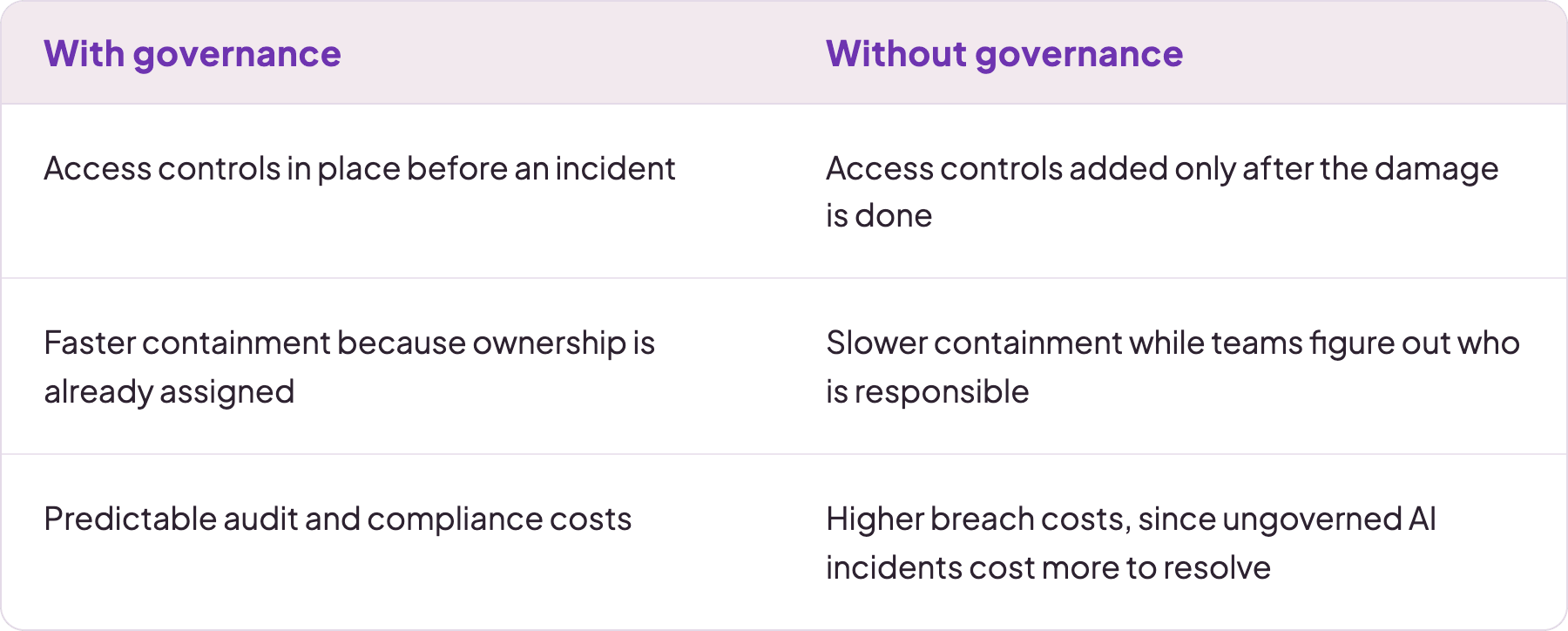
The table below shows what changes in practice, access, incident response, and cost, when governance is in place versus when it isn’t.
A security automation guide covers the practical side of closing these gaps before they turn into an incident.
What's your next step in AI governance?
None of this has to happen at once, and it should not.
The companies that get AI governance right start with visibility into what they are already running, then layer in the policies, roles, and monitoring this guide covers, one risk tier at a time.
Make's 2026 AI predictions point to the same conclusion from a different angle: the companies scaling AI successfully are the ones treating governance as part of the build, not an afterthought bolted on once something goes wrong.
Frequently asked questions
1. Who is responsible for AI governance in a company?
Responsibility usually sits with a cross-functional team, typically including the CIO or CTO, the CISO, a data or legal lead, and an AI governance lead who makes the calls that cross departmental lines.
2. What is the difference between AI governance and AI ethics?
AI ethics defines the values an organization wants its AI to reflect, such as fairness or transparency. AI governance is the operational system, the policies, roles, and monitoring, that makes those values actually happen in practice.
3. Do small and mid-sized companies need AI governance, or only large enterprises?
Any company running AI systems or agents that access customer data, make financial decisions, or work with regulated processes needs governance, regardless of size. The scale of the governance should match the company's risk, not skip governance entirely.
4. How is governing AI agents different from governing a single AI model?
An AI agent takes multi-step action on its own instead of producing one output for a human to review. Governance has to cover identity, permissions, and audit trails for every action an agent takes, not just its final answer.
5. What's the first thing a company should do to start governing its AI?
Build an inventory of every AI system, model, and agent already in use, including the ones adopted without formal approval, since governance cannot cover what nobody has counted yet.
Related blogs
Tool and strategies modern teams need to help their companies grow.
AI
AI Adoption: What It Means and Why It Matters
AI adoption means moving artificial intelligence from isolated pilots into everyday operational use across every team, workflow, and business decision.

Raife Dowley
July 20, 2026
AI
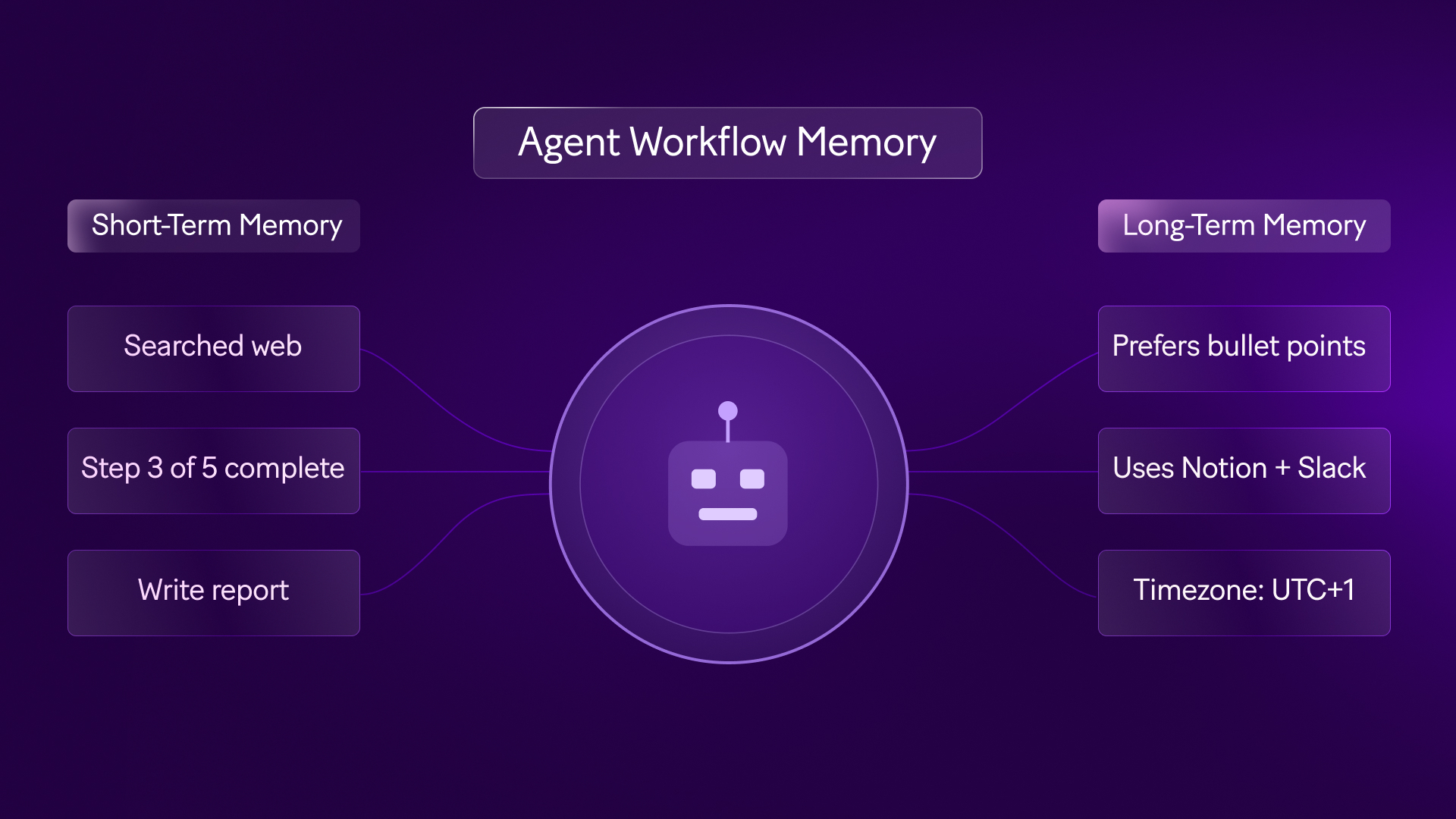
Agent workflow memory: 2026 guide to AI agents that remember
Discover how agent workflow memory enables AI agents to retain context across sessions. Learn architecture patterns and implementation strategies for 2026.
Raife Dowley
May 5, 2026
AI
5 Best AI Automation Tools for Teams in 2026: Full breakdown
A hands-on comparison of five leading AI automation platforms, covering features, pricing, and the best fit for your team's workflows.
Raife Dowley
August 4, 2026