Competitive intelligence: how to automate monitoring with AI
Learn what competitive intelligence means, how the process works, and how to automate a sourced weekly brief with Make.
Tracking competitors by hand usually means a dozen browser tabs, a folder of screenshots nobody reopens, and no record of where a claim actually came from.
This guide explains what competitive intelligence is, how the process works, and how to build an automated pipeline that links every finding back to its original source.
Key takeaways
- Competitive intelligence (CI) is the ongoing practice of collecting, analyzing, and sharing information about competitors and the market forces around them to inform a company's decisions.
- Competitive intelligence splits into two types: strategic intelligence (long-term risks and disruption) and tactical intelligence (short-term decisions like pricing and deal strategy).
- The competitive intelligence cycle has four stages: define priorities, gather data, analyze findings, and act on them.
- Competitive intelligence only uses public, legally obtained information; gathering it through deception or theft is industrial espionage, not competitive intelligence.
- An AI-driven monitoring pipeline can collect, summarize, and source competitor updates automatically, without someone manually checking the same pages every week.
What is competitive intelligence?
Competitive intelligence (CI) is the ongoing practice of collecting, analyzing, and sharing information about competitors, used to inform a company’s decisions.
It also covers the market conditions that affect competitors, such as regulatory changes, shifts in customer demand, and new competitors entering the industry.
Companies use it to track pricing changes, product launches, and shifts in how a competitor positions itself, then turn those signals into specific actions for sales, marketing, and product teams.
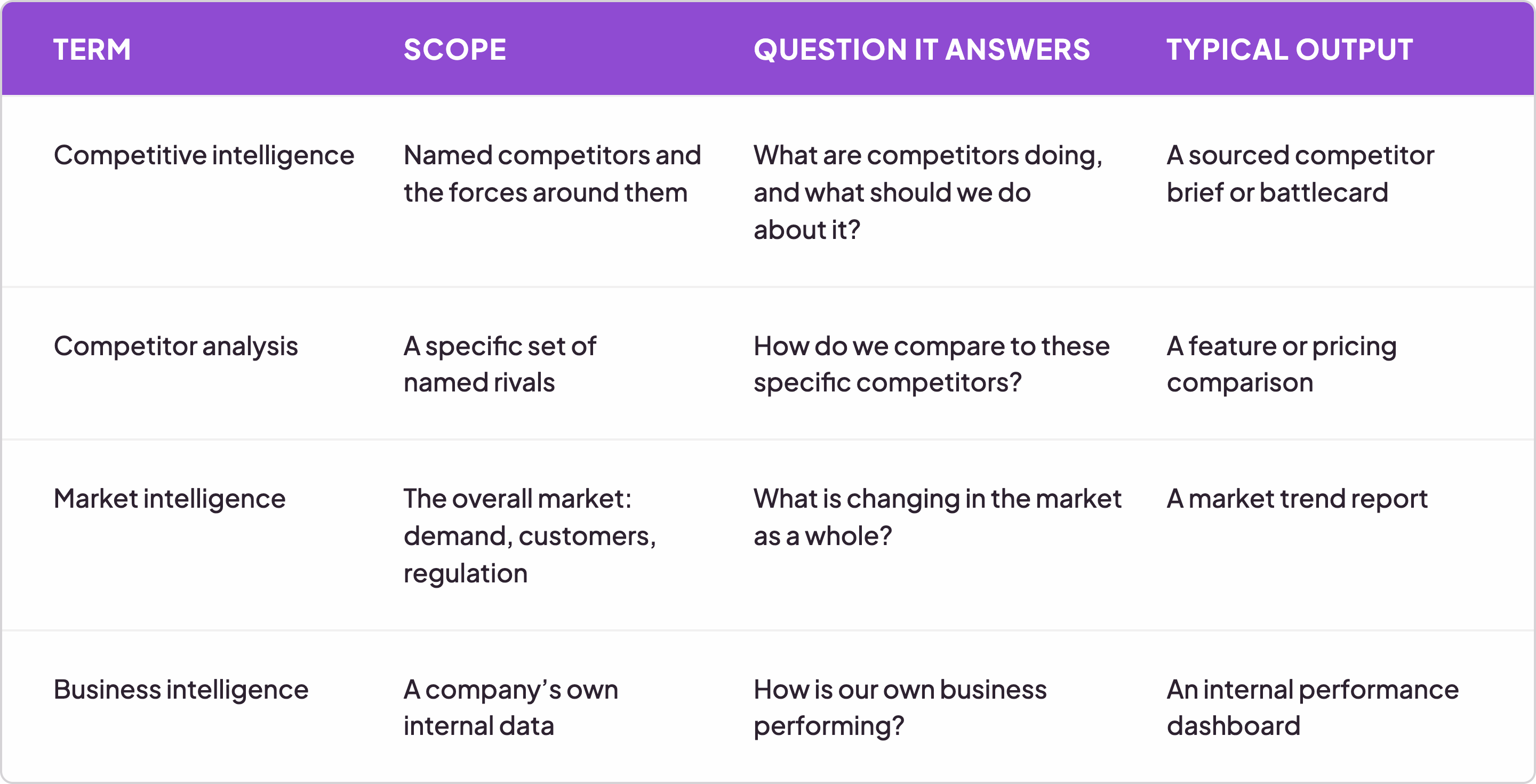
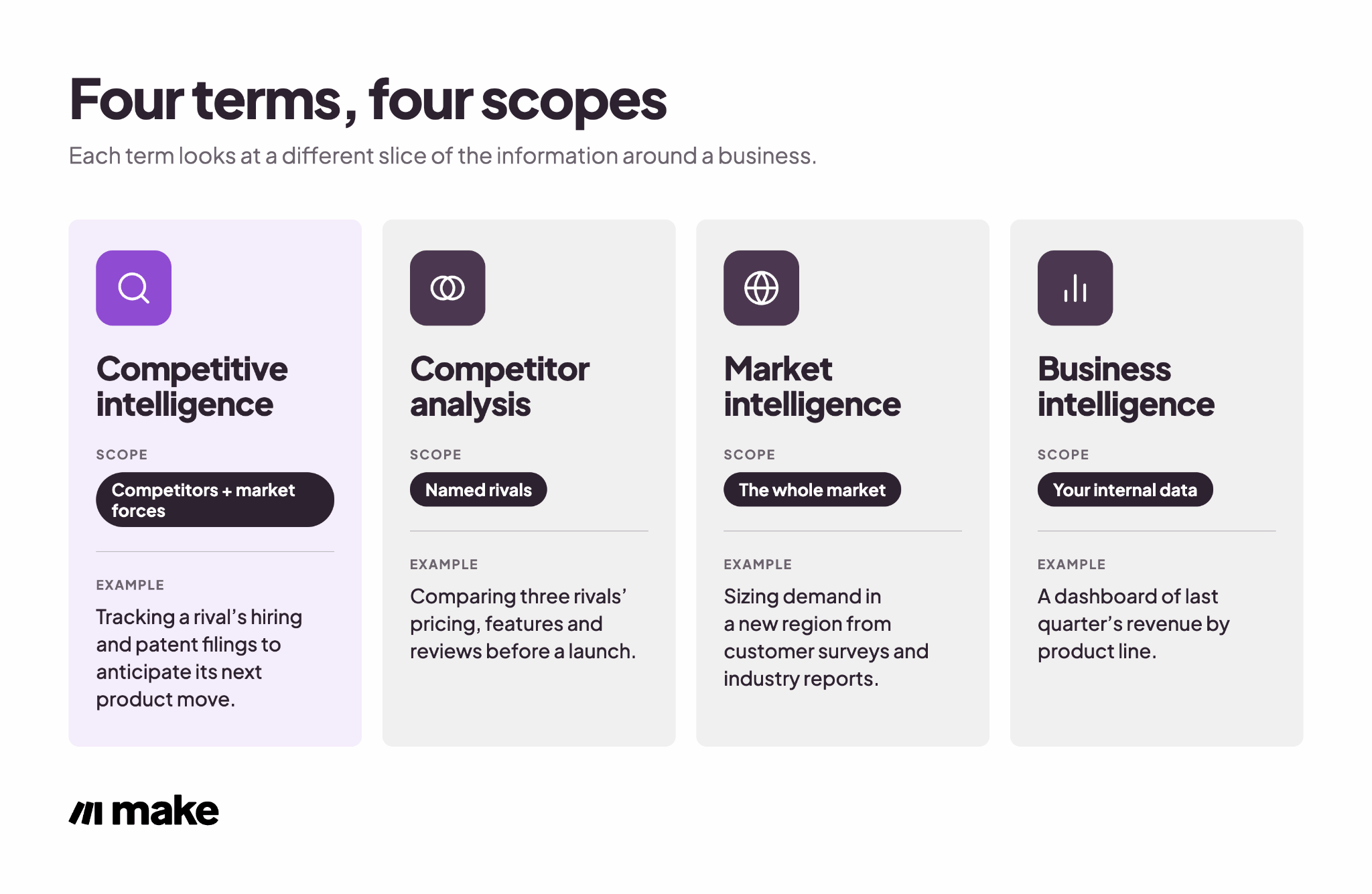
Competitive intelligence is often confused with three related terms:
- competitor analysis
- market intelligence
- business intelligence
Competitor analysis is a narrower, often one-time comparison of a company against specific named rivals on criteria like pricing or features.
Market intelligence covers the broader market, including customer demand and regulatory change, rather than any single competitor. Business intelligence focuses on a company's own sales, operations, and financial data, rather than competitors or the market.
The table below compares what each term covers, the question it answers, and what it typically produces:
Competitive intelligence increasingly relies on AI to read and summarize public sources, rather than someone manually opening a dozen competitor websites each week.
Make's AI automation platform, for example, can run these searches on a schedule and format the results for a team to review.
What are the benefits of competitive intelligence for revenue and ops teams?
Competitive intelligence only pays off once it reaches the people making decisions. For revenue and operations teams specifically, that means fewer surprises in a deal and faster reactions when a competitor moves.
Consider a renewal call where the customer mentions a competitor's new pricing tier the rep has never heard of.
The rep either improvises an answer or loses time checking with a manager, and either way the deal takes longer to close.
Here are the advantages the competitive intelligence knowledge brings to the table:
- Shorter deal cycles: sales reps who know a competitor's pricing and positioning going into a call spend less time countering objections they did not see coming.
- Faster response to launches: knowing about a competitor's new feature the week it ships, rather than the month a customer mentions it, gives product and marketing time to react.
- Sharper renewal conversations: customer success teams renewing a contract can address a competitor's pitch directly instead of guessing what a customer has already seen.
These benefits only materialize if the intelligence reaches the right team quickly, which is exactly what a sourced, automated brief is built to do.
In a published Blackbaud case study, Klue reports that the software company attributed a 28% increase in win rate against its top competitors to an AI-assisted competitive workflow. That figure reflects one company’s reported result, not an industry-wide average. It still matters because it shows what a sales team can do with a competitive signal once it actually reaches them, rather than sitting in a report no one opens.
Measuring whether a competitive intelligence effort is worth the ongoing work is its own exercise.
Make's blog post on measuring AI ROI walks through how to calculate the return on investment of any AI-driven workflow, competitive intelligence included.
For a revenue or ops team, that calculation matters because this kind of effort usually results in closed deals.
How does competitive intelligence work?
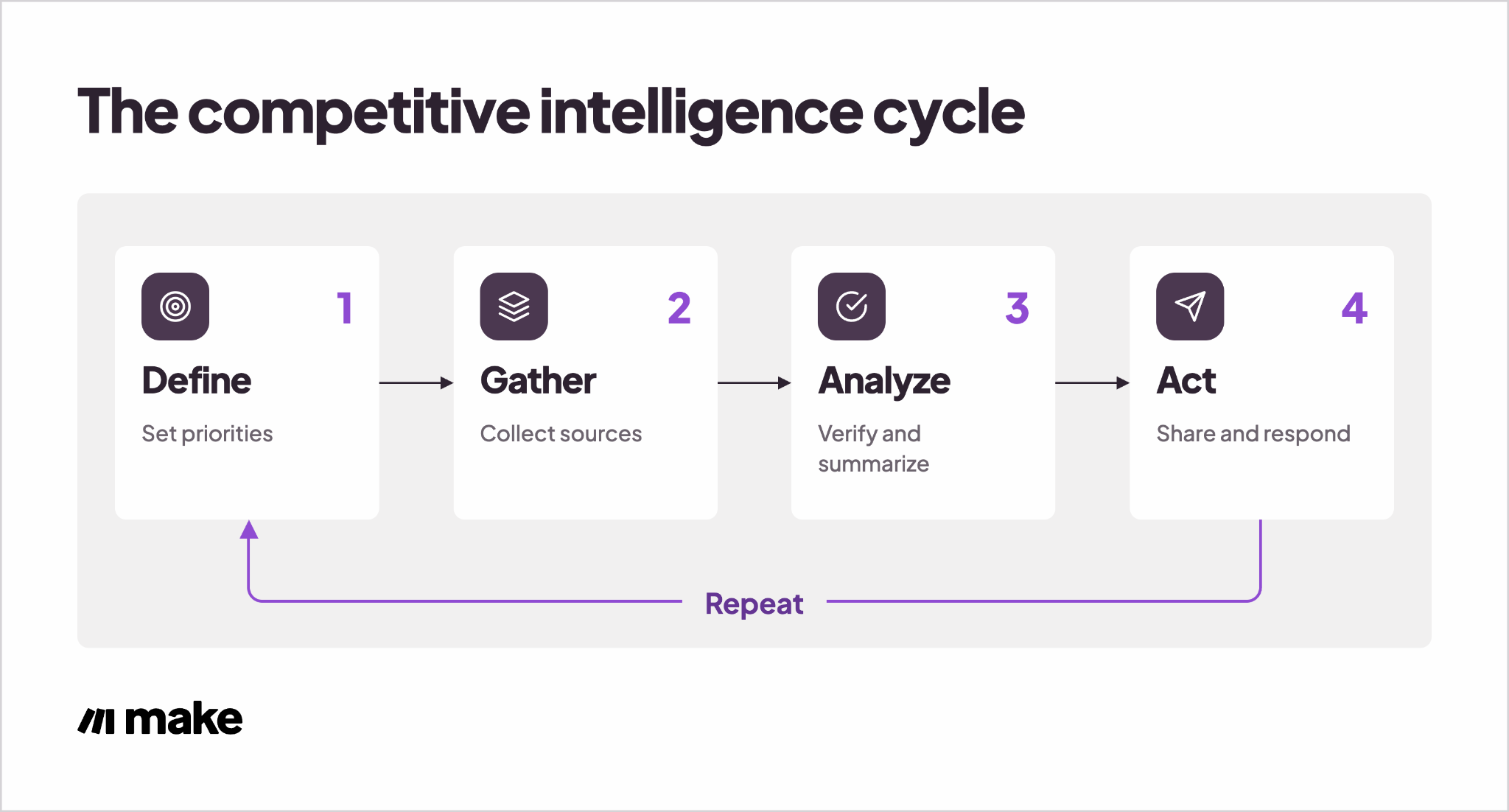
Competitive intelligence follows a four-stage cycle that repeats continuously. Each stage feeds directly into the next.
1. Define intelligence priorities
This stage starts with specific questions, not open-ended data collection. A team might ask whether a competitor's pricing change threatens a specific deal, or whether an emerging technology could affect the market within a few years.
These two types of questions map to two types of competitive intelligence. Strategic intelligence looks at long-term risks and disruption, while tactical intelligence supports short-term decisions like pricing and deal strategy.
2. Gather data from public sources
Once priorities are set, the next step is collecting the data itself, always from information a company makes public on its own.
- Competitor websites and pricing pages
- Product changelogs and release notes
- Review sites, such as G2 or Capterra
- Job postings, which often signal new positions a company is opening, such as a machine learning engineer role that hints at an AI feature in development
- Earnings calls and filings, for public companies
Sticking to sources like these from the start avoids the ethical and legal problems covered later in this guide.
3. Analyze and verify signals
Raw data only becomes useful once someone checks it for accuracy and decides what it means for the business. Make AI Agents, for example, can run that first pass and flag only the signals worth a closer look.
Two techniques do most of the work here: win-loss analysis, a structured review of why specific deals were won or lost.
The other is battlecards, a one-page reference sales reps use during a competitive deal.
Teams that need a broader strategic view sometimes apply frameworks such as SWOT analysis (strengths, weaknesses, opportunities, and threats) or Porter's Five Forces (a model of competitive pressure).
Neither framework is specific to competitive intelligence, but both can organize findings once they are gathered.
4. Act on what you find
Intelligence that stays in a document nobody reads never changes a decision.
The findings need to reach the people who can act on them: sales before a competitive deal, product before a roadmap meeting, leadership before a pricing decision.
Competitive intelligence examples
The stages above describe the process in the abstract. These four examples show what competitive intelligence looks like when a specific signal turns into a specific action.
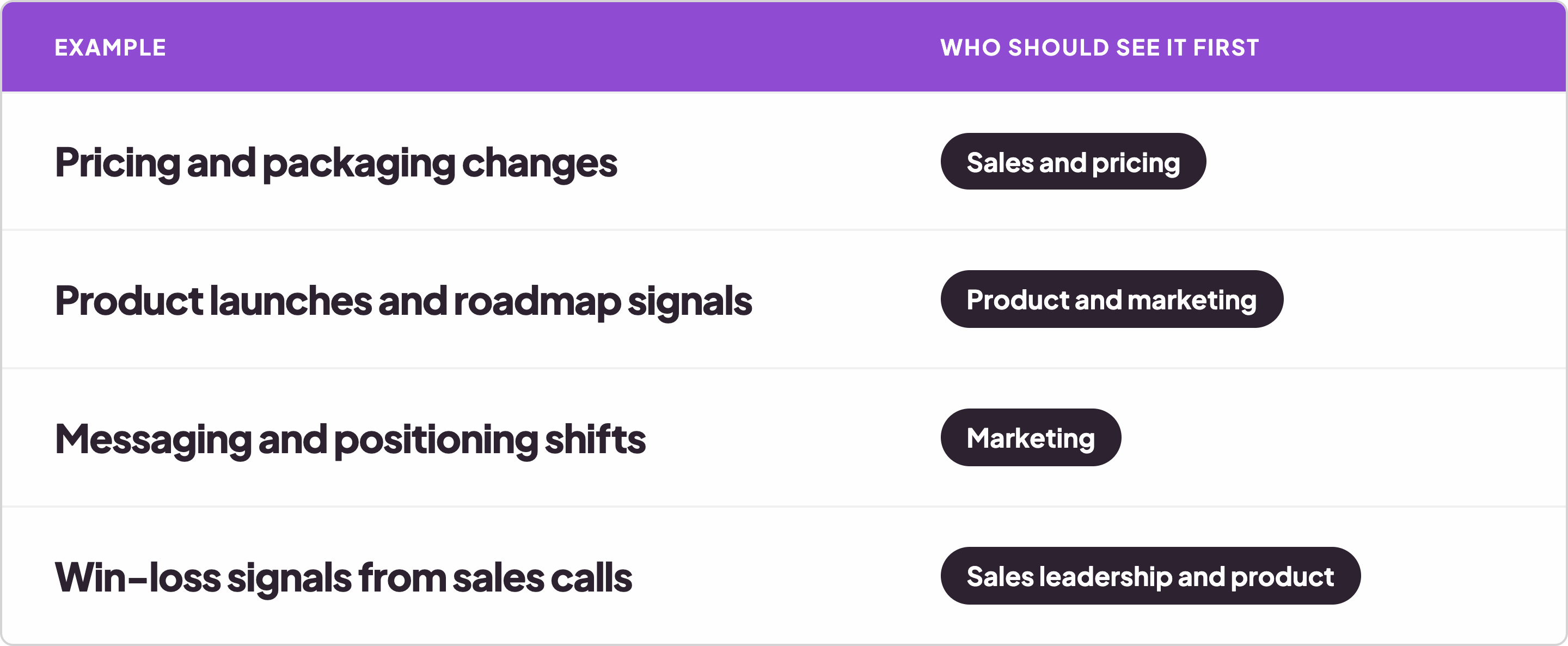
Pricing and packaging changes
A competitor raises the price on one plan tier or bundles a feature that used to cost extra.
A team tracking the pricing page catches the change within days and logs it, for example by using Make's Google Sheets integration. It keeps a running record that pricing and sales teams can reference.
Missing a packaging change for a few weeks can mean a sales team quoting an outdated price in an active deal.
Product launches and roadmap signals
A competitor publishes a changelog entry or press release about a new feature.
Flagging that update the week it ships gives product and marketing time to prepare a response.
Product teams that miss this signal often find out about a competitor's launch only when a customer asks why their own roadmap does not have it yet.
Messaging and positioning shifts
A competitor rewrites its homepage to target a new audience or drops a claim it used to make. Spotting that shift early tells a marketing team whether its own messaging still holds up.
Make's AI automation examples post shows other automations built on the same pattern: watching for new or changed information and acting on it.
A positioning shift often shows up before a pricing change does, since a company typically messages a new direction before it adjusts what it charges for.
Win-loss signals from sales calls
A sales rep loses a deal and mentions, almost in passing, that the prospect chose a named competitor instead.
Capturing that detail systematically, rather than letting it disappear into a call transcript, is what turns individual losses into a pattern a team can act on.
When the same competitor shows up across several lost deals, that pattern belongs in the team's battlecard, so the next rep starts the call prepared to explain where your offer stands stronger.
The table below summarizes who should see each type of signal first, so a finding does not stay unread in a shared document.
What are the risks of gathering competitive intelligence?
Competitive intelligence should only use information a company makes public or obtains through legal means. Crossing into deception or theft turns it into industrial espionage, a different and illegal activity.
The Competitive Intelligence Alliance's competitive intelligence ethics page names multiple cases that crossed that line.
They include:
- Oracle hiring investigators in 2000,
- WestJet accessing Air Canada's internal data from 2004 to 2006
Those cases involved fraud or theft to obtain confidential internal records, not information that was already public. Day-to-day monitoring carries a lighter version of the same risk: misrepresenting who you are to get information a company wouldn’t otherwise share.
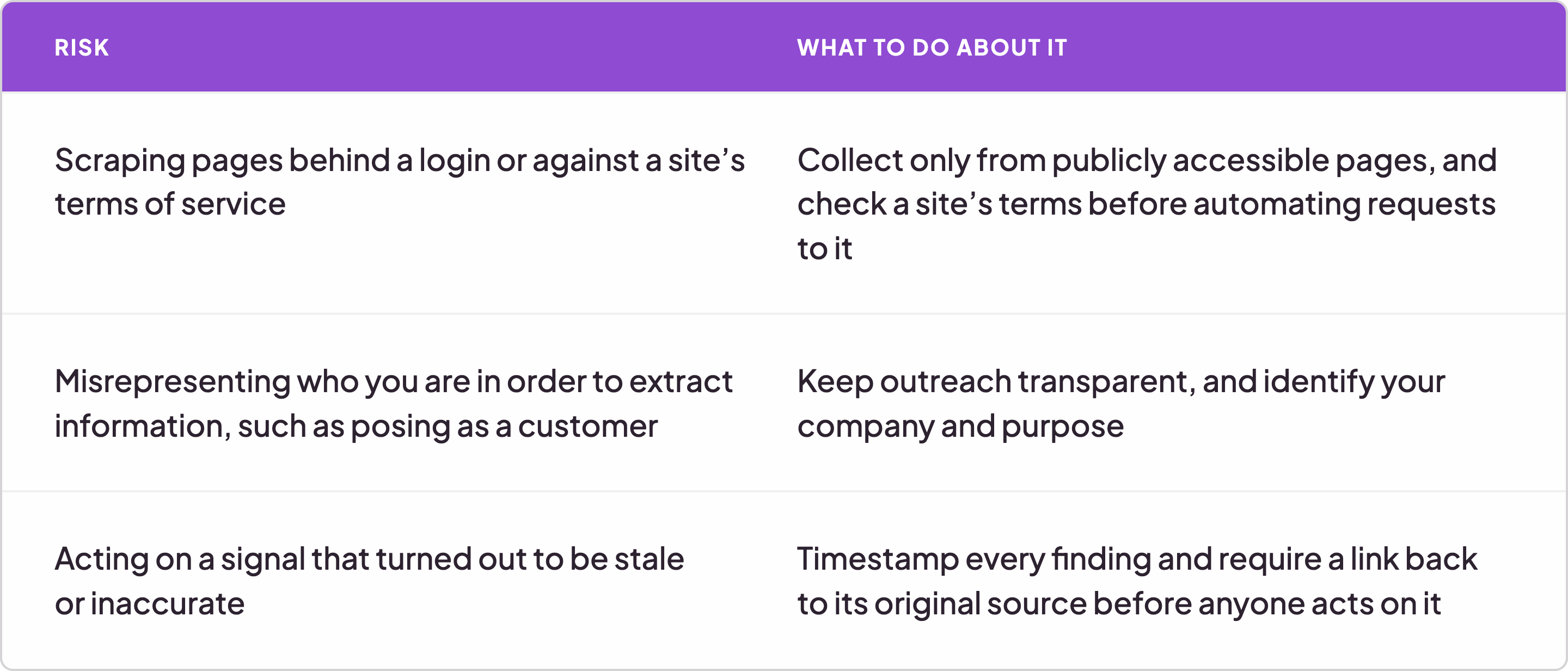
Although most day-to-day risk has nothing to do with espionage, it comes from smaller, easier-to-miss mistakes in how data is collected and used.
The table below names three practical risks in day-to-day monitoring and what to do about each one.
Keeping that link-to-source trail intact matters even more once AI is involved in deciding what counts as a significant signal.
Make's guide on agent transparency controls explains how a reasoning panel shows exactly what an AI agent decided and why, which keeps that judgment call auditable.
Treating every finding as provisional until it is sourced is one practical way to avoid acting on something that turned out to be wrong.
How Make helps with competitive intelligence
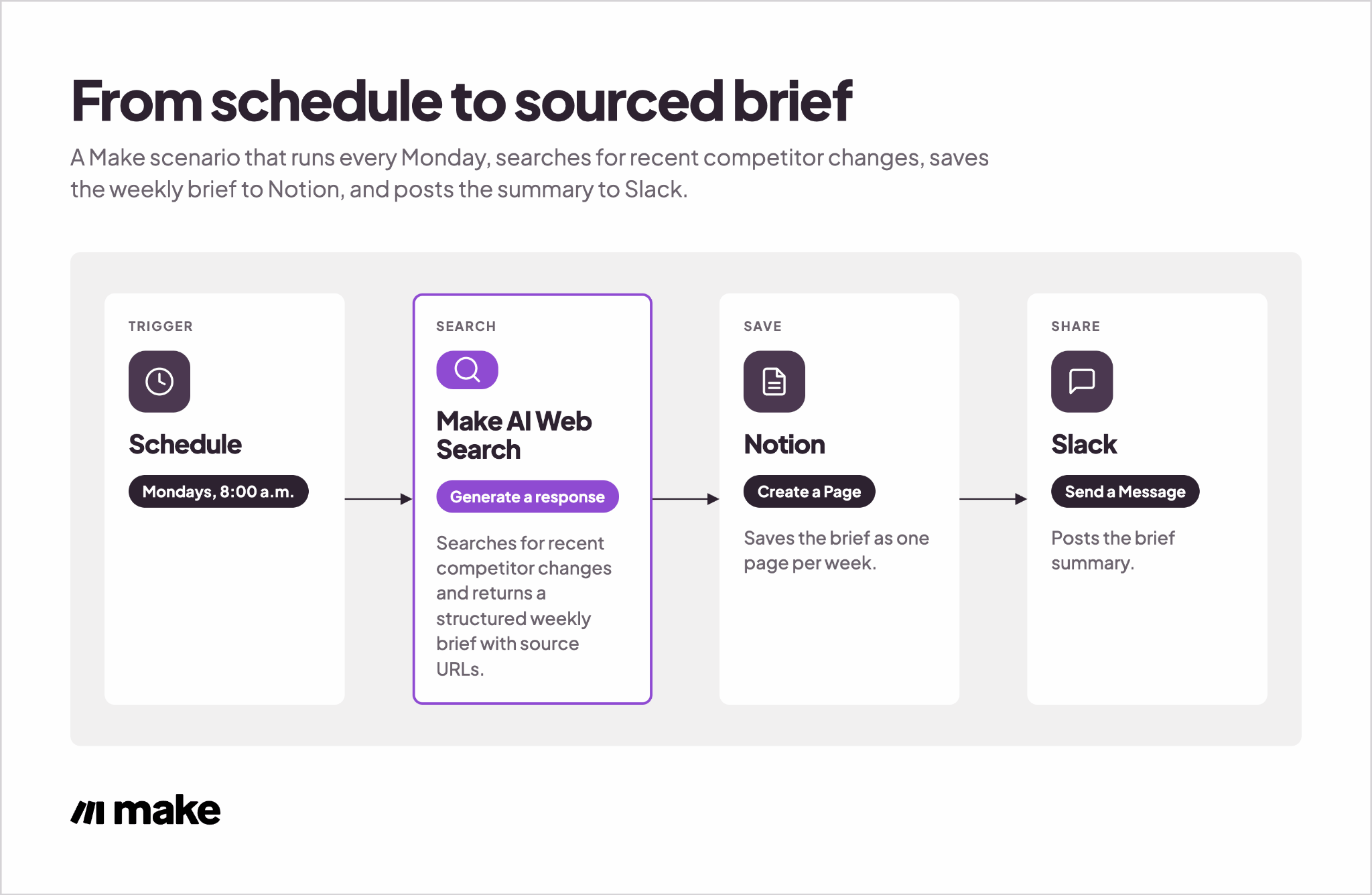
Teams already running a manual process do not need to throw it out. The pattern below adds an automated, sourced layer to whatever a team already tracks.
Defining what to track and where
The first decision is which competitors and which signals matter, the same priorities set in the define stage above.
- Competitor pricing and product pages
- Changelogs and release notes
- Review sites
- Job postings
Picking too many sources at once usually produces more noise than insight, so it helps to start with two or three competitors and expand once the pipeline is working.
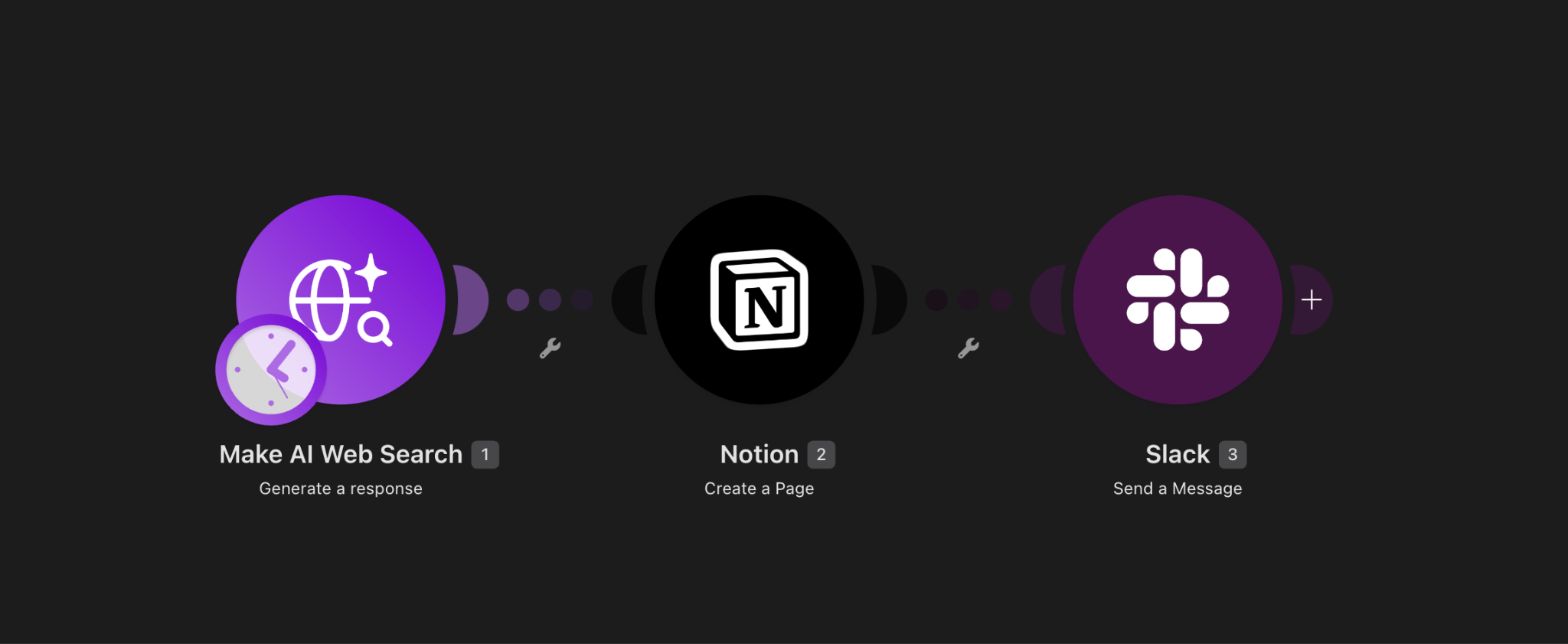
Automating the search with Make AI Web Search
Make AI Web Search is Make's built-in app for pulling live internet data into a scenario, without a separate scraping tool.
Its Generate a response module takes a prompt, such as a request to summarize a competitor's recent pricing changes, and returns a written answer plus the source pages it used.
Turning on the module's JSON option returns the result as JavaScript Object Notation (JSON), a structured, machine-readable format a scenario can parse automatically instead of a block of freeform text.
Make's announcement post on real-time web data covers how this works in more detail.
Structuring every finding into a sourced brief
Each finding needs both a conclusion and the source behind it. A consistent structure works well: the competitor, the signal, a one-line summary, and a link to the original page.
Storing that structure somewhere a team already checks, such as Make's Notion integration, keeps the brief in a place people will actually open.
Pairing every finding with its source is also what separates an automated brief from a generic AI summary. Every line has a place to click through and check, rather than asking a reader to accept the model's output without checking it.
Routing the brief to sales and product teams
A weekly schedule keeps the brief current without turning it into a constant stream of alerts. Posting a summary through Make's Slack app integration puts it where sales and product teams already work.
A Monday morning delivery works well for most teams, landing before the week's sales calls and planning meetings begin.
For a version delivered as a formatted document instead of a chat message, Make's AI report guide walks through building a similar weekly report as a PDF sent by email.
What will you track next?
Competitive intelligence turns scattered signals, pricing changes, product updates, hiring moves, into decisions a team can act on. That only happens when someone defines what to watch, gathers it on a set schedule, and routes each finding to the person who can use it.
Automating the gathering and distribution steps removes the manual search work described above, leaving the analysis for a person to do. That shift turns competitive intelligence from an occasional, last-minute check into a routine a team can trust.
Pick one competitor and one signal; pricing is usually the easiest place to start, and build the pipeline described above this week.
Once a similar few automations are running, the Make Grid post shows how to see them all mapped alongside the rest of a company's automation.
Frequently asked questions
Q1: What is competitive intelligence?
Competitive intelligence (CI) is the ongoing practice of collecting, analyzing, and sharing information about competitors. It also covers the market conditions that affect them, such as regulatory changes, shifts in customer demand, and new entrants to the industry.
CI covers both long-term strategic questions and short-term tactical ones, such as pricing and deal strategy.
Q2: Is competitive intelligence legal?
Competitive intelligence (CI) is legal when it relies only on publicly available information gathered through honest means, such as reading a competitor's website or public filings. It becomes illegal, and turns into industrial espionage, once it involves deception, theft, or accessing information a company has deliberately kept private.
Q3: What's the difference between competitive intelligence and market intelligence?
Competitive intelligence (CI) focuses on specific named competitors, including their pricing, products, and positioning. Market intelligence covers the broader market instead, including customer demand, industry trends, and regulatory change, without being tied to any single rival.
Q4: What are some real-world examples of competitive intelligence?
Common examples of competitive intelligence (CI) include tracking a competitor's pricing and packaging changes, and monitoring product launches and changelog updates. Running a win-loss analysis after losing a deal to a named rival is another common example.
Q5: What is win-loss analysis?
Win-loss analysis is a structured review of why a company won or lost a specific deal, usually gathered by interviewing the sales rep or the buyer. It is one of the most common techniques used in competitive intelligence (CI).
Q6: How often should a competitive intelligence brief run?
A weekly schedule works well for most teams: frequent enough to catch a pricing or product change quickly, without creating more updates than anyone has time to read. Teams tracking a fast-moving market may want a competitive intelligence (CI) brief more often.
Related blogs
Tool and strategies modern teams need to help their companies grow.
Marketing
11 best marketing automation tools 2026: ranked and reviewed
Eleven marketing automation platforms ranked on AI readiness, workflow flexibility, integrations, and pricing for mid-market teams scaling in 2026.

Raife Dowley
June 18, 2026
AI
AI Business Strategy: A 2026 Framework That Works
A practical framework for turning AI experiments into a strategy the whole business can execute.
Raife Dowley
August 4, 2026
AI
AI integration: How to connect AI to your business workflows
AI integration is the process of connecting your AI models directly to your business systems, turning isolated prompts into repeatable, observable workflows. This guide explains how to turn this promise into a reality.