AI ROI: how to measure and maximize the return on your AI investment
AI spending keeps rising, but proof of payoff is becoming increasingly importanant. Here's the formula, metrics, and mistakes that matter most.
AI ROI is the financial and operational return an organization gets from its AI investment, measured against total cost: licenses, infrastructure, integration, and the time people spend running it.
Only 29% of leaders say they can measure AI ROI with confidence, even as adoption keeps growing.
This guide covers the formula, the metrics that matter, and the mistakes that quietly sink the number.
What is AI ROI?
Traditional automation ROI measures a fixed process: replace manual steps with automated ones, and the time saved is the return.
AI ROI is harder to pin down because AI touches judgment-based work too, drafting, summarizing, and recommending, where the "before" and the "after" aren't always the same task.
The pressure to prove this number is rising quickly. 82% of organizations now consider AI essential to their business, but 49% of CIOs cite proving AI's value as their top barrier to scaling it further.
For larger organisations, that pressure usually lands on operations or revenue teams who adopted AI tools quickly and now need to defend the budget in the next planning cycle.
Whether the goal is AI adoption or a deeper AI transformation changes what a defensible return actually looks like, and which of the numbers below is worth reporting first.
Why is AI ROI hard to measure?
AI investment keeps growing faster than the confidence to measure it.
Three problems explain why the return is so hard to pin down.
Returns take longer than expected
Most organizations need two to four years to reach a satisfactory AI ROI, far longer than the seven to 12 months typically expected of technology investments, according to Deloitte's AI ROI research.
Only 6% of respondents saw payback within a year, even among the strongest projects.
Teams that budget for a quick win often abandon promising initiatives before the return has time to show up.
AI rarely acts alone
AI adoption tends to arrive bundled with data cleanup, team restructuring, and new tooling, all happening at once.
That makes it difficult to credit one outcome to AI alone.
A support team that adds an AI assistant might also be revising its ticketing process in the same quarter, so the results blend together.
Isolating the AI's share of the change usually means connecting every system that touched the outcome, not just the one running the model.
Most teams are tracking the wrong number
Hours saved is the easiest metric to produce, and the least useful one to defend. It tells you time was freed up, not what happened to it afterward.
Make's own research into AI maturity found that measurement needs to evolve at each stage of adoption, since the number that matters during a pilot rarely matches the one that matters once AI use spreads across a team.
How do you calculate AI ROI?
There's no universal AI ROI calculator, but the formula behind most of them follows the same four steps.
Step 1: How do you set a baseline?
Before a project starts, note down two or three measurable indicators, such as time per task, error rate, or cost per ticket, and record at least a month of data before AI touches the process.
Without this baseline, any improvement is an educated guess dressed up as a result.
Step 2: How do you calculate total cost of ownership?
Total cost covers more than the subscription. Add setup and integration time, training, ongoing human review, and any infrastructure the tool needs to run.
Teams that only count the license fee routinely overstate their return, because the real cost of running AI is spread across several budget lines instead of one.
Step 3: How do you quantify net value?
Net value combines every measurable gain: hours saved multiplied by the loaded cost of that time, revenue influenced by faster response or better targeting, and costs avoided through fewer errors or reduced risk.
Add these together before moving to the final step.
Step 4: How do you run the calculation?
The formula is straightforward once the inputs are set: ROI equals net value minus total cost, divided by total cost, multiplied by 100.
Some practitioners go further and calculate a risk adjusted ROI, which discounts the raw benefit by reliability signals such as error rate or how often a person has to step in and fix the output.
One practitioner interviewed in that same report put a number on the target: a payback period of under two quarters for operations use cases, and under a year for developer productivity platforms.
Make's own survey work on AI adoption found that teams who track a number like this from day one report enthusiasm turning into real, defensible results far more often than teams who don't.
Hard ROI vs soft ROI
Not every gain from AI shows up as a dollar figure right away. Splitting ROI into two categories keeps both types visible.
Boards ask for hard ROI first because it's easy to defend in a budget meeting.
But soft ROI is often the leading indicator: a team with steady adoption and real trust in the tool is the one whose hard numbers hold up a year later.
Some analysts split this differently by time horizon instead of type, tracking early "trending" signals separately from the "realized" financial return that shows up later. The label matters less than tracking both.
Deciding how much weight to put on each type often comes down to when AI should run on its own versus when a person needs to stay in the loop: the more autonomous the workflow, the more soft signals like override rate deserve equal billing with the hard numbers.
What AI ROI metrics and KPIs should you track?
The right metrics depend on where a workflow sits, but four categories cover most of what's worth tracking.
- Efficiency, the fastest signal to appear: hours saved per week, tasks completed without manual rework, and cycle time from request to resolution.
- Financial, the number a board actually asks for: cost avoided, revenue influenced by faster response, and cost per outcome rather than cost per license.
- Quality, the signal that protects the other two: error rate, rework rate, and accuracy measured against a human baseline.
- Adoption, the leading indicator for everything else: active usage, task completion without a person stepping in, and employee sentiment collected through a short survey.
Most of these numbers live in different systems by default, which is exactly why teams that orchestrate their workflows end up with a cleaner ROI picture than teams pulling the same data by hand from five separate tools each month.
What are some common AI ROI mistakes?
The same handful of mistakes shows up across almost every AI project that fails to prove its value.
- Tracking usage instead of outcomes. Logins and prompts sent measure activity, not whether anything changed for the business.
- Skipping the baseline. Without a "before" number, any "after" number is just an opinion.
- Ignoring total cost of ownership. Counting only the license fee and forgetting integration, training, and review time inflates the return on paper.
- Crediting or blaming AI alone. Most workflows blend AI and human judgment, so attributing the full result to either side distorts the number.
- Changing the success metric partway through a project. This makes any before and after comparison meaningless.
- Having no named owner. Without one person accountable for a workflow's outcome, nobody produces a number more useful than hours saved, a pattern that shows up across most organizations still in the process of adopting AI.
How Make helps you actually prove AI ROI
Everything above works whether or not a platform sits underneath it, but proving AI ROI gets considerably harder once AI use spreads past one team and one tool.
For teams whose AI use stops at a single chatbot window, a spreadsheet is still a reasonable way to track ROI by hand.
For teams running AI across multiple systems, the rest of this section is for them. This is the problem Make AI Agents were built to solve.
Instead of asking someone to log outcomes after the fact, a scenario (Make’s visual automation canvas) can watch every AI Agent or model run, tag the result (time saved, cost avoided, or an escalation that needed a person), and write it straight into a Google Sheets or Data store bundle.
The ROI report builds itself as the workflow runs, rather than being reconstructed once a quarter from memory.
This matters most for the metrics that usually get skipped: adoption, override rate, and task completion without a person stepping in.
Because the scenario watches the whole workflow rather than one tool in isolation, it can show not just that an AI Agent ran, but what happened right after: whether a person had to fix the output, whether the customer replied, whether the ticket reopened.
That's the net value calculation covered earlier in this guide, generated automatically instead of reconstructed by hand.
A working AI ROI example
Diggiehippie, a web design business, used automation to handle the two tasks eating up its founder's time: daily social media posting and sales follow-up.
Before automating, leads went cold because responses were too slow, and hiring help wasn't an option.
The published outcomes show what happens when the metrics covered earlier actually move:
None of those figures is itself an ROI number.
Turning it into one means applying the four steps from earlier in this guide: baseline revenue and hours spent on social media and follow-up before automating, the cost of the automation itself, and net value from the leads that no longer went cold.
Diggiehippie's public case study reports the outcome side of that equation; the cost side is the piece every team has to fill in with its own numbers before quoting an ROI percentage.
The bottom line on AI ROI
AI ROI is measurable once the baseline, total cost, and net value are defined before the project starts, not after.
The formula stays the same regardless of team size: net value minus total cost, divided by total cost.
What changes is the discipline to track hard and soft signals together, and to give the project enough time to clear the two to four year window that most AI investments actually need.
Get started with Make to turn that measurement into a workflow instead of a quarterly spreadsheet.
Frequently asked questions
Q1: What is a good ROI for an AI project?
Most finance teams look for a positive return within the first year and a payback period under 12 months for efficiency projects. Revenue focused AI projects often take longer, since revenue is harder to attribute directly to one tool.
Q2: How long does it take to see AI ROI?
Research puts the realistic range at two to four years for a satisfactory return, far longer than most technology budgets assume. Efficiency focused projects tend to pay back faster than projects aimed at new revenue.
Q3: What is the difference between AI ROI and automation ROI?
Automation ROI measures a fixed, rule based process against its old manual equivalent. AI ROI covers judgment based work too, so the two often overlap; this AI automation guide breaks down where the line sits.
Q4: Can you measure AI ROI without hard financial data?
Yes, with soft ROI. Track adoption, sentiment, and task completion rates as leading indicators while the financial baseline is still being built. These numbers won't satisfy a finance team alone, but they show whether the investment is moving in the right direction.
Q5: What is the biggest reason AI projects fail to show ROI?
No baseline. Without a clear "before" measurement, teams can't prove what changed, so the project defaults to reporting hours saved, the softest and least defensible number available.
Related blogs
Tool and strategies modern teams need to help their companies grow.

AI
5 best automated workflow tools for scaling manual processes
See how Make, Zapier, n8n, Power Automate, and Gumloop compare on features, pricing, and fit, so you can choose fast.

Raife Dowley
August 20, 2026
AI
The AI maturity payoff: Why 'AI saved us time' is the least useful sentence in your business case
A stage-by-stage look at how AI payoff actually gets measured, once "hours saved" stops telling the truth.

Daria Hvizdalova
July 17, 2026
AI
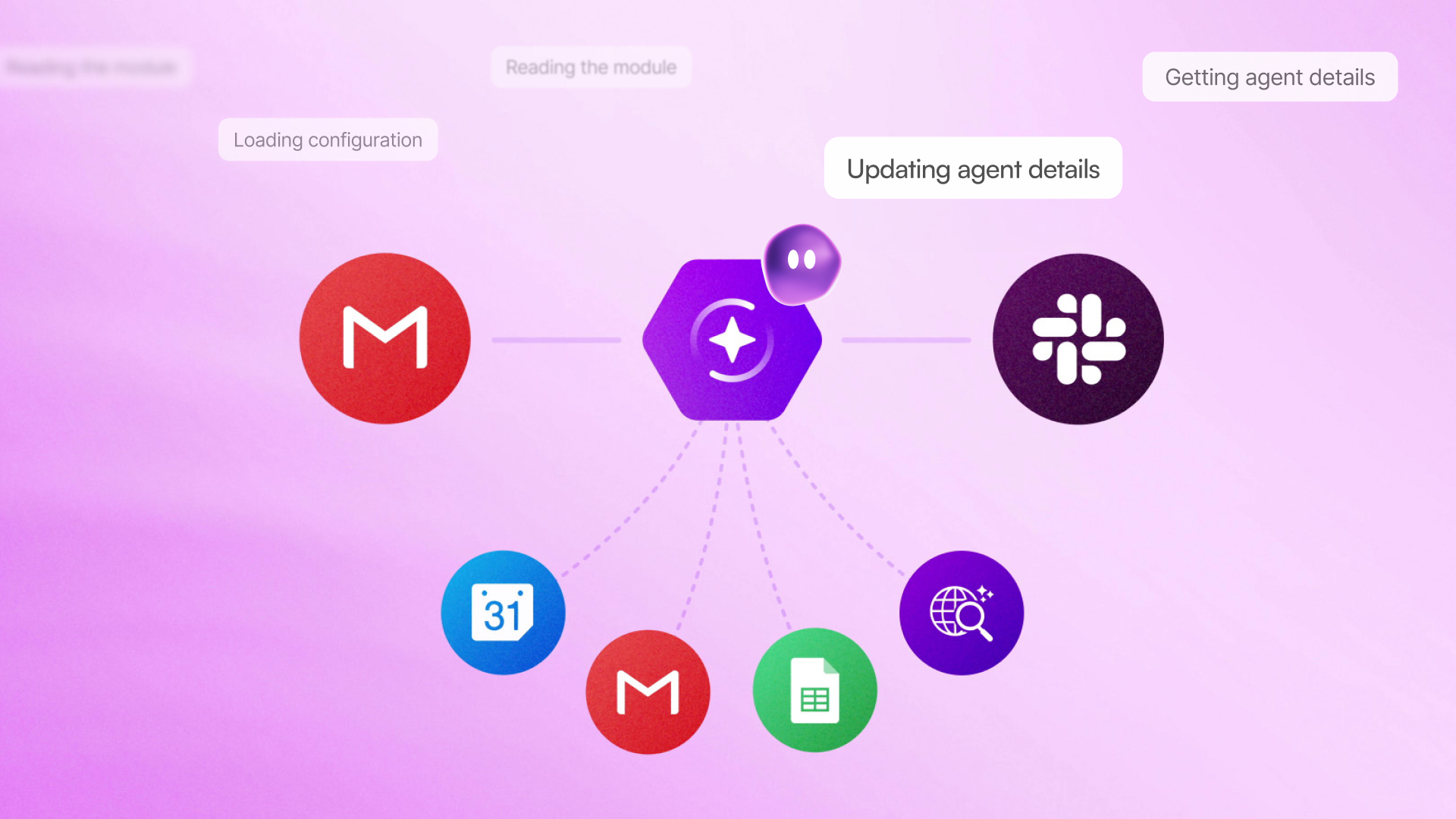
Maia by Make: A conversational co-worker that empowers teams to build automations and AI agents from day one
Meet Maia, your conversational AI co-worker who builds automation steps visually in front of you, translating plain language into working solutions. Maia helps beginners learn, seasoned builders iterate, and team leads enable automation across the company.

Irina Vasilkova
August 12, 2026
AI
AI Business Strategy: A 2026 Framework That Works
A practical framework for turning AI experiments into a strategy the whole business can execute.
Raife Dowley
August 4, 2026